

BTC Volatility Weekly Review (0907-0914)

Spot Metrics
From September 7, 16:00 to September 14, 16:00, BTC/USD fell 2.4% ($79,500 → $77,600), while ETH/USD rose 0.8% ($2,490 → $2,510).
BTC/USD Spot Technical Outlook
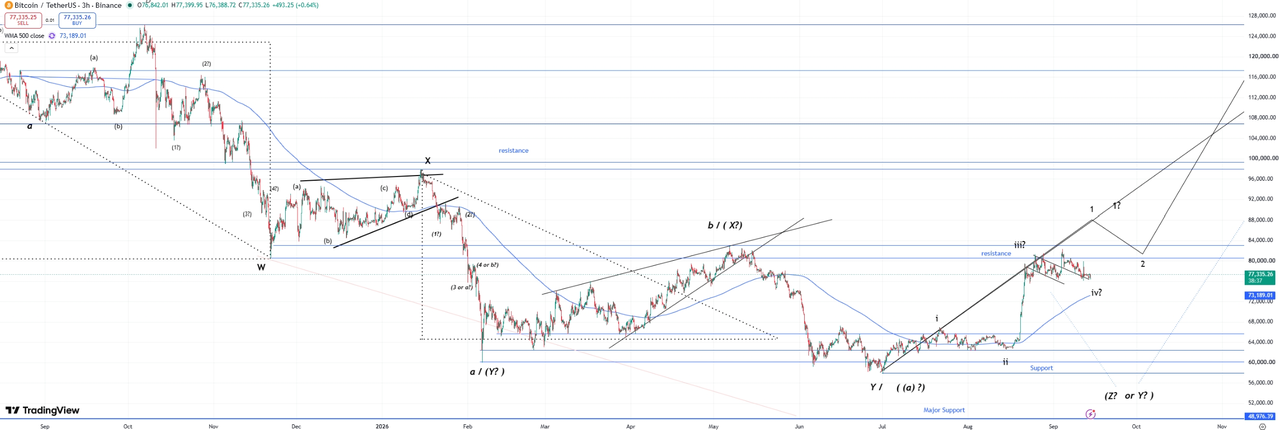
• BTC price action remains very sideways, trading within the $76,000–$80,000 range. The move initially leaned bullish and was in an upward impulse phase, but ultimately became congested and began ranging horizontally — from an Elliott Wave perspective, this fits very well with the characteristics of a "Wave 4."
For now, ahead of the Fed meeting, the market may continue to range sideways unless a major geopolitical shift occurs. After that, we hope to get more confirmation on directional moves. There is still a risk of one final price drop, but the longer the price holds in the higher range, the lower the probability of that risk materializing. If the price clearly breaks above $83,250–$83,500, it would open upside room and could unfold in an explosive rally, as this would trigger short stop-losses built up ahead of that key resistance zone.
Market Themes
As the market fully re-engaged after the summer holidays (last Monday's U.S. Labor Day holiday further extended the break), macro markets saw some volatility last week. The volatility came primarily from several fronts:
1. Oil prices continued to rise. As the U.S.-Iran situation continued to escalate, Brent crude broke above $100/barrel; meanwhile, Houthi forces disrupted Saudi oil production.
2. Although Bessent announced $6 billion in Treasury purchases this week, above the $4 billion minimum, the amount was ultimately still insufficient to curb the sustained sell-off in long-dated U.S. Treasuries.
3. After CPI came in slightly stronger than expected, Fed rate pricing shifted notably toward supporting a rate hike.
4. AI has been developing extremely rapidly recently, prompting several CEOs to publicly express concerns and driving market calls to slow the pace of development.
Given multiple forces acting simultaneously, we expect market volatility will not be easily suppressed in the coming weeks. The market will closely watch the FOMC to observe the committee's language and voting splits, even though the market has already priced in an 85%–90% probability of a rate hike. As stronger-than-expected nonfarm payroll data pushed prices down ahead of the U.S. long weekend, the crypto market started the week on a weaker note. Prices initially attempted to reclaim $80,000, but subsequent rises in oil prices and U.S. Treasury yields, combined with broad risk-off sentiment, pushed spot prices down to test the $76,500 support level before rebounding ahead of the CPI release. After the strong CPI data was released, prices once again tested $76,000; that support held, and a sharp short squeeze followed, with prices briefly approaching $80,000. ETH broke through the $2,550 resistance level, triggering stop-losses, with prices briefly rising above $2,600 before giving back all gains. On Monday morning, positive news regarding the "Clarity Act" helped spot prices rebound from weekend lows — BTC once again tested and held $76,500 — bringing the market back to the middle of the $76,000–$80,000 range early in the week.
BTC Implied Volatility
BTC ATM Implied Volatility (September 7, 16:00 to September 14, 16:00 HKT)
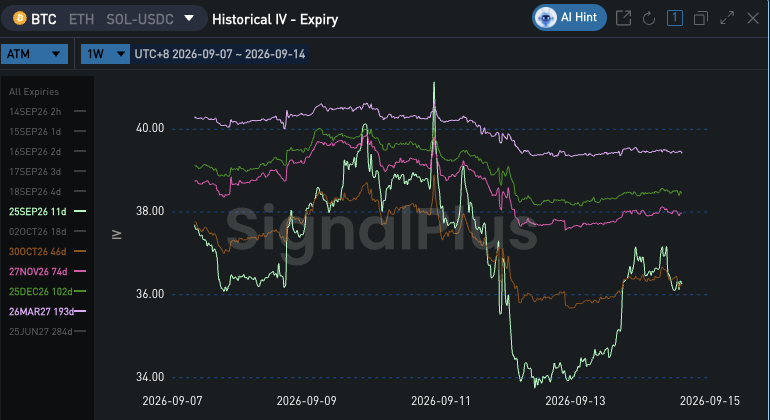
• Due to rising macro volatility and market focus on CPI, some short-dated option demand emerged early in the week, particularly on the upside, pushing implied volatility higher. However, although realized volatility briefly rose at the time of the CPI release, spot prices ultimately settled firmly back within the range, dampening further option demand. This led to aggressive selling across the entire volatility curve before the weekend.
• The term structure remains fairly flat. The volatility decline did not show a particularly pronounced weighting. With macro factors still changing rapidly, some market demand is still visible at the front end of the curve; however, at the far end, buyers remain hard to find, while a steady stream of smaller but consistent overlay strategy selling continues to flow in.
BTC Skew/Kurtosis
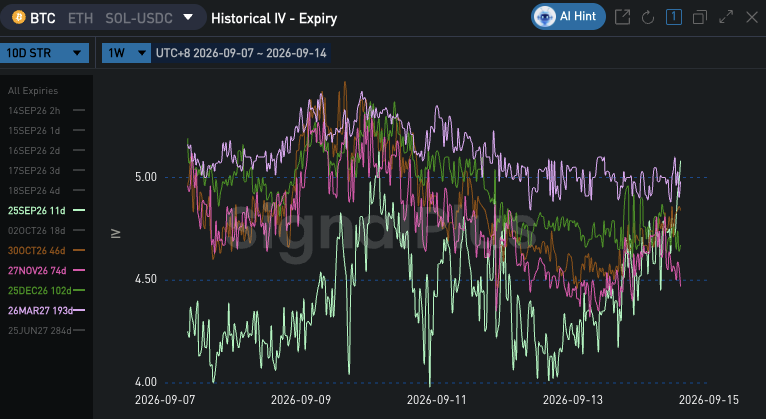
BTC 10d Kurtosis (September 7, 16:00 to September 14, 16:00 HKT)
BTC 25d Skew (September 7, 16:00 to September 14, 16:00 HKT)
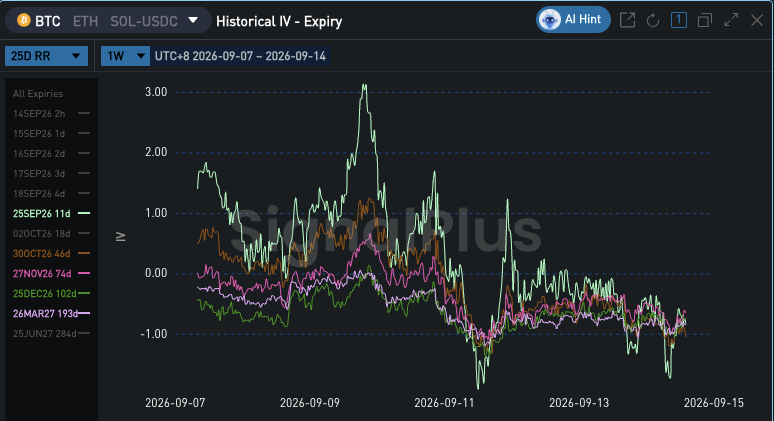
Skew overall shifted toward puts this week. Spot prices once again failed to break above $81,000–$82,000 and moved lower during the week amid a deteriorating macro backdrop. However, as spot prices declined, both realized and implied volatility generally fell; at the same time, short squeezes in spot continued to exhibit higher volatility. For example, after the CPI release, spot prices first tested $76,000, then quickly squeezed higher, briefly approaching $80,000. On the downside, if prices clearly break below the $76,000 support level, realized volatility could begin to rise. However, there is denser support around $73,000–$74,000 below; if that support is also broken, volatility would likely rise further. Overall, however, from a realized volatility perspective, the direction more prone to large moves remains to the upside — namely, a clear break above $83,000. Unless prices clearly break below $76,000, the market should be cautious about underpricing upside tail risk.
Kurtosis prices edged lower last week, with very limited participation at the far end of the curve. As we noted last week, kurtosis had been slightly elevated relative to ATM implied volatility; this repricing was broadly in line with the decline in ATM implied volatility. Overall, at current levels, holding ATM volatility is more valuable than holding kurtosis. Therefore, for long-term directional bets, call spreads and put spreads are attractive structures.
About Optimus
Optimus is a technology-driven digital asset trading and liquidity solutions provider, focused on delivering professional digital asset trading technology and services to institutional clients. The company independently develops core technologies including algorithmic trading, market making, pricing, risk management, and API connectivity, providing institutional clients with efficient trading and liquidity management solutions.