

BiyaPay研究院观察|美股芯片重挫、港股科技反弹,本周CPI与财报能否稳住预期?

Last Week in Review: November 2–6 | This Week to Watch: November 9–13
According to BiyaPay market observations: last week, US and Hong Kong stocks moved in different directions. US tech hardware saw concentrated selling, and small-cap stocks that had been relatively strong the previous week also turned lower; Hong Kong internet and auto stocks drove an index rebound, but southbound funds still posted a small net sell for the full week.
The market's questioning of AI investment is deepening. From how much is being invested and when it will pay back, the focus is extending to whether projects can be completed on schedule, when equipment will be delivered, and whether customer payments can cover the costs of continued expansion.
For those holding positions, the key is to distinguish whether the stock price adjustment stems from changes in valuation and positioning, or from weakening operating expectations; for those preparing to participate in the rebound, they need to judge whether, after short-term buying, there is still earnings and funding support. This week's US inflation data, along with earnings from cloud computing, networking equipment, and semiconductor companies, will continue to provide verification.
1. US Stocks Review: The Correction Spread from Tech Heavyweights, Small Caps Failed to Extend Their Strength
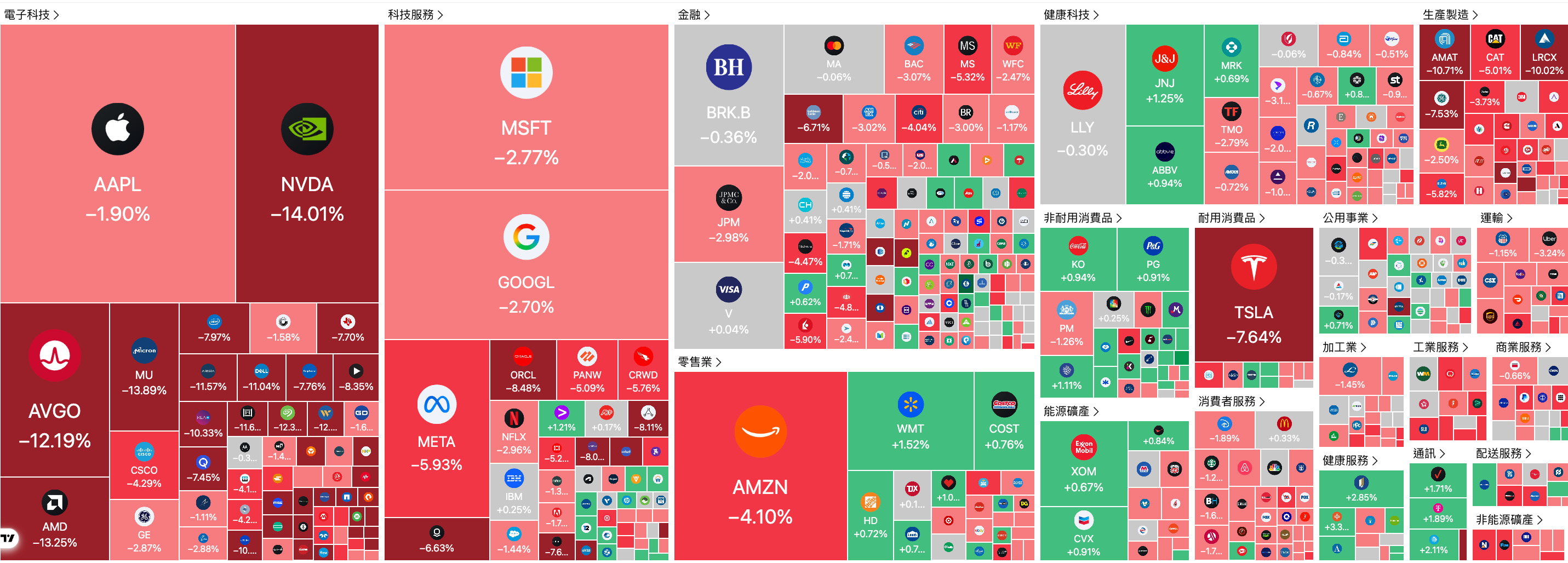
As of the close on November 6, the S&P 500 stood at 7,376.86, down 2.68% for the week; the Nasdaq Composite stood at 24,579.42, down 3.37%; the Dow Jones Industrial Average stood at 51,285.73, down 0.94%; and the Russell 2000 fell 2.05%.
Compared with the previous week, the important change is that small caps also turned lower. The earlier rotation of funds into other styles did not free the market from overall adjustment pressure.
The intraweek reversal was especially pronounced. US stocks rebounded on Wednesday, while on Thursday the S&P 500 and Nasdaq fell 4.36% and 5.52%, respectively; although there was some recovery on Friday, it was not enough to recoup the losses. The VIX rose about 32% for the week to 25.64, indicating that short-term volatility expectations reflected in the options market remained higher than at the end of the previous week.
Funding data requires attention to cutoff times. In the week ended November 4, US money market funds saw net inflows of $117.97 billion, and equity funds also saw net inflows of $14.81 billion. While investors increased cash allocations, there were still selective equity subscriptions, so this cannot be summarized as a comprehensive withdrawal from the stock market; this dataset also does not cover Thursday's sharp selloff.
Therefore, judging whether Friday's rebound signals stabilization still requires subsequent trading and funding data. Easing selling pressure after a decline and institutions rebuilding long-term positions are signals at different levels.
2. Within Tech Stocks, There Is Still a Gap Between Order Growth and Stock Price Gains
AMD's Revenue Growth Still Faces Market Scrutiny Over Long-Term Returns
AMD fell 11.05% for the full week last week, Nvidia fell 8.80%, Micron fell 22.01%, and the semiconductor ETF SOXX fell 13.13%. Western Digital and Seagate in the storage segment also posted relatively large declines.
At the same time, AMD reported quarterly revenue up 45% year over year to $13.377 billion, data center revenue up 97%, and fourth-quarter revenue guidance of about $17 billion.
Operating growth and stock price declines occurring simultaneously shows that market requirements have gone beyond current-quarter revenue. Whether orders can be sustained, when customer projects will enter operation, and how much future growth is embedded in current valuations all affect the price investors are willing to pay.
Data center construction also involves power supply, approvals, financing, and equipment delivery. If projects are delayed, even if demand has not disappeared, supplier revenue recognition may be pushed back, and the time customers' capital is tied up will be extended. However, this transmission logic cannot be directly equated with orders having been canceled; it still needs to be verified through company announcements and subsequent guidance.
For those holding positions, a more practical approach is to check what the original judgment relied on: product share, delivery growth, or margin improvement. Only by confirming whether these foundations have changed can one judge whether the stock is worth reassessing after the decline.
The Application Side Is Also Diverging; It Cannot Simply Be Concluded That Funds Are Rotating from Hardware to Software
AppLovin rose 71.21% last week, while Palantir fell 12.89%. Both are grouped by the market into AI-related trades, yet the stock price reactions of the two companies were markedly different.
AppLovin's third-quarter revenue was $2.185 billion, up 55% year over year; net profit was $1.439 billion, up 72% year over year. Revenue and profit already reflected in the financial statements provide independent performance support.
But the performance of a single company cannot be extrapolated to mean that all AI application companies will outperform hardware. Software companies equally need to answer whether customers will continue paying, how service costs will change, and how much cash growth can leave behind.
Optical communications stocks also involve special factors. Lumentum fell 35.94% last week; in addition to the sector adjustment, this also involves the all-stock acquisition arrangement proposed by Marvell. Under a fixed exchange ratio, changes in the acquirer's stock price affect the market value of the transaction consideration, so the entire decline cannot be explained as weakening AI demand.
This round of market action requires more company-by-company analysis. Business growth, valuation, transaction structure, and positioning changes may all affect prices simultaneously.
3. Hong Kong Stocks Observation: The Rebound Broadened, but Funds Have Not Yet Given a Consistent Signal
Last week, the Hang Seng Index rose 5.10% to close at 24,481.86; the Hang Seng Tech Index rose 8.61% to close at 4,078.23; and the Hang Seng China Enterprises Index rose 5.24% to close at 8,274.10.
Compared with the previous reliance on support from banking and oil heavyweights, this time internet and auto stocks became the main drivers of the rebound. Tencent, Alibaba, Meituan, and JD.com rose 9.44%, 8.09%, 12.29%, and 12.85%, respectively; Xiaomi rose 14.50%, Li Auto rose 10.69%, and BYD rose 8.64%.
But tech hardware did not strengthen in tandem. Lenovo Group fell 8.24%, and ASMPT fell 10.57%. This means that a rise in the Hang Seng Tech Index cannot substitute for judgment on different segments of the industrial chain.
Auto stocks also require separating deliveries from profitability. XPeng delivered 50,237 vehicles in October, up 20% year over year and 22% month over month, providing a demand clue; whether these sales can translate into profit still depends on pricing, model mix, gross margin, and selling expenses, and it cannot be concluded from this that price competition has ended.
On the funding side, southbound trading posted a net sell of about HK$3.237 billion for the full week. Of that, Tuesday saw net buying of HK$23.420 billion, while on Thursday, when the Hang Seng Index surged, there was instead a net sell of HK$21.326 billion, reflecting a clear pattern of buying at lows and reducing holdings on rebounds.
Thursday's volume-driven rise shows increased trading participation, but it is not yet sufficient to confirm sustained incremental capital inflows. Southbound flows also do not represent all funds in Hong Kong stocks, so in the absence of complete data, the remaining buying cannot be directly attributed to foreign capital.
HKEX's financial report offers another reminder. Profit attributable to shareholders rose 15% year over year in the first three quarters, but third-quarter profit fell 1%, and average daily turnover of stock products fell 11% year over year. Cumulative growth and quarterly deceleration can coexist; whether this week's rebound in turnover can translate into revenue still depends on how long it lasts.
Cross-Market Observation: Beyond Market Divergence, Funding Arrangements Also Need to Be Clarified
US chip stocks falling and Hong Kong internet stocks rebounding make cross-market comparison more meaningful. But positions in different markets may also be jointly affected by dollar liquidity, tech growth expectations, and risk appetite, so diversification cannot be judged solely by listing location.
For users who follow both US and Hong Kong stocks and digital assets, currency conversion, trading participation, and subsequent use of funds also need to be considered. A large number of accounts and entry points increase the hassle of switching operations and managing funds.
As a global one-stop asset allocation platform, BiyaPay uses USDT as its core funding entry point, connecting US and Hong Kong stocks, cryptocurrencies, commodity futures, and cross-border remittances through a single account system. It supports exchange among more than 30 fiat currencies and more than 200 digital currencies, and provides zero-commission trading of real US and Hong Kong stocks. A centralized entry point helps reduce switching between different tools and makes currency conversion, trading, and subsequent funding arrangements flow more smoothly.
4. Macro Observation: Falling Long-Term Bond Yields Do Not Mean Easing Has Arrived
US nonfarm payrolls rose by 165,000 in October, the unemployment rate fell from 4.2% to 4.1%, and employment in August and September was revised up by a combined 84,000. This set of data does not support the judgment that the economy is suddenly stalling.
At the same time, the US 10-year Treasury yield fell back to about 4.86% last Friday. The decline in yields may include safe-haven demand and changes in rate expectations, and cannot be directly taken as proof that the Federal Reserve is turning toward easing.
Lower yields help ease valuation pressure, but they cannot solve problems of project delays, customer payments, and investment returns. This is also why tech stocks can still fall even when long-term bonds rise.
The impact of falling oil prices also varies by industry. Last week, the energy ETF XLE fell 12%, while sectors such as airlines were supported by expectations of improved costs. Falling oil prices may reduce transportation and manufacturing costs, but they also lower revenue expectations for upstream oil and gas companies; airline profits are also affected by fares, load factors, and hedging arrangements.
To judge macro positives, one must continue to ask how they enter corporate revenue, costs, and profits, rather than stopping at one-directional inference from asset prices.
5. This Week to Watch: Can Inflation Cool, and Can Orders Be Fulfilled on Schedule?
CPI and PPI: Judge in Conjunction with Employment and Price Structure
According to the current schedule of the US Bureau of Labor Statistics, October CPI is scheduled for release at 21:30 Beijing time on November 10, and October PPI is scheduled for release at 21:30 on November 13.
For CPI, focus on core services, housing, and goods components. The recent decline in oil prices has a lag in its transmission to prices, so it cannot be directly regarded as October core inflation having already cooled.
If inflation eases and employment remains stable, it may help reduce policy constraints; if employment remains resilient and price pressures persist, the market still needs to assess how long high rates will be maintained. PPI can supplement observation of production-side costs and changes in some service prices.
CoreWeave, Cisco, and Applied Materials: Verifying the Pace of Construction and Delivery
According to the current schedule, CoreWeave will report results after the US market close on November 10, while Cisco and Applied Materials are scheduled for after the close on November 12, subject to the companies' latest announcements.
For CoreWeave, the focus is on how signed contracts translate into revenue, progress in bringing capacity online, capital expenditures, and financing arrangements. Contract scale needs to be analyzed together with fulfillment timing, customer structure, and cash collection.
For Cisco, watch the conversion of AI networking orders into revenue, gross margins, and demand for non-AI businesses; Applied Materials provides clues on equipment demand, customer investment, and delivery pace. There is a time lag from orders to revenue; these companies provide industrial-chain evidence, and one company's earnings cannot be used to draw conclusions for the entire industry.
For Hong Kong Stocks, Watch SMIC's Results and Post-Rebound Operating Fulfillment
SMIC plans to announce its third-quarter results after the Hong Kong market close on November 12, with focus on capacity utilization, product mix, gross margin, and capital expenditure.
Hua Hong's earnings last week already showed that analyzing semiconductor growth requires attention to consolidation scope. Expansion of scale and improvement in the original business need to be distinguished; not all revenue growth can be treated as demand growth on a like-for-like basis.
During Double 11, for internet platforms, watch like-for-like sales, subsidies, and fulfillment costs. Gross merchandise value does not equal net revenue, and sales growth may not necessarily improve profits in tandem.
Whether the Hong Kong stock rebound can continue will depend on whether turnover remains after the volume increase, whether southbound funds continue to reduce holdings substantially during rallies, and whether platform and hardware companies can deliver operating evidence that supports valuations.
Last week's market action shows that within tech stocks and across different markets, there are no uniform answers. What is more worth adhering to this week is to match price changes with companies' ability to deliver: Have orders changed? Have deliveries been delayed? Can cash be collected? Only as these foundations gradually become clear will it be easier to make judgments on rebounds and corrections.