


Global Payments Weekly | 2026W45

Author / Editor: WANG TAI
1. This Week's Highlights
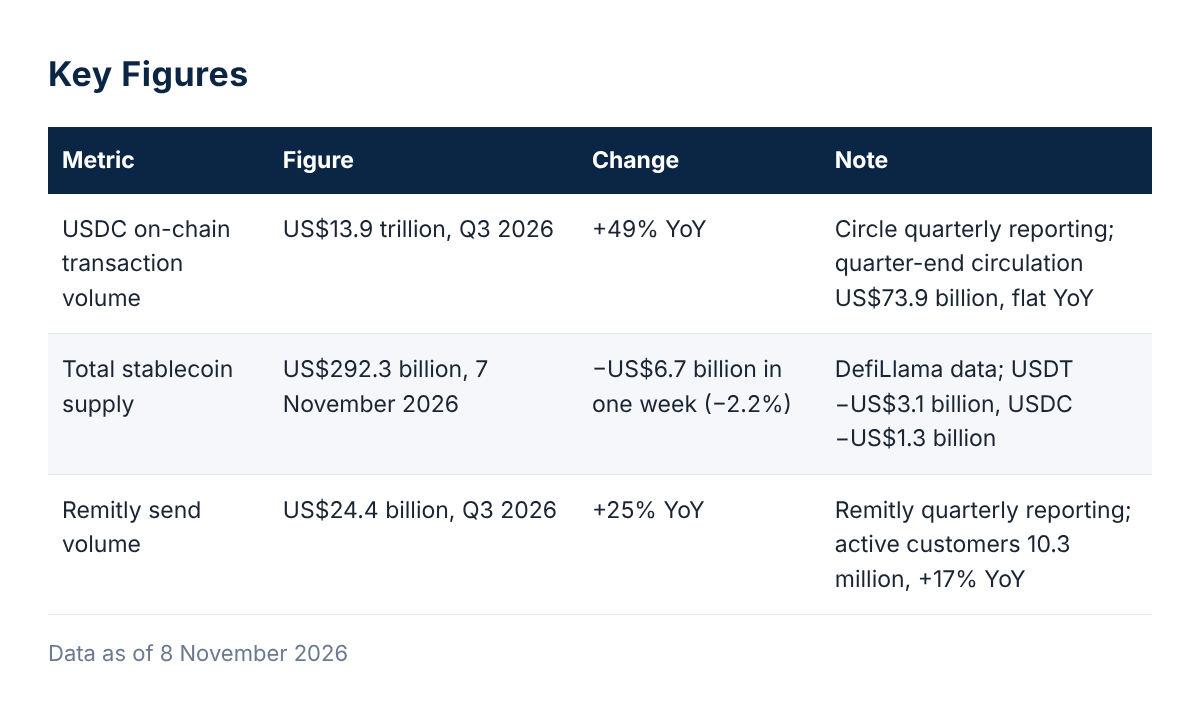
Stablecoin usage and stablecoin balances parted ways this week. Circle said on 4 November that USDC on-chain volume rose 49% year on year in the third quarter while quarter-end circulation was flat; in the week to 7 November total stablecoin supply then shrank by about US$6.7 billion. An issuance model that lives on reserve interest is being diluted by the fast turnover of payments.
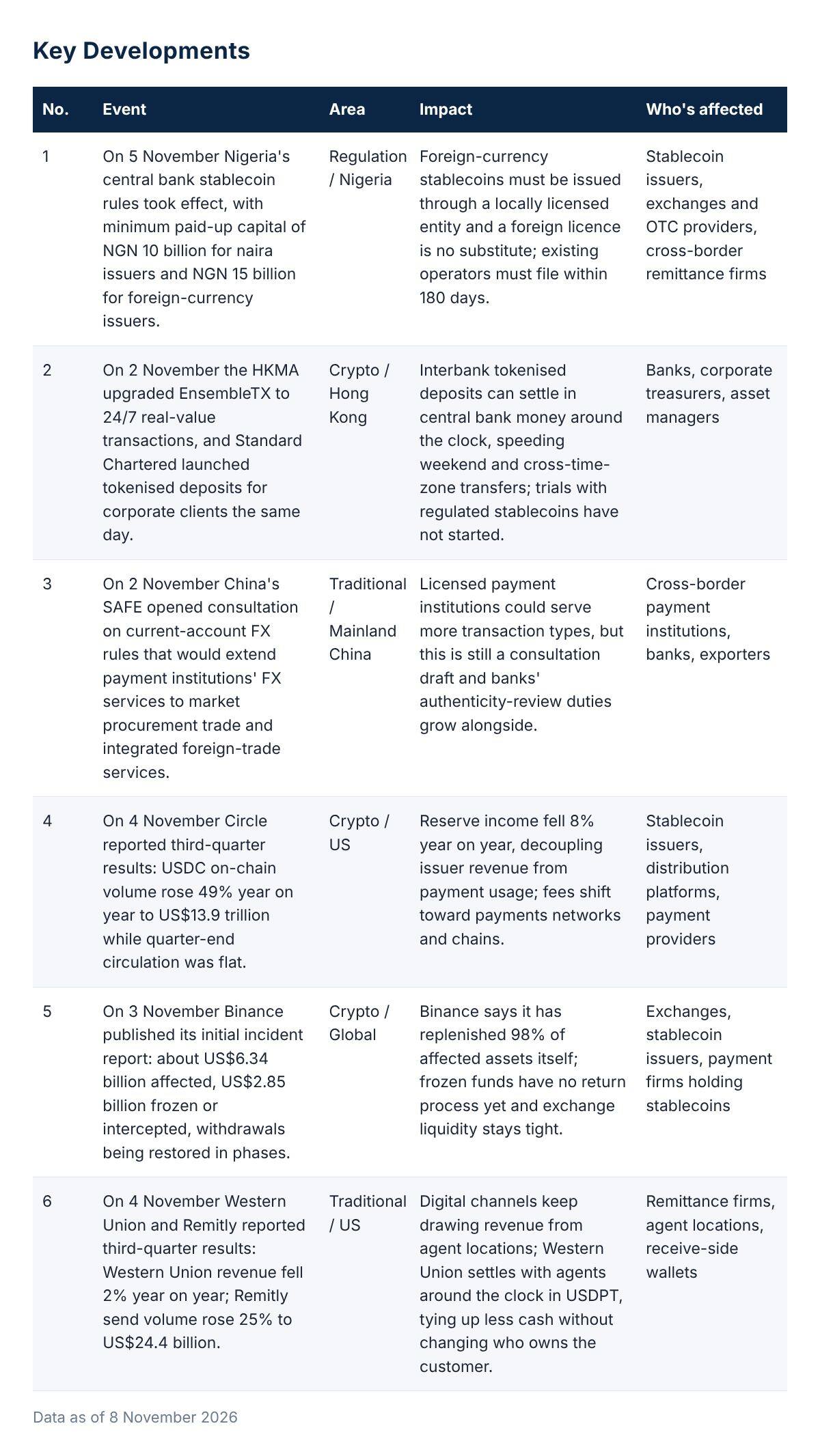
The first signal is that bank on-chain settlement now runs around the clock. On 2 November the HKMA moved EnsembleTX to 24/7 real-value transactions and Standard Chartered launched tokenised deposits the same day.
The second signal is that emerging markets are pulling issuers onshore. Nigeria's central bank rules, in force from 5 November, require dollar stablecoins to be issued through a locally licensed entity with at least NGN 15 billion in paid-up capital.
The third signal is that remittance firms still keep stablecoins in the back office. Western Union put USDPT in circulation at about US$20 million, and Remitly said stablecoins make up only about 1% of consumer cross-border payments.
Of last week's three watch items, Hong Kong FinTech Week delivered the EnsembleTX upgrade but no new stablecoin licence; neither Western Union nor Remitly disclosed stablecoin payout volumes in their results; and Binance has reopened withdrawals in phases since 1 November but had not restored all of them by the weekend.
Key Figures
2. Key Developments
3. Analysis
Traditional payments
Western Union's third-quarter revenue fell 2% while Branded Digital transactions rose 21%. Almost all remittance growth is online, where revenue per transfer is lower, so the fixed cost of an agent network has to be absorbed by tying up less settlement cash, which is why Western Union lets agents settle around the clock in USDPT. Dense agent coverage will keep losing ground to faster cash turnover.
Hong Kong extended interbank tokenised-deposit settlement to 24/7, and SAFE proposes letting payment institutions serve market procurement trade and integrated foreign-trade services. The first keeps corporate cash on banks' own ledgers for weekend transfers; the second lets payment institutions into trade FX settlement that banks used to handle. Banks hold the treasury relationship while payment institutions gain more small exporters.
Crypto payments
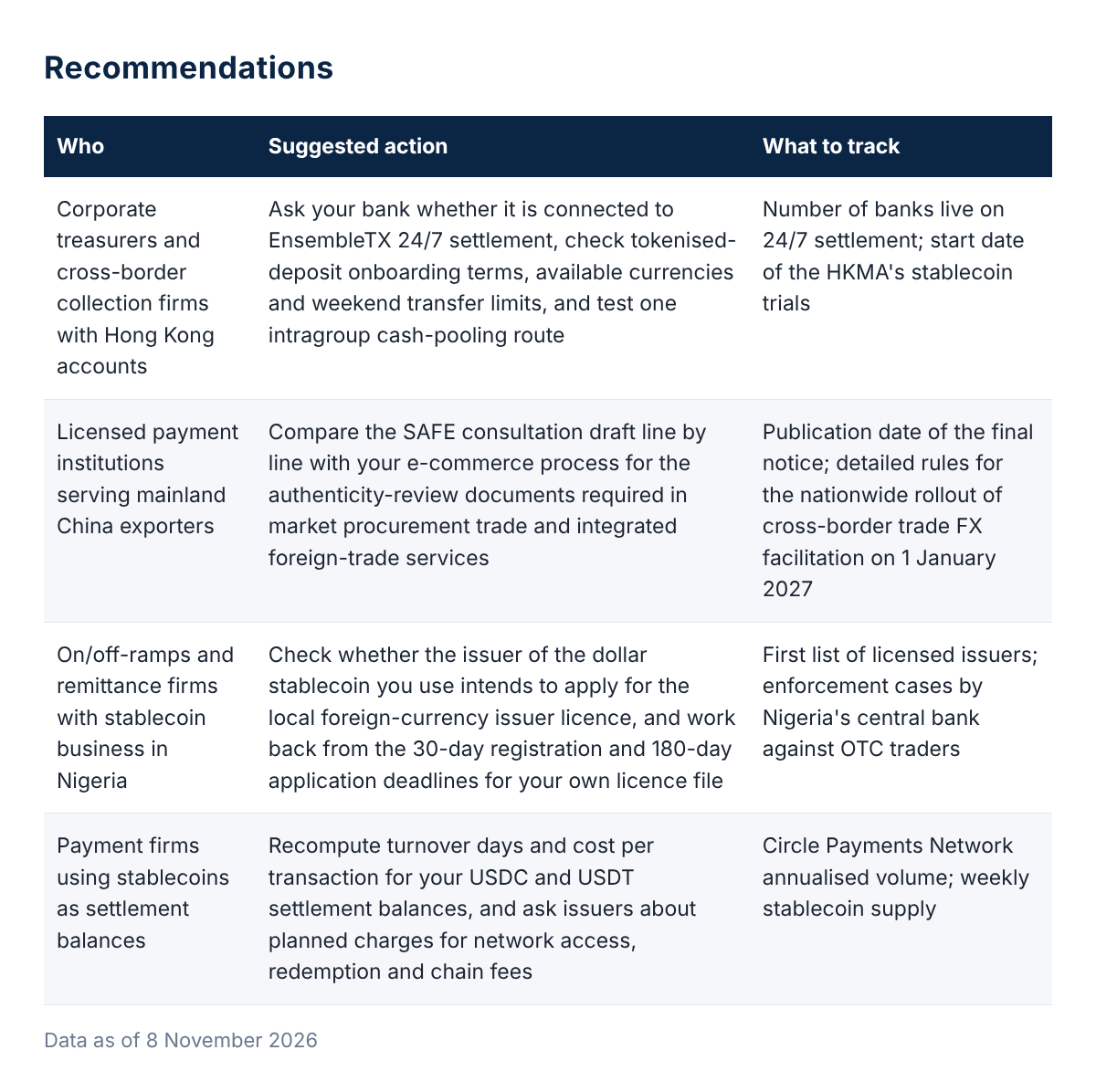
Circle's on-chain volume rose 49%, circulation was flat and reserve income fell 8%. Payments make each stablecoin turn over faster without adding to the balance on which the issuer earns interest, so the issuer must look to network services and its own chain for revenue. For payment firms, minting, redemption and access that are free today are more likely to carry a price.
Nigeria now requires foreign-currency stablecoins to be issued through a locally licensed entity with at least NGN 15 billion in paid-up capital, and bans paying yield to holders. Issuer compliance costs stretch from managing reserves to setting up entities market by market. A small market may not justify its own licence, leaving local on/off-ramps to switch to a local naira stablecoin or carry the risk of reselling an unlicensed token.
4. Recommendations
5. What's Next
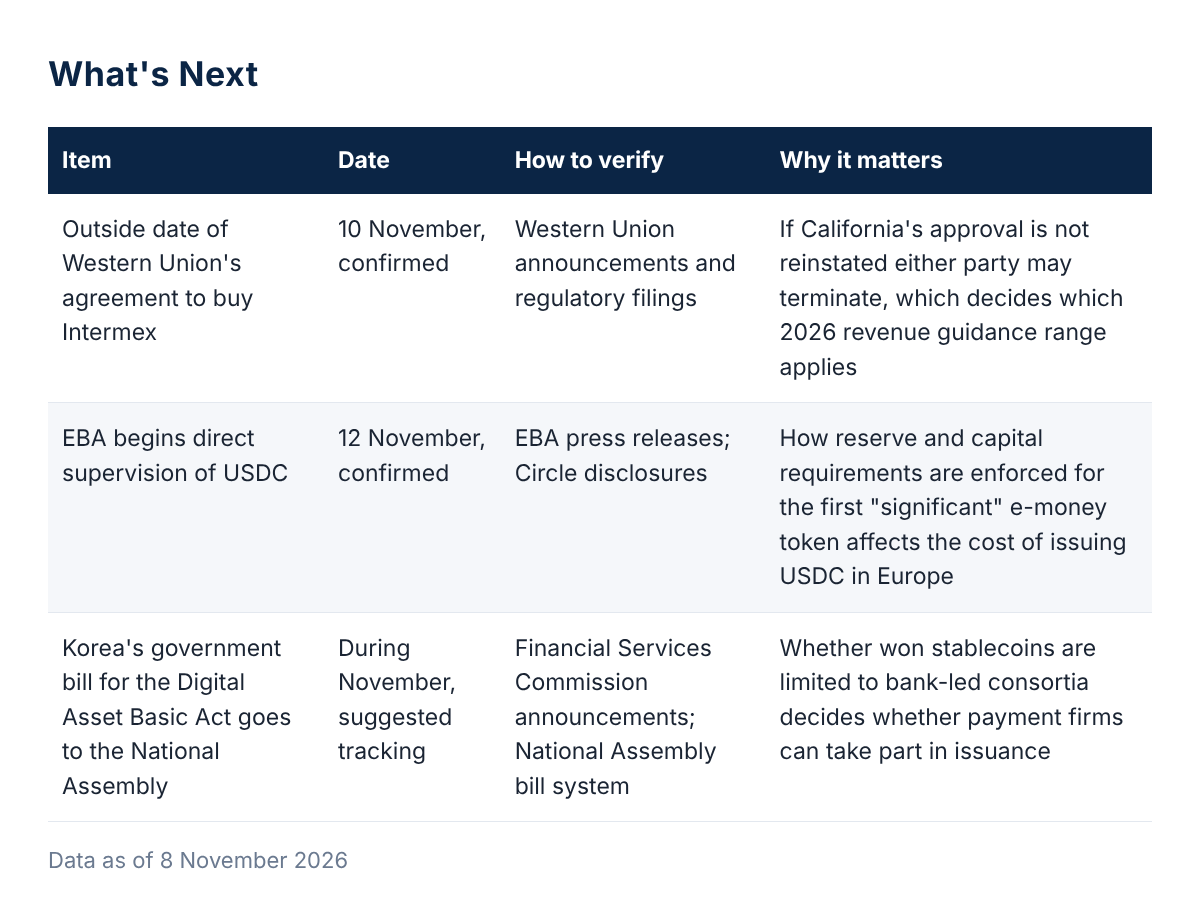
Covers 9–15 November 2026.
6. Deep Dive | USDC volume is up by half and circulation has not moved: who earns the money in stablecoin payments?
This week's evidence
On 4 November Circle reported third-quarter USDC on-chain volume of US$13.9 trillion, up 49% year on year, with quarter-end circulation of US$73.9 billion flat on a year earlier. Reserve income fell 8% to US$658 million, yet total revenue rose 17% to US$865 million; growth came from US$207 million of other revenue, of which US$182 million was the ARC token presale. Circle Payments Network ran at US$41.3 billion of annualised volume. Western Union told its earnings call that about US$20 million of USDPT is in circulation against US$150–200 million of transactions every 30 days, and Remitly said stablecoins account for only about 1% of consumer cross-border payments.
How the money moves and who gets paid
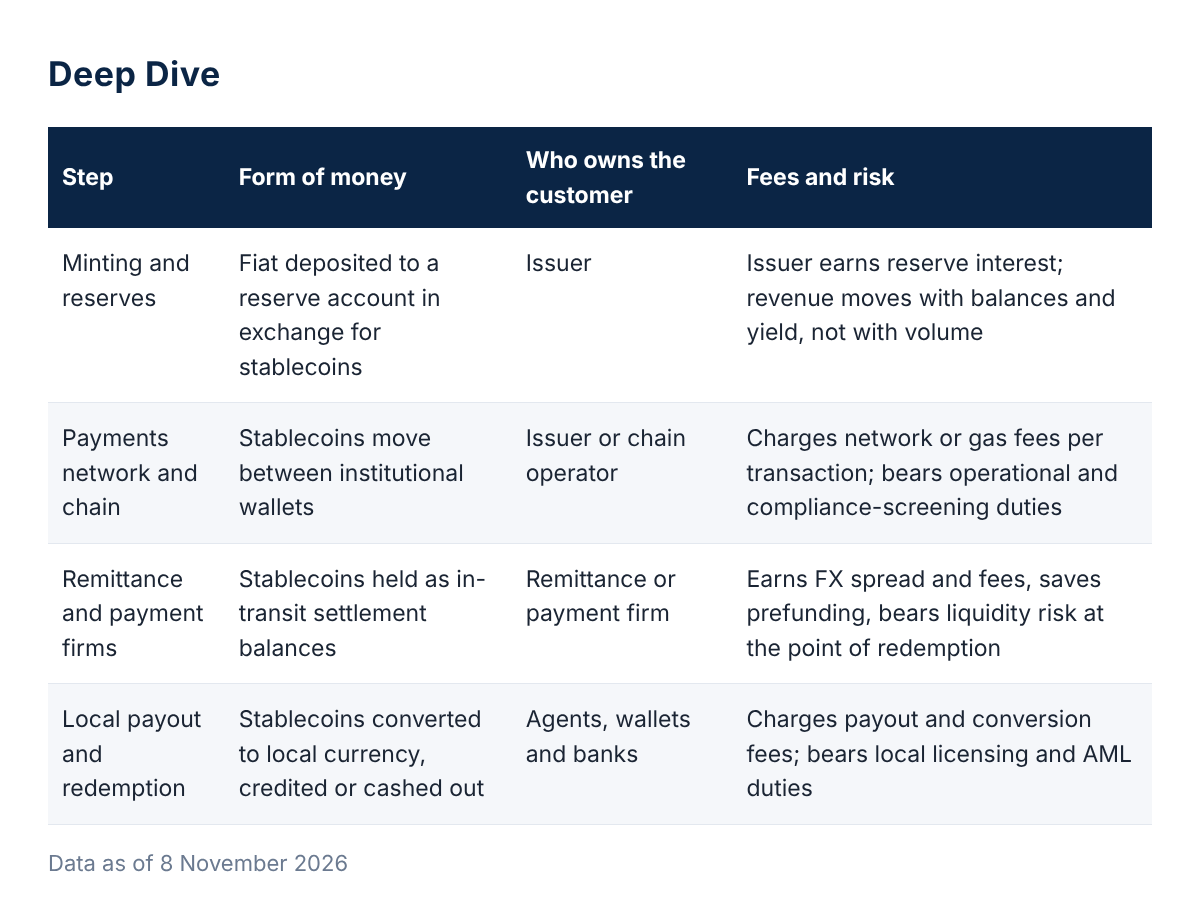
An issuer's revenue is reserve balance times yield; it does not depend on how often a token changes hands. In payments, money does not sit still: a remittance firm mints stablecoins to pay an agent, the agent soon redeems, and one token turns over many times a month while the balance left in reserves stays small. Western Union's roughly US$20 million outstanding supports seven to ten times that in monthly volume. The bigger payments get, the thinner the interest an issuer earns on each dollar transacted, and pricing power moves to whoever processes the transaction.
What it means for both sides
For traditional payment institutions, stablecoins are first a settlement tool, not yet a new customer front door. Remittance firms use them to shorten settlement with agents, while customers, pricing and last-mile payout stay in the existing system; the local conversion, licences and cash-out networks Remitly stresses have not been replaced. For crypto payment firms, issuers are no longer content with interest income. Circle is betting its growth on a payments network and its own chain, so minting, redemption and cross-chain transfers that are free today may be charged per transaction.
What is still missing
Circle has not disclosed pricing or revenue for its payments network, so how much of the US$41.3 billion annualised volume becomes revenue cannot be judged; the US$13.9 trillion on-chain figure does not separate payments, trading and internal transfers; the ARC presale is one-off revenue; and Western Union's USDPT figures are company-reported.
How to verify
Watch three things: whether Circle breaks out payments-network revenue next quarter; whether USDC circulation stays flat while volume keeps rising if reserve yields fall further; and whether Western Union's ratio of monthly USDPT volume to circulation holds as it expands beyond two Latin American agents.
7. Around the World
Singapore: On 4 November HSBC, Kinexys by J.P. Morgan, MUFG Bank, Societe Generale-FORGE and Standard Chartered announced GL1 Org, a Singapore-based non-profit that takes over the MAS-convened work on standards for tokenised market infrastructure. This week Pyvio announced a MAS Major Payment Institution licence, effective 1 November.
Japan: On 2 November an FSA study group discussed whether to change the ¥1 million transfer cap on stablecoins and whether banks themselves may issue stablecoins directly; no conclusion was reached.
UAE: On 6 November Visa Acceptance Platform began supporting online transactions for Jaywan, the UAE's domestic card scheme, so merchants can accept its debit, credit and prepaid cards online.
Germany: On 4 November B2B payments company Pliant announced an US$80 million Series C to enter the US and Canada.
Compiled from public reports and official announcements; analysis and recommendations reflect the editorial team's views.