

Global Payments Weekly | 2026W46

Author / Editor: WANG TAI
1. This Week's Highlights
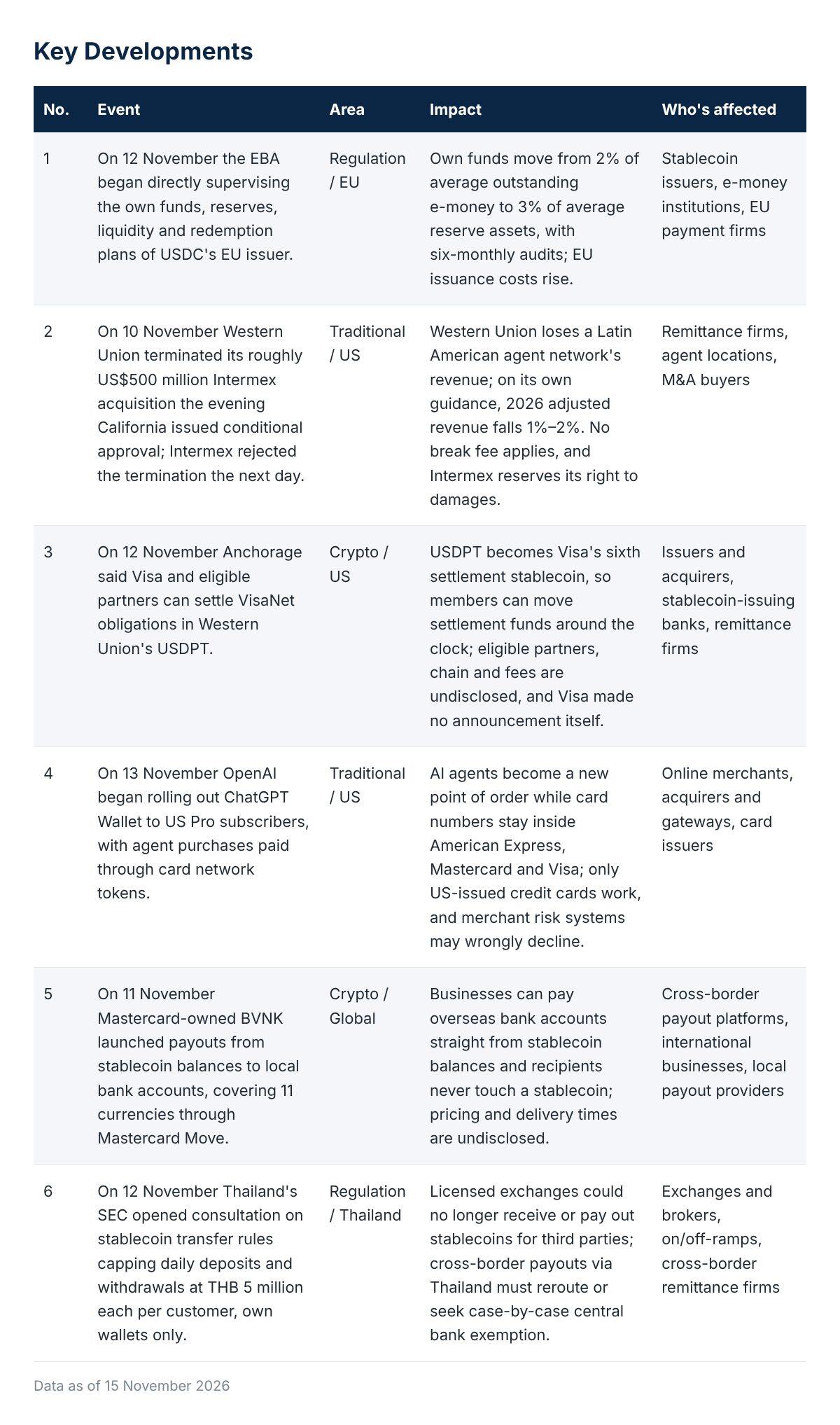
Card networks and regulators both pulled stablecoins inside their perimeter this week. On 12 November the EBA began directly supervising USDC's reserves and capital, and the same day Anchorage said Western Union's USDPT can be used to settle VisaNet obligations. Stablecoins look ever more like a settlement asset whose pricing is set by networks and supervisors.
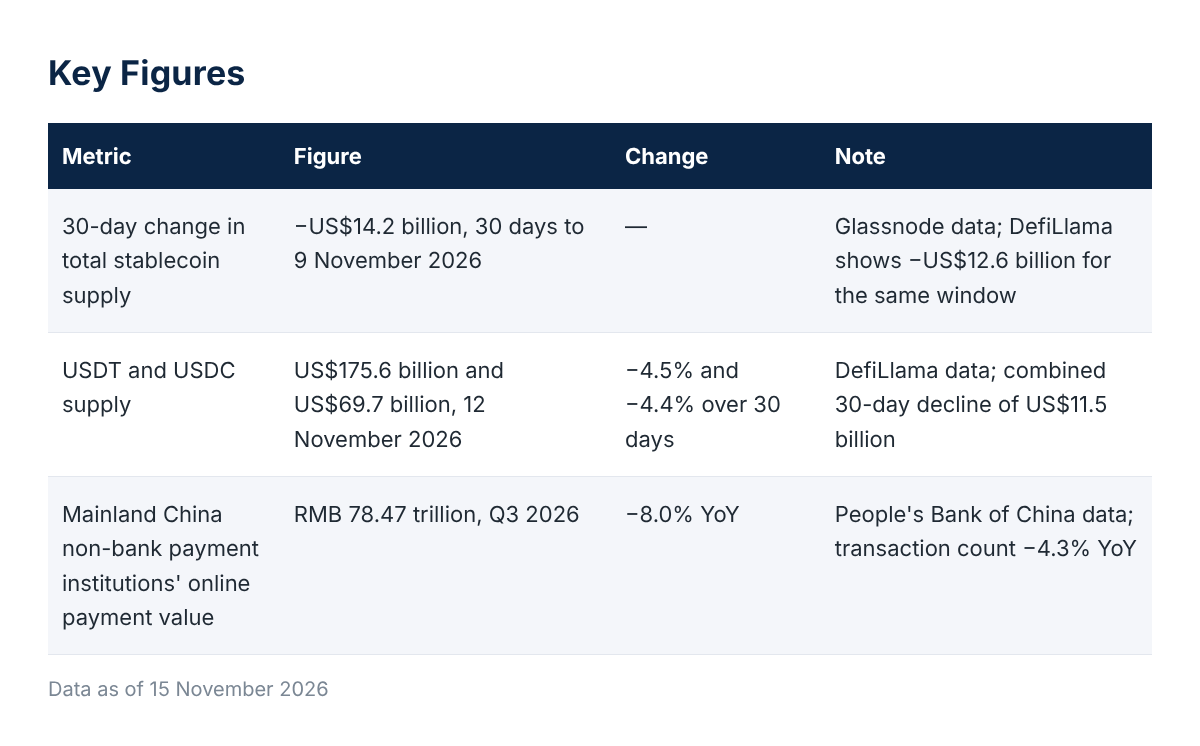
First, balances are shrinking while connections multiply. Glassnode data show total stablecoin supply fell US$14.2 billion in the 30 days to 9 November, the fastest drop since June 2022; payment firms should watch redemption access, not size.
Second, a state regulator can rewrite a merger. Western Union terminated its roughly US$500 million Intermex deal on 10 November because California's approval conditions would have changed its agent relationships.
Third, AI agents now carry a card. OpenAI began rolling out ChatGPT Wallet to US Pro subscribers on 13 November, with credentials still issued as tokens by the card networks.
Of last week's three watch items, the Western Union deal ended in termination, the EBA took over USDC on schedule, and Korea's Digital Asset Basic Act bill has still not reached the National Assembly.
Key Figures
2. Key Developments
3. Analysis
Traditional payments
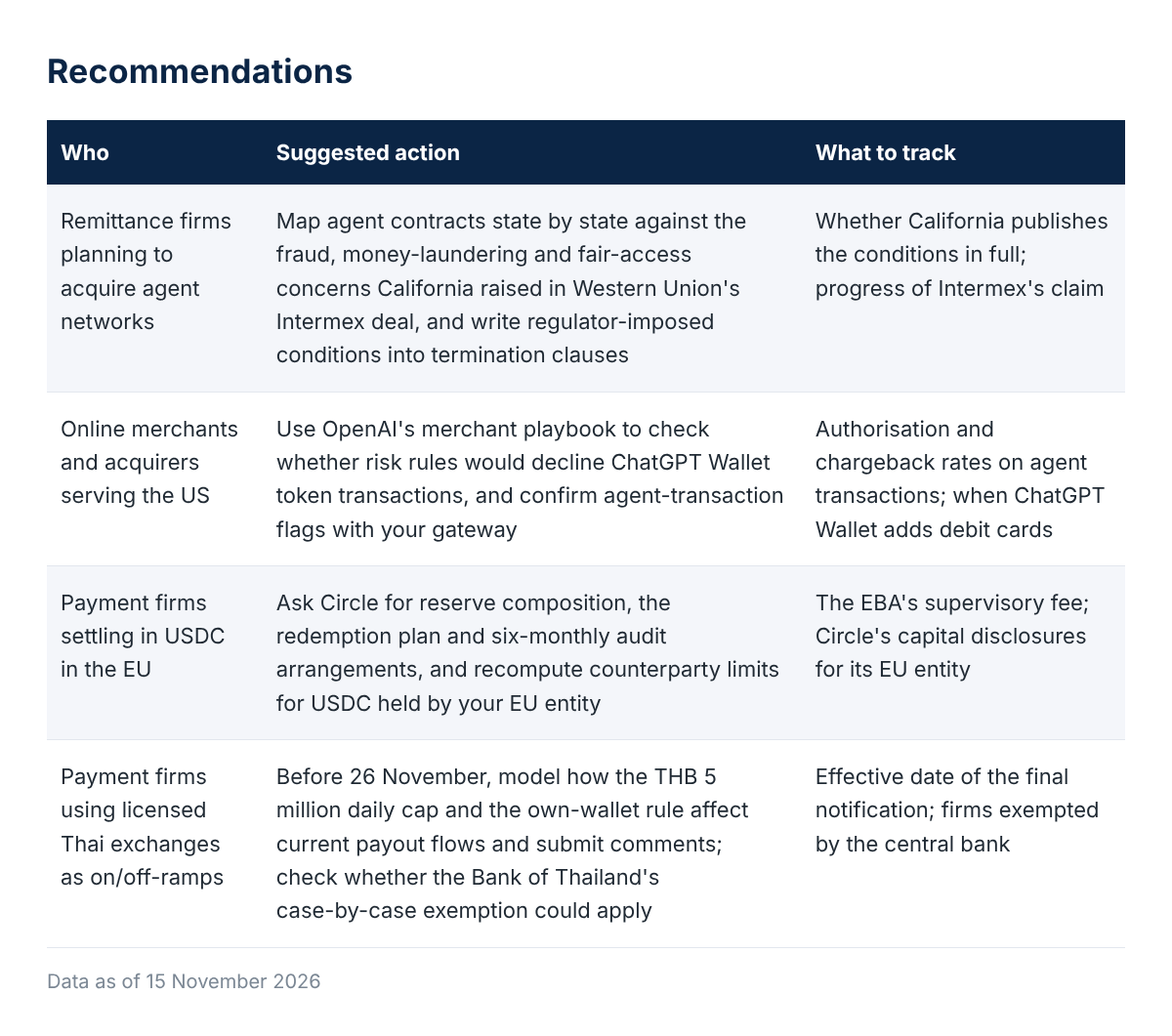
California's final approval came with conditions touching Western Union's agent relationships, and the company chose to walk away. Retail remittance firms buy agent networks to offset falling walk-in revenue, yet agent contracts are exactly where state regulators exert consumer protection, so the cost of a deal shifts from price to conditions. The US$400 million of commercial paper Western Union raised in July for the deal needs a new use, and retail consolidation will slow.
Every ChatGPT Wallet payment needs a biometric confirmation before the card network issues a token. The agent takes over selection and ordering, but credentials, disputes and rewards stay with issuers and networks, and merchants keep the customer. Pricing power in agentic commerce lands first on token services; gateways and acquirers must make risk engines recognise agent transactions.
Crypto payments
Under the EBA, USDC's EU issuer must hold own funds equal to 3% of average reserve assets, and supervisors can add a 20% buffer. The larger the token, the heavier the capital, stress testing and supervisory fee, a cost that will eventually reach minting and redemption terms inside the EU. Circle has flagged in its quarterly filing that it may need more capital or liquidity there.
Thailand's draft confines stablecoin transfers to a customer's own wallets and caps daily deposits and withdrawals at THB 5 million each. Exchanges go back to being trading venues and can no longer act as third-party payout channels, leaving cross-border payouts to central-bank-supervised firms approved case by case. The compliance route for on/off-ramps shifts from securities regulation to a central bank licence.
4. Recommendations
5. What's Next
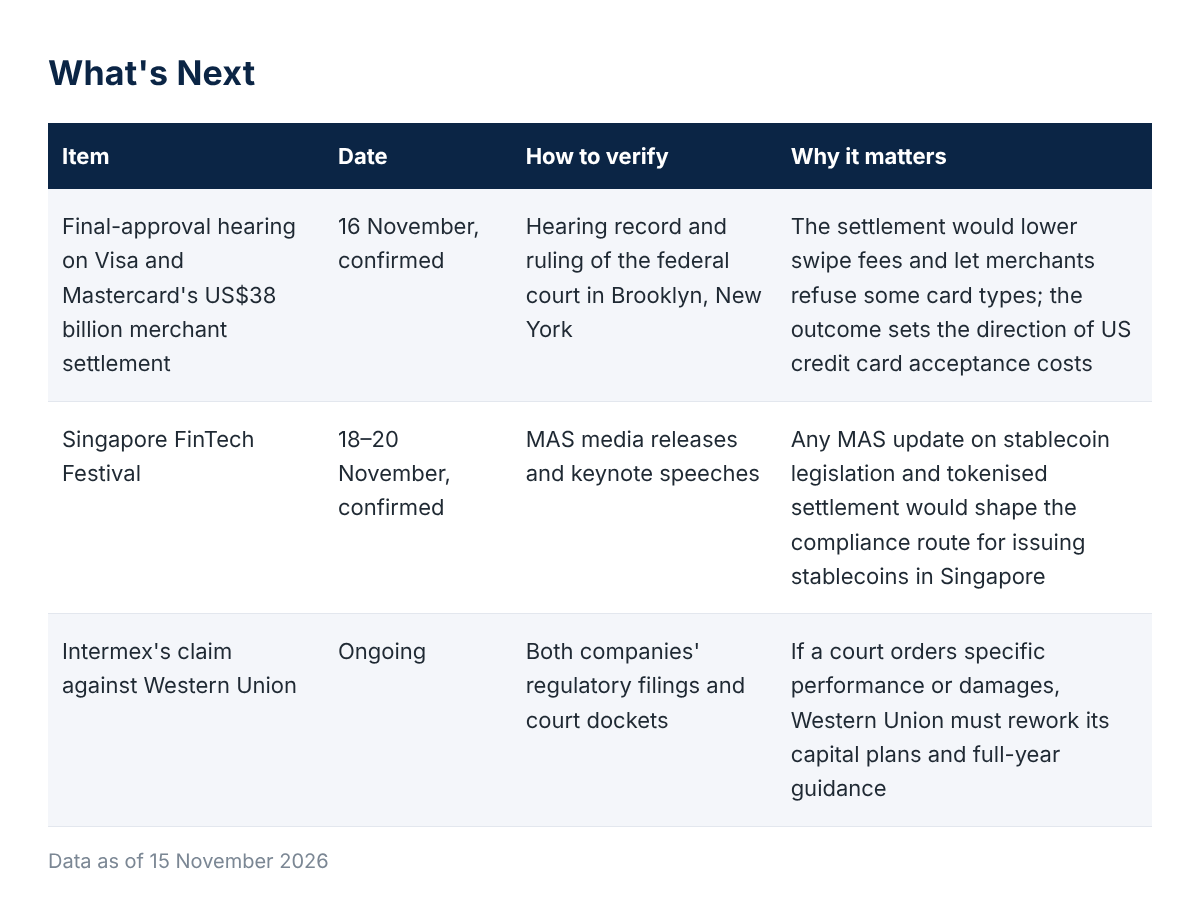
Covers 16–22 November 2026.
6. Deep Dive | Once stablecoins sit inside the card networks, what is left for issuers and payment firms?
This week's evidence
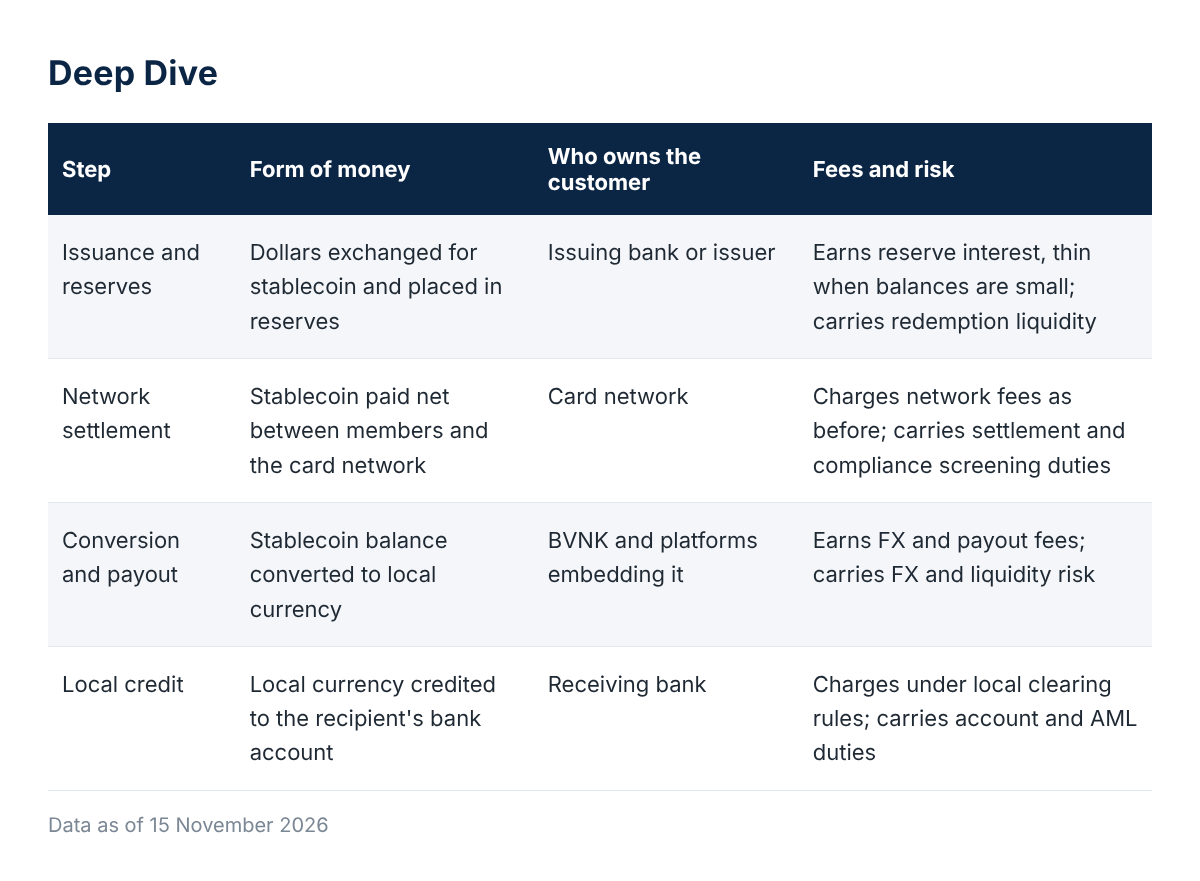
On 12 November Anchorage said Visa and eligible partners can settle VisaNet obligations in Western Union's USDPT, the sixth settlement stablecoin Visa accepts; Visa said on its 27 October earnings call that annualised stablecoin settlement had passed US$25 billion. On 11 November BVNK, which Mastercard finished acquiring in August, launched payouts that convert a business's stablecoin balance into 11 local currencies and deliver it to bank accounts through Mastercard Move. Bloomberg reported on 10 November that Goldman Sachs, Citi, Santander, Deutsche Bank and others have committed about US$270 million to fund the first five years of a dollar stablecoin company planned by 21 institutions.
How the money moves and who charges
In both cases the stablecoin travels only between institutions. On Visa's side, an issuer or acquirer that used to pay its net settlement position in dollars can now pay in stablecoin, weekends and holidays included; cardholders, merchants and fees are unchanged. On Mastercard's side, the business holds stablecoins, BVNK converts them and Mastercard Move delivers local currency, so the recipient sees an ordinary credit. Stablecoins save prefunding and waiting time; the fees still sit in FX, payout and network services.
What it means for each side
For traditional payment firms this is the easy route: no wallet or on-chain build, just a settlement option from the network that brings round-the-clock settlement and leaves customer relationships untouched. For crypto payment firms, standalone on/off-ramps and payout rails get squeezed by networks that already exist, so differentiation must come from corridors and customers the networks do not reach. For issuers, network access brings turnover, not balances. Total stablecoin supply fell US$14.2 billion in the past 30 days, so payment connections have not held up the stock, which is also why banks would rather fund an issuer of their own.
What evidence is missing
Visa has made no announcement of its own, and eligible partners, chain, volumes and fees are undisclosed. BVNK has not published pricing or delivery times. The US$270 million comes from people cited by Bloomberg, and the consortium has not named a token or a launch date.
How to verify
Watch whether Visa updates its annualised stablecoin settlement figure next quarter and names members using USDPT; whether BVNK's live currencies reach the planned 40-plus in 2027; and whether USDPT in circulation grows beyond Western Union's own use.
7. Around the World
Mainland China: Third-quarter data released by the People's Bank of China this week also show UnionPay's interbank system processed RMB 77.92 trillion, up 5.9% year on year, and CIPS processed RMB 61.34 trillion.
Hong Kong: On 10 November Standard Chartered Hong Kong said it had completed a pilot with Ant International providing bridge liquidity against redemptions of a tokenised money market fund, so a corporate can use the cash before the fund settles.
UAE: On 9 November Liv, Emirates NBD's digital bank, announced a memorandum to bring USDU, the dollar stablecoin registered with the central bank, into its app; no date for trading has been given.
South Korea: On 12 November a Financial Services Commission official said a technology company may be the largest shareholder of a won stablecoin issuer as long as banks together hold a majority.
Japan: On 13 November SBI Holdings and the National Bank of Cambodia signed a memorandum to test settling Japan–Cambodia remittances in the yen stablecoin JPYSC.
Compiled from public reports and official announcements; analysis and recommendations reflect the editorial team's views.