

Global Payments Weekly | 2026W47

Author / Editor: WANG TAI
1. This Week's Highlights
Banks started selling the on-ramp to on-chain dollars themselves this week. On 16 November DBS and JPMorgan went live with tokenised dollar deposit transfers between Singapore and the US; two days later DBS said institutional clients can mint and redeem USDC through it. A company's first stop on-chain is shifting from the exchange to its house bank, so on/off-ramp providers face banks directly.
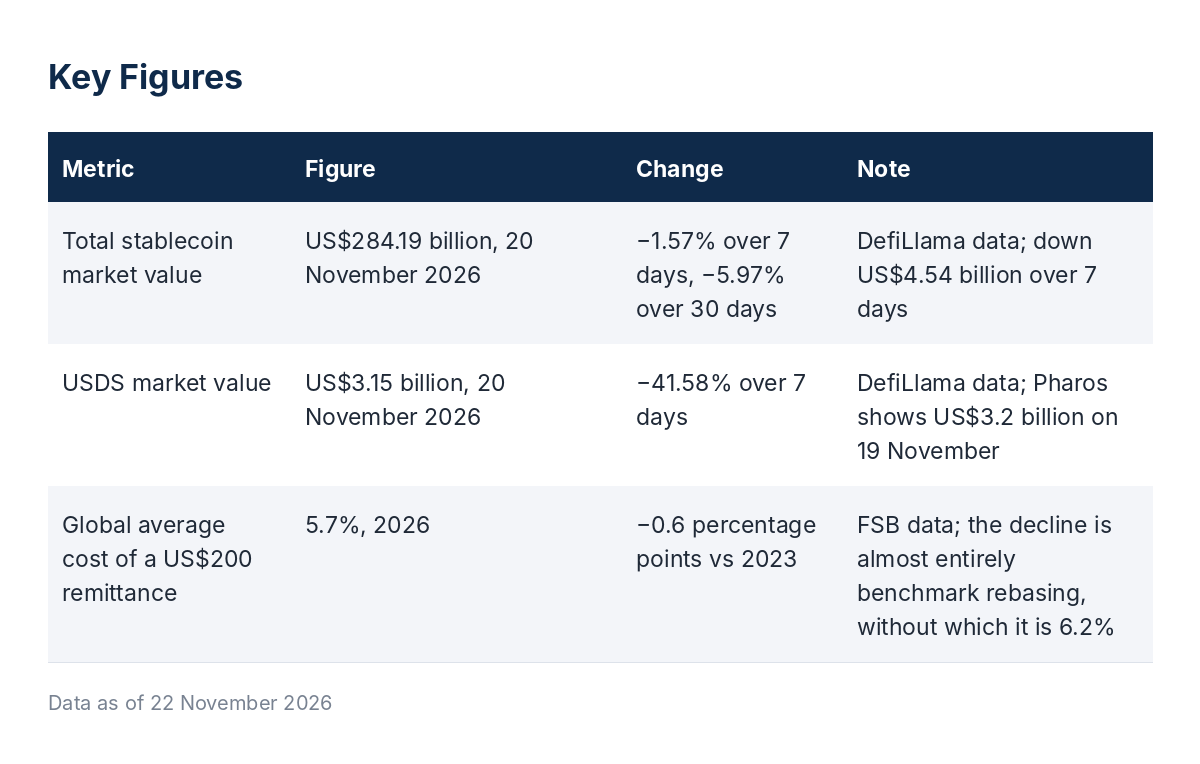
First, compliance risk can become liquidity risk within a day. A 19 November investigation said US$518 million of illicit-linked funds had passed through Sky's reserve module; over US$1.5 billion of USDC was swapped out that day.
Second, Hong Kong is putting banks and wallets under one licensing regime: a bill gazetted on 20 November requires SFC registration to offer virtual asset services.
Third, retail cross-border payments are no faster. The FSB's 16 November report shows the share credited within one business day is 14.2 percentage points below 2023.
Of last week's three watch items, the Visa and Mastercard settlement was heard but not ruled on, MAS restated its stablecoin legislation plan without a timetable, and Intermex's claim saw no public progress.
2. Key Developments
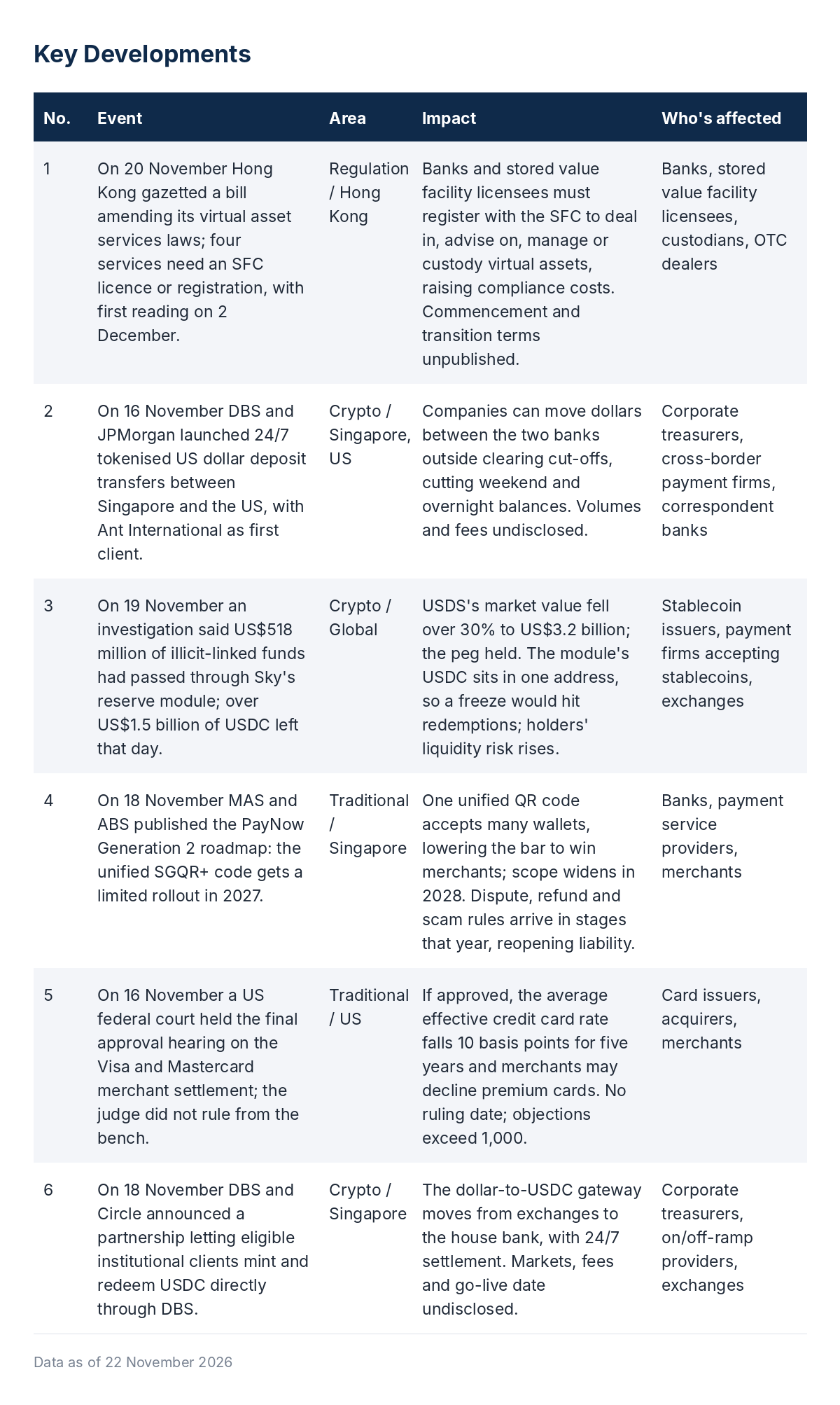
3. Analysis
Traditional payments
The FSB report shows 57% of wholesale cross-border payments arrive within an hour, yet retail payments credited within a business day are 14.2 points below 2023. Bank-to-bank rails are faster; the last leg to the customer is not, slowed by FX, screening and local crediting. Pricing power will shift to firms that commit to a delivery time.
The PayNow Generation 2 roadmap schedules merchant dispute, refund and scam rules for 2028, governed by the new Singapore Payments Network. Account-to-account payments have been cheaper than cards partly because they lacked a card-style dispute process. Once rules exist, banks and providers carry the investigation cost, and the fee gap with cards narrows.
Crypto payments
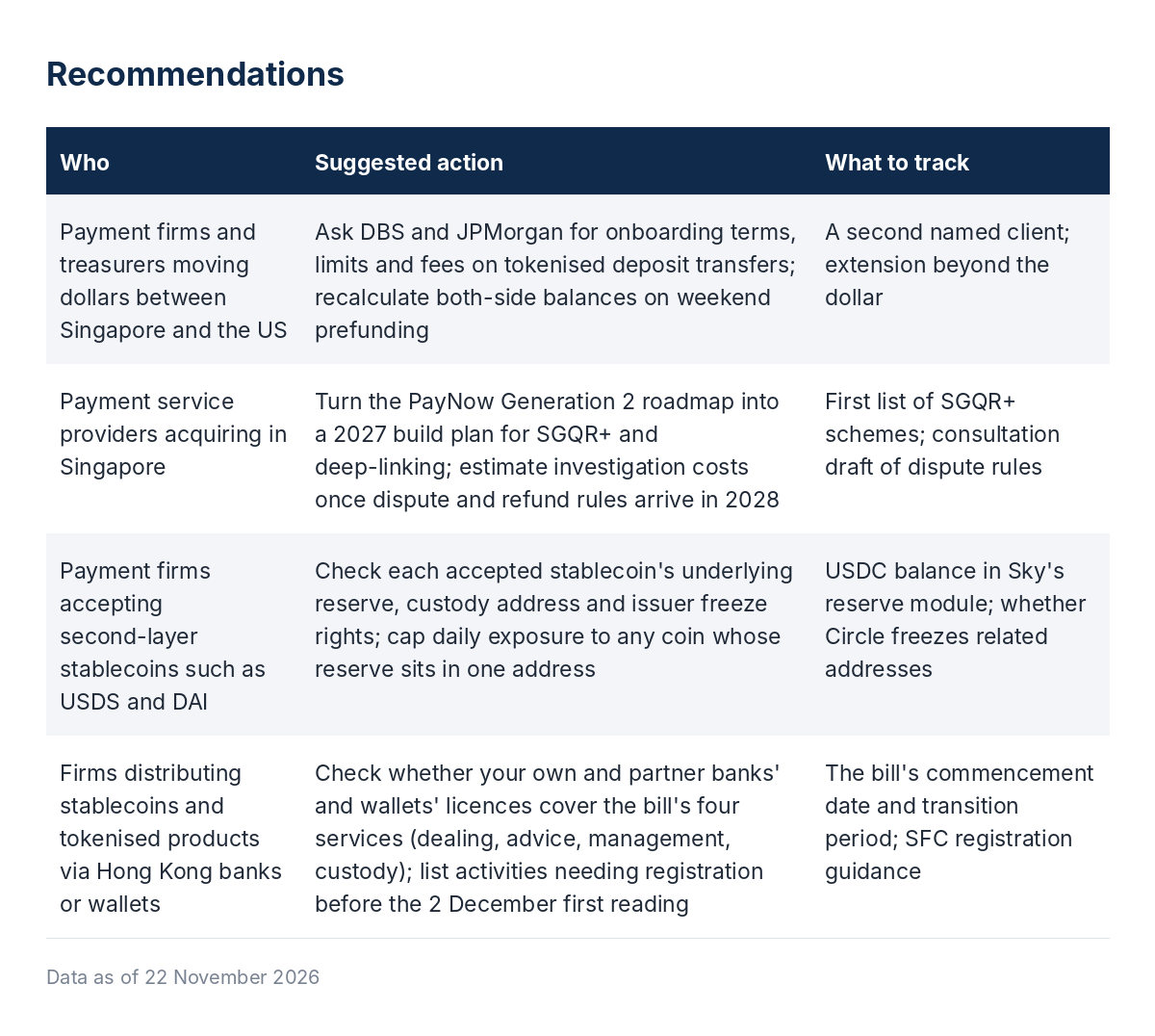
Sky's reserve module lost over US$1.5 billion of USDC in a day because of a compliance investigation, not an asset loss. USDS is redeemed out of that USDC, which its issuer can freeze, so a compliance event becomes a liquidity event. Payment firms accepting such second-layer stablecoins need limits that look through to the reserve and its freeze rights.
Hong Kong's bill requires banks and stored value facility licensees to register with the SFC for virtual asset services. HSBC's Hong Kong dollar stablecoin entered PayMe in October and from 19 November can buy a tokenised money market fund. Stablecoins are moving from payments into wealth, putting wallets under both the HKMA and the SFC. Costs rise for licensed wallets; room for unlicensed distribution shrinks.
4. Recommendations
5. What's Next
Covering 23–29 November 2026.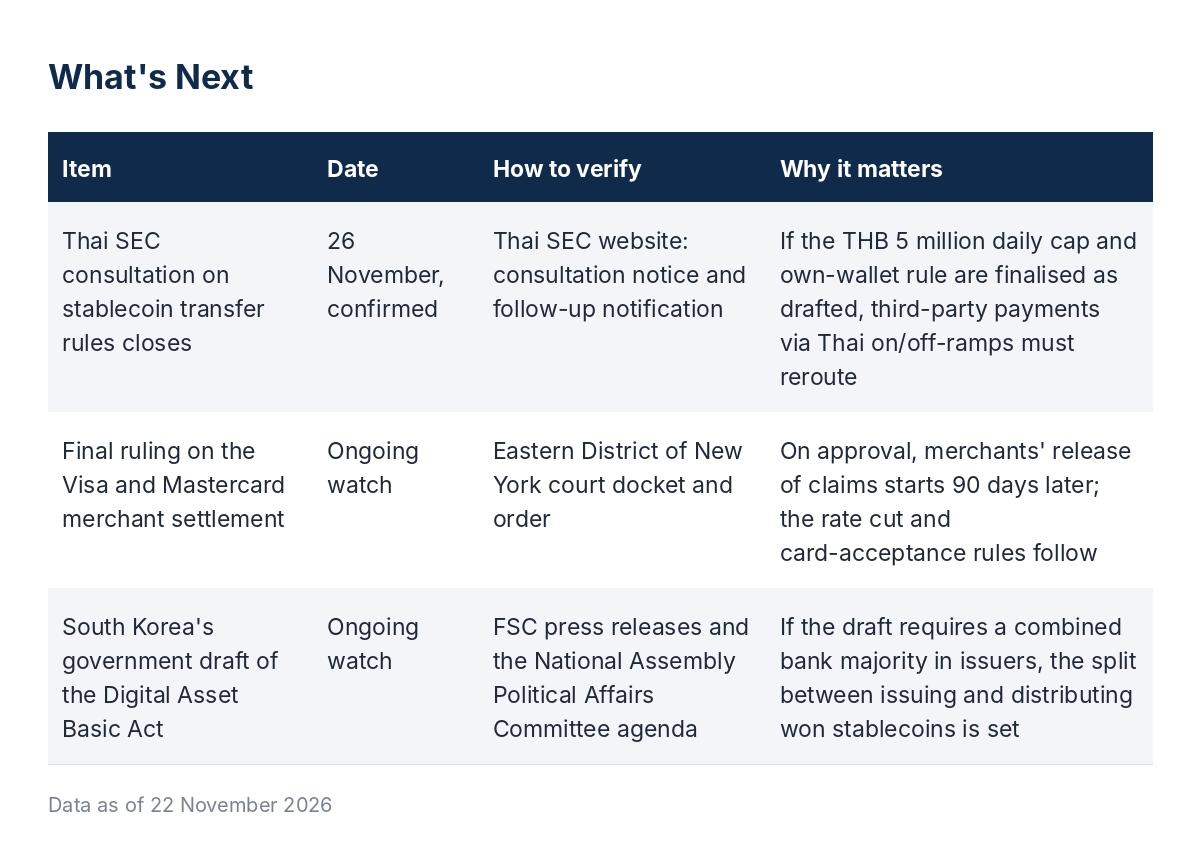
6. Deep Dive | When banks sell on-chain dollars themselves, who owns the corporate customer?
This week's evidence
On 16 November DBS and JPMorgan's Kinexys launched round-the-clock tokenised dollar deposit transfers between Singapore and the US. Ant International, the first client, uses it for treasury management between its entities there. On 18 November DBS and Circle said eligible institutional clients can mint and redeem USDC directly through DBS. On 19 November StraitsX, OCBC and Standard Chartered completed a proof of concept that settled one interbank dollar payment in minutes, after conventional cut-off. The same week the HKMA said it will explore cross-border multi-currency tokenised deposits with Swift, with Bank of China (Hong Kong), HSBC and Standard Chartered.
How the money moves and who gets paid
There are two routes. With tokenised deposits the money stays a bank liability and moves only between the two banks' permissioned ledgers; the client needs accounts at both ends, and deposit and fee stay with the banks. With USDC the deposit becomes a Circle liability and leaves the bank's balance sheet. The bank earns only the conversion, Circle earns the reserve income, and the company gets a dollar it can pay to any wallet. Offering both, DBS concedes some deposits will leave but keeps the door they leave through.
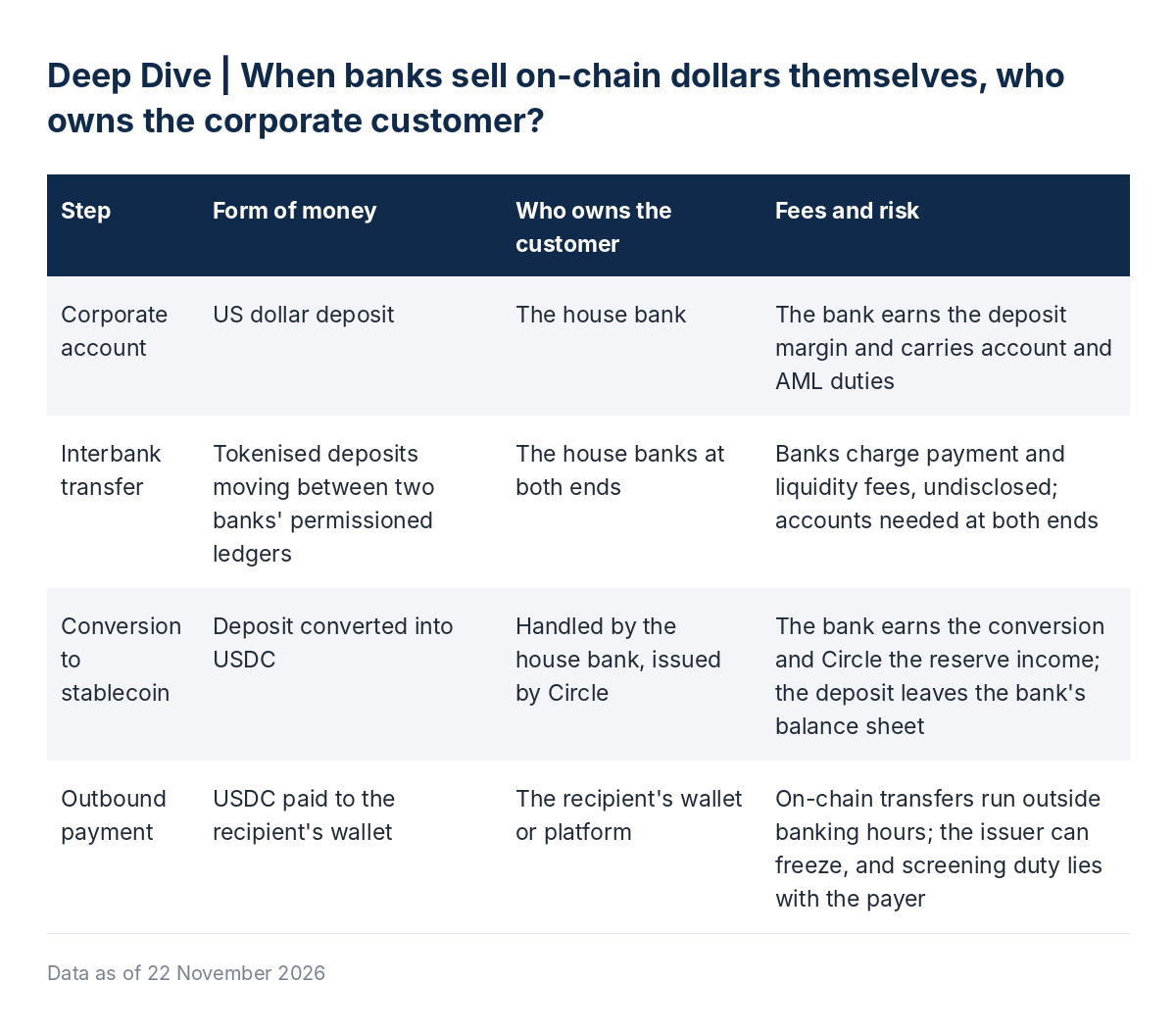
What it means for each side
For traditional payment firms this is a tool banks use to keep corporate clients. Large banks can give treasurers a dollar account that moves at weekends; smaller banks outside such networks will first lose the most active treasury clients. For crypto payment firms, dollar-to-USDC conversion was the core of the on/off-ramp business, and the house bank now takes it in passing. What remains is where banks prefer not to operate: multi-currency local payouts, small merchants and emerging-market corridors.
What evidence is still missing
Neither service discloses volumes or fees. DBS and Circle give no go-live date or market list. Ant International has worked with both banks for years, so it is not proof of unprompted demand. The StraitsX proof of concept covered one payment, and rollout still needs legal, regulatory and commercial review.
How to verify
Watch for further clients that are not fintech peers; whether DBS breaks out tokenised services within transaction services income; whether bank-minted USDC is reported; and whether tokenised deposit transfers reach other currencies or a third bank.
7. Around the World
Mainland China: On 16 November UnionPay and Visa announced deeper network connectivity. Overseas users will be able to scan and pay inside the Nihao China app with no terminal changes for acquirers; no launch date was given.
Macau: The 2027 Policy Address published this week makes the digital pataca a priority, with sandbox testing and dedicated legislation to follow.
Europe: The trilogue of 18–19 November failed to reach a political agreement on the digital euro law; the procedure for setting holding limits and compensation for payment service providers remain open.
UAE: On 17 November cross-border payments firm Sokin said it had obtained a DFSA licence and launched dirham accounts.
Japan: On 18 November yen stablecoin issuer JPYC said its app remains suspended with no date for resumption; issuance and redemption continue as normal.
Brazil: On 19 November Ant International said Alipay+ is connected to Pix, letting users of more than 50 wallets scan and pay in Brazil.
Compiled from public reports and official announcements; analysis and recommendations reflect the editorial team's views.