搜索
全部
文章
快讯
专题
活动
专栏作者
文章


查看更多
快讯

Iran: Will Exhaust the U.S. Through a War of Attrition
Odaily News In an interview aired on the U.S. public television station PBS on August 11 local time, Mohammad Reza Naqdi, an advisor to the Commander-in-Chief of Iran's Islamic Revolutionary Guard Corps, pointed out that the two main goals of the U.S. war against Iran—overthrowing Iran's leadership and dividing the country—have "already failed," and "victory is on Iran's side." Naqdi stated that in this war, the U.S. has been seen in a state of confusion and bewilderment, noting that "the U.S. announces a new goal every few days, turning this into a war 'without a strategy.'" Naqdi also emphasized that Iran will continue to achieve victory, adding that during more than five months of fighting against the U.S., Iran has not only gained experience but has also seen that the U.S. military is weaker than imagined—and that Iran must achieve deterrence so that enemies will never dare attack Iran again. One way to do this is to "prolong the war" and exhaust the U.S., so that in the future, anyone considering attacking Iran "will first weigh the price they would have to pay." (CCTV International News)
Korea Launches AIDC Alliance, Plans to Build 18.4GW AI Data Center Infrastructure
Odaily News The Ministry of Science and ICT and other relevant government agencies, together with industry players, established the AIDC Alliance on July 29, with plans to cultivate Korea's AI data center ecosystem as a national strategic industry. The initiative includes building 18.4GW of AIDC infrastructure, cross-ministerial financial support, and the formation of a working group to promote packaged exports for global industrialization. Morgan Stanley recently defined AI infrastructure as a system comprising seven value chain segments: semiconductor processes, NPUs, CXL and memory server components, server integration, networking, internal power and liquid cooling, and external power and grid infrastructure. The Korean proposal suggests placing government-funded research institutions at the center of AIDC full-stack technology development and comprehensive pilot projects, with organizations such as KIST, ETRI, KISTI, KIMM, KERI, and KIER covering areas including semiconductors, AI chips, supercomputing, liquid cooling, power grids, and distributed power generation. The proposal also recommends designating the "K-AIDC Full-Stack Integrated Pilot Project" as the first national strategic research task following the abolition of the PBS system, aiming to develop a liquid-cooled, NPU-integrated, grid-connected modular AIDC reference system with over 50% domestic NPU adoption within three years, while establishing a nationally certified pilot center.
特朗普:放弃铀矿不会换来对伊朗制裁的解除
Odaily: According to PBS, US President Trump stated that giving up uranium mines will not lead to the lifting of sanctions on Iran, and Saudi Arabia should join the Abraham Accords. (Jinshi)
Iran's Foreign Minister Says New Supreme Leader Will Not Negotiate with the U.S.
Odaily News On March 9 local time, Iranian Foreign Minister Alagchi stated in an interview with the Public Broadcasting Service (PBS) of the United States that he does not believe Iran's new Supreme Leader will consider dialogue or re-engage in negotiations with the United States. The Iranian Foreign Minister said the responsibility for the conflict lies entirely with the U.S. and Israel. Alagchi emphasized that the slowdown and even stagnation of oil production and transportation in the Middle East, and the insecurity of the entire region, are all the responsibility of the United States and Israel, for which Iran bears "no responsibility"—this is a "war imposed on Iran," and what Iran has done is merely "legitimate and justified self-defense." (Jin10)
Bitwise Donates $100,000 to Two Ethereum Open-Source Development Organizations
Odaily News: Cryptocurrency asset management firm Bitwise Asset Management announced its second donation to Ethereum open-source developers, amounting to $100,000, awarded to two Ethereum open-source developer organizations: Protocol Guild and PBS Foundation. Bitwise had previously committed to donating 10% of the annual revenue from its Bitwise Ethereum Exchange-Traded Fund (ETHW) to support the development of the Bitcoin network. To date, this ETF has accumulated over $361 million in inflows. (PRNewswire)
Bitwise Donates $100,000 to Support Ethereum Open Source Developers
Odaily News Bitwise Asset Management announced its second annual donation to Ethereum open source developers, amounting to $100,000. This donation is part of Bitwise's commitment to annually donate 10% of the gross profits from the Bitwise Ethereum ETF (ETHW) to the Ethereum open source developer initiative.The funds will be allocated to two non-profit organizations, Protocol Guild and PBS Foundation, to support Ethereum protocol research and development, as well as the development and maintenance of open-source infrastructure.Hong Kim, Co-founder and Chief Technology Officer of Bitwise, stated that open source developers and researchers are crucial to the Ethereum network infrastructure. When launching ETHW, Bitwise hoped to support these builders while the crypto industry grows.Since its launch in July 2024, ETHW has cumulatively attracted $361 million in inflows. Bitwise currently manages over $15 billion in client assets and offers more than 40 crypto investment products.Previous news: Bitwise Donates $233,000 to Bitcoin Open Source Developers, Marking Its Second Round of Annual Donations
Ethereum researchers propose decentralized solution to MEV problem
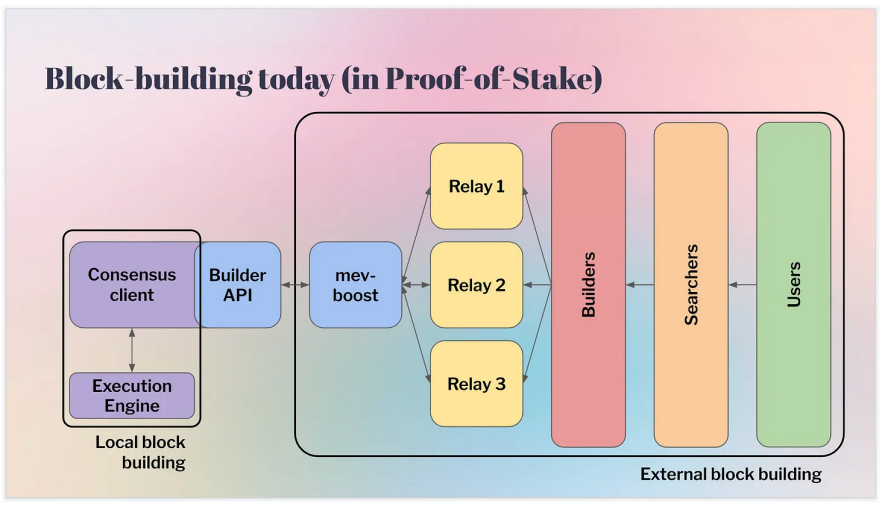
Odaily News Ethereum researcher "Malik672" proposed the "Decentralized Random Block Proposal" solution, which aims to eliminate MEV and solve the centralization problem. Currently, about 80% of Ethereum blocks are proposed by only two entities, which is contrary to the spirit of decentralization. Malik672's proposal allows all Ethereum clients (rather than a few builders) to build blocks using a random algorithm, thereby preventing profit-driven transaction manipulation. The main advantages of this solution include: completely eliminating MEV at the block level; decentralizing block construction power from a few entities to all clients; potentially reducing block time from 12 seconds to 6-8 seconds; and supporting Ethereum's future Danksharding expansion plan. Compared with the current Proposer-Builder Separation (PBS) mechanism, the new system performs better in decentralization and eliminating MEV, but is slightly lacking in L2 efficiency optimization. For Ethereum, which values fairness, this solution is of great value.
Bitwise Donates $100,000 to Support Ethereum Open Source Developers
Odaily News Bitwise donated $100,000 to support Ethereum open source developers, and when the Bitwise Ethereum ETF ($ETHW) is launched in July 2024, it promises to give back 10% of ETHW's gross profit to the Ethereum ecosystem each year. This is reportedly Bitwise's first annual donation.
Pre-election "closed border" poll shows Harris leading Trump by 4 percentage points
Odaily News According to Jiemian News, the closing poll released by National Public Radio (NPR), PBS and Marist Poll shows that US Vice President and Democratic presidential candidate Harris leads Republican presidential candidate Trump by 4 percentage points in national support. Harris received the support of 51% of likely voters, while Trump's support rate was 47%, just outside the 3.5% margin of error. This result is very similar to four years ago. The 2020 poll results showed that Biden's support rate was 51%, while Trump's support rate was 47%, and Trump also lagged behind by 4 percentage points.
Vitalik thanks Bitwise for donating to Ethereum developers
Odaily News Regarding Bitwise's plan to donate 10% of its Ethereum spot ETF profits to Ethereum developers, Ethereum co-founder Vitalik Buterin thanked Bitwise in a post on X, "I am glad to see the support of Protocol Guild and PBS Foundation. I look forward to seeing more projects and organizations follow your steps and donate to important public welfare initiatives within the ecosystem."
查看更多