

Coreweave and France: Two Cracks Under High Interest Rates

Original author: Xu Chao
Original source: Wallstreetcn
Is the music about to stop?
Over the past week, two seemingly unrelated events occurred at the same time: the bond yield of an AI computing power company surged to 15.7%, and the streets of a major European country descended into fire and riots.
On the surface, one is technical stress in the capital markets, and the other is a political eruption of social contradictions. But Goldman Sachs rates strategist David Curtin placed these two events within the same logical framework — high interest rates are turning the global financial system into a pressure cooker, with stress erupting at the weak links along debt scale, financing costs, and cash flow. Whoever cannot hold on first may become the first domino under a high-rate environment.
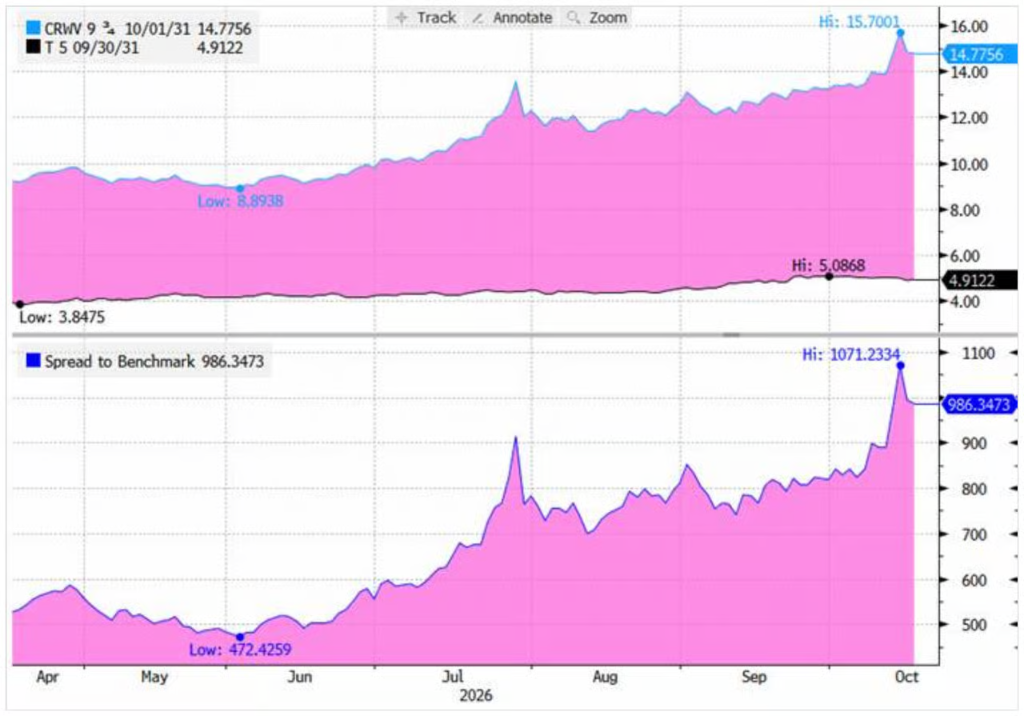
Two sets of numbers are enough to illustrate the severity of the problem: the yield on CoreWeave's 9.75% bonds maturing in 2031 rose to as high as 15.7%, while its spread over U.S. Treasuries widened from 472 basis points to a peak of 1,071 basis points; the yield on French 30-year government bonds has seen a maximum increase of about 130 basis points since the outbreak of the Iran war, and the France-Germany spread briefly touched 142 basis points. The market is no longer merely facing rising interest rates; high rates are beginning to change who can continue borrowing and who must pay a higher price for financing.
Even more alarming is that Goldman Sachs' analysis points to a counterintuitive closed loop: the AI capital expenditure boom itself is one of the factors pushing up long-term interest rates. If high rates intensify AI financing pressure and force capital expenditure to cool, long-end rates may instead fall — but not without cost: the AI supply chain will face slower investment, downward asset valuation revisions, and adjusted revenue expectations. Two cracks, pointing to the same possible rate inflection point.
The First Crack: CoreWeave, the Financing Cost of the AI Boom Begins to Show
To understand why CoreWeave has become a landmark case under high interest rates, one must first understand its business model.
CoreWeave's logic is a typical "debt-driven expansion" path: using high-cost financing to purchase Nvidia GPUs, build AI computing infrastructure, and then rely on long-term contracts with major customers such as Microsoft, OpenAI, and Meta to gradually recoup the investment. When rates are low, this model can generate considerable arbitrage space; but once financing costs surge, the entire logic begins to come under pressure.
Goldman Sachs data shows that the yield on CoreWeave's 9.75% bonds maturing in 2031 once surged from a May low of 8.89% to 15.70%, while the spread over U.S. Treasuries also soared from 472 basis points to a peak of 1,071 basis points, before retreating slightly and still hovering near 986 basis points. In other words, the market's pricing of CoreWeave bonds is already close to the most dangerous range within junk debt. CoreWeave's five-year credit default swaps (CDS) closed at a record 1,117 basis points, implying a roughly 63% probability of default within five years.
Even more alarming is that the risk does not stop at CoreWeave itself: about $14 billion of junk-grade bonds are backed by data centers whose sole tenant is CoreWeave — and CoreWeave itself relies on junk bond financing to sustain operations. This constitutes a rare "junk backing junk" structure, with risk compounding exponentially.
The crack has spread to the investment-grade market. Goldman Sachs statistics show that spreads on 30-year U.S. dollar AI bonds have already stratified significantly: Oracle's 30-year bond spread is as high as about 300 basis points, SpaceX about 250 basis points, while Meta and Google's newly issued 2025 bonds are in the 170 to 180 basis point range, and other leading tech companies remain concentrated near 100 to 130 basis points.
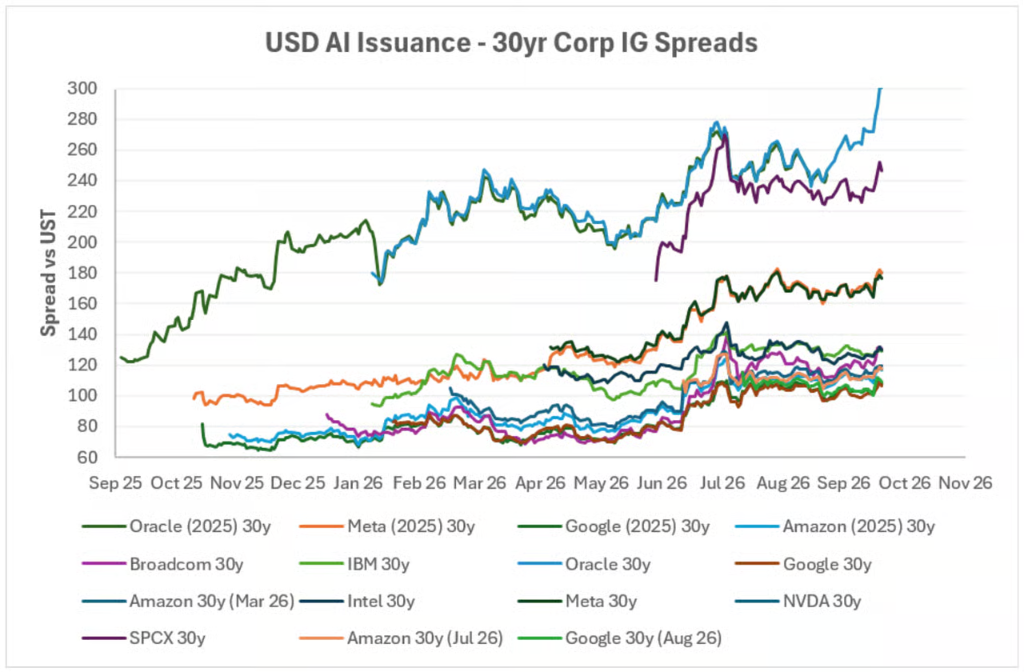
The pricing logic the market is applying is clear: whoever needs to borrow more and is more fragile relative to its own balance sheet must pay a higher financing premium.
Goldman Sachs warns that the core issue is not weakening AI computing demand, but "the cost and scale of financing itself." For hyperscale data center operators, a blended financing cost of 6% to 8% may still be tolerable; but for emerging cloud computing companies rated below investment grade, high rates will bite faster and harder.
The Second Crack: France, Fiscal Deficits Meet High Long-Term Rates
The problem facing France is logically similar to CoreWeave's, but larger in scale and with a longer transmission chain.
Since the Iran war triggered a global rise in long-end yields, the increase in French 30-year government bond yields has led among G5 countries — up about 130 basis points from pre-war levels at the peak, and still about 115 basis points higher at present.
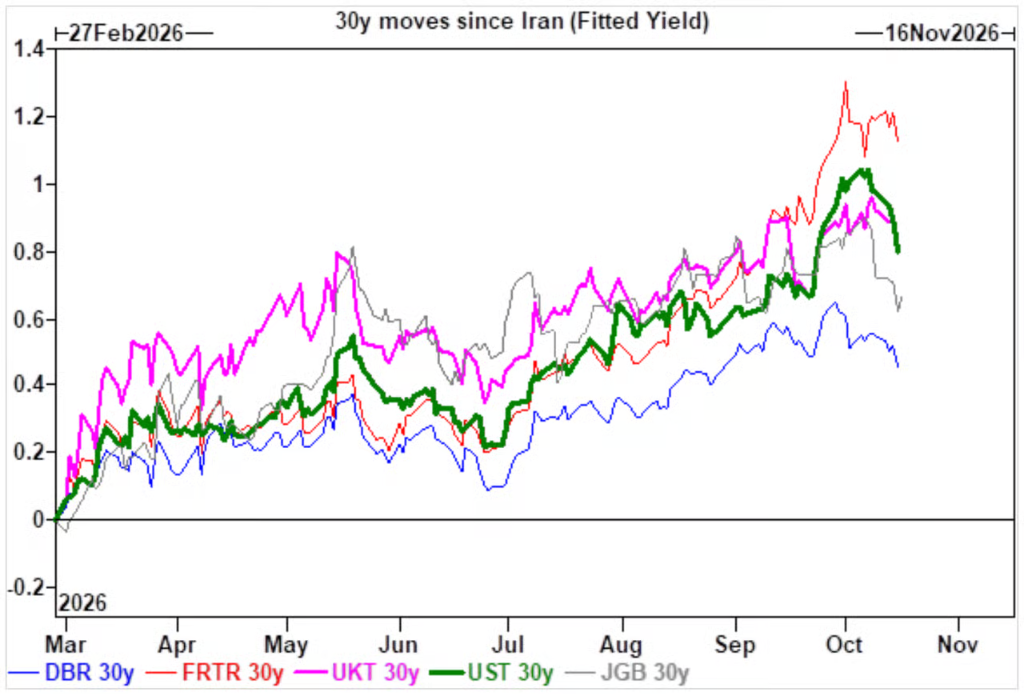
By comparison, German government bond yields rose only about 45 basis points, and the France-Germany 10-year government bond spread (OAT-Bund spread) briefly touched 142 basis points. In the market, German short-term government bond spreads widened, sovereign credit curves flattened, bank stocks underperformed the broader market, and the euro weakened.
This combination closely resembles the market reaction during the 2011 European debt crisis.
France's dilemma lies in this: the government needs to continuously roll over enormous debt, while bond investors demand higher yield compensation, meaning that both new borrowing and refinancing of old debt are becoming more costly. More troublesome is that the room for fiscal consolidation is extremely limited — Goldman Sachs holds explicit skepticism about France's ability to push through fiscal contraction, and notes that European elections in 2027 are unlikely to change this situation.
The Japan factor is also intensifying pressure. Japanese investors have long been important buyers of French government bonds, with holdings of about 23 trillion yen (roughly $145 billion). But as Japanese government bond yields rise, the yield advantage of holding French debt after currency hedging has narrowed substantially, and capital is withdrawing.
The International Monetary Fund (IMF)'s statement is also worth "reading carefully": France's current yield rise is "still manageable," but without fiscal consolidation measures, future financing pressure will further increase. Translated into market language: this is not yet a crisis, but if nothing changes, the bond market itself will become the source of pressure forcing the government to adjust fiscal policy.
Curtin's comment is almost blunt: unless a bond market crisis forces the government to act, France will not voluntarily cut its deficit.
Two Cracks May Point to the Same Rate Inflection Point
Goldman Sachs analysis points out that there are two "strongest drivers" pushing global long-end yields higher — fiscal easing and the continued expansion of AI capital expenditure. The former suppresses prices by increasing sovereign bond supply; the latter pushes up term premiums through supporting nominal GDP growth and issuing large amounts of long-term bonds to finance AI.
This means that the AI capital expenditure boom is not just a matter of financing demand in capital markets; it is also one of the forces pushing long-end yields higher: the AI construction boom continuously exerts upward pressure on long-term rates through channels such as "supporting nominal economic growth and increasing long-term bond supply." But if high rates worsen AI financing conditions and force capital expenditure to cool, long-term rates may instead fall.
This logic has already seen preliminary market validation recently: U.S. CPI and PPI data both came in above expectations, yet the 10-year U.S. Treasury yield unexpectedly moved lower. The reason is precisely that AI credit concerns triggered by CoreWeave lowered market expectations for AI-driven long-term economic growth and long-bond supply.
However, this is not a "win-win" outcome. Goldman Sachs outlines a more complete cycle:
High rates pressure the most leveraged AI borrowers → debt financing conditions tighten → AI capital expenditure is forced to slow → long-end rates fall due to reduced supply → but the AI supply chain simultaneously faces valuation downgrades, adjusted revenue expectations, and slower investment.
The bond market may get some relief, at the cost of pressure on the AI industry. This is not the interest rate problem resolving itself, but risk being redistributed across different asset classes.
A Global "Battle for Capital" Begins
High interest rates are accomplishing one thing: forcing the market to reprice a long-forgotten common sense — capital has a cost, and financing has boundaries.
The widening of French government bond spreads shows that the immunity of sovereign debt is declining; the surge in CoreWeave bond yields shows that the financing foundation of the AI boom is not monolithic. The two cracks point in the same direction: the impact of high rates is transmitting from the pricing level of financial markets to the financing capacity of real-economy borrowers.
Goldman Sachs analyst Privorotsky warns that in the post-financial-crisis era, the world economy has operated on abundant savings and structurally low interest rates. Governments' fiscal systems are also built on the assumption that cheap capital will persist for a long time. Now that assumption is breaking down.
If AI investment can generate internal rates of return of 20%-30%, then financing at rates approaching double digits is still reasonable. But the question is what happens to other sectors that also need capital. This may explain why real yields are hard to bring down. If the market expects a large volume of high-quality private-sector bonds to be issued soon, the appeal of buying sovereign bonds will decline.
Privorotsky proposes two possible outcomes: first, AI gradually becomes self-funding and financing pressure eases; second, capital is rationed in other sectors, and the more fragile parts of the economy begin to break.
Stress erupts at the weak links along debt scale, financing costs, and cash flow. Whoever has the most fragile balance sheet is squeezed out first. And when the borrowers being squeezed out are large enough — whether a country or an AI infrastructure empire — the entire market will have to recalibrate its judgment of the "long-term neutral rate."
This recalibration has only just begun.