BiyaPay Market Watch: AI Is Getting Stronger, So Why Hasn't GOOGL Surged?
Google has once again pushed a more powerful model into broader use cases, but the stock price reaction remains restrained.
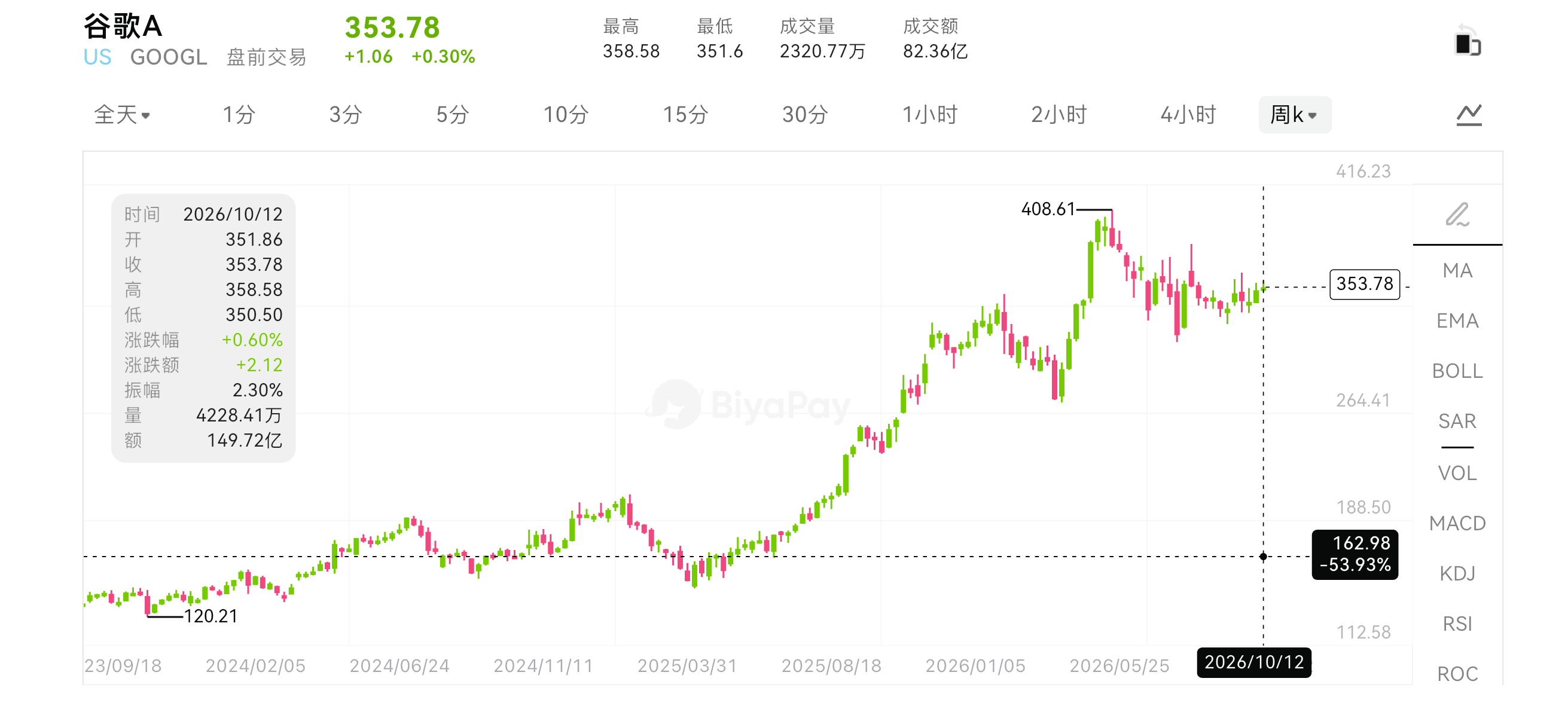
BiyaPay market data shows that on October 13, US Eastern Time, Alphabet Class A shares (GOOGL) closed at $353.78, up about 0.30%. On the same day, Gemini's official update log announced that Gemini 4 Argon began rolling out gradually to Google AI Pro and Ultra subscribers in the Gemini app. The market did not deliver a rally commensurate with the product's buzz, but that does not amount to a rejection of the new model, nor should a single day's move be attributed entirely to a model launch.
The timeline needs to be distinguished. Google already introduced Gemini 4 Argon on September 30, emphasizing that it targets complex, long-workflow professional tasks. This week's development is an expansion of availability, not the first announcement of the name. For capital markets, the value of broadening access lies in subjecting real demand, willingness to pay, and service costs to faster scrutiny.
What Google now needs to prove is that model capabilities can improve its existing businesses while also building new revenue streams. Search, cloud, and subscriptions can all use the same underlying technology, but they make money in different ways.
A stronger model still needs commercialization to translate into revenue
Improved capability on complex tasks may increase enterprise use of AI. If the model can reliably handle coding, document processing, and professional work, the case for paying becomes clearer than for an ordinary Q&A exchange. But usage frequency, task quality, and actual revenue still need product and pricing to connect them.
Better model capabilities can make previously impossible tasks possible, and can also make tasks that once required extensive manual correction more reliable. The former expands potential demand; the latter improves input-output efficiency. Still, trial buzz is not retention, and retention is not gross margin. The more complex the task, the more compute consumption and service costs may rise.
When comparing Google with other AI companies, investors can use BiyaPay, a global one-stop asset allocation platform, to monitor GOOGL, related tech stocks, and digital asset quotes in one place. The platform uses USDT as its core funding gateway, connecting US and Hong Kong stocks, cryptocurrencies, and fiat currency exchange scenarios to reduce switching between multiple platforms; it also supports users trading real US and Hong Kong stocks with USDT at zero commission. Viewing price reactions side by side helps identify whether the market is rewarding application revenue, infrastructure demand, or a broader shift in risk appetite.
Google's distinguishing feature is its many distribution gateways, through which models can enter search, apps, and enterprise services. But more gateways also mean more complex operational questions: how to charge for new experiences, whether they increase service costs, and whether they cannibalize existing revenue all need to be verified separately. A higher model ranking cannot directly answer these questions.
Gemini is stronger, but Google still needs to prove how AI makes money
The advantage of the search business is not just that people ask questions, but that it can identify demand and connect information with commercial services. After AI changes the way answers are presented, Google needs to maintain that connection while making experience improvements economically valuable.
If answers are more complete, users may ask more complex questions, and search's coverage has room to expand. But the same change could also alter web clicks and ad display patterns. How much commercial demand new usage actually generates cannot be judged solely by the number of conversations.
Looking at the second-quarter financial report, Google Search and other revenue was $63.271 billion, up about 17% year over year. This shows that as of that quarter, the search business was still growing, but it cannot be used to count the contribution of the newly opened model in October ahead of time.
More valuable evidence going forward is whether search growth can continue and whether the company can explain the relationship between AI experience and advertising effectiveness. If usage rises, commercial demand conversion remains stable, and unit service costs gradually decline, the operating logic will be more convincing. If usage rises markedly but costs grow even faster, the market will still press on revenue quality.
Therefore, when discussing Gemini and search, it is inappropriate to write only that "AI will replace search" or that "traffic is large, so victory is assured." Google is changing its own product form and rearranging its existing business model. What ultimately matters is how revenue and costs realign after the experience changes.
The cloud business is already growing, but not all of it can be credited to Gemini
Alphabet's total second-quarter revenue was about $119.796 billion, up 24% year over year; Google Cloud revenue was about $24.8 billion, up 82% year over year. The company disclosed that growth was driven jointly by enterprise AI solutions, AI infrastructure, and core cloud services.
These figures show that enterprise demand has already left results on the revenue side, but Google Cloud does not sell only Gemini. Compute, data, networking, security, and other cloud services are also part of its business. Attributing all cloud growth to a single model would exaggerate the product's independent contribution.
For enterprise customers, adopting a model often also requires integrating data, permissions, workflows, and internal systems. Google's opportunity is to combine model capabilities with existing cloud services to reduce deployment complexity; but enterprise budgets, testing time, and contract execution also determine when technical capability turns into revenue.
After the model expands access, more usage can help Google discover demand, but free trials, promotional periods, and formal long-term paid subscriptions represent different stages. For revenue to be sustained, reliability and cost also need long-term competitiveness. A customer willing to try once and a customer placing critical work in the system for the long term have different commercial value.
High margins and cash flow pressure can coexist
The hardest question to avoid with AI investment is time. Cash is spent first on infrastructure, while operating returns need to be realized gradually.
Alphabet's second-quarter operating cash flow was about $39.069 billion, purchases of property and equipment were about $44.924 billion, and free cash flow as defined by the company was about negative $5.855 billion. This does not mean the company posted a loss for the quarter; it reflects that related capital investment in the quarter exceeded operating cash flow. A single quarter's cash flow also cannot replace a full-year judgment.
Capital expenditure is not entirely expensed in the period when it is purchased, and later affects profit through depreciation and other means. Therefore, the market needs to look at both the revenue brought by new products and subsequent fixed costs, equipment utilization, and ongoing construction needs. Strong revenue and periodic pressure on free cash flow are not contradictory.
This is also a reasonable analytical framework for why Google's stock price has not surged sharply with every model upgrade, but it should not be written as the sole proven reason. The market also considers prior expectations, sector rotation, and interest rate changes. For a company of this size, a product needs to generate a sufficiently large operating increment to sustainably change valuation.
Gemini's expanded access gives Google another set of validation opportunities closer to real usage. Search needs to prove that commercial demand can be supported by a better AI experience, cloud needs to prove that growth and profit can continue, and subscriptions need to prove payment and retention. Product capability has moved forward; what the capital market cares about next is how much revenue this step can bring back, how many resources it consumes, and how soon it forms more stable cash returns.