

IOSG: Papertrade's Daily Revenue Is Second Only to Tether — A Casino That Returns 90% of Its Rake to Losers

Author: Mario Chow
Source: IOSG Ventures
Data as of October 19, 2026, 10:00 UTC, 212 hours after launch.
Summary
Papertrade is a synthetic perpetual contract on HyperEVM, launched on October 10. It only offers BTC and ETH, with leverage up to 1000x. The team consists of Jez (Colin Hong, former venture partner at Standard Crypto) and anonymous developer Blurr. No funding, no pre-mine, and the team kept no allocation. To get the PAPER token, there is only one way: lose money on the platform.
Headline volume now stands at $1.361 trillion, all notional amounts amplified by leverage of up to 1000x; over the same period, Hyperliquid's entire 24-hour perpetual volume was $5.2 billion. Real money is far smaller: about 23,000 addresses deposited $335 million, closed $249 million in losses, and traders are net down $63.2 million.
The core of this article is here. Of the $63.2 million in net trader losses, $54.1 million (86%) went to PAPER stakers. Another $4.7 million remained in the LP, and developers received about $4.5 million (7%). Those receiving the payouts are the people who lost money: the top 1,000 wallets hold 88% of PAPER, bore 81% of all losses, and took 91% of the distributions. In plain terms, this is a casino that refunds the rake to the gamblers.
Staking revenue arrives in waves, tracking mining rewards. In the first ten hours, stakers received $24 million; a second wash-trading wave from the 12th to the 16th distributed another $24.9 million; on the 17th it fell to $800,000. Separately, PAPER now has a price. Paragon launched a HIP-3 perpetual para:PAPER on Hyperliquid on October 18, opening at $0.012, surging to $0.035 within two hours, and then hovering around $0.024. Based on 8.69 billion tokens, that is a market cap of $211 million, roughly twice the cost of wash-trading to mine one PAPER. PAPER itself still cannot be transferred.
Key Findings
- A rebate loop. 86% of net losses went to stakers, and stakers are precisely the wallets that lost money: the top 1,000 wallets hold 88% of PAPER, bore 81% of losses, and took 91% of the distributions.
- Revenue arrives in waves tied to wash trading. $24 million in the first ten hours, $24.9 million from the 12th to the 16th, only $800,000 on the 17th when the mining rate dropped to about 12 PAPER per dollar, and $2.1 million on the 18th after the perpetual launched.
- PAPER has a price, but it is thin. para:PAPER trades at $0.024, about twice the cost of wash-trading to mine; this is a 3x-leverage pre-market perpetual with about $5 million in open interest, on an underlying token that no one can ever settle.
- Solvency has held throughout. No winner has ever queued, and BTC and ETH would now need to rise together by 3.7% to drain the pool; on day one it was only 0.7%.
How It Works
Where the Price Comes From
Opening and closing each read the price once: the contract obtains the midpoint of Hyperliquid's best bid and best ask through a HyperCore precompile. The orders themselves are not executed on Hyperliquid. There is no order book, and for any single position under the $10 million cap, there is no slippage no matter how large it is, and no funding rate. You are betting against a pool.
The Pool Is a Water Tank
This pool (the LP) is the sole counterparty, with no backstop behind it. It starts at zero, outsiders cannot deposit into it, and you can think of it as a water tank with an overflow spout:
- Losers pour in. On a losing close or liquidation, 98% of the loss goes into the pool.
- Winners draw out. A profitable close is paid regardless of how much remains in the pool, after deducting the discount described below. If the pool is drained, unpaid profits (margin is unaffected) enter a first-in, first-out queue to be filled by future losers. There is no other backstop.
- Overflow goes to stakers. Anything above $5 million in the pool is pushed to PAPER stakers. The team announced on October 17 that this line would be raised to $10 million, but as of October 19 on-chain it was still $5 million, and we found no explanation for the delay.
- Every close, win or lose, charges a 2% fee on P&L, with 1% each to stakers and developers. On a loss it is deducted from the loss, so 98% enters the pool; on a gain it is deducted from the proceeds. The fee is waived while anyone is queued.
Those are the rules. The money in the pool is not promised to anyone, and how much ultimately reaches winners versus stakers depends entirely on how trading unfolds.
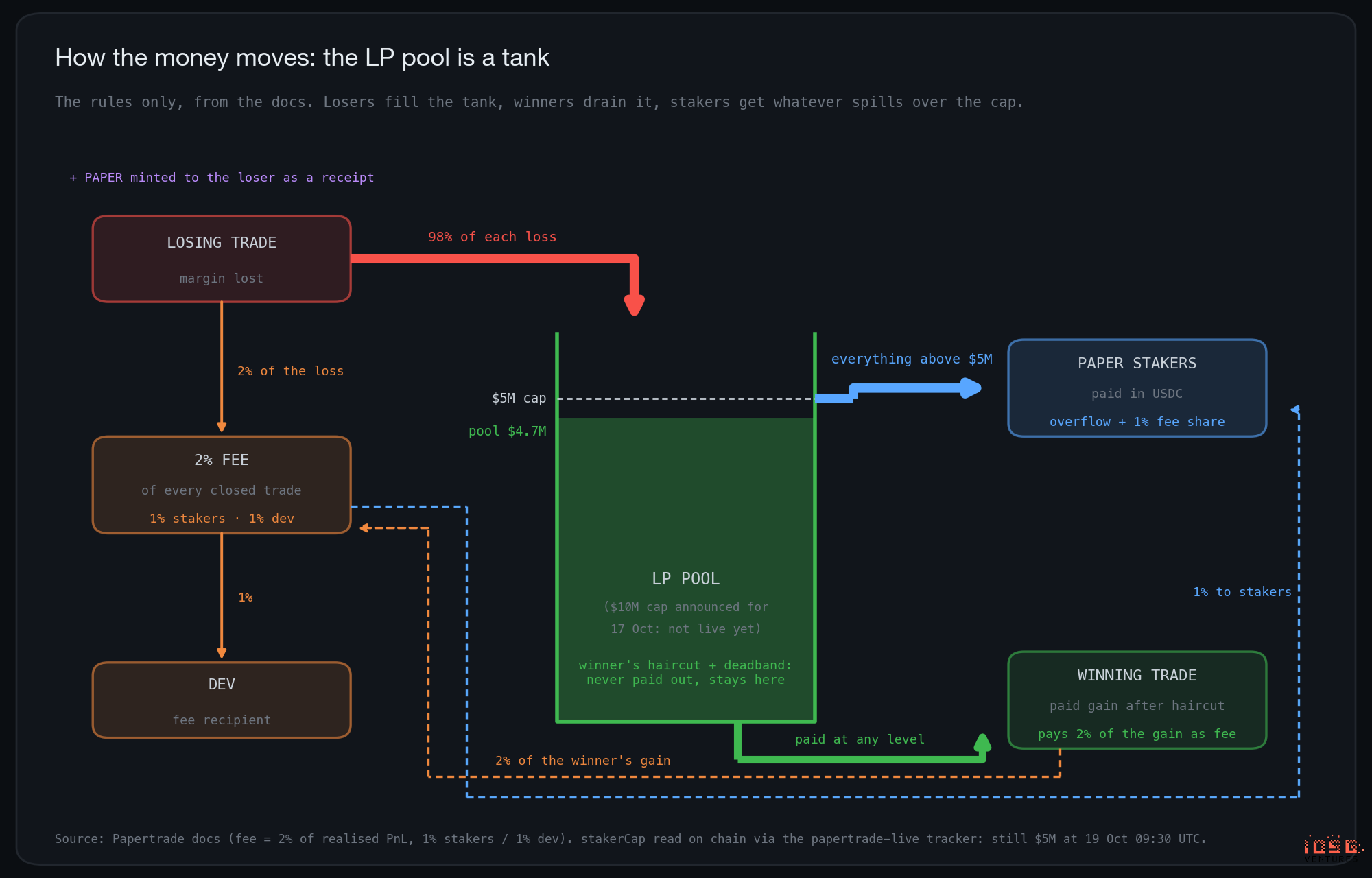
▲ How funds flow: the LP pool is a water tank
The most important point is this: this casino does not guarantee that winners get paid. On a normal exchange, a winner's money is always paid by someone with capital—a market maker, an insurance fund, or the house's own balance sheet. Papertrade has none of these. The pool contains only what losers left behind, its cap is deliberately set, and once the excess is swept to stakers it cannot be recovered. The portion of a winner's profits exceeding the pool amounts to a claim on "people who haven't lost yet," and nothing in the contract can force those people to show up.
Strictly speaking, this is not a Ponzi: no returns were ever promised, and the house edge is real. But from the perspective of a queued winner, it is no different from a Ponzi: new money must keep coming in for them to get paid.
The real risk is the long-tail winner. A single position cannot break the pool: with a $10 million notional cap per position, even a 1000x long that gets extraordinarily lucky would need a gain of about 57% to owe $5 million. The problem is that no rule limits a single wallet from opening dozens of positions. 0x2025 once held about 30 ETH shorts of $9.9 million each, totaling $297 million; at that size, a 2% adverse move would owe more than all the money in the pool. On the first night, 0x2025 was pushing Hyperliquid's midpoint, and within 35 minutes winners took $2.4 million from the pool; at 21:45 UTC there was still $4.91 million, and by 22:20 only $2.48 million remained. Nothing like it has happened since.
How PAPER Is Issued
When the LP is below $2 million, losing $1 mines 100 PAPER. Above $2 million, the mining rate is 100 × (120M / (120M + H))², where H is a high-water mark that only rises, effectively the cumulative inflow into the LP above $2 million. H is currently $243 million, so losing $1 now mines only 10.9 PAPER, versus 100 at launch.
Total supply will ultimately approach about 12.7 billion: 12 billion on the curve (100 × $120 million), plus 660 million mined at 100 PAPER per dollar during the first hour after launch, before the pool reached $2 million. 8.69 billion have already been issued, 69% of the cap.
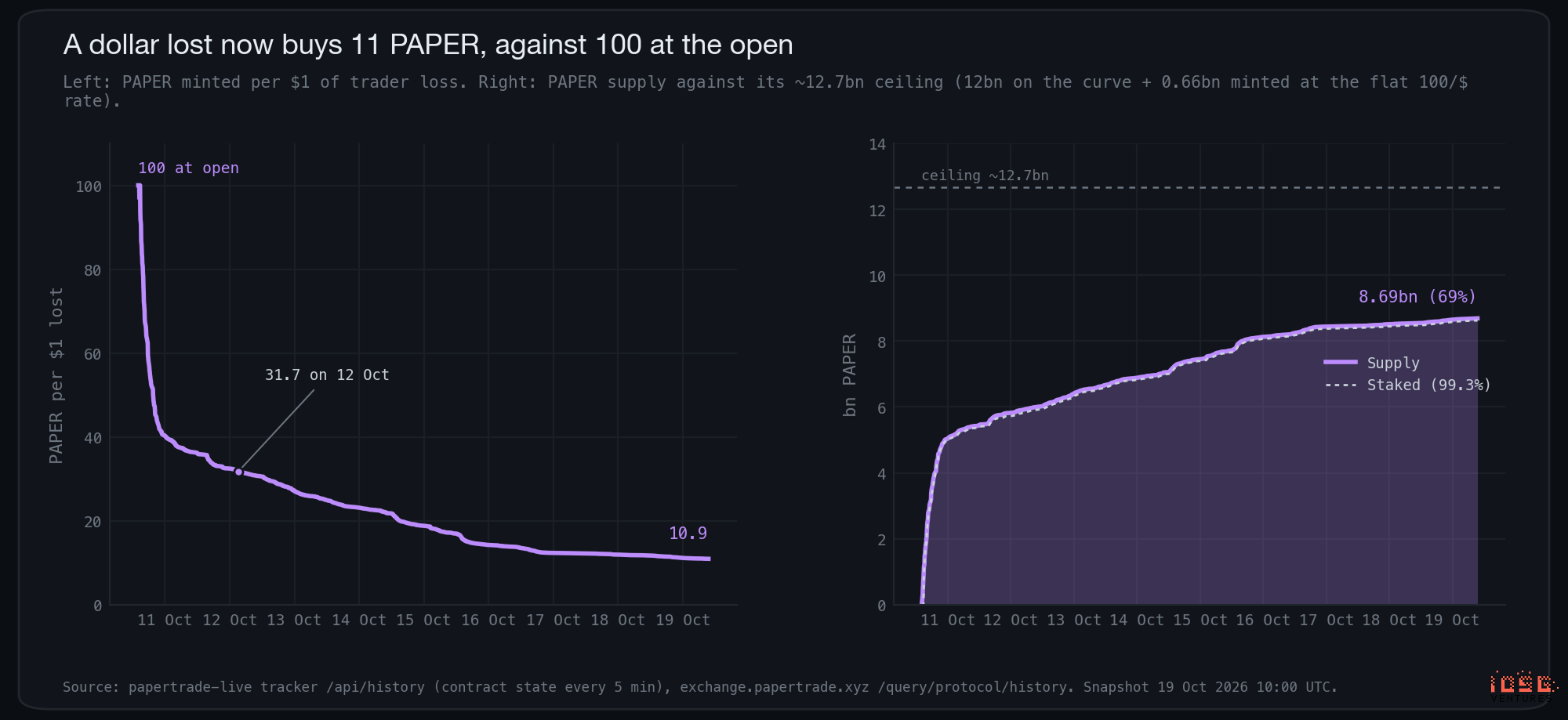
▲ PAPER mining rate and supply
Staking
Staking does not produce new tokens. The threshold is 1,000 PAPER, with no lock-up—deposit and withdraw at any time. PAPER still cannot be transferred, and 99.3% of it is staked. Distributions are paid in USDC, pro rata to staked amount each time, with no boost and no tiers.
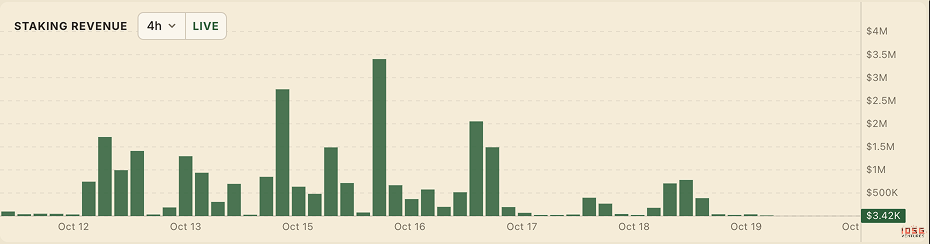
As for when stakers actually get paid, the documentation sets out three rules:
- Queued winners always come first. When the pool cannot pay a winner, the shortfall enters a FIFO queue, the pool's available cash for everyone else becomes 0, and both fee shares stop. New losses are recorded in a separate bucket earmarked for the queue. Until the queue is cleared, stakers get nothing. This has not happened yet.
- Overflow is swept in batches, not streamed in real time. A keeper calls pushStakerFees() to move anything above $5 million into the staking contract. Swept money leaves the pool and cannot be recovered by any future winner.
- Between sweeps, first come, first served. Winners are paid in the same transaction as their close; overflow waits for the next sweep.
Where the Rake Is Hidden
Beyond the 2% fee, the platform does not charge on notional. The rake is hidden in the liquidation rules and on the profit side:
- The liquidation line is 5bp early. At 1000x leverage, margin can withstand a 0.1% move, but liquidation triggers at roughly 0.052%, taking the entire margin.
- Profits first face a 0.2bp dead zone, then an "asymmetric impact" discount that bites harder the smaller the move. Under launch parameters, BTC winners keep at most 90% of their raw profit, about 88% on a 1% move, and only about 74% on a 0.1% move.
- The remaining profit is then charged a 2% fee.
Discounted amounts go to no one; they stay in the pool and overflow to stakers once it is full. A quick calculation: 100U, BTC, 1000x. A 5.2bp adverse move wipes out the 100U. A 5bp favorable move should earn 50U at fair value, but actually yields 30.4U. No parameter changes have been announced since launch.
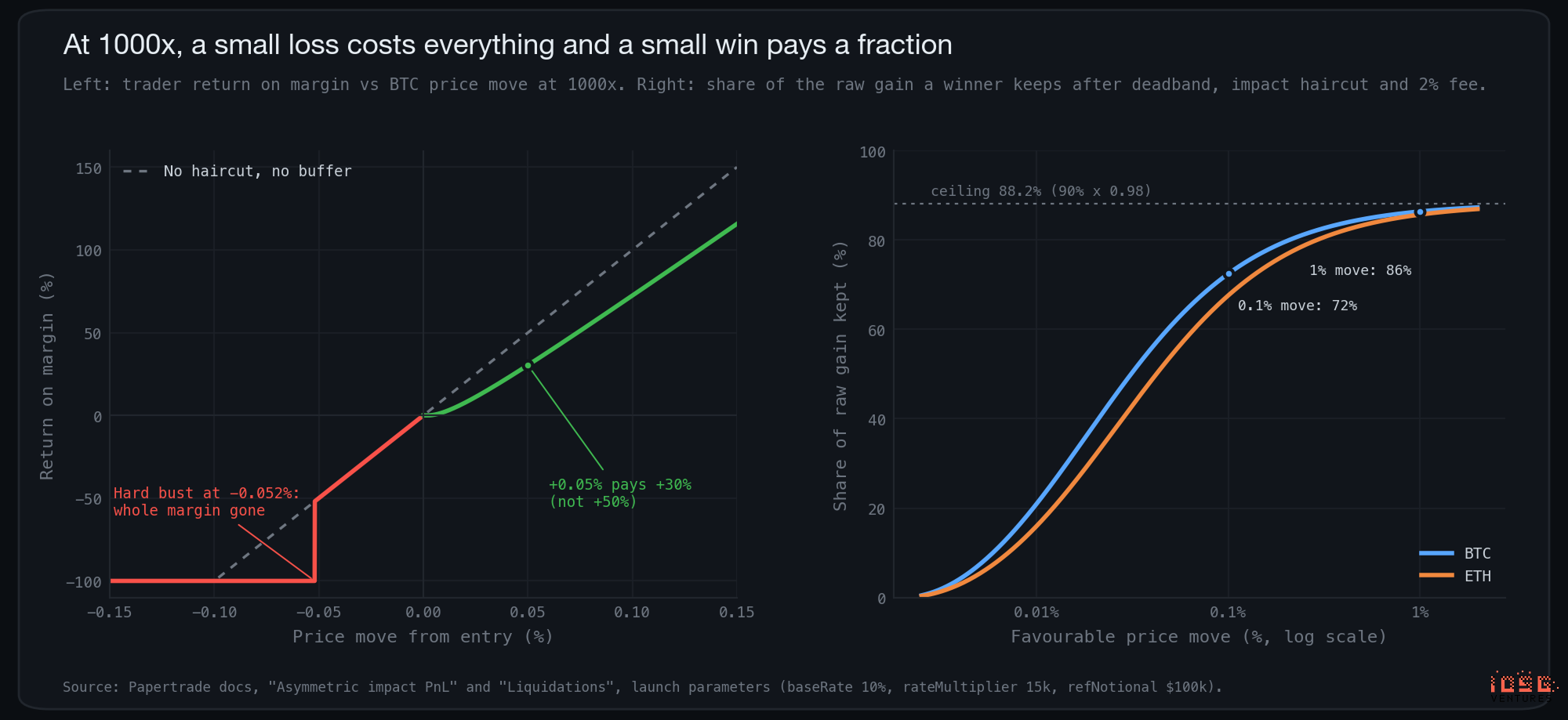
▲ P&L and profit retention at 1000x
Who Controls the Switches
Opening, closing, and staking all go through Papertrade's relayers; withdrawals do not, so users can always pull their money out directly. A 2-of-3 multisig can pause openings, delist markets, change position caps, minimum margin, and minimum order size, and adjust the impact curve and fee parameters. Contract upgrades have a 7-day timelock. Relayer ordering is "adaptive," with large orders prioritized.
The Numbers
Unless otherwise noted, all data is as of October 19, 10:00 UTC, 212 hours after launch.
How Much Real Money Is Behind $1.361 Trillion in Volume
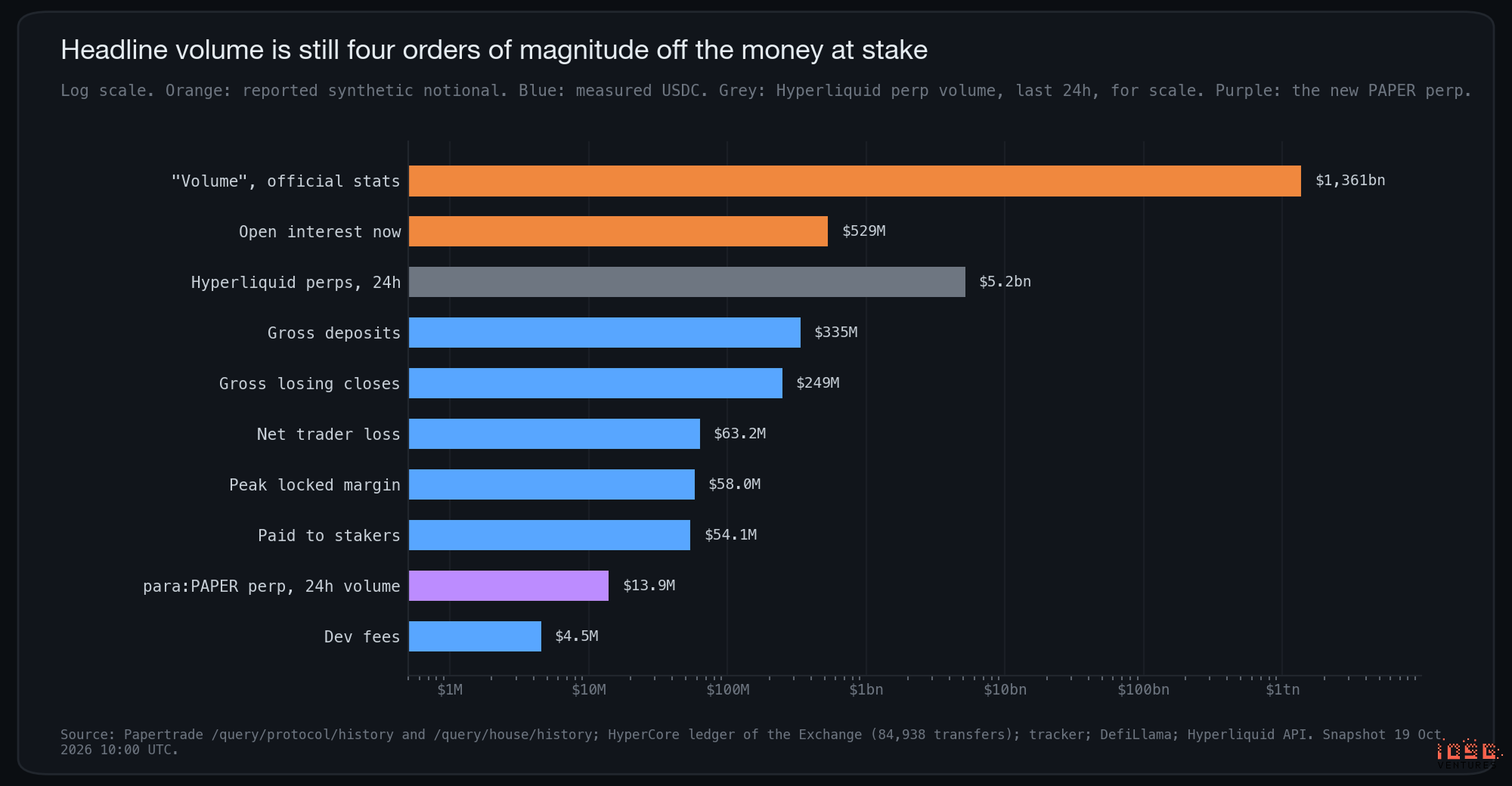
▲ Headline volume vs. actual USDC
Peeling it back layer by layer:
- $1.361 trillion, headline volume. It appears openings and closes are each counted once.
- $529 million in open interest, backed by $10.7 million in margin, averaging about 50x. On day one the average was about 160x.
- $335 million actually deposited, from about 23,000 addresses; $271 million withdrawn. Locked margin peaked at $58 million on day one.
- $249 million in losing closes, money that actually changed hands.
- $63.2 million in net trader losses—the only layer that can be distributed to stakers.
Net losses are about 0.46bp of headline volume. The team earned roughly $4.5 million in fees.
Where the $249 Million in Losses Went
Losing trades poured a cumulative $249 million into the pool. This is gross—all losing closes count, including the losing leg of wash trades, and PAPER is mined on this basis. It went four ways:
- $185 million (75%) was paid to winning trades, mostly the other leg of the same wash trades.
- $54.1 million (22%) was distributed to stakers.
- $4.7 million remains in the pool, just short of the cap.
- About $4.5 million (2%) went to developers.
Netting out the winners' share, traders are net down $63.2 million, 86% of which went to stakers.
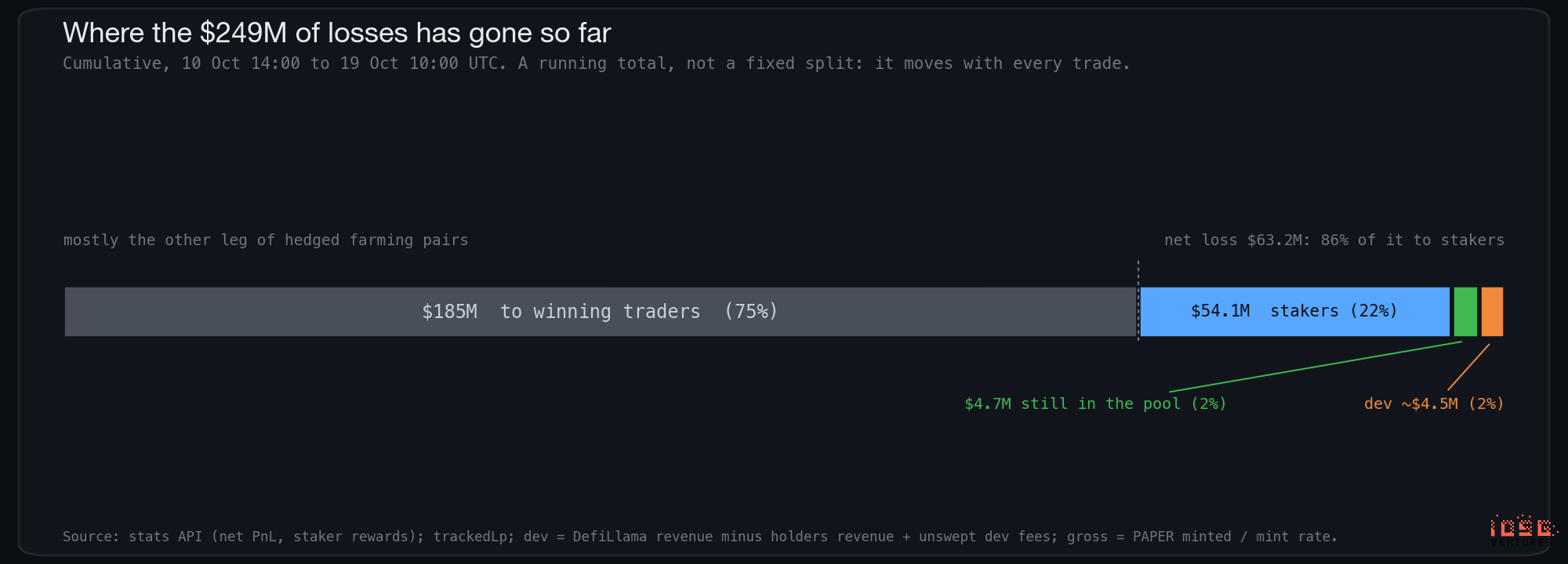
▲ Where the $249 million in losses went
Who Holds PAPER
16,198 wallets hold PAPER, of which 13,291 meet the 1,000-token staking threshold. Holdings are highly concentrated, and holders are the customers: the top 10 wallets hold 15%, the top 100 hold 52%, and the top 1,000 hold 88%. Those same 1,000 wallets bore 81% of the losses among all losing wallets and took 91% of the distributions.
Holders have lost an average of $0.0073 per PAPER, or just $0.0016 after distributions. At the perpetual price of $0.0243, 97% of the supply is in profit after accounting for distributions. Overall, traders lost $63.2 million, got back $54.1 million in cash, and hold PAPER worth $211 million at the perpetual price. That valuation only becomes money if someone buys, and right now no one can buy PAPER itself.
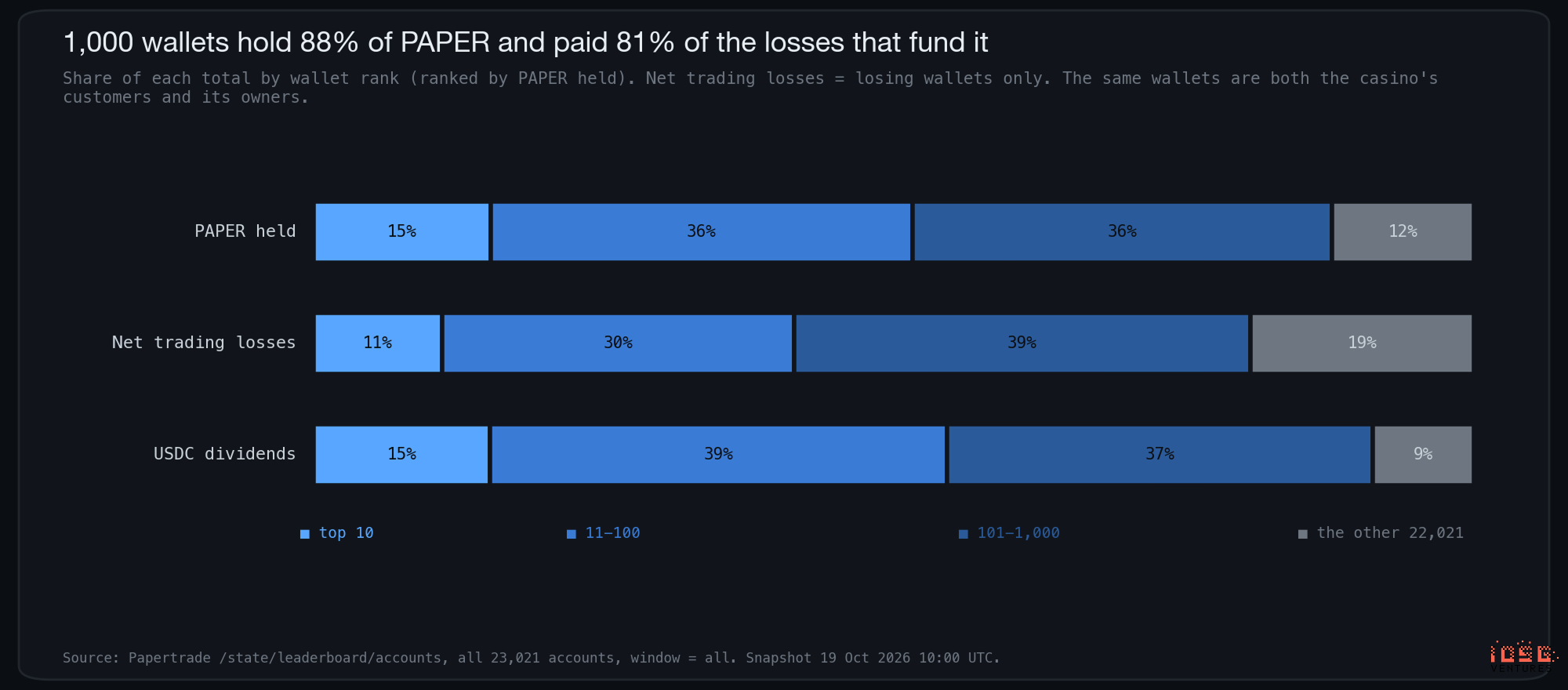
▲ Who holds PAPER
The Vault and the LP Are Not the Same Thing
The money in the vault is not the house's. It is all the USDC held by the Exchange contract, $63.1 million in total: about $47.6 million in traders' available balances, $10.7 million in margin locked by positions, $4.7 million in the LP, and $100,000 in developer fees not yet swept. Only the LP belongs to the house, about 7% of the vault. The vault fell from $138 million to around $60 million in the first two days, and has since stayed between $58 million and $69 million. Since October 12, the LP has stayed between $4.3 million and $5.2 million, with daily deposits and withdrawals roughly offsetting each other, $5 million to $26 million in each direction.
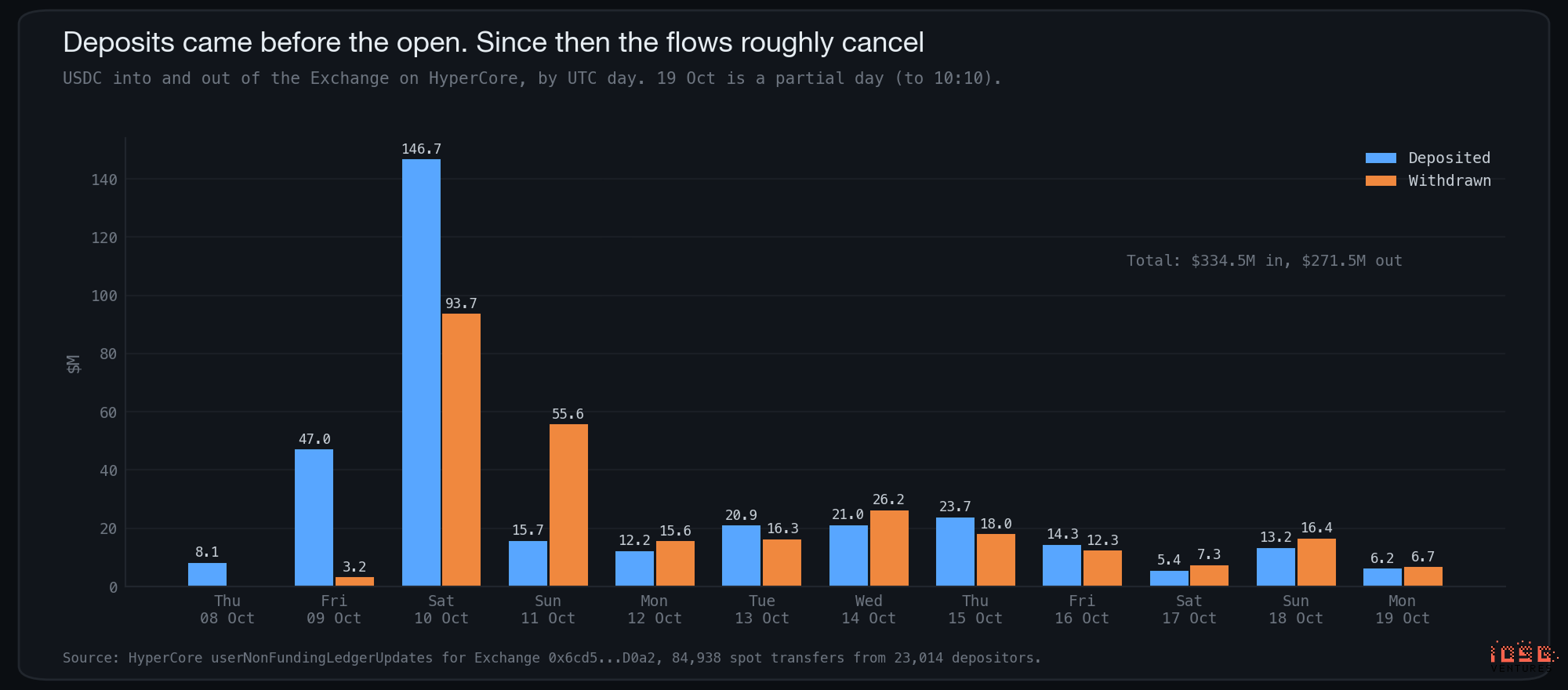
▲ Daily USDC deposits and withdrawals
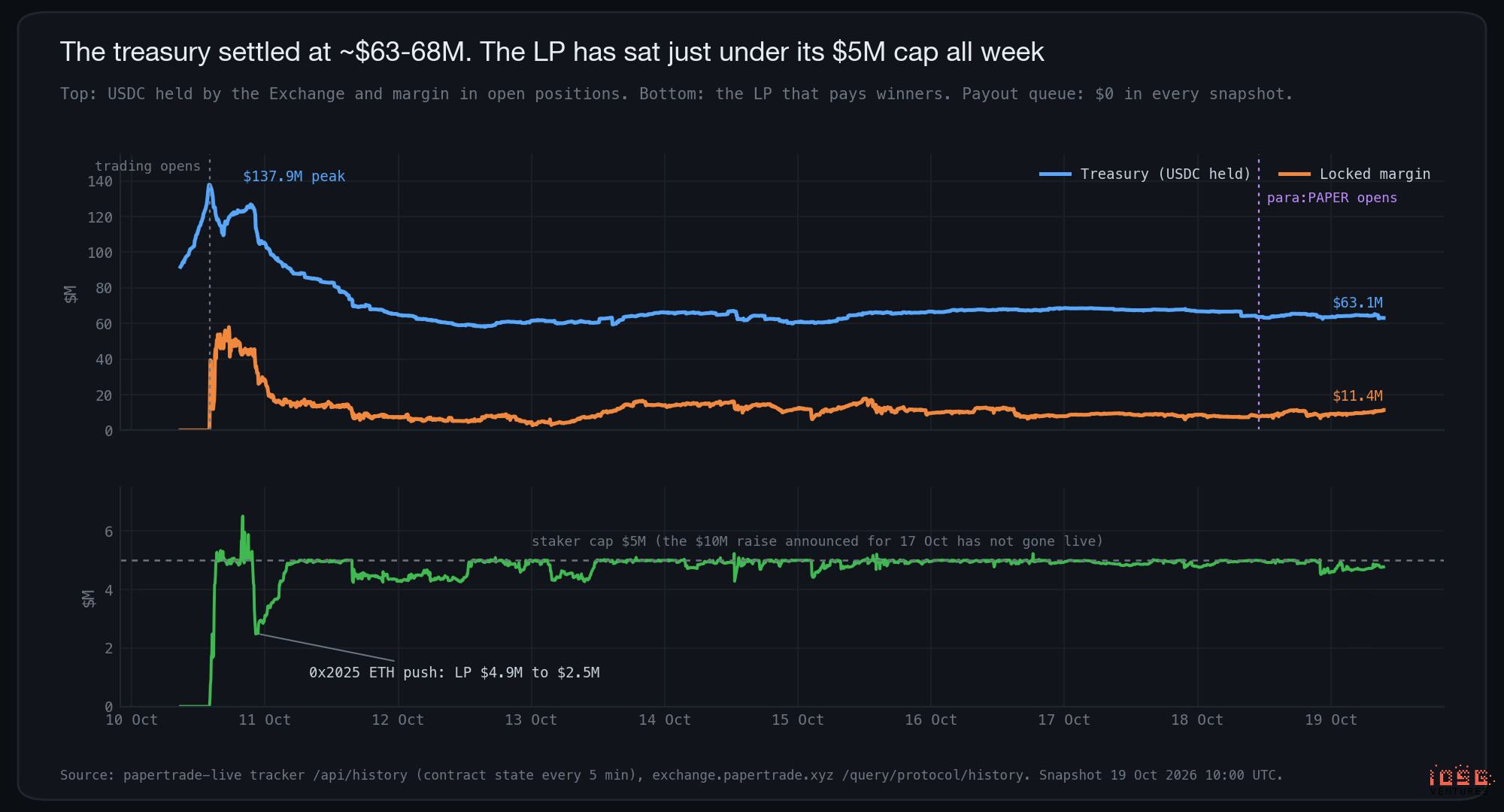
▲ Vault, locked margin, and LP
How Much Is Lost Each Day
Day one: $75 million in losing closes, $28.4 million net loss. On the 11th and 12th: about $20 million in gross losses and $4 million in net losses per day. Then the second wave: gross losses rose to $27 million on the 14th and $41 million on the 15th, with net losses of $4.5 million to $7.4 million per day from the 13th to the 16th. On the 17th it fell off a cliff, to $6 million gross and $700,000 net. On the 18th it recovered to $11.9 million gross and $2.2 million net, mostly after the perpetual opened.