

After the new car took to the skies, what did Tesla's first earnings report say?

Original | Odaily (@OdailyChina)
Author|Azuma (@azuma_eth)
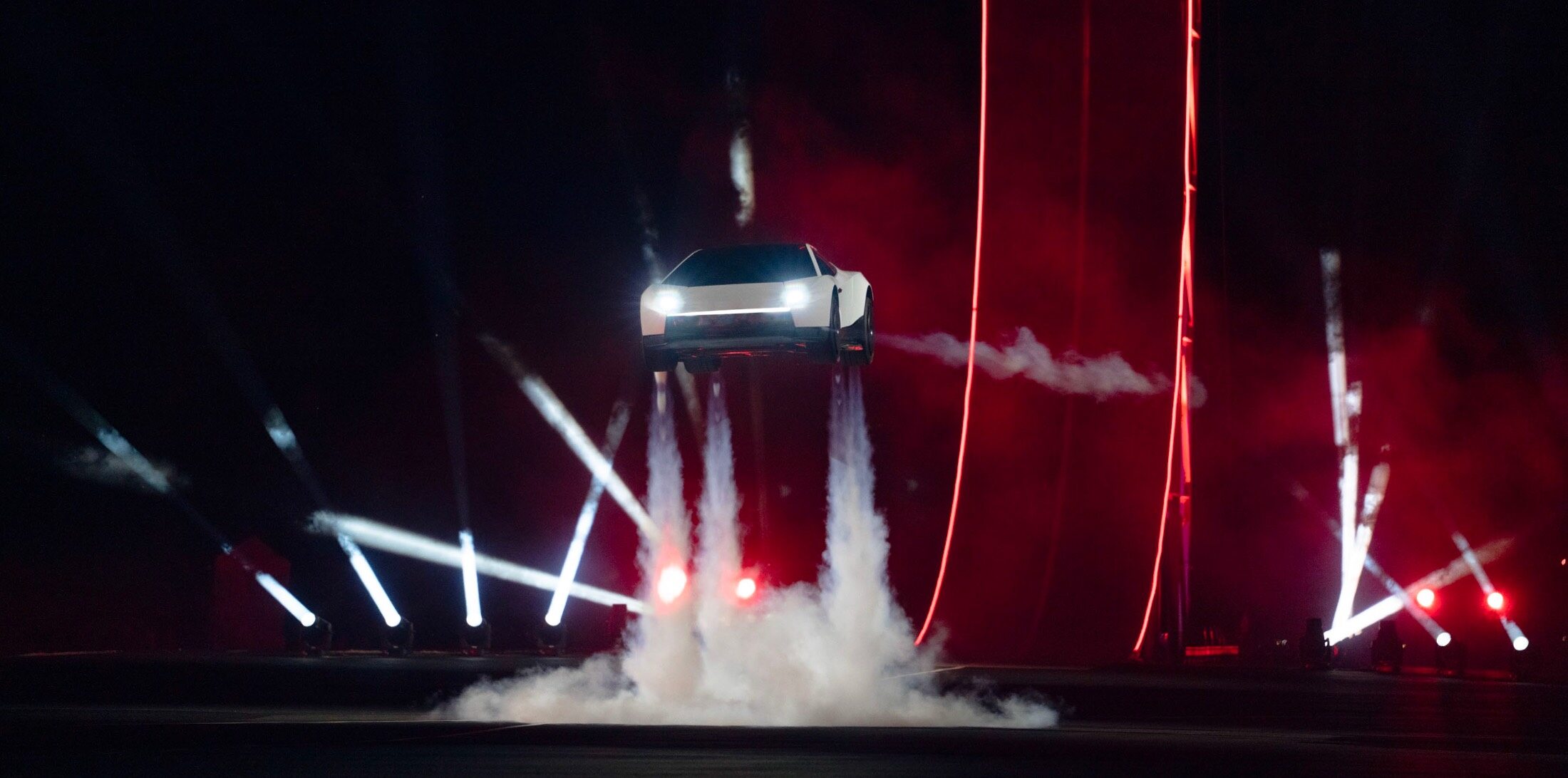
On October 15, Tesla once again refreshed the world's imagination of the automobile with a sci-fi-flavored flying Roadster demonstration in Texas.
Just six days later, a far more realistic report card was placed before investors — on October 21 local time, Tesla officially released its Q3 2026 financial results after the U.S. market close. The company posted quarterly revenue of $28.046 billion, essentially flat year-over-year; net income attributable to common stockholders was $787 million, down 43% year-over-year; adjusted earnings per share came in at $0.48, beating the market expectation of $0.43.
This is a report card that is not without bright spots yet harbors hidden expectation gaps. On one hand, automotive gross margin excluding credits climbed strongly, free cash flow broke Wall Street's pessimistic forecast of "massive cash burn" and turned positive again, and FSD and Robotaxi delivered rare quantitative progress; on the other hand, energy storage revenue unexpectedly stalled and dragged total revenue into stagnation, while elevated R&D and incentive expenses suppressed the operating margin to a low of 2.6%.
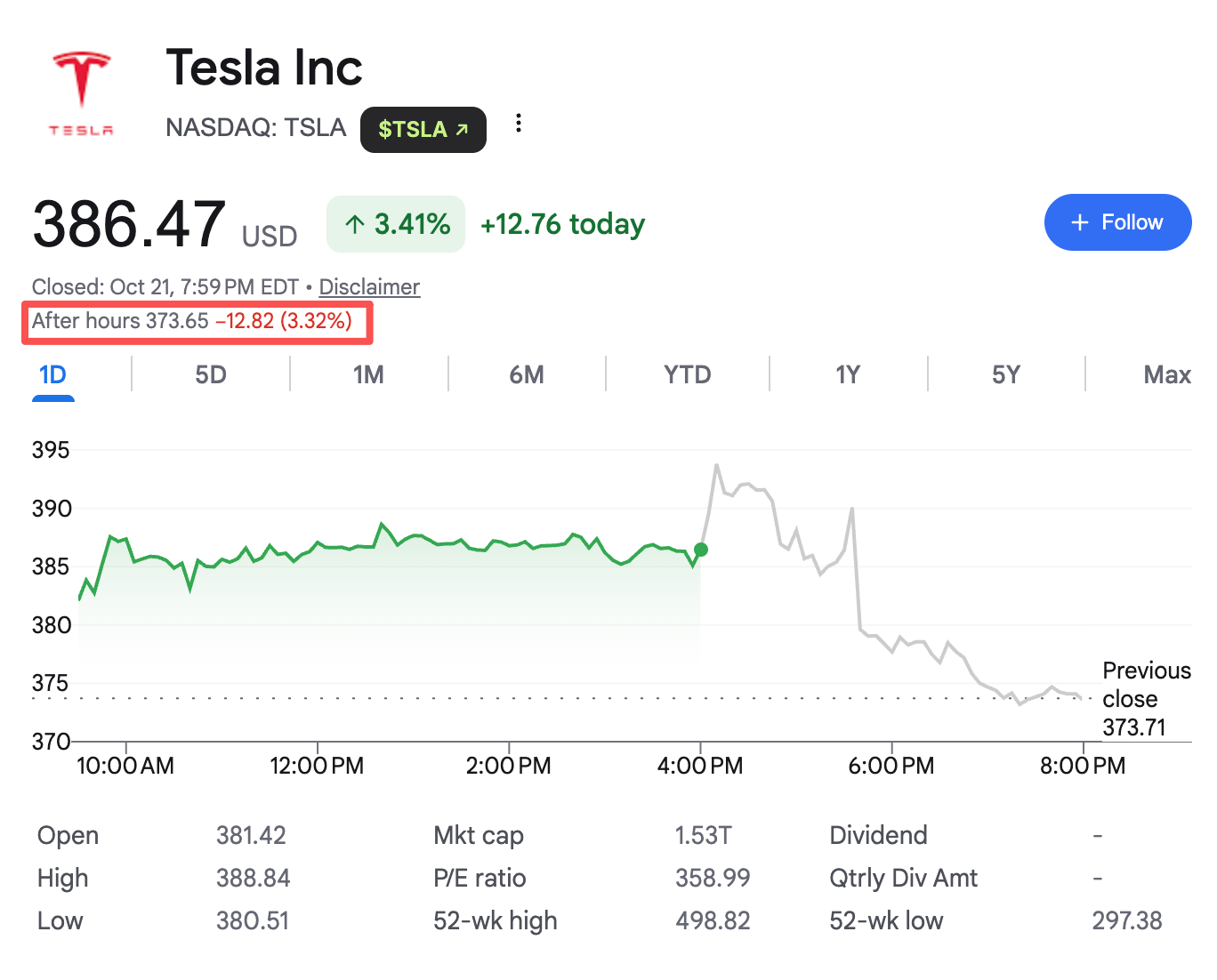
This contradiction was directly reflected in after-hours trading.At the initial release of the earnings, the market pushed the stock up more than 2% on the surprise of margin recovery and cash flow; but as the earnings call progressed, investors began to reassess the potential capex peak and profit realization cycle in Q4, and the stock turned from gains to losses, now down more than 3%.
After the Roadster pushed the narrative into the sky, what this earnings report truly warrants scrutiny is how far those future imaginations, not yet fully realized, remain from becoming a business that can sustain itself.
Revenue Essentially Flat, but Profit Fell 40%
Let's start with the core operating foundation.
In Q3, Tesla posted total revenue of $28.046 billion, almost flat versus $28.095 billion a year earlier and slightly below the market expectation of $28.13 billion; but operating income was halved from $1.624 billion a year earlier to $718 million, a year-over-year plunge of 56%; the operating margin slid further from 5.8% to 2.6% — in other words, for every $100 of revenue Tesla generated, it ultimately retained only $2.6 in operating profit.
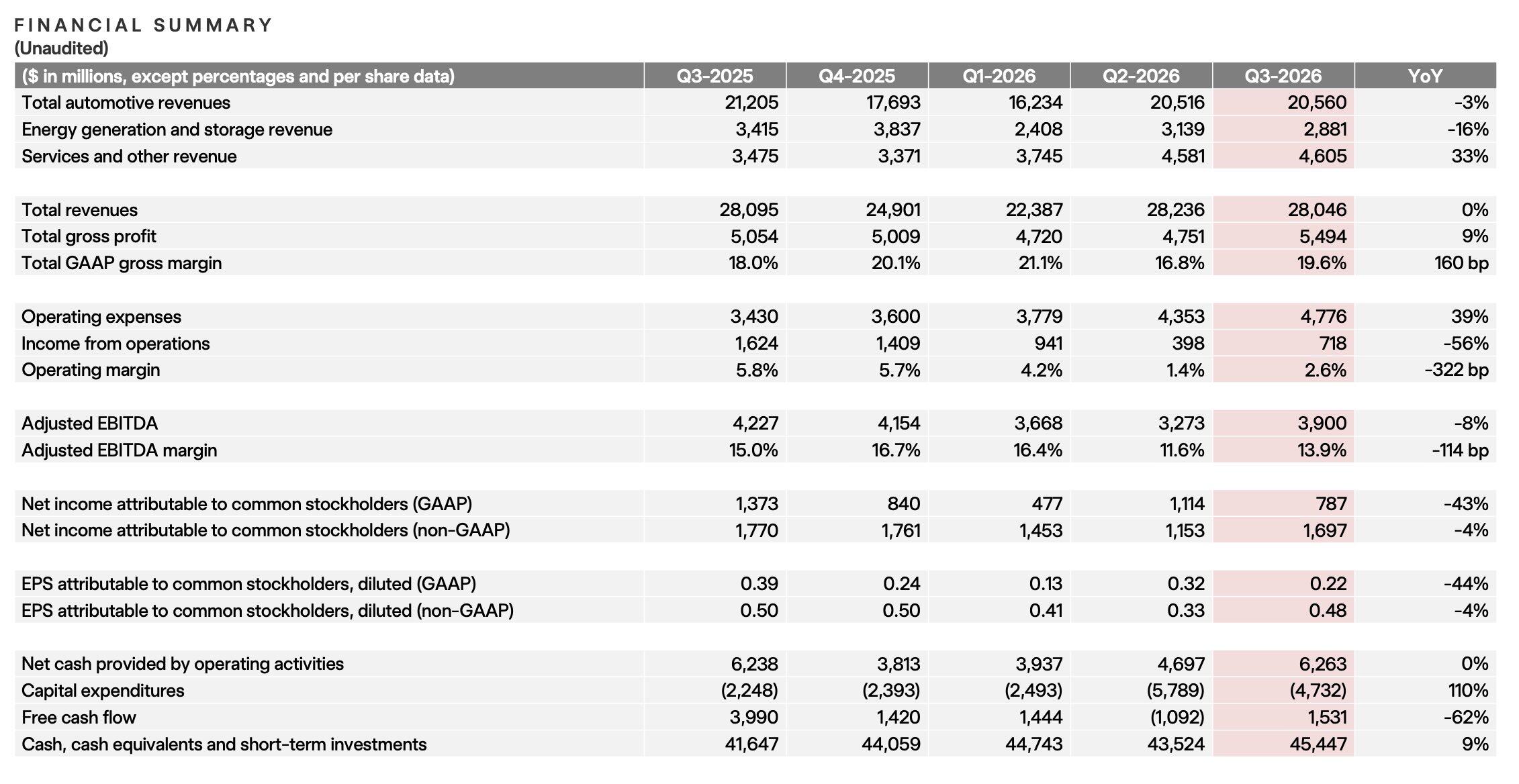
The stagnation in revenue can be explained by the revenue structure. In Q3, automotive revenue was $20.56 billion, down 3% year-over-year; energy generation and storage revenue was $2.881 billion, down 16% year-over-year, making it the biggest drag on quarterly revenue; services and other revenue was $4.605 billion, up 33% year-over-year. While the growth in services is noteworthy, it is not yet enough to offset the revenue decline in automotive and energy.Tesla still needs to rely on the automotive business to support overall revenue, while both vehicle deliveries and average selling price are currently under pressure.
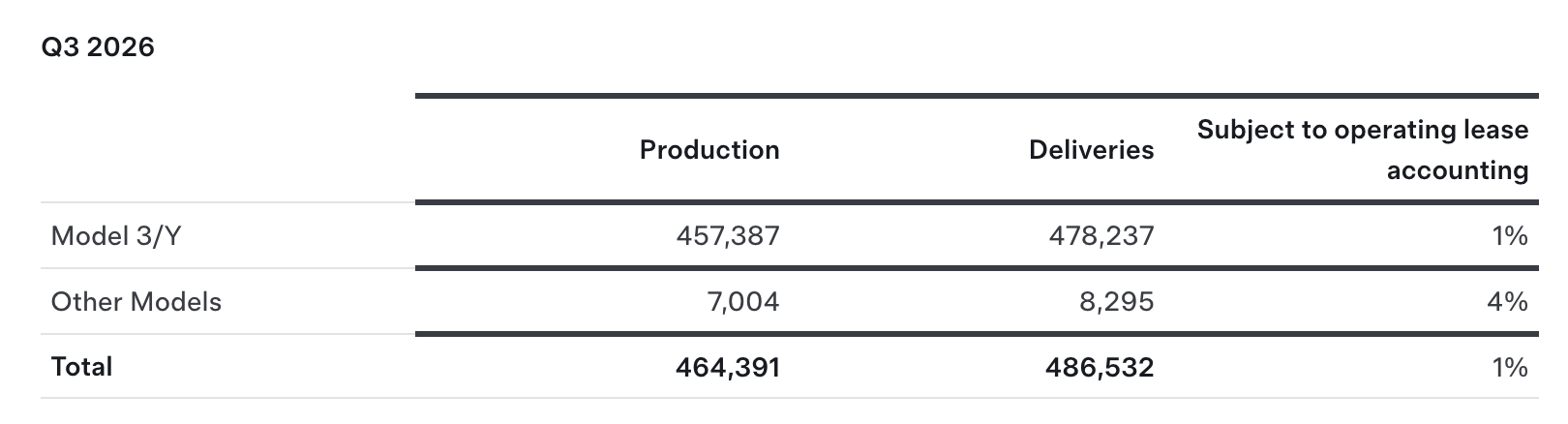
In delivery data published on October 2, Tesla had disclosed that it delivered 486,500 vehicles in the quarter, down about 2% year-over-year. Among them, Model 3/Y deliveries were 478,200 units, down 1% year-over-year; other models delivered 8,295 units, down 48% year-over-year.
Although deliveries declined, Tesla's gross profit performance this quarter was quite encouraging.In Q3, Tesla's total gross profit reached $5.494 billion (up 9% year-over-year), and total gross margin recovered to 19.6%, a sharp rebound from 16.8% in Q2.The metric the market watches most closely — automotive gross margin excluding regulatory credits — jumped from 16.3% last quarter to 18.1% (versus 15.4% a year earlier) — Tesla's regulatory credit revenue in Q3 was only $113 million, down 73% year-over-year. Without relying on "selling carbon credits" to dress up the picture, Tesla managed to withstand the downward pressure on average selling price (ASP) through regional product mix optimization and scaling of FSD software subscriptions.
Gross profit rose significantly, so why did profit still fall sharply?The real black hole devouring profit lies in sharply swelling operating expenses (OpEx) and non-operating P&L adjustments.In Q3, Tesla's operating expenses reached $4.776 billion, surging 39% year-over-year. Among them, R&D expenses soared from $1.630 billion a year earlier to $2.761 billion, an increase of nearly 70%; selling, general and administrative (SG&A) expenses also rose to $2.015 billion.
Moreover, comparing the huge gap of nearly $910 million between GAAP net income ($787 million) and non-GAAP net income ($1.697 billion) makes the accounting logic even clearer.
- Heavy stock-based compensation (SBC): The quarter accrued as much as $1.165 billion in stock-based compensation expense (after-tax impact of $982 million, or $0.28 per share), including amortization of the 2025 CEO performance incentive plan;
- Fluctuations in investment fair value: The SpaceX equity investment that contributed more than $1 billion in pre-tax unrealized gains to Tesla in Q2 recorded an unrealized loss of $142 million this quarter (after-tax impact of $108 million), partially offsetting the $288 million in unrealized gains from digital assets (after-tax $224 million).
This fully explains the profit puzzle of Q3: Tesla's gross profit foundation is thickening, but it is pouring every bit of incremental gross profit it earns, together with hefty R&D and talent incentives, into future battlefronts.
Free Cash Flow Turns Positive, but Bigger Spending May Lie Ahead
Looking only at the GAAP income statement, this report card remains heavy, but the cash flow performance delivered a huge "expectation gap" to the market.
Before the earnings release, due to negative free cash flow in Q2 (-$1.092 billion), combined with high-intensity AI infrastructure investment, Wall Street unanimously expected Tesla's Q3 free cash flow to deteriorate to -$4.5 billion to -$4.99 billion.However, the actual result was that Tesla's Q3 operating cash flow reached as high as $6.263 billion, and free cash flow not only did not collapse but came in at positive $1.531 billion.Cash, cash equivalents and short-term investments at period end climbed to a total of $45.447 billion, a net increase of about $1.9 billion quarter-over-quarter.

While holding a massive $45.4 billion in cash, Tesla's on-book interest-bearing debt and finance lease liabilities total only about $9.5 billion (of which the current portion is $1.387 billion and the non-current portion is $8.136 billion, with the vast majority being non-recourse debt). This extremely robust balance sheet is Musk's greatest confidence for daring to fight on multiple fronts.
But why did Wall Street quickly calm down after the surprise? Because the free cash flow beat largely stemmed from "money originally planned to be spent in Q3 not yet being fully spent" — in Q3, Tesla's capital expenditure (CapEx) was $4.732 billion. Although this figure surged 110% year-over-year, it retreated from $5.789 billion in Q2 and was far below the market's prior estimate of $7.77 billion.
Previously, Tesla management's full-year 2026 capex guidance was "more than $25 billion." If this full-year target is not lowered, it means Tesla would need to spend about $12 billion in Q4 alone — nearly 2.5 times Q3 spending.Therefore, the positive free cash flow in Q3 looks more like a pacing breather than the end of the capex peak.As long as this ten-billion-dollar infrastructure bill remains queued up ahead, the sword of Damocles over cash flow will still hang overhead.
FSD and Robotaxi: Finally Delivering Hardcore Quantitative Results
If the vehicle business determines Tesla's operating floor, then autonomous driving is the core pillar supporting its dynamic P/E ratio of more than 200x. In this earnings report, Tesla unusually disclosed a number of highly persuasive quantitative operating metrics.
First is the leap in FSD (Supervised) monetization capability. In Q3, Tesla's global active FSD subscribers reached 1.74 million (including one-time purchases and monthly subscriptions, excluding free trials), surging 67% year-over-year and above 1.48 million in Q2 and the market expectation of 1.57 million. The more critical metric is the North American market — as the most mature base, FSD's attach rate in North American new vehicle deliveries has exceeded 75%, up nearly 20 percentage points quarter-over-quarter.

On overseas regulatory breakthroughs, since the end of Q2, Tesla has obtained approvals in four countries: Croatia, Slovenia, the Czech Republic and Slovakia. FSD is now live in 9 EU countries, with more than 100,000 active users in Europe and cumulative driving mileage exceeding 160 million kilometers. FSD is no longer a novelty toy for a handful of geeks, but a genuine software cash cow capable of driving vehicle sales and thickening per-vehicle gross profit.
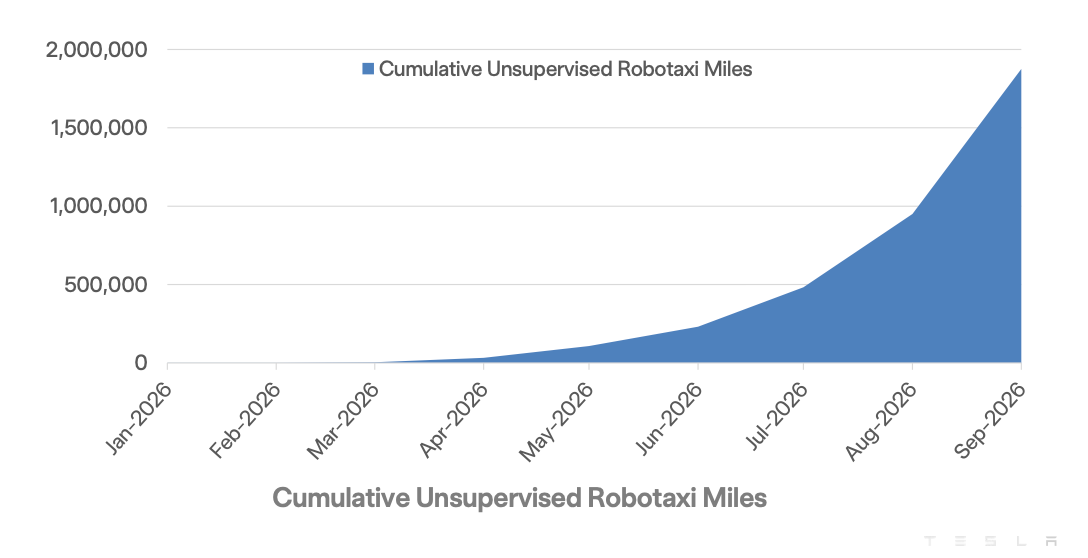
Second is Robotaxi formally entering an unsupervised real-world operating cycle. The earnings report confirmed that on September 3, Tesla officially added the steering-wheel-free Cybercab to its Robotaxi commercial fleet in Austin, Texas. By the end of Q3, Robotaxi's cumulative unsupervised driving mileage had approached 2 million miles, and driven by sustained double-digit weekly growth, quarterly mileage surged 8x quarter-over-quarter.
Currently, Austin operations cover 6 a.m. to midnight. At the same time, Tesla has deeply embedded the AI assistant Grok into the Cybercab, allowing passengers to invoke Grok Bot and Connectors via full voice interaction and handle email inboxes, calendars, work files, chats and scheduling tasks hands-free. Tesla is attempting to reconstruct the Cybercab from a mere mobility tool into a "mobile office" and "second living room."
From early closed-road testing to routine operations on the streets of Austin today, Robotaxi has crossed the proof-of-concept stage. But as Morgan Stanley noted in its pre-earnings report, fleet size and mileage expansion are only the first step. What will determine whether this business can support a trillion-dollar valuation is per-vehicle utilization, safety records under extreme road conditions, and the unit economics after deducting depreciation and O&M costs.
Energy Business: Beneath the Surface of Revenue Decline Lie 33% High Gross Margin and Historic Orders
Looking back at this quarter's most market-surprising "underperformer" — the energy generation and storage business — its performance actually presents a strong case of "appearance versus reality."
On the surface, revenue of $2.881 billion (down 16% year-over-year) indeed fell well short of Wall Street expectations, but digging into operating details reveals that this was not caused by shrinking downstream demand.
- Deployments continue to grow: Q3 energy storage product deployments reached 13.7 GWh, up 10% year-over-year and a slight increase from 13.5 GWh in Q2;
- Refunds disrupt revenue recognition: Management explicitly stated that the quarterly revenue decline was partly due to tariff-related customer refunds and changes in average product prices;
- Gross margin surged against the trend: The energy business generated gross profit of about $954 million in Q3, with a gross margin as high as 33.1%, not only far above the vehicle business but also a leapfrog recovery from about 20.4% in Q2.
Even more forward-looking is the order reservoir. Tesla emphasized in the earnings report that in Q3, both the order rate and backlog for energy storage products hit all-time records.
Capacity expansion and supply chain localization are also accelerating in tandem. The Texas Megafactory, with planned annual capacity of up to 50 GWh, has officially begun production; meanwhile, Tesla has shipped the first batch of Megapacks assembled entirely with LFP (lithium iron phosphate) cells produced in-house in Nevada, a key step toward reducing dependence on external cells and avoiding tariff barriers.
In terms of narrative logic, the energy storage business is becoming deeply tied to AI computing infrastructure. As global tech giants frantically expand large AI data centers, grid capacity bottlenecks and peak load oscillations have become the biggest constraints on computing deployment, and Megapack happens to be a ready-made solution that can fastest supplement grid power and smooth the peak-valley electricity use of computing centers.As long as the logic of data centers lacking power remains unchanged, short-term fluctuations in quarterly delivery pace are unlikely to shake the long-term quality of energy storage as Tesla's "second growth curve."
Optimus, Semi and Roadster: New Stories Begin Rolling Off the Line
The most future-significant information in the earnings report is: how far along are the many "big promises" Musk has drawn?
- Optimus (humanoid robot): Tesla announced that the high-capacity production line at its Fremont, California factory has begun producing the first batch of Optimus robots that meet "production-quality standards." The official framing is that although hardware and processes will continue to iterate, "the current manufacturing process has proven fully applicable to commercial products." The Fremont line is currently in the early ramp stage, while the Optimus line at the Texas factory is under construction. Although the earnings report has not yet disclosed specific output or commercial revenue, moving from laboratory prototypes to standardized production lines remains a key watershed for the real-world deployment of physical AI hardware.
- Tesla Semi (electric heavy truck): The high-volume Semi line at the Nevada factory, with planned annual capacity of 25,000 units, officially began volume production in Q3. The top-spec Semi can achieve 500 miles of range at a fully loaded gross vehicle weight of 82,000 pounds, with energy consumption as low as 1.7 kWh per mile, and energy costs only one-third of comparable diesel heavy trucks. To support Semi deliveries, the first factory-preassembled Megacharger supercharging station has also been deployed.
- Next Gen Roadster (flying sports car): Although the flying demonstration on October 15 grabbed plenty of attention, in the earnings report's production status table, the Roadster's location is still marked "TBD," and its status remains at the "design development" stage. As outsiders joke, "the one that can fly can't go on the road, and the one you can buy can't fly yet." This car, which Tesla calls "the last and best human-driven car," is clearly in the near term only a catalyst to elevate the brand's technological totem, not a source of incremental revenue in the financial statements.
Using Old-World Cash Flow to Feed New-World Ambition
If this earnings report were to be summed up in one sentence, it might be: "Tesla is using old-world cash flow to feed new-world ambition."
On the books, Tesla still has to confront the reality of pressured average vehicle prices, a 40% decline in GAAP net income, and an operating margin that has fallen to 2.6%; but beneath the surface, an 18.1% automotive gross margin excluding credits proves the resilience of its manufacturing foundation, a $45.4 billion cash reserve provides ample luxurious room for error, and a 75% North American FSD attach rate on new vehicles plus nearly 2 million miles of unsupervised Robotaxi mileage are making the footsteps of physical AI commercialization increasingly clearly heard by the market.
Technology demonstrations can instantly ignite imagination, and production line launches can prove engineering and manufacturing capability, but the capital market ultimately recognizes only the real money delivered in the income statement and cash flow statement.
The Roadster has already flown into the sky. Next, the real test left for Musk and Tesla is how, amid the ten-billion-dollar capex peak in Q4 and the next two years, to make Robotaxi, energy storage and robots truly run through a commercial closed loop and steadily withstand the gravitational pull of that 200x valuation.