


US Stocks Daily | Oil closes at $116, a six-month high; Dow falls 653 points (October 24)

1. Top Stories
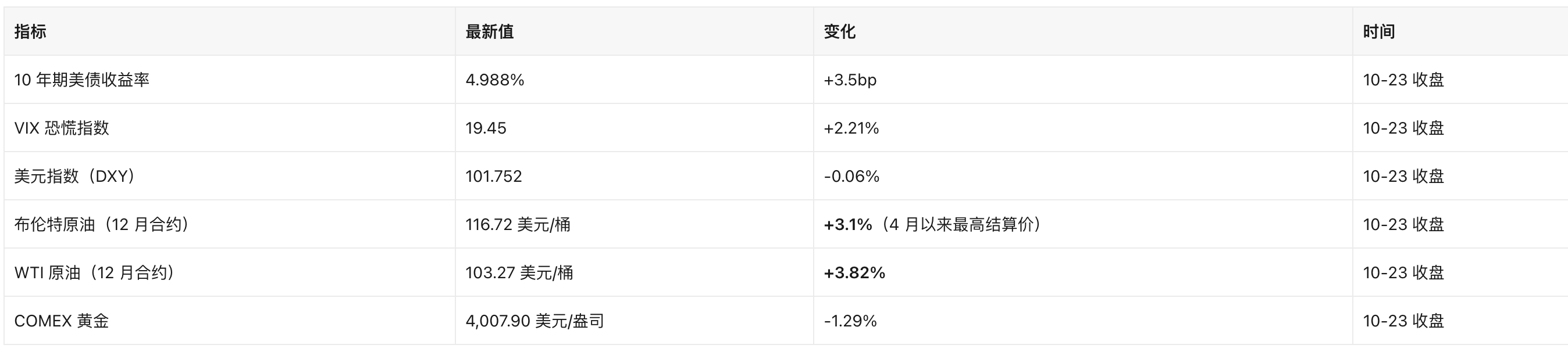
- Oil prices take over as the main source of pressure: Brent crude December contract settled at $116.72/barrel, up 3.1%, the highest settlement since April; WTI settled at $103.27, up 3.82%. Houthi attacks and Middle East supply disruptions combined with expectations of escalating US-Iran conflict directly drove up inflation concerns and long-end rates (Sources: Reuters, WSJ, Barron's, Yahoo Finance market data).
- Index declines narrowed but structural divergence was pronounced: The Dow fell 652.82 points (-1.23%) to lead losses, the S&P 500 fell 0.52%, the Nasdaq fell just 0.21%, and the Philadelphia Semiconductor Index rebounded 0.44%. Barron's described it as "the AI selloff cooled on Friday, but the indices still closed lower"—capital withdrew from financials, industrials, and consumer sectors and rotated into energy (Sources: Barron's, Yahoo Finance).
- American Express announced 3,500 layoffs (about 5% of staff), citing AI-driven efficiency gains as one reason; the stock fell 3.67%, making it one of the Dow's worst-performing heavyweight components. The market is concerned about white-collar job cuts transmitting to consumer credit (Sources: New York Post, Yahoo Finance, Fast Company, October 23).
- Jobs data remained strong, weakening rate-cut expectations: Initial jobless claims came in at 194,000, below the 200,000 forecast; continuing claims were 1.728 million, above expectations; the 10-year Treasury yield rebounded 3.5bp to 4.988% (Sources: Nasdaq Economic Calendar, Yahoo Finance).
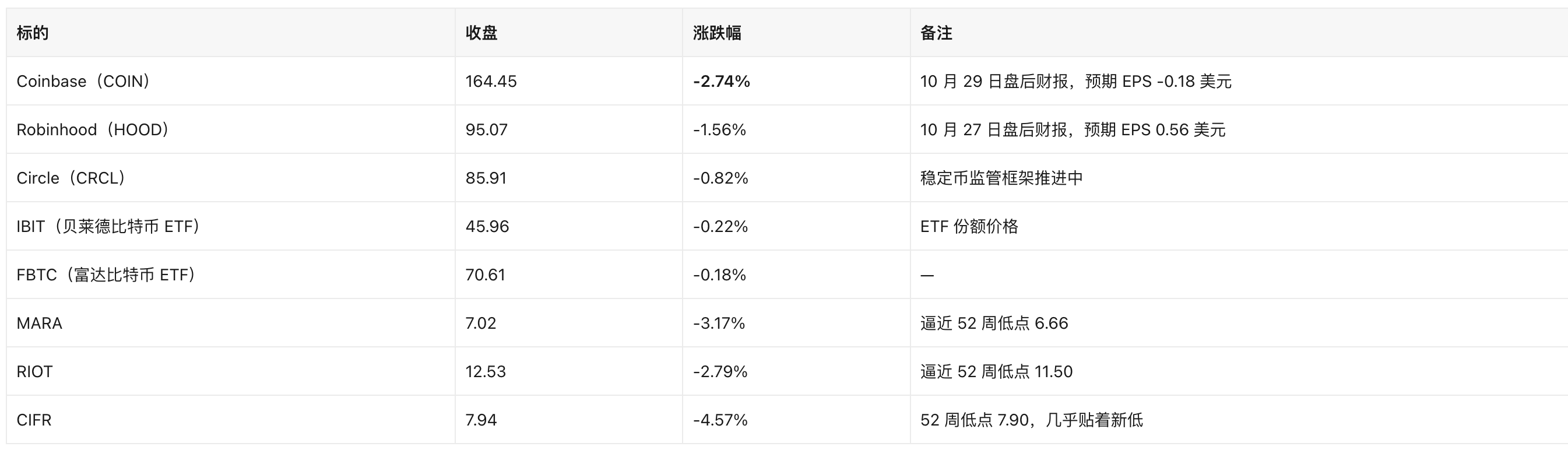
- Crypto sector diverged against the trend: MSTR edged up 0.14% to $146.01, with market cap/holdings at about 0.90x (roughly a 10% discount); COIN fell 2.74%, and miners dropped 3%-5%; US spot Bitcoin ETFs saw net outflows of $635.6 million on Thursday, the largest single-day outflow in October (Sources: Yahoo Finance market data, Decrypt, The Block).
2. US Stock Market and Macro
Three Major Index Closes (US Eastern, 2026-10-23 16:00)

Source: Yahoo Finance market data
Trend characteristics: The three major indices closed lower for a second consecutive day, but the declines narrowed significantly—on Thursday the Nasdaq fell 2.60% and the Philadelphia Semiconductor Index fell 6.72%, while on Friday the SOX rebounded 0.44% and the Nasdaq fell only 0.21%. The real divergence was in the Dow: the -1.23% decline was mainly driven by financials (AXP -3.67%, GS -1.75%, JPM -1.47%, V -1.55%), industrials (CAT -2.42%), and consumer (NKE -2.66%), while energy giants XOM +2.79% and CVX +2.88% (approaching its 52-week high of 233.74) propped up the S&P.
This week's leadership rotation: The Dow rose 0.41% for the week, the Nasdaq fell 0.71%, and the SOX fell 3.21%—after the "AI capex trade" cooled, capital did not leave the market but rotated into energy and defensives, with oil prices becoming the new pricing anchor.
Sector Performance (October 23, SPDR Sector ETFs)

Source: Yahoo Finance market data. Note the complete reversal from Thursday: Thursday saw consumer staples lead gains and semiconductors crash, while Friday saw energy stand alone at the top and consumer play catch-up on the downside
Rates, Dollar, and Commodities
Source: Yahoo Finance market data
Transmission logic: Rising oil prices → higher inflation expectations → rebounding long-end rates (10Y +3.5bp) → pressure on high-valuation growth stocks and valuation compression in financials and consumer. Notably, gold fell 1.29% in tandem—under the combination of rising real rates and tighter dollar liquidity, safe-haven capital did not flow into gold, which also explains BTC's synchronized weakness.
Macro Data and the Fed
Data released October 23 (US):
- Initial jobless claims: 194,000 (forecast 200,000, previous 200,000)
- Continuing claims: 1.728 million (forecast 1.720 million, previous 1.703 million)
- Conference Board leading index: 0.0% (forecast -0.1%, previous -0.1%)
- Kansas City Fed manufacturing composite index: 11 (previous 14)
Source: Nasdaq Economic Calendar. The data was broadly strong and does not justify a rate cut.
The Fed: According to the FOMC calendar on the Fed's official website, the October meeting is October 27-28, with the decision and press conference to be released on October 28 at 14:00 (US Eastern). This meeting does not include a Summary of Economic Projections (SEP). The current federal funds target range is 3.75%-4.00% (effective after the 25bp hike at the September 16 meeting), and the market consensus expects the rate to remain unchanged at 4.00% this time.
Correction: Some third-party calendars label this decision as October 29, which does not match the Fed's official website; this report follows the official website.
3. Hot Stocks and Sectors
Energy: The Only Certain Winner
- ExxonMobil (XOM) closed at $183.21, +2.79%, approaching its 52-week high of 183.75; Chevron (CVX) closed at $233.21, +2.88%, hitting a 52-week high.
- Logic: Strong spot prices—Brent at $116.72 and WTI at $103.27—directly improve upstream cash flow; meanwhile, the US again tapped its Strategic Petroleum Reserve (SPR) to counter supply disruptions, indicating the physical market is tight rather than speculative (Sources: OilPrice, October 23; Yahoo Finance market data).
- Risk: Oil prices have already priced in a substantial geopolitical premium; if signs of US-Iran negotiations emerge, the pullback could be equally sharp.
American Express (AXP): AI Layoff Narrative Hits Financials for the First Time
- Closed at $313.22, -3.67%, one of the Dow's worst-performing heavyweight components (CAT -2.42% and GS -1.75% also came under pressure).
- Event: The company plans to cut about 3,500 positions (roughly 5% of staff), its first major contraction in two years, and media widely linked it to AI-driven efficiency gains (Sources: New York Post, Yahoo Finance, Fast Company, October 23).
- Market interpretation: On one hand, cost improvement; on the other, concerns about "consumer spending and employment expectations among high-income customers"; in a sensitive period for consumer credit, investors traded the latter first.
Semiconductors: Stopped Falling but Not Recovered
- Micron (MU) +2.46%, AMD +1.74%, Intel (INTC) +1.72%, Qualcomm (QCOM) +1.78%, TSMC (TSM) +1.49%; Nvidia (NVDA) still fell 0.59% to $210.96, and Broadcom (AVGO) -0.48%.
- Structure: The rebound was concentrated in memory and CPUs, with the GPU leader not participating; Western Digital (WDC) bucked the trend and fell another 2.97%, showing divergence within memory.
- Background: After the SOX plunged 6.72% in a single day on Thursday, Friday was merely a technical repair, and the index still fell 3.21% for the week. The debate over the "return cycle" of AI capex is not over, and next week's Microsoft, Google, and Amazon earnings are the first verification hurdle (Sources: Yahoo Finance market data; Reuters "Wall St Week Ahead," October 23).
Mega-Cap Tech: Waiting Ahead of Earnings
- Microsoft (MSFT) +0.66% to $524.51, with earnings due after the close on October 28; Apple (AAPL) -0.14%; Google (GOOGL) -1.24%; Amazon (AMZN) -0.95%; Tesla (TSLA) -0.63%; Meta (META) -0.96%.
- Interpretation: After Meta's post-earnings plunge on Thursday, mega-cap tech entered a "wait-for-earnings" mode on Friday, with volatility compressing but direction undecided.
Sectors Under Pressure: Industrials and Consumer
- Caterpillar (CAT) -2.42%, Nike (NKE) -2.66%, UnitedHealth (UNH) -1.62%, Visa (V) -1.55%, Goldman Sachs (GS) -1.75%, JPMorgan (JPM) -1.47%.
- Common thread: Dual sensitivity to rates and consumption. With the 10Y back at 4.99%, names with "rate sensitivity + peak-demand concerns" were the first to be trimmed.
4. Crypto-Related US Stocks (Crypto-Equity)
DAT Leader: Strategy (MSTR)
Holdings and Cost (SEC 8-K, disclosed October 19, 2026, data as of October 18):

Capital operations:
- The board raised the digital credit securities repurchase authorization from $2 billion to $3 billion, with $1.16 billion remaining as of October 18; actual repurchases last week totaled $193.1 million (about 8.7x the amount of BTC purchased that week).
- The MSTR common stock repurchase program has $1 billion remaining.
- Interpretation: Nearly all new capital came from ATM share sales, and the scale was very small ($22 million), indicating the company is currently prioritizing repairing preferred stock prices and shareholder returns rather than aggressively adding to its position—a rational choice in an mNAV discount environment.
Valuation and trading:
- Closed at $146.01, +0.14%, one of the few crypto stocks to close higher on the day; volume was 18.58 million shares, with a 52-week range of $81.81-$299.80.
- Total market cap $61.61 billion (Nasdaq); based on 848,517 BTC × $80,644, holdings are worth about $68.43 billion → market cap/holdings (mNAV) about 0.90x, a discount of about 10%.
- Analyst 1-year price target of $211.50 (Nasdaq consensus).
- Earnings: After the close on October 29; analyst consensus EPS is $21.50 (including bitcoin fair value gains, so comparability is limited).
Next disclosure milestone: As is customary, the company will file an 8-K on October 26 (Monday) disclosing BTC purchases for October 19-25—the first observation point for judging "whether it continues to add in a discount environment."
Second-Largest DAT: Strive (ASST)
- On October 19, it added 1,223 BTC for about $100 million, bringing total holdings to 36,818 BTC (Source: The Block, October 19).
- On October 20, it launched a new preferred stock (SATA) with a 15% coupon to continue financing BTC purchases (Source: Bitcoin Magazine, October 20).
- Closed at $28.97, -0.21%; total market cap $3.594 billion. Based on 36,818 BTC × $80,644, holdings are worth about $2.969 billion, market cap/holdings about 1.21x (based on common stock market cap, not deducting preferred stock and debt).
- Comparative significance: Both are DATs, yet ASST still trades at about a 21% premium while MSTR trades at a 10% discount—the market has given a premium to the "smaller, more flexible, higher preferred coupon" structure and a discount to MSTR's large size and leveraged structure.
Spot ETF Fund Flows
Latest published data (October 22, Thursday):

- The single-day outflow wiped out nearly 60% of the roughly $1.07 billion in net inflows over the prior three days; cumulative net inflows into Bitcoin ETFs fell to $57.8 billion, with total net assets of $100.2 billion (Sources: Decrypt ETF Tracker, The Block, October 23).
- Fund flow data for October 23 (Friday) had not been published as of the generation of this report, and no speculation has been made.
Broad Crypto US Stocks
Source: Yahoo Finance market data
Three company-level events worth noting:
- Coinbase: The Central Bank of Ireland fined its Irish entity €3.25 million (about $3.6 million) over deficiencies in client fund segregation and outsourcing management—the second fine for its European branch within a year; meanwhile, the company launched an "AI agent proxy trading" feature (Sources: The Block, Decrypt, October 22-23).
- Stablecoin infrastructure continues to pave the way: The central banks of Singapore, Malaysia, and Thailand expanded cross-border stablecoin pilots, with participants including Ripple, Visa, and Mastercard; HSBC launched a retail-facing HKD stablecoin, RedCoin, in Hong Kong; SoFi launched interest-bearing tokenized deposits (Sources: The Block, Decrypt, October 22-23).
- Rumors that Visa is acquiring Fireblocks (about $2.5 billion) were denied by Fireblocks—unconfirmed M&A rumors are not treated as fact in this report (Source: The Block, October 22).
Regulatory and Accounting Drivers
- The SEC's 2027 examination priorities list "AI superintelligence" and "asset tokenization" as systemic market risks, meaning compliance reviews for tokenized products will be front-loaded (Source: Decrypt, October 23).
- JPMorgan noted that a series of recent regulatory actions partially offset the negative impact of the failure of the Clarity Act legislation, but gaps in industry rules remain (Source: The Block, October 22).
- At the congressional level: Senator Blumenthal demanded an explanation regarding Tether's payment to a company founded by a former White House crypto adviser (Sources: Decrypt, The Block, October 23).
- Accounting treatment: Under fair value accounting standards, BTC prices flow directly into current-period profit and loss, which is why MSTR's Q3 book profit and