


US Stock Daily|Tech stocks sold off again as Nasdaq falls 1.07%, Marvell's $100 billion-plus acquisition heightens AI concerns (November 3)

1. Top Stories
- AI trade under pressure again, Nasdaq and SOX diverge from Dow: The Nasdaq fell 1.07% to 25,164.36, and the Philadelphia Semiconductor Index (SOX) fell 3.37% to 10,328.33; the Dow rose 0.41% against the trend to 51,983.98, and the equal-weight S&P (RSP) rose 0.77%. Interpretation: This is a typical case of "broad index declines but internal rotation in the market"—what got hit were AI/semiconductor heavyweights, while defensive and value sectors rose, indicating that capital has not fully withdrawn but is reassessing the return cycle of AI capital expenditures.
- Marvell announces $115 billion all-stock acquisition of Lumentum: Reuters, CNBC, and Bloomberg all reported the transaction consideration at $115 billion, making it one of the largest M&A deals in tech history. Interpretation: Amid doubts that "AI is burning cash too fast," a vertical integration deal involving large-scale share issuance was interpreted by the market as a signal of declining risk appetite rather than expansion—MRVL fell 12.72% that day, and LITE fell 18.59%.
- Expectations of US-Iran peace talks send oil prices plunging more than 7% in a single day: WTI settled at $96.33/barrel (-7.5%), and Brent settled at $104.35/barrel (-7.6%). MarketWatch said the dollar decline was the largest in nearly 7 months. Interpretation: Oil prices are the fastest transmission variable for global inflation expectations; if the reopening of the Strait of Hormuz materializes, it will simultaneously lower inflation, reduce rate-hike bets, and pressure energy stocks (XLE -3.96% that day).
- Strategy adds 811 BTC, market cap now below value of holdings: Holdings rose to 849,327 BTC, with a total cost of $64.08 billion and an average price of $75,451; based on the 11-02 closing price and market cap, market cap/value of holdings is 0.85x. Interpretation: The core business model of DATs is "issuing shares at a premium to buy coins." When mNAV turns to a discount, the capital cycle of issuing shares to buy coins is cut off, which is also the key to the valuation reassessment of the entire DAT sector.
- Event density rising: US midterm elections on November 3, AMD earnings after the close, October nonfarm payrolls on Friday, plus MSCI's decision before November 11 on index eligibility for digital asset treasury companies. Interpretation: Policy and earnings uncertainty are concentrated this week, and volatility (VIX 21.15, +8.91%) has already risen first.
2. US Stock Market and Macro
2.1 Indices and Key Assets (US Eastern Time 11-02 Close)
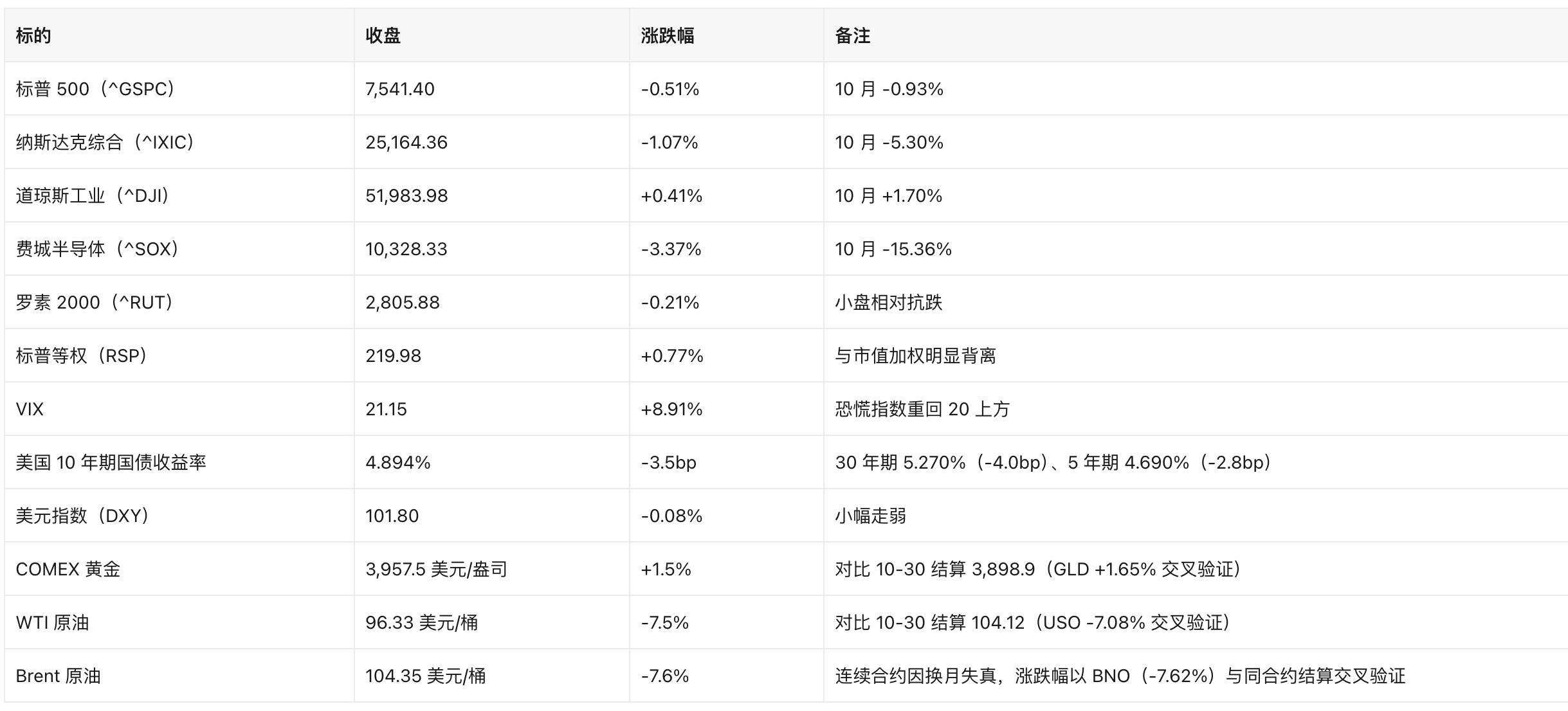
2.2 Core Drivers
- Doubts over returns on AI capital expenditures are the main thread. At the end of October, Alphabet reported quarterly results, with revenue missing expectations while maintaining 2026 capex unchanged and forecasting a "significant increase" in 2027; its stock fell 10% in a single day, which Morningstar called its worst single day ever; Reuters summarized the late-October market with "AI cash burn concerns trigger tech selloff," and Fortune reported that Wall Street lost $1 trillion in market value in a week, with AI spending by tech giants reaching $828 billion.
- On November 2, a structure of "selling heavyweights, buying defensives" emerged. XLK -2.95%, XLE -3.96%, while XLY +2.41%, XLF +1.86%, XLB +1.76%, XLP +1.58%, XLI +1.38%, XLRE +1.09%, XLU +0.55%, XLC +0.36%, XLV -0.15%.
- The oil price plunge changed the inflation narrative. Expectations of US-Iran peace talks intensified, WTI settlement fell 7.5% in a single day, and while energy stocks came under pressure, cost-sensitive sectors such as airlines and consumer benefited; this was also an important reason why the Dow and equal-weight indices rose against the trend.
2.3 Macro Data and the Fed
- October ISM Manufacturing PMI 55.5 (expected 54.5, previous 54.5), new orders 55.5, employment 52.4; prices paid index 75.2 (previous 77.9), still at a high level (Nasdaq Economic Calendar).
- Construction spending: -1.9% (expected +0.4%, previous +2.0%), one of the few data points that day clearly below expectations (Nasdaq Economic Calendar).
- Atlanta Fed GDPNow: latest growth tracking value 3.7% (previous 3.2%).
- The Fed kept rates unchanged at its October 28 meeting, and the post-meeting statement described inflation as "elevated." On October 30, Dallas Fed's Logan said "at least two more rate hikes" are needed and that the pace can be gradual; another official also made the case for rate hikes the same day.
- Institutional level: CNBC and Quartz reported that Chair Warsh is reducing the number of rate votes and tightening forward guidance. The market's pricing of "higher for longer" has not been removed.
- Curve shape: 3-month Treasury bill yield 4.040%, 6-month 4.150%, 10-year 4.894%, 30-year 5.270%; the long-end term premium is elevated, reflecting fiscal and inflation risk premiums rather than growth expectations.
3. Hot Stocks and Sectors
3.1 Marvell (MRVL): $115 billion all-stock acquisition of Lumentum, stock -12.72%
- Event: Marvell announced an all-stock acquisition of optical communications company Lumentum for $115 billion. MRVL closed at $171.41, down 12.72%; LITE closed at $684.40, down 18.59% (from 10-26 to 10-29, LITE had already risen from 818.10 to 919.53).
- Logic: All-stock payment means significant dilution from share issuance (MRVL's closing market cap was $150.31 billion), and the buyer paid a high consideration during a cooling phase for the AI trade; both Barron's and Morningstar questioned whether it "overpaid," and Stifel downgraded LITE. The market's pricing of "growth through M&A" was clearly negative.
- Watch points: whether the deal can pass regulatory review, the exchange ratio, and synergy guidance.
3.2 Oracle (ORCL): $20 billion equity and debt financing, stock -8.76%
- Event: Oracle announced a total of $20 billion in financing through stocks and bonds (including $10 billion in equity) to expand AI infrastructure; the stock fell 8.76% to $119.22 that day, and Yahoo Finance said market cap shrank by more than $60 billion.
- Logic: AI data center capex is shifting from "internal cash flow" to "external financing," and the market is worried about free cash flow and leverage; Oracle is a core name in the "AI debt financing" narrative and is therefore highly sensitive to financing news.
3.3 Intel (INTC): second wave after the crash, stock -8.80%
- Event: Intel closed at $59.97, down 8.80%. On October 30, it plunged 29% in a single day, the worst single day since 1974, and fell 45% in October (CNBC); calculated from the 10-29 close of $92.07, it fell 34.86% over two trading days.
- Logic: Weak earnings guidance combined with doubts about progress in the foundry business; MarketWatch said "analysts see no reason to bottom-fish." A $12 billion decline in the value of the government's stake amplified political attention.
3.4 Memory: Micron (MU) -5.78%, Western Digital (WDC) -7.52%, SanDisk (SNDK) -6.59%
- Event: Kioxia issued a cautious outlook, triggering concerns that the memory cycle has peaked; MU closed at $833.59, WDC at $338.59, and SNDK at $1,075.08.
- Logic: AI demand is driving memory prices higher, but price increases are also suppressing downstream end demand (Apple was cited as facing "rising memory costs"), and the market has begun trading "the late stage of the price-increase cycle" rather than pure demand expansion.
3.5 AMD: volatility amplifies before earnings, stock -7.52%
- Event: AMD closed at $466.84, down 7.52%; the company will report earnings after the US market close on November 3, with consensus EPS expected at $1.68.
- Logic: As the "second supplier" of AI accelerators, AMD's guidance is a direct gauge of the sustainability of AI capex; high volatility before earnings shows extremely large market divergence.
3.6 Defense and Domestic Demand: Walmart (WMT) +3.38%, Costco (COST) +2.79%, Amazon (AMZN) +2.20%
- WMT closed at $127.69 and COST at $1,040.55, leading gains on a day of tech selloff, a typical defensive allocation; AMZN closed at $245.63, and Yahoo Finance reported that Morgan Stanley listed five major catalysts and raised its target price, with AWS growth expectations improving.
- Logic: Capital shifted from "AI sellers with high capex" to "domestic-demand buyers with stable cash flow," corroborating the strength in equal-weight indices and the Dow.
Reference for other heavyweight stocks: MSFT 507.12 (-2.83%), AAPL 338.32 (-1.83%), GOOGL 278.99 (-0.30%), META 606.73 (-1.34%), NVDA 202.06 (-1.26%), TSLA 403.82 (+1.00%), AVGO 322.23 (-1.18%), TSM 398.63 (-1.85%), ARM 196.79 (-4.46%), SMCI 30.44 (-7.62%), PLTR 178.34 (-3.13%).
4. Crypto-Related US Stocks
4.1 DAT (Digital Asset Treasury) Company Developments
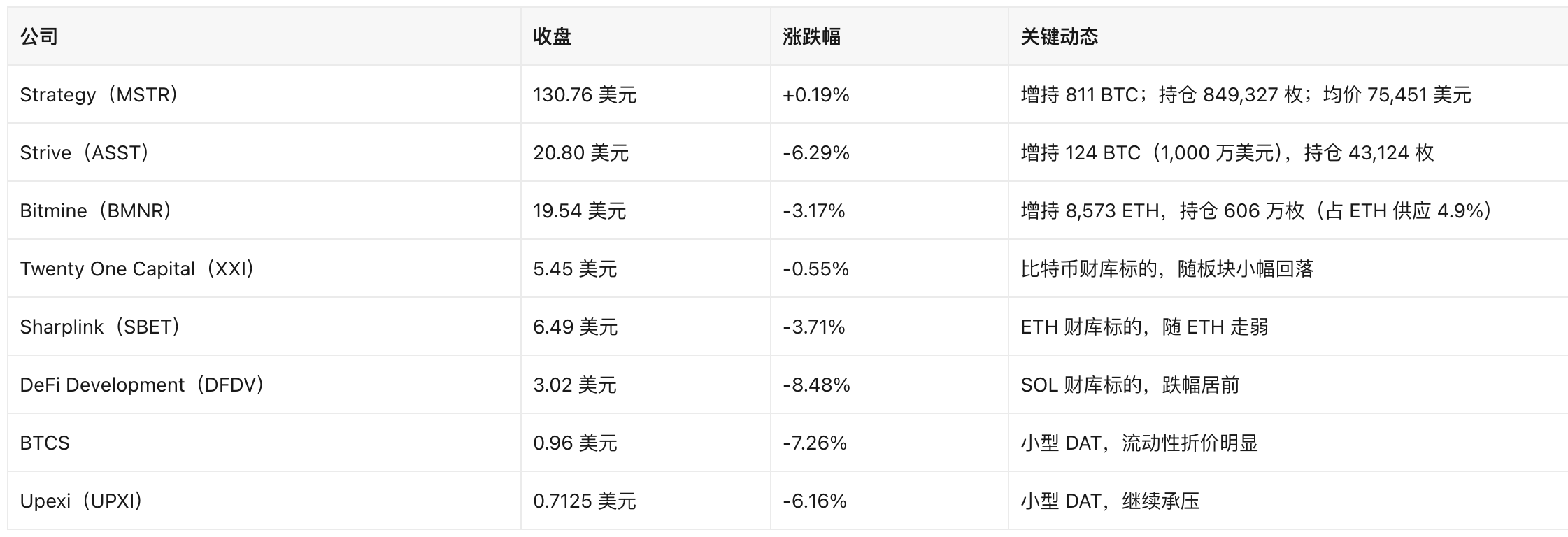
Strategy (MSTR) Key Data (SEC 8-K, filed 2026-11-02)
- From October 26 to November 1, purchased 811 BTC for $65.5 million, average price $80,846 (including fees), funded by net proceeds from MSTR common stock ATM.
- As of November 1, holdings were 849,327 BTC, cumulative cost $64.08 billion, average price $75,451. Based on the 11-02 BTC quote of $76,686.31, the value of holdings was $65.13 billion, a floating gain of 1.6% relative to cost—meaning the coin price has fallen back near the company's cost line.
- ATM: Sold 1,178,552 MSTR shares this period, net proceeds $164 million (of which $65.5 million was used to buy coins and $98.5 million was transferred to USD Cash); remaining MSTR common stock ATM capacity $18.62 billion, STRC remaining $17.51 billion.
- Repurchases: Repurchased 2,092,035 STRC shares this period for $208.2 million (paid in USD Cash); USD Reserve balance $4.79 billion, USD Cash balance $132.7 million.
- mNAV: Nasdaq market cap of $55.18 billion ÷ value of holdings of $65.13 billion = 0.85x (excluding debt and preferred stock, so the enterprise value basis would be higher). This means the company has shifted from "issuing shares at a premium to buy coins" to a "discount," and the capital cycle efficiency of issuing shares to buy coins has declined significantly.
- Earnings: Q3 net income of $19.5 billion (The Block), mainly contributed by changes in Bitcoin fair value—this is an accounting profit brought by the fair value accounting standard effective from 2025 and needs to be distinguished from operating cash flow.
Strive (ASST): Added 124 BTC ($10 million, implied average price $80,645), holdings 43,124; The Block said its gap with Twenty One Capital narrowed to 390. The stock fell 6.29%, indicating that "adding holdings" is no longer a positive catalyst for the stock price in the current environment.
Bitmine (BMNR): Added 8,573 ETH, holdings 6.06 million (4.9% of ETH supply, close to the 5% target); the company disclosed crypto assets plus cash and marketable securities totaling $14.5 billion. Tom Lee said the market reaction after the Binance incident was "mild" and interpreted it as a bullish signal (Decrypt/The Block). Based on the 11-02 ETH quote, the ETH holdings alone were worth $13.63 billion.
4.2 New Entrants and Transformations (including SPAC/Reverse Merger)
- No new announcements were found today of US-listed companies announcing for the first time the purchase of BTC/ETH as reserve assets, or announcing restructuring/renaming into crypto DAT companies. The main increment on November 2 came from routine purchases by existing DATs (Strategy, Strive, Bitmine), and the watchlist had no new additions this period.
- Existing watchlist (classified by nature):
- BTC treasuries: Strategy (MSTR), Strive (ASST), Twenty One Capital (XXI), BTCS, Upexi (UPXI);
- ETH treasuries: Bitmine (BMNR), Sharplink (SBET);
- SOL treasuries: DeFi Development (DFDV);
- To watch: Japan's Metaplanet announced a JPY 25.27 billion buyback that day (not a US stock, for sector reference only).
- Sector consolidation also under observation: Reports said Tether proposed merging Twenty One Capital with Strike and Elektron and has taken over SoftBank's XXI shares (CoinMarketCap/Stocktwits, 10-31; not confirmed at the company level, unverified). If true, it means the DAT industry is beginning to move from "each adding holdings" to "mergers and restructuring."
4.3 Broad Crypto US Stocks: Exchanges, ETFs, Stablecoins, and Miners
Exchanges and Financial Platforms
- Coinbase (COIN): Closed at $137.83, down 3.98%, approaching the 52-week low of $135.47 (52-week high $342.80, now down 59.8% from that). Q3 revenue fell 35% year over year and transaction revenue fell more than 40% year over year, but a $715 million gain turned net income positive; Coinbase One subscriptions hit a record high, and prediction market annualized revenue exceeded $200 million (company press release). After earnings on October 30, the stock fell 11% in a single day, and combined with the Binance hack incident, valuation continued to compress.
- Robinhood (HOOD): Closed at $83.84, down 1.35%, down 43.9% from the 52-week high of $149.41.
- Galaxy Digital (GLXY): Closed at $14.59, down 8.81%, a decline significantly larger than exchange peers, related to its dual beta of "crypto assets + investment banking."
Spot ETFs and Fund Flows
- Prices: IBIT $43.35 (-0.02%), FBTC $66.60 (-0.17%), GBTC $59.09 (-0.05%), BITB $41.55 (-0.05%), ETHA $50.74 (+0.64%).
- Fund flows (10-30 basis): US spot Bitcoin ETFs saw a single-day net outflow of $643 million, the largest single-day outflow since June 25 (The Block); spot Ethereum ETFs saw a single-day net outflow of $432 million, the 11th consecutive trading day of net outflows