

Wall Street Learns from Crypto: What Exactly Are the "US Stock Perpetual Futures" Approved in the US?

While the U.S. midterm elections were rattling nerves across global markets, a bombshell piece of news capable of rewriting the history of Wall Street trading was largely overlooked.
On November 3, CFTC Chairman Mike Selig announced: Single-stock perpetual contracts have been approved for trading on regulated U.S. exchanges for the first time, and will be brought under a dual regulatory framework overseen by both the CFTC and the SEC.
This means that perpetual contracts — a product largely popularized by cryptocurrency trading platforms — have finally crossed over into the regulatory framework of traditional U.S. securities markets.
Put plainly, Wall Street has started learning from Crypto, "stealing" its most successful financial invention of the past decade — perpetual contracts (Perps).
What's more interesting is that this shift is not entirely Wall Street-led. Over the past six months, Crypto trading platforms have successively tried to bring U.S. equities such as Apple, Nvidia, and Tesla on-chain, reorganizing how these assets are traded using perpetual contracts, stablecoin margin, and even 7×24 order books.
Now, even ICE — the parent company of the New York Stock Exchange — is considering bringing Hyperliquid's perpetual contract infrastructure into the United States.
A year ago, we were discussing whether U.S. stocks could become "never closed" like Crypto; a year later, the market is already discussing: can U.S. stocks directly adopt Crypto's trading rules?
1. From "the Last Hour" to "Never Expiring": Why Did Wall Street Ultimately Fall for Perps?
To understand the significance of this CFTC icebreaker, we first need to understand: what exactly did perpetual contracts change?
Few people know that perpetual contracts are one of the few genuine "Native financial innovations" in the crypto world, first pioneered in 2016 by the crypto derivatives exchange BitMEX, which only announced its closure this year.
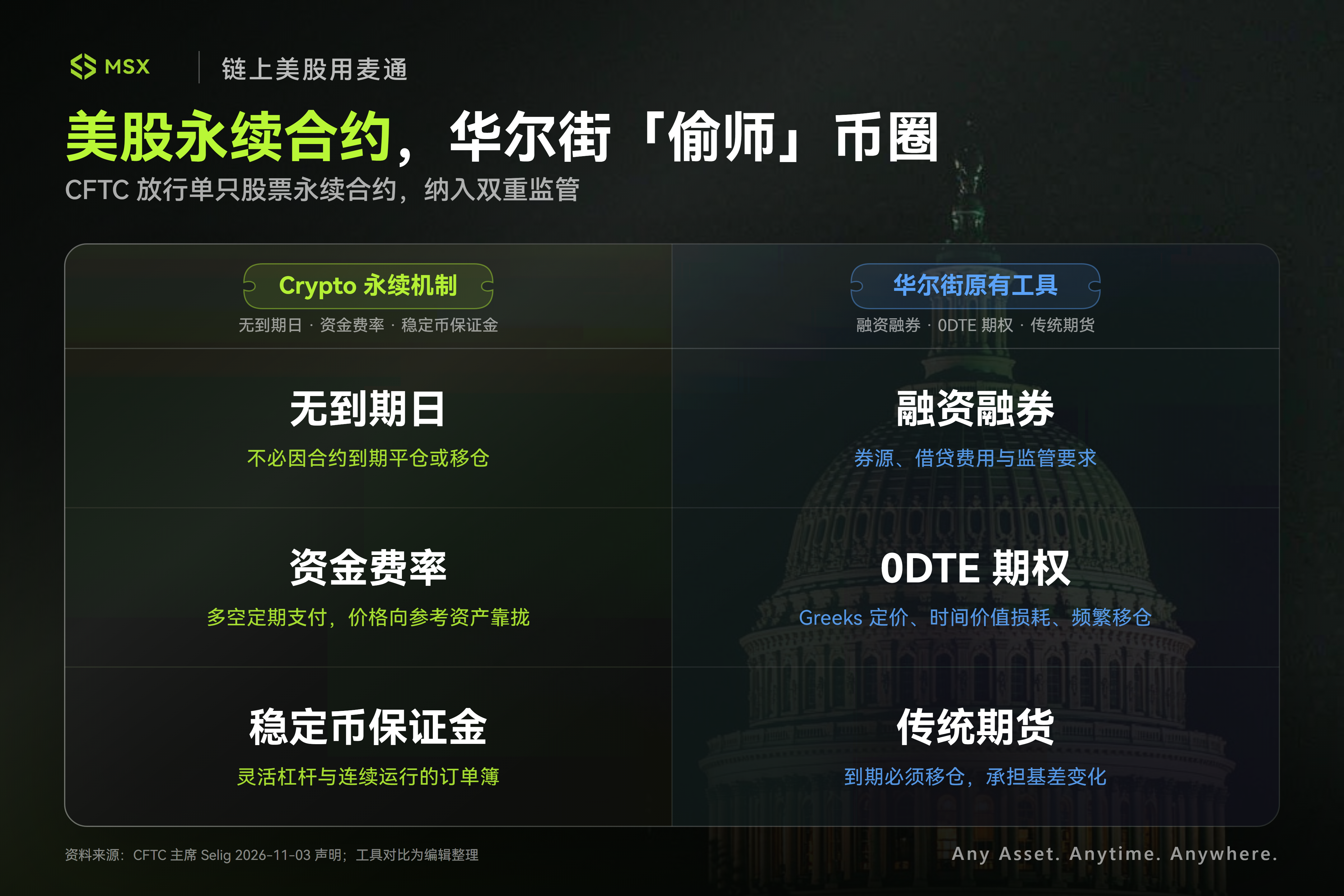
Generally speaking, in the U.S. stock market, if investors want to trade a single stock (such as NVDA or TSLA) with leverage or go short, the mainstream options each have their limitations:
- Margin financing and securities lending: This relies on brokers providing financing and securities lending services. Not only can funding costs be high, but short selling is also constrained by securities availability, borrowing fees, and related regulatory requirements, making it difficult to form a globally unified, around-the-clock trading mechanism;
- Options, especially the 0DTE end-of-day options that have exploded in popularity in recent years: Although they offer strong explosive potential, the complex pricing of Greeks, time value decay (Theta Decay), and frequent roll-overs at expiration raise the barrier to entry for ordinary investors and fragment liquidity across different expiration dates and strike prices;
- Traditional futures: These have clear expiration dates. If investors want to maintain exposure continuously, they must roll over periodically, bearing additional trading costs and basis change risk;
The biggest innovation of Crypto perpetual contracts is that they remove the expiration mechanism of traditional futures.
Investors can hold long or short positions indefinitely without being forced to close or roll over due to contract expiration. Platforms instead use funding rates periodically paid between longs and shorts to push the contract price toward the reference asset price, and combined with flexible leverage and continuously running order books, this creates a trading experience entirely different from traditional securities trading.
This mechanism has been a "dominant force" in the crypto market.
Over the past few years, BTC and ETH perpetual contracts have gradually become the most dominant derivatives trading tools in the crypto market, underpinning the massive trading ecosystems of crypto trading platforms such as Binance, OKX, and Bybit. According to The Block, in 2025 perpetual contracts contributed about 75% of total trading volume on centralized crypto exchanges, with cumulative annual trading volume approaching $49 trillion — far exceeding the spot and options markets.
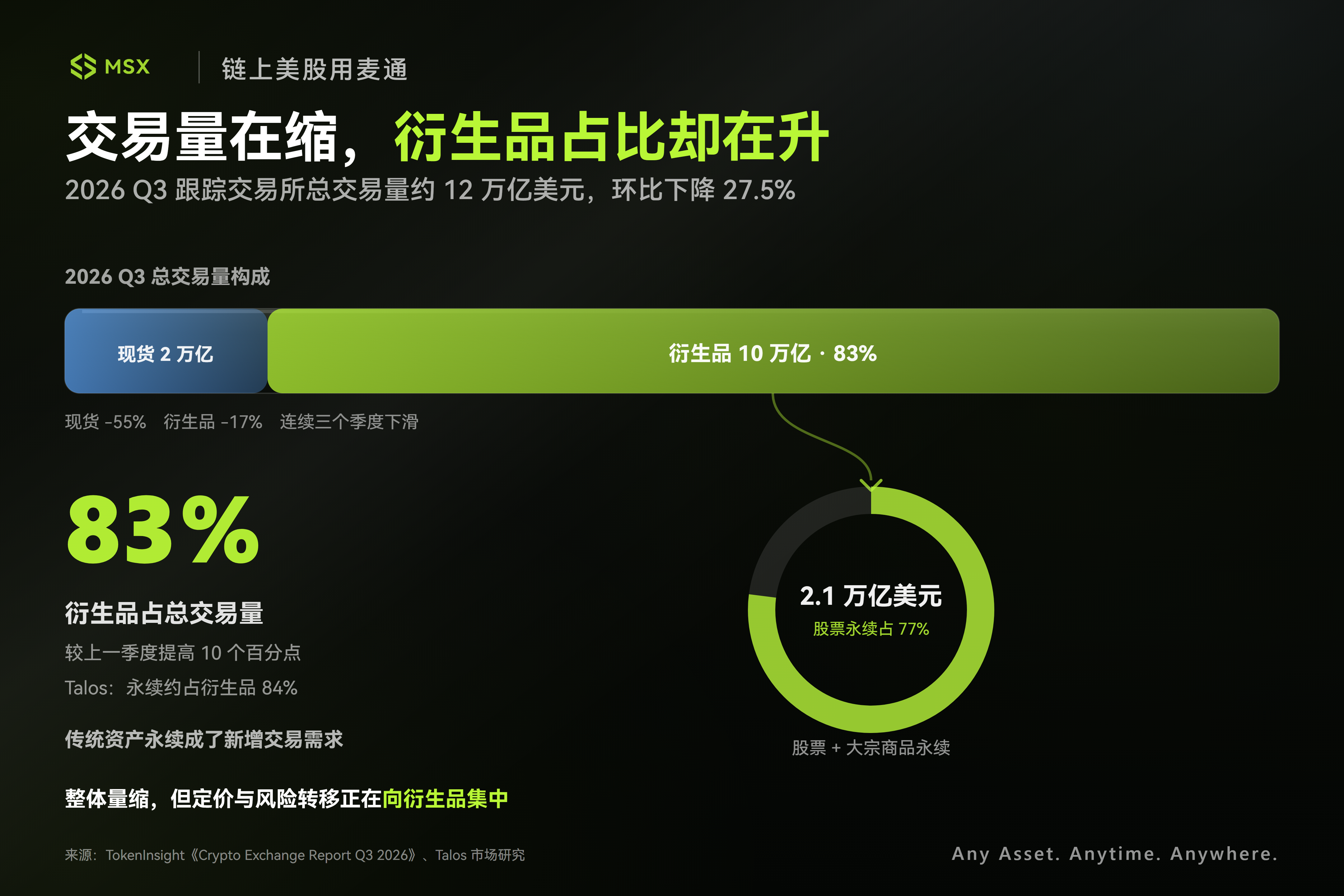
This trend continued into 2026. TokenInsight's latest Q3 exchange report shows that derivatives already account for 83% of total trading volume on major crypto trading platforms.
In other words, perpetual contracts have long been the core infrastructure supporting trading liquidity, price discovery, and risk transfer across the entire industry.
But when this highly efficient trading method began extending to traditional assets such as stocks, gold, crude oil, and stock indices, a sharp question surfaced: Why can global investors smoothly trade Nvidia and Tesla 7×24 on crypto platforms, yet find it so hard to access similar products within the U.S. domestic compliant system?
Behind this lie both the technical constraints of underlying infrastructure and the long-standing jurisdictional barriers of the U.S. regulatory system.
On the technical level, as we previously pointed out in "U.S. Stocks Sprint Toward "Never Closed": Why Did Nasdaq Launch a "5×23 Hour" Trading Experiment?", traditional U.S. stock spot trading is a precision gear system where one move affects the whole. Even if Nasdaq extends front-end matching hours to 23 hours a day, the back-end brokers, custodians, and clearing institutions (DTCC) remain constrained by the end-of-day batch processing, reconciliation, and margin transfers of centralized ledgers.
The forced "1-hour daily downtime window" and "48-hour weekend market closure" are exactly the real-world problems that traditional financial infrastructure must solve as it moves toward all-weather operation.
Second is the regulatory level. Stock perpetual contracts use single stocks as reference underlying assets but adopt Crypto-native perpetual derivative structures, placing them precisely at the intersection of two regulatory systems — the CFTC (responsible for commodities and derivatives) and the SEC (responsible for securities markets). As a result, uncertainty over regulatory jurisdiction and product classification once left such products in a state where clear implementation was difficult.
Since the start of this year, this issue has begun to see substantive changes:
- On March 11, 2026, the SEC and CFTC signed a memorandum of understanding (MOU) on regulatory cooperation, explicitly strengthening coordination between the two agencies on financial innovation, market supervision, and investor protection;
- Subsequently, on May 29, the CFTC approved the first Bitcoin perpetual contract BTCPERP submitted by KalshiEX, bringing a true Bitcoin perpetual contract into a regulated U.S. exchange for the first time;
- And the November 3 announcement extended this progress further into the traditional securities field: according to CFTC Chairman Selig, single-stock perpetual contracts are recognized as security futures products under the Commodity Futures Modernization Act of 2000 (CFMA) framework, subject to both the Commodity Exchange Act and U.S. federal securities laws, and supervised by both the CFTC and SEC;
Specifically, trading venues able to offer such products need both CFTC-registered Designated Contract Market (DCM) status and national securities exchange status with notification registration to the SEC and approval to trade security futures products.
More notably, regulatory changes have already begun translating into actual products.
On November 3 itself, Kalshi began offering perpetual contracts on four U.S. stocks — Amgen (AMGN), McDonald's (MCD), Qualcomm (QCOM), and Costco (COST) — with maximum leverage of about 4.9x.
For the U.S. market, this not only means one more stock trading tool, but also means that trading mechanisms first established by crypto trading platforms are beginning to gain recognition from the traditional financial regulatory framework.
2. Reviewing the Past Year: The "Three-Way Convergence" of Regulation, TradFi, and Crypto Platforms
If the CFTC's move represents the traditional financial regulatory system beginning to accept perpetual contracts, then over the past year, Crypto-native platforms have in fact already completed a considerable amount of product exploration.
Looking back at this timeline, one can see that the development of U.S. stock tokenization has long been gradually forming a more complete trading system encompassing spot, perpetual contracts, leveraged trading, and cross-asset margin.
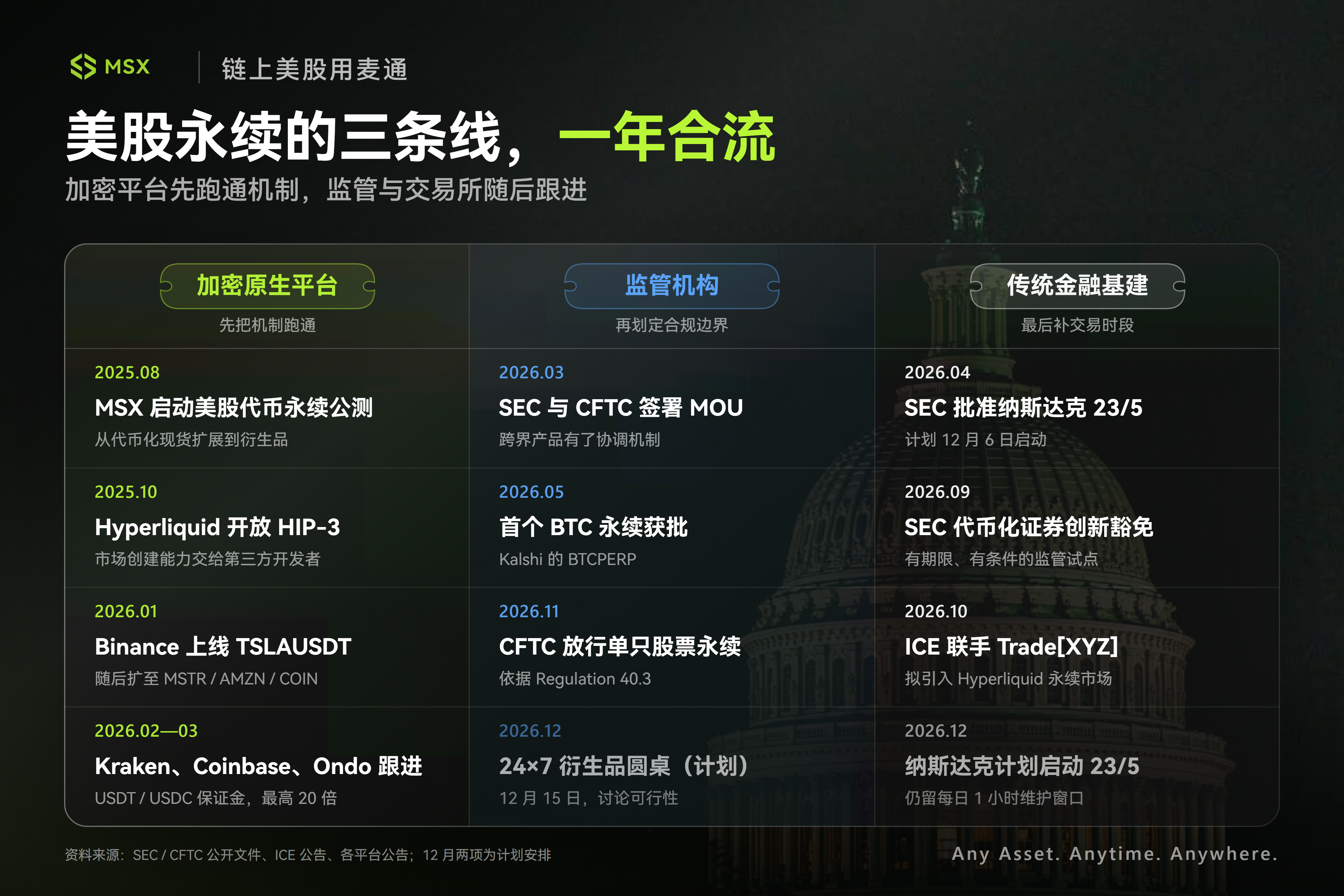
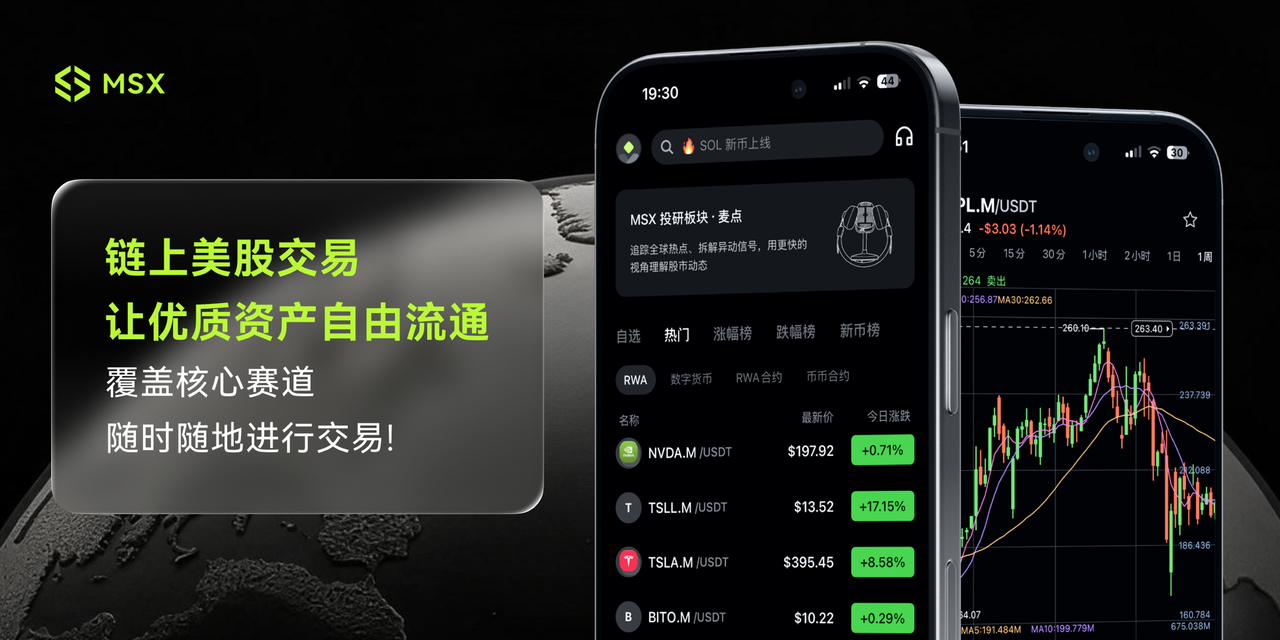
As early as August 11, 2025, MSX launched public beta for tokenized U.S. stock perpetual contracts, further expanding its previous tokenized U.S. stock spot trading into the derivatives market.
Shortly after, in October 2025, on-chain derivatives leader Hyperliquid launched the highly pivotal HIP-3 mechanism, opening perpetual contract market creation capabilities to third-party developers, thereby breaking trading underlying assets beyond the boundaries of BTC and ETH and rapidly expanding to stocks, indices, commodities, and forex.
Entering 2026, the U.S. stock perpetual track saw concentrated follow-up from more mainstream trading platforms:
- On January 28, Binance listed the TSLAUSDT stock perpetual contract; on February 9, it further launched multiple stock perpetual contracts including MSTR, AMZN, CRCL, COIN, and PLTR, using USDT margin and settlement and supporting 7×24 trading.
- On February 3, Ondo Finance announced the Ondo Perps plan, preparing to bring traditional assets such as stocks, ETFs, and commodities into the perpetual contract market and further exploring the use of tokenized securities as margin. The platform officially launched in July.
- On February 24, Kraken launched tokenized stock perpetual contracts based on xStocks, offering eligible non-U.S. users in more than 110 countries and regions 24×7 leveraged trading in stocks such as Nvidia, Apple, and Tesla, with maximum leverage reaching 20x.
- On March 20, Coinbase also officially launched stock perpetual contracts, allowing eligible non-U.S. users to trade U.S. stocks and crypto assets within the same derivatives trading system, settled in USDC.
- Bitget also incorporated Stock Perps into its product system, covering multiple U.S. stocks and ETFs such as Nvidia, Apple, Tesla, and Microsoft, with related contracts settled in USDT and supporting near all-weather trading.
It is worth noting that this round of expansion happened precisely against the backdrop of continuously declining trading volume in Crypto-native markets.
According to a report published by TokenInsight, the exchange sample it tracks recorded total trading volume of about $12 trillion in Q3, down 27.5% quarter-over-quarter and marking three consecutive quarters of decline — among which spot trading volume fell 55% to $2 trillion, while derivatives trading volume fell 17% to $10 trillion.
But another intriguing data point is that despite the overall decline in trading volume, the share of derivatives in total trading volume actually rose to 83%, up 10 percentage points from the previous quarter.
At the same time, the trading scale of perpetual contracts on traditional financial assets is expanding rapidly. Among the nine exchanges tracked in the report, combined Q3 trading volume in stock and commodity perpetual contracts reached $2.1 trillion, of which stock perpetual contracts accounted for about $1.61 trillion, or 77%, while commodity perpetual contracts accounted for about $491 billion.
This set of data sends a fairly clear signal: as growth in the original Crypto trading market comes under pressure, traditional financial assets are becoming an important direction for crypto trading platforms to compete for new trading demand.
Of course, one cannot simply attribute platforms' expansion into TradFi to the decline in crypto market trading volume. More importantly, leading trading platforms already possess mature derivatives engines, stablecoin settlement systems, margin management, and global user bases, so expanding into assets such as stocks, indices, gold, and crude oil does not require building a trading system from scratch.
For them, rather than limiting themselves to competing for finite BTC and ETH trading flow, it is better to replicate their already mature trading infrastructure across more asset classes.
Moreover, the underlying structures of these platforms' products have already diverged into two paths:
- The first is "synthetic perpetual contracts" anchored to stock prices, such as Binance's USDT-margined contracts and Coinbase's USDC-margined contracts. What investors obtain is long/short exposure to stock price movements, and the underlying does not involve actual stock delivery;
- The second is a perpetual and portfolio system based on "tokenized stocks", such as MSX, which early on completed the closed loop between spot and contracts, Kraken with xStocks, and Ondo, which supports tokenized securities as collateral;
The two paths are not entirely the same, but both are pushing traditional assets from mere price exposure toward richer trading and financial application scenarios.
And just as Crypto-native platforms continue to expand, traditional financial giants have also begun to enter the fray.
On October 29, Intercontinental Exchange (ICE), the parent company of the NYSE, announced a partnership with Trade[XYZ], planning to bring a perpetual contract market based on Hyperliquid into the United States.
According to the plan announced by both parties, ICE will be responsible for operating the new regulated trading venue and clearing architecture while making a strategic investment in Trade[XYZ]; Trade[XYZ] will be responsible for related market design and product technology, with future plans to cover assets such as stocks, indices, cryptocurrencies, commodities, and forex.
It is worth noting that this new market is planned to rebuild a dedicated trading and clearing system around U.S. regulatory requirements, and the related business still needs regulatory approval.
The symbolic significance of this is considerable.
In the past, Crypto platforms tried to bring traditional assets on-chain, challenging traditional exchanges' control over asset liquidity and trading access; now, the parent company of the NYSE has instead chosen to cooperate with the Crypto-native perpetual contract market and even directly invest in related participants.
Crypto has more flexible trading mechanisms, stablecoin settlement, and a global user base, while traditional finance has a mature regulatory system, clearing infrastructure, and institutional resources. Both sides are beginning to realize that what will truly matter in the future is precisely who can integrate the advantages of the two systems.
3. Pricing U.S. Stocks on Weekends: Is All-Weather Liquidity Really Coming?
If the first two parts discussed trading products and regulatory systems, then the most far-reaching impact of this transformation actually lies in the quiet transfer of market pricing power.
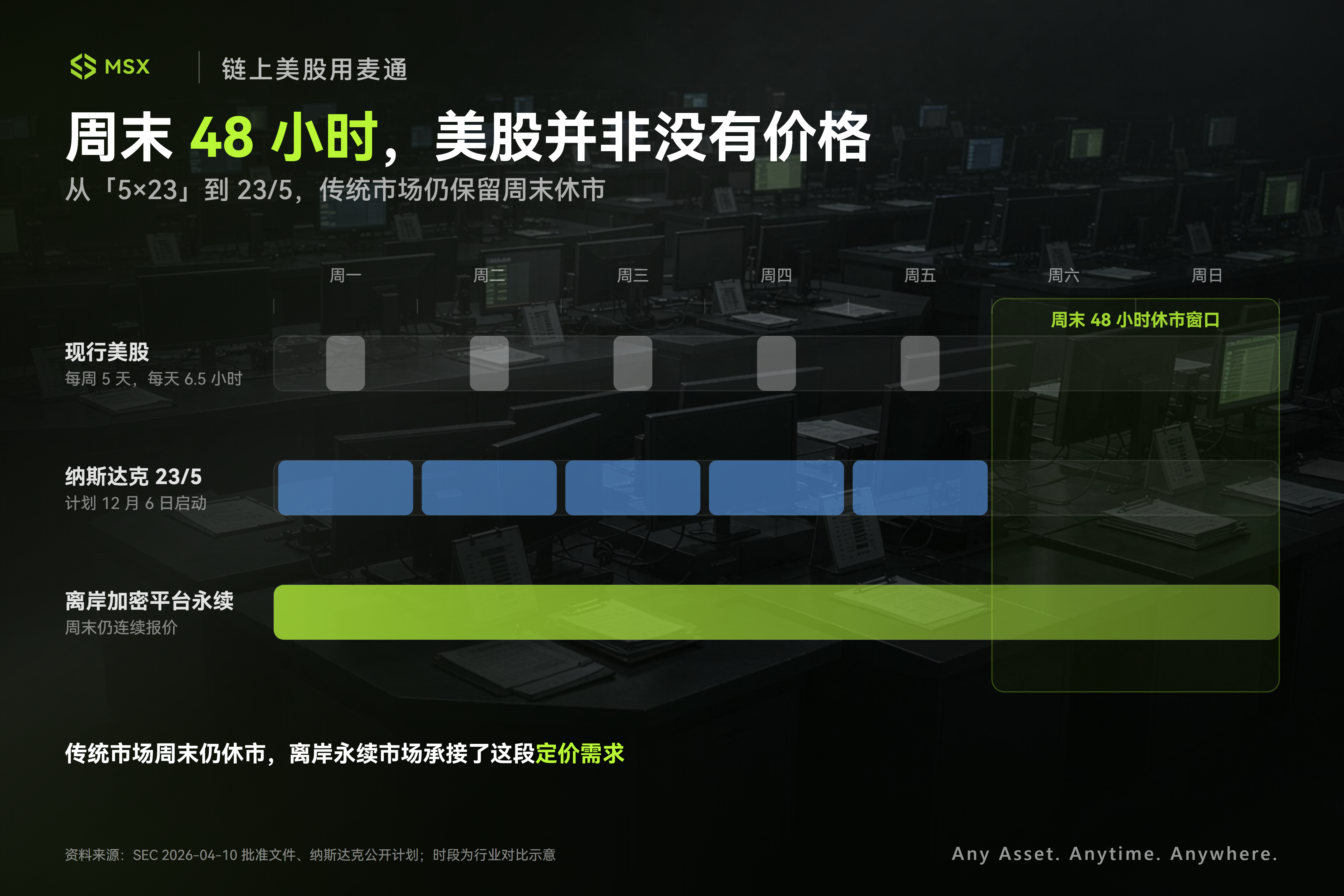
In the past, price discovery for U.S. stocks was mainly concentrated during the trading hours of traditional venues such as Nasdaq and the NYSE. Even as pre-market and after-hours trading gradually became widespread, weekends and holidays still remained a market vacuum of more than 48 hours.
But the closure of the traditional U.S. stock market does not mean investors' demand to trade U.S. stocks disappears with it.
And the emergence of U.S. stock perpetual contracts is changing this situation.
Now, even after Wall Street rings the closing bell on Friday, global investors can still trade perpetual contracts on Nvidia, Apple, and Tesla without interruption on crypto trading platforms or on-chain protocols. Global breaking events, company news, macroeconomic data, and even weekend market sentiment can all be converted into continuous price changes through these trading markets.
It could even be said that U.S. stock perpetual contracts on crypto platforms today — especially during weekend closures of the U.S. stock market — have gradually evolved from pure speculative quotes into continuous price discovery markets with certain reference value.
1. From "Basis Smoothing" to Cross-Platform Arbitrage: How Are Weekend Prices Formed?
Many people may wonder: since both Nasdaq and the NYSE are closed, why can Nvidia and Tesla still generate real-time prices on crypto platforms?
Taking Coinbase's stock perpetual contracts as an example, prices are actually formed continuously through internal price indices, perpetual contract order books, tokenized stock quotes, and cross-platform trading to estimate the value of the underlying asset:
- During normal trading hours, index prices are mainly constructed using external stock market data sources such as Pyth and Blue Ocean ATS;
- During weekends and some market closure periods, the system switches to internal indices, combining the EMA of perpetual contract mark prices and available tokenized stock quotes to form a new price reference;
- At the same time, the platform also uses price deviation limits and transition mechanisms when reconnecting to external market data to minimize abnormal volatility caused by price switching;
This mechanism at least shows that weekend U.S. stock pricing is no longer simply freezing Friday's closing price until Monday; instead, it is beginning to form a continuously operating price discovery system through multiple data sources and market mechanisms.
What truly allows this mechanism to gradually mature are two forces.
The first is the funding rate mechanism of perpetual contracts themselves. When the contract price remains above the reference index, the funding rate usually moves positive, requiring longs to pay funding fees to shorts, thereby raising the cost of continuously holding high-premium long positions; conversely, when the contract price is below the reference index, negative funding rates raise the holding cost for shorts.
This gives both longs and shorts incentives to continuously adjust positions, but it cannot by itself guarantee accurate prices — especially when external spot markets are closed, the reference index itself may also lag.
More important is the participation of cross-platform quantitative arbitrage capital. As platforms such as Hyperliquid, Binance, and Coinbase gradually form multiple competing trading venues, the same stock may show price deviations across different perpetual contract markets.
For example, suppose on Saturday Nvidia's perpetual contract is quoted at $200 on Platform A and $203 on Platform B. If the reference assets, contract