

Anthropic IPO Race for Allocation: From Selling Bay Area Homes for Shares to Bitget Opening $100 Allocations

Author: Zen, PANews
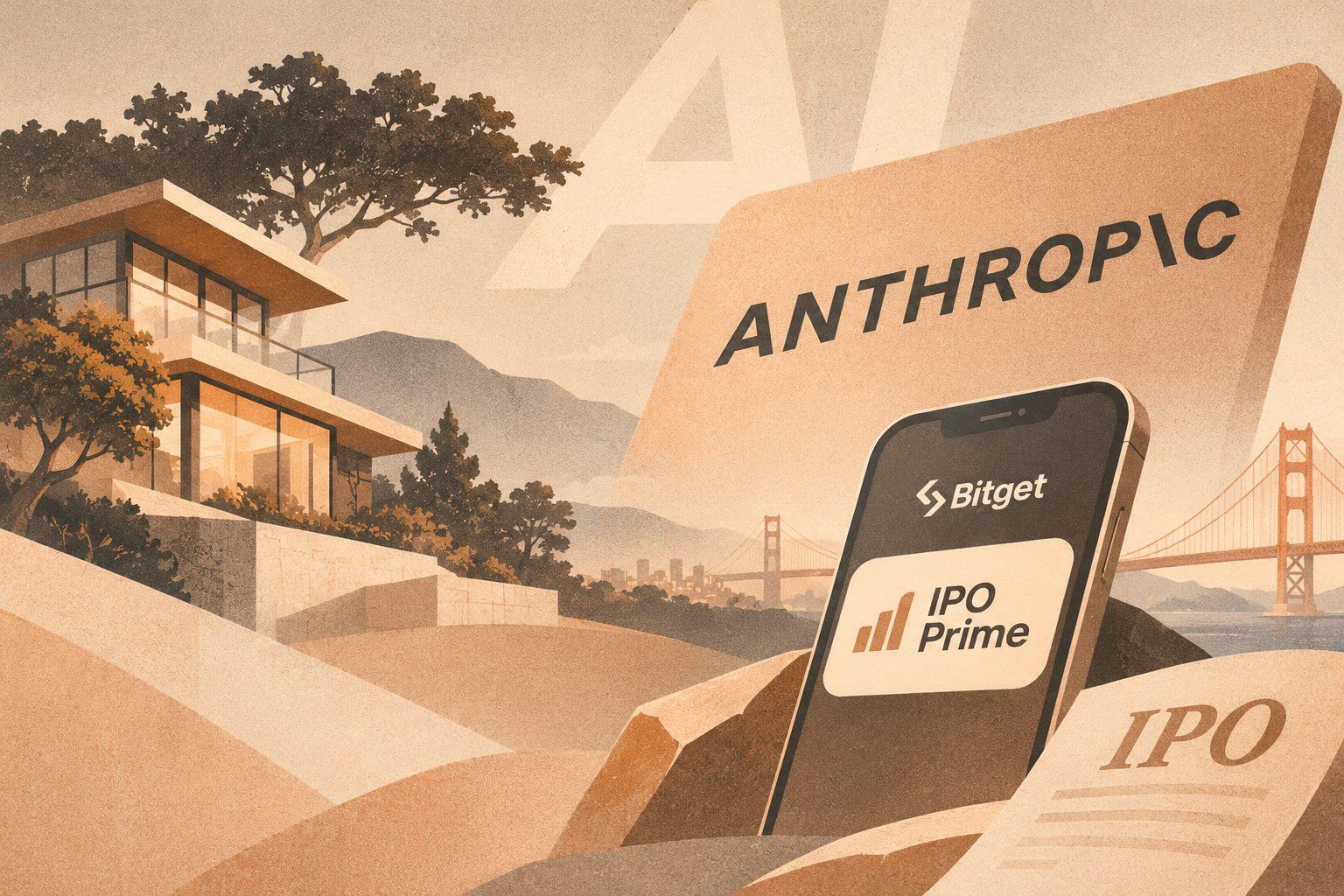
In April of this year, a rather unusual real estate transaction surfaced in the San Francisco Bay Area.
An investment banker named Storm Duncan planned to sell his estate, valued at roughly $8 million. But unlike a typical homeowner, he wanted the buyer to pay not in cash, but in shares of AI company Anthropic. To help close the deal, he was even willing to let the buyer retain 20% of the upside on the exchanged shares during the lock-up period.
Asked why he chose such an unusual method of sale, Duncan's explanation was simple: too many houses, too few AI assets. Conversely, some of Anthropic's early employees may find themselves in the opposite situation—holding company equity worth a fortune but lacking enough cash to buy property.
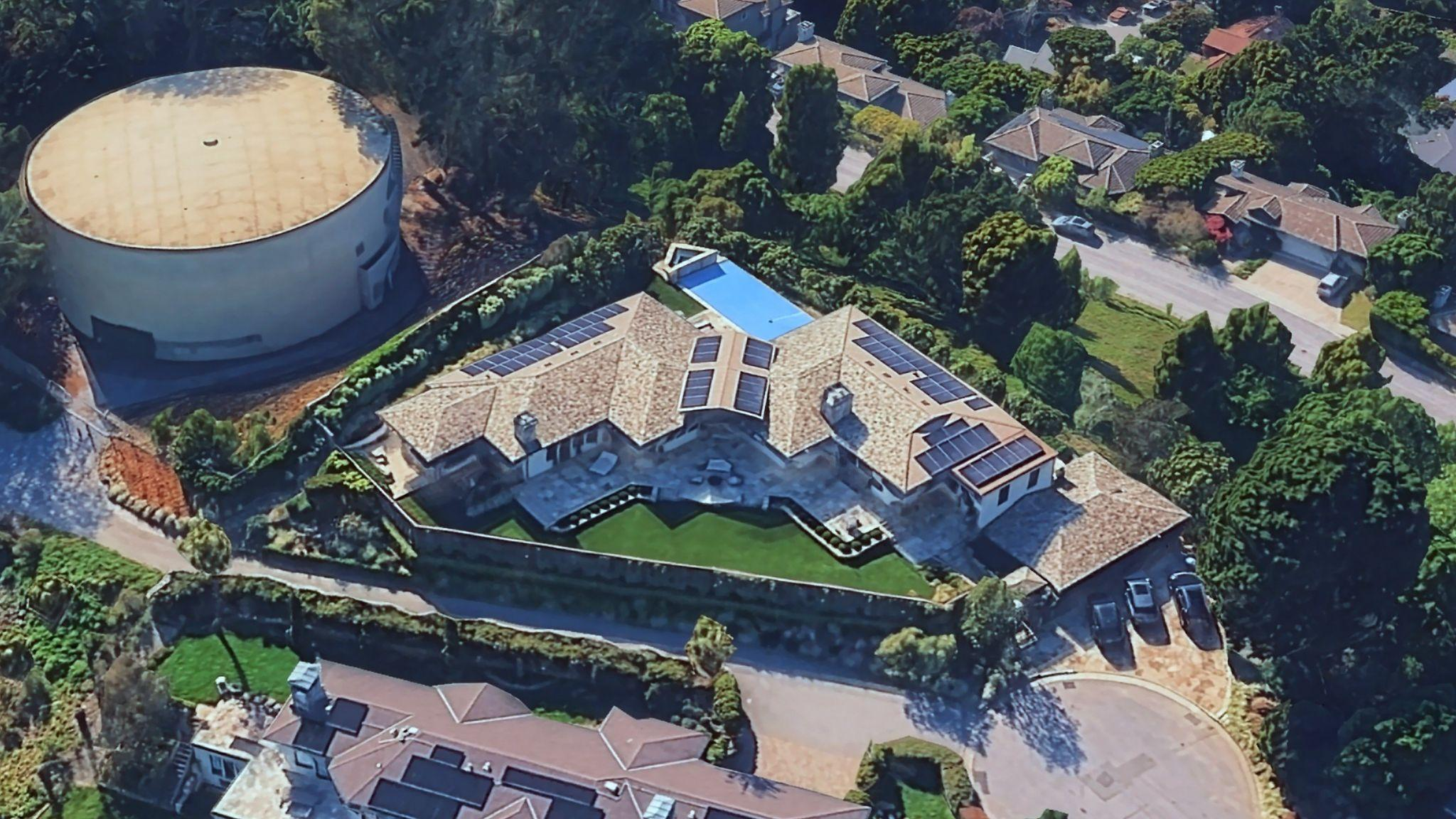
The luxury home listed for sale by Storm Duncan
A few weeks later, Wired magazine found that more similar property listings had appeared in the San Francisco Bay Area.
Among them, the owner of a tech PR firm, selling a $2.5 million residence, offered a special deal: if the buyer paid with Anthropic stock, they would only need to provide $2 million worth of equity—effectively a 20% discount.
Whether these transactions ultimately close remains unknown, but they are enough to illustrate one point: Anthropic equity is becoming one of Silicon Valley's most sought-after and hardest-to-obtain assets.
And this pursuit of Anthropic equity has finally opened a window to the public market. On October 26, Anthropic officially filed its IPO prospectus with the U.S. Securities and Exchange Commission (SEC), planning to list on Nasdaq under the ticker ANT, with market expectations of a listing valuation of $1.5 trillion to $1.75 trillion.
From wealthy Silicon Valley residents willing to trade luxury homes for shares to Wall Street institutions preparing to commit tens of billions of dollars, Anthropic's IPO has long been one of the most closely watched events in global capital markets. Consensus holds that equity supply will fall short of demand; what the market really cares about is how to secure a ticket in the tight allocation and how to price this rapidly growing AI company.
Joining the Trillion-Dollar Club in Five Years: Anthropic's Valuation Logic
In 2021, Dario Amodei and his sister Daniela Amodei led a group of former OpenAI employees to found Anthropic. At the time, ChatGPT had not yet been released, and the commercial market for generative AI was far smaller than it is today.
Five years later, the company stands at the center of the global AI industry. According to its latest prospectus, revenue in the third quarter of 2026 alone was equivalent to 3.7 times its full-year 2025 revenue. In addition, Reuters reported that Anthropic's revenue forecast for 2028 reaches $190 billion to $200 billion. Its astonishing pace of commercialization and growth prospects have made Anthropic one of Wall Street's most closely watched IPOs. Its listing valuation expectation once reached about $2 trillion; although some investors have recently lowered their expectations, the valuation still under market discussion runs as high as $1.5 trillion to $1.75 trillion.

Such a massive valuation is supported not only by rapidly growing revenue and enterprise customer demand, but also by the capital market's high expectations for Anthropic's future growth potential.
As the IPO approaches, investors face another more practical question besides judging whether the valuation is reasonable: even if they are bullish on Anthropic, how likely are they to obtain shares at the offering price?
After all, for an IPO project like Anthropic that commands global investor attention, allocation at the offering price will be especially scarce.
From SpaceX to Anthropic: How Are Tickets to Hot IPOs Allocated?
In June of this year, when SpaceX went public, the market witnessed firsthand the enormous appeal of a top-tier hot tech company IPO.
On June 11, SpaceX officially set its offering price at $135 per share. The next day, it listed on Nasdaq and closed its first trading day at $160.95, up 19.2% from the offering price. The stock continued to climb afterward. On June 16, SpaceX hit an intraday high of $225.64, up about 67% from the offering price; it closed that day at $201.80, still up 49.5%.
For investors who obtained shares at the $135 offering price, this meant considerable paper gains. However, not all investors bullish on SpaceX had the opportunity to buy shares at the offering price—a textbook example of how tight hot IPOs can be.
In traditional U.S. IPOs, share allocation is mainly handled through underwriters, and institutional clients typically have more mature allocation channels and resources. For projects in high demand, even if brokerages allow retail clients to subscribe, they may still fail to receive a full allocation due to limited shares available for distribution.
By the time the stock officially enters the secondary market, investors often face a different price altogether. This further highlights the scarcity value of securing an original allocation at the offering price.
This market demand has also created opportunities for new subscription platforms.
In April of this year, crypto asset trading platform Bitget launched IPO Prime, attempting to give users a channel to participate in pre-IPO and IPO-stage investment in hot tech companies through stablecoin subscriptions and tokenized financial products.
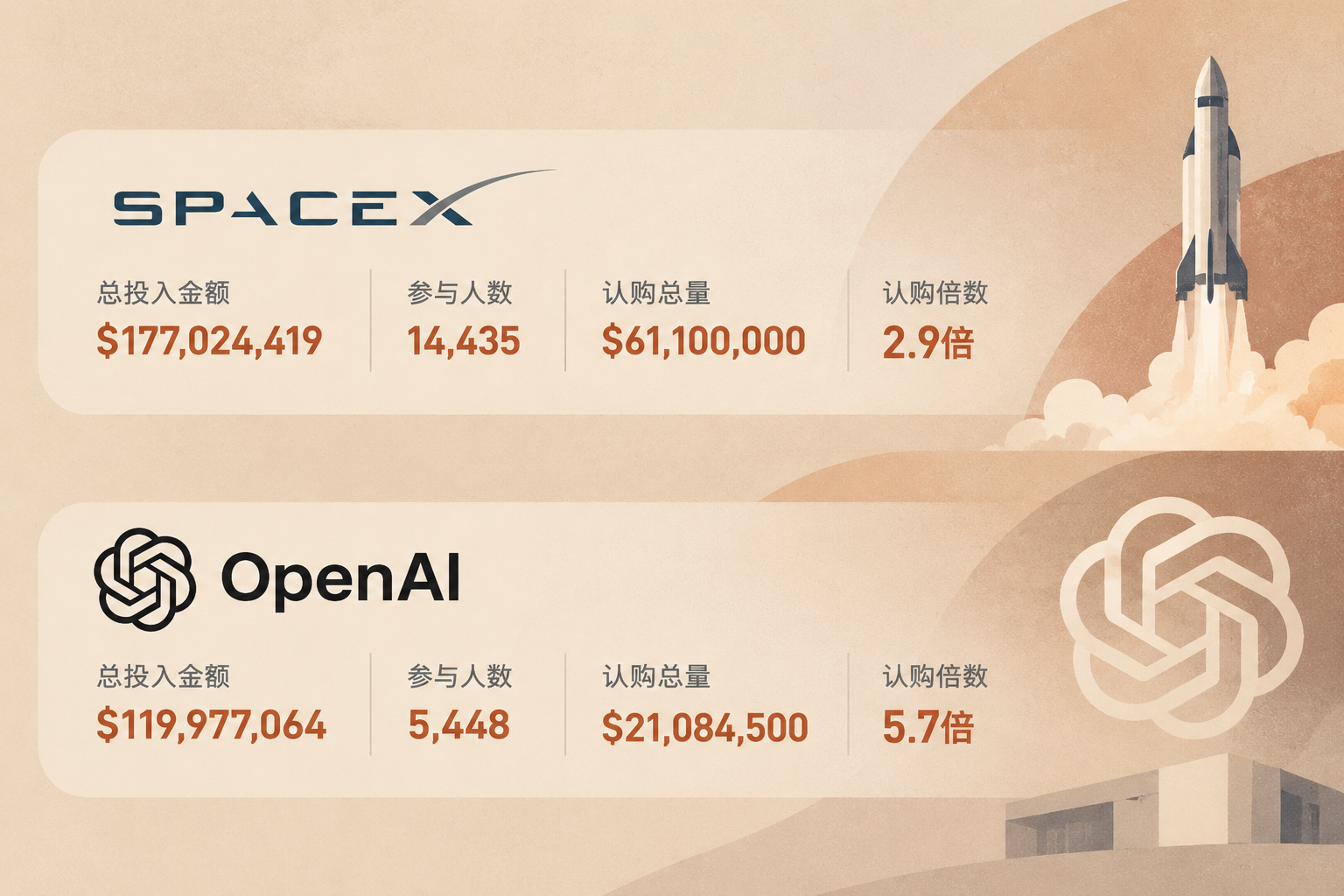 Subscription data for past IPO Prime projects (Source: Bitget official website)
According to historical records disclosed on Bitget's official website, its SpaceX-related Pre-IPO project attracted a cumulative $177 million in subscription funds from 14,435 participants, representing a subscription multiple of about 2.9x against the $61.1 million offering size; the OpenAI-related project attracted about $120 million in subscriptions from 5,448 participants, a subscription multiple of about 5.7x against the $21.08 million offering size.
Both products also posted considerable gains in the secondary market: the SpaceX-related token preSPAX (later renamed preSPCX) rose from a subscription price of $650 to $948, a peak gain of about 45.8%; the OpenAI-related token preOPAI rose from $725 to $1,079, a peak gain of about 48.8%.
It is worth noting that the previous SpaceX and OpenAI projects used Pre-IPO token products linked to the post-listing stock prices of the relevant companies. What investors received were yield-right certificates provided by the issuer, not actual shares of SpaceX or OpenAI.
For Anthropic's current IPO, Bitget has extended its subscription mechanism to the formal stock offering stage: allocated assets will be delivered in the form of rANT, with each rANT backed 1:1 by actual Anthropic shares, and relevant corporate actions will also be reflected in the tokenized assets in sync—a key difference from previous Pre-IPO products.
Starting at $100: Anthropic IPO Prime Opens Two Subscription Rounds
According to an announcement published by Bitget, the Anthropic IPO Prime is divided into a VIP round and a public round, with subscriptions opening at 16:00 Beijing time on November 5 and November 10, respectively. Both rounds support participation with USDT or USDGO, with a minimum investment of $100. The aim is to lower the threshold for ordinary people to participate in top-tier tech IPOs, moving away from the common frustration of joining the crowd in traditional new-share subscriptions only to walk away empty-handed.
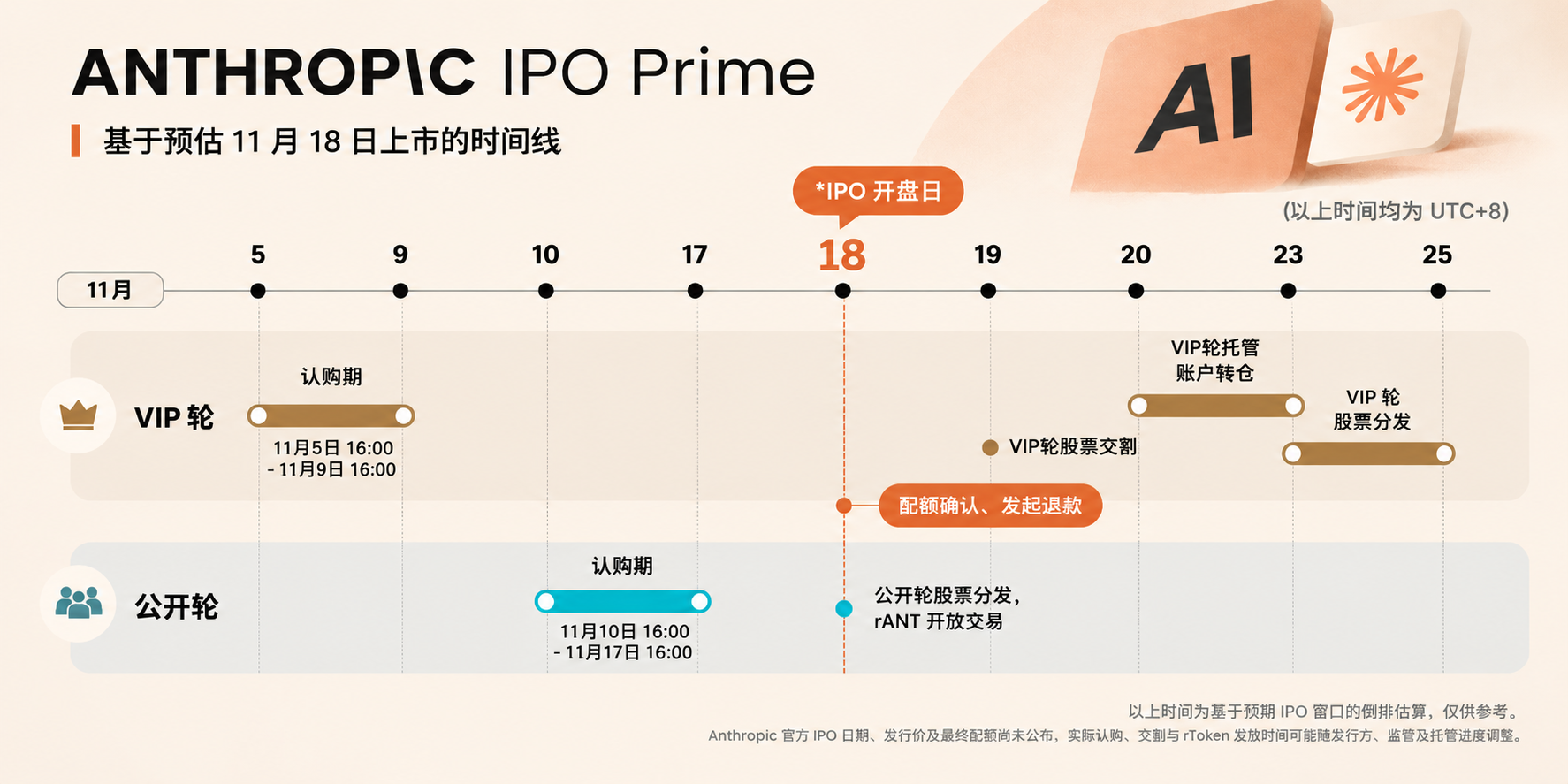
The public round is open to all eligible users, with a maximum investment of $25,000 per person; the VIP round raises the maximum investment limit to $3 million. Notably, VIP eligibility is not limited to existing members—users who upgrade and meet the qualification requirements before the VIP round subscription closes at 16:00 on November 9 also have the opportunity to participate in the VIP priority subscription and enjoy a higher subscription limit.
Unlike participating in an IPO through an ordinary securities account, investors can submit subscription applications through their existing crypto asset accounts, with the platform connecting to stock allocation channels through partner institutions, reducing the cumbersome steps of cross-market account opening and fund transfers.
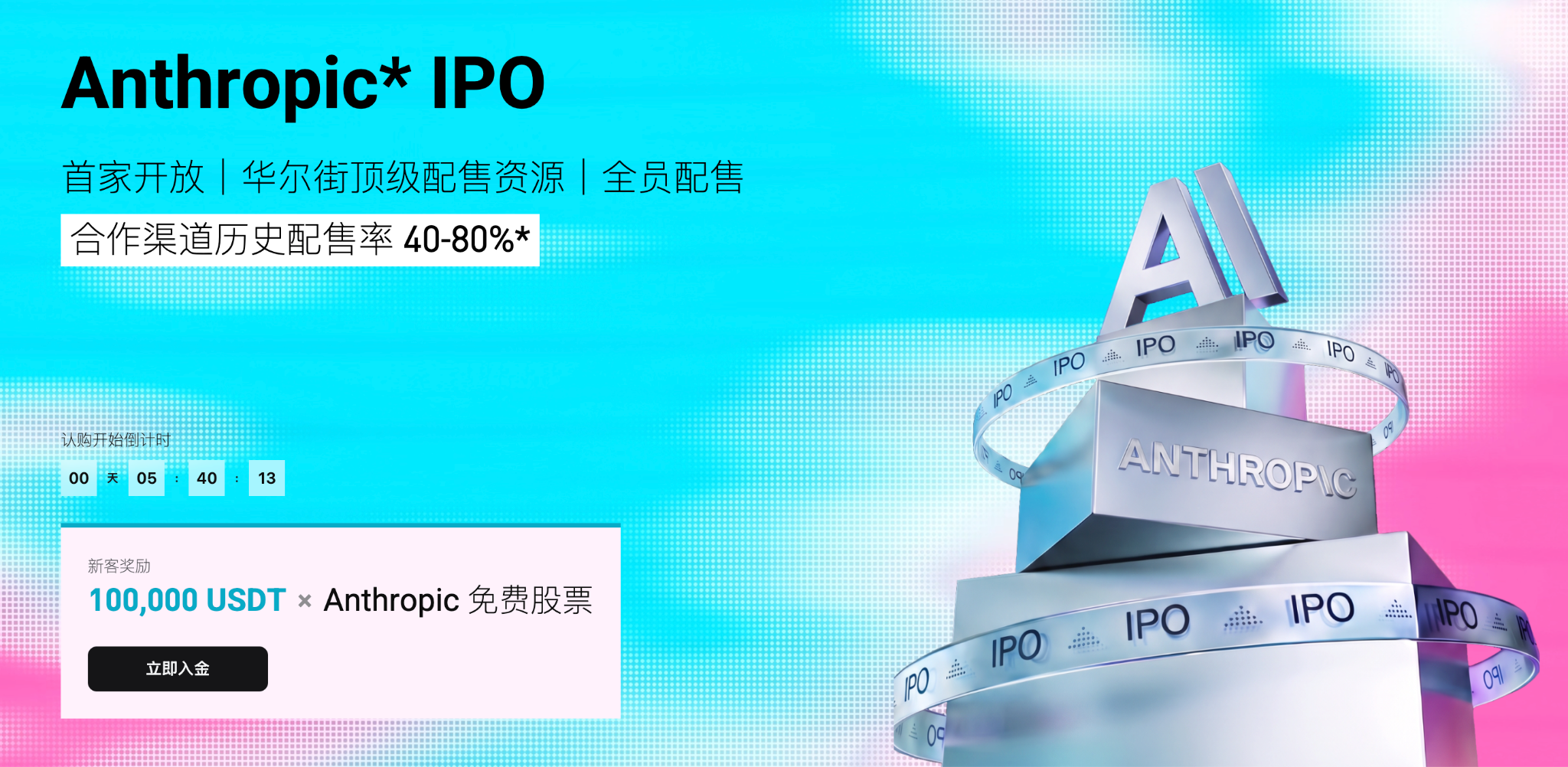
According to Bitget's disclosure, its partner channels have a historical allocation rate of 40% to 80%. However, this figure can only serve as a reference for the actual allocation ratio in Anthropic's current IPO; the final allocation still depends on the allocation results of the underwriting channels and will be distributed according to the proportion of user investment in each round.
In terms of asset delivery, the allocated assets will take the form of rANT tokens; as noted above, each rANT is backed 1:1 by actual Anthropic shares, and relevant corporate actions will also be reflected in the tokenized assets in sync. It should be noted, however, that rANT still differs legally from Anthropic shares directly registered and held by investors; holders will not simultaneously obtain shareholder status or voting rights.
In addition, product subscription fees are also an important factor affecting actual returns. The underwriting service fee for the public round is 5% of the actual allocated amount, while for the VIP round it is 12%; delivery times also differ between the two rounds—the public round is expected to be delivered before the market opens on listing day, while the VIP round is expected to be delivered within 3 to 5 business days after listing.
Alongside this event, Bitget has also set up a $100,000 Anthropic stock prize pool for new users. Users who meet the requirements for registration, deposit, subscription, and fund retention can all participate, further lowering the threshold for new customers to try it out.
From pre-listing linked tokens for SpaceX and OpenAI to actual stock-backed IPO subscriptions for Anthropic, Bitget IPO Prime is attempting to connect the allocation resources of traditional capital markets with crypto accounts, giving more people a chance to participate in hot IPOs that were previously difficult to access.
But when it comes to actual returns—especially for hot IPOs—securing an allocation is only part of the investment process; ultimate returns still depend on the offering price, allocation ratio, and post-listing stock performance.
Whether it is users who receive an allocation or those investors in the San Francisco Bay Area willing to trade luxury homes for shares, what they are essentially betting on is the value of Anthropic's sustained growth over the coming years.
Now, as the IPO approaches, this AI company's equity is about to enter a more public and more liquid capital market. Against a backdrop of strong demand and scarce shares, the debate and competition surrounding its trillion-dollar valuation will also enter a new phase.