

Tonight PPI Takes the Stage, Nvidia's CEO Shakeup, Nebius Falls Despite Strong Earnings: Is AI Starting to Pay a "Time Tax"?

One discounts governance continuity, the other discounts the timeline for profit realization. As the 10-year US Treasury yield approaches 5%, AI assets may be shifting from "telling growth stories" to "proving delivery."
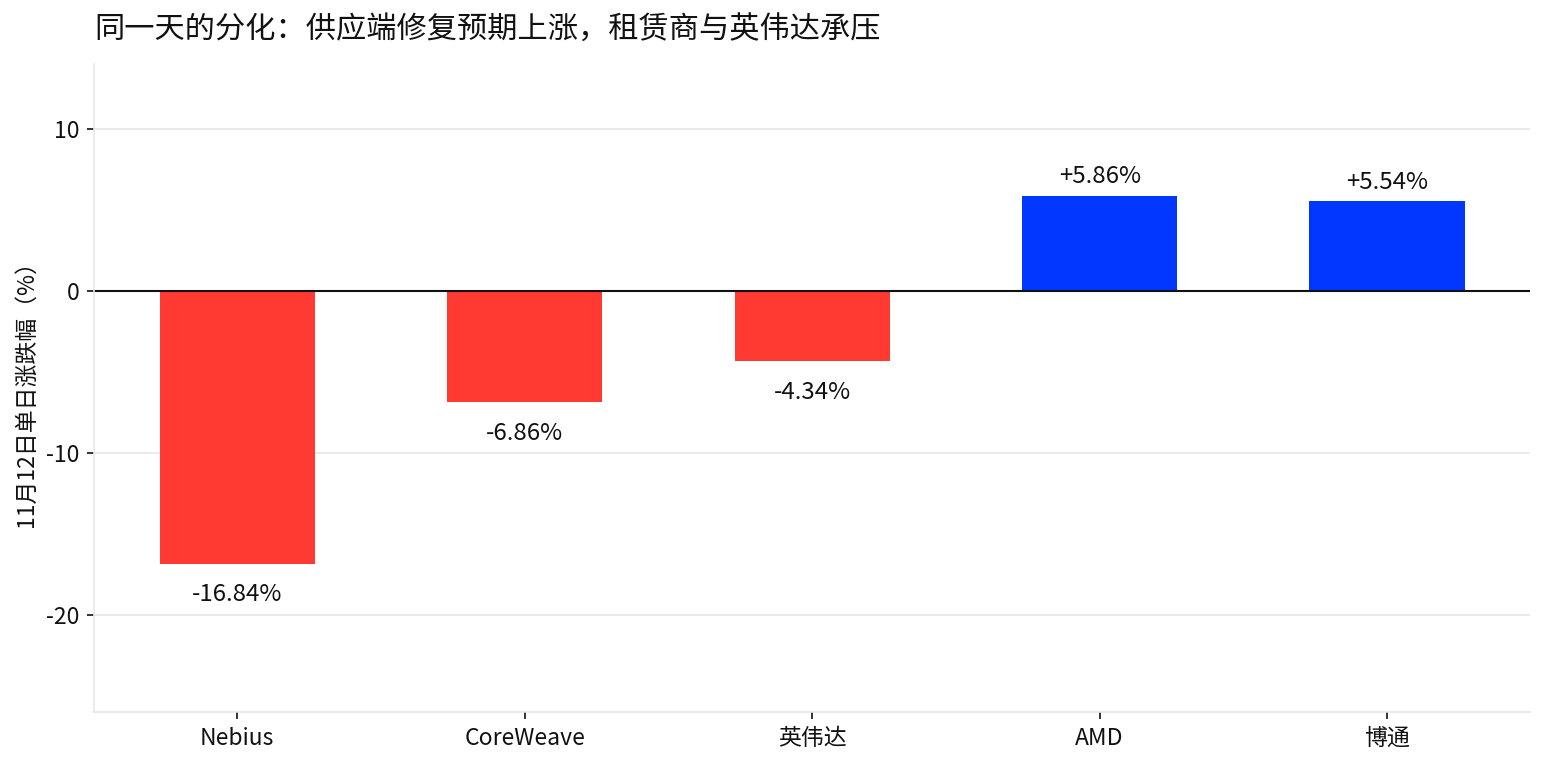
What the AI bull market is starting to charge may not be a "growth tax" but a time tax. On November 12, a rather telling combination emerged across the AI supply chain: upstream core chip supplier Nvidia abruptly changed its leadership, with the stock falling as much as 14.35% intraday; almost simultaneously, compute cloud service provider Nebius reported third-quarter results that clearly beat expectations, yet its stock closed down 16.84%.
The two companies face entirely different problems. Nvidia's problem is "who will continue to steer the ship," while Nebius's problem is "when will it be delivered." But the market's answers leaned in the same direction: in the past, as long as growth was fast enough, many problems could be put off; now, governance, delivery, capital expenditure, and realization timelines are all starting to feed directly into valuations.
The macro environment behind this has also changed. The 10-year US Treasury yield approaching 5% means the opportunity cost of capital can no longer be ignored. For an AI company that needs to continuously invest billions or even tens of billions of dollars while relying on future capacity release for revenue, a six-month delay is no longer just a project management delay—it may directly mean higher funding costs, longer payback periods, and lower valuations.
So what was most noteworthy on November 12 was not that AI suddenly became worthless, but that the market is no longer buying AI's forward growth for free.
1. Nvidia Falls 14% Intraday: What Exactly Is the Market Cutting Off?
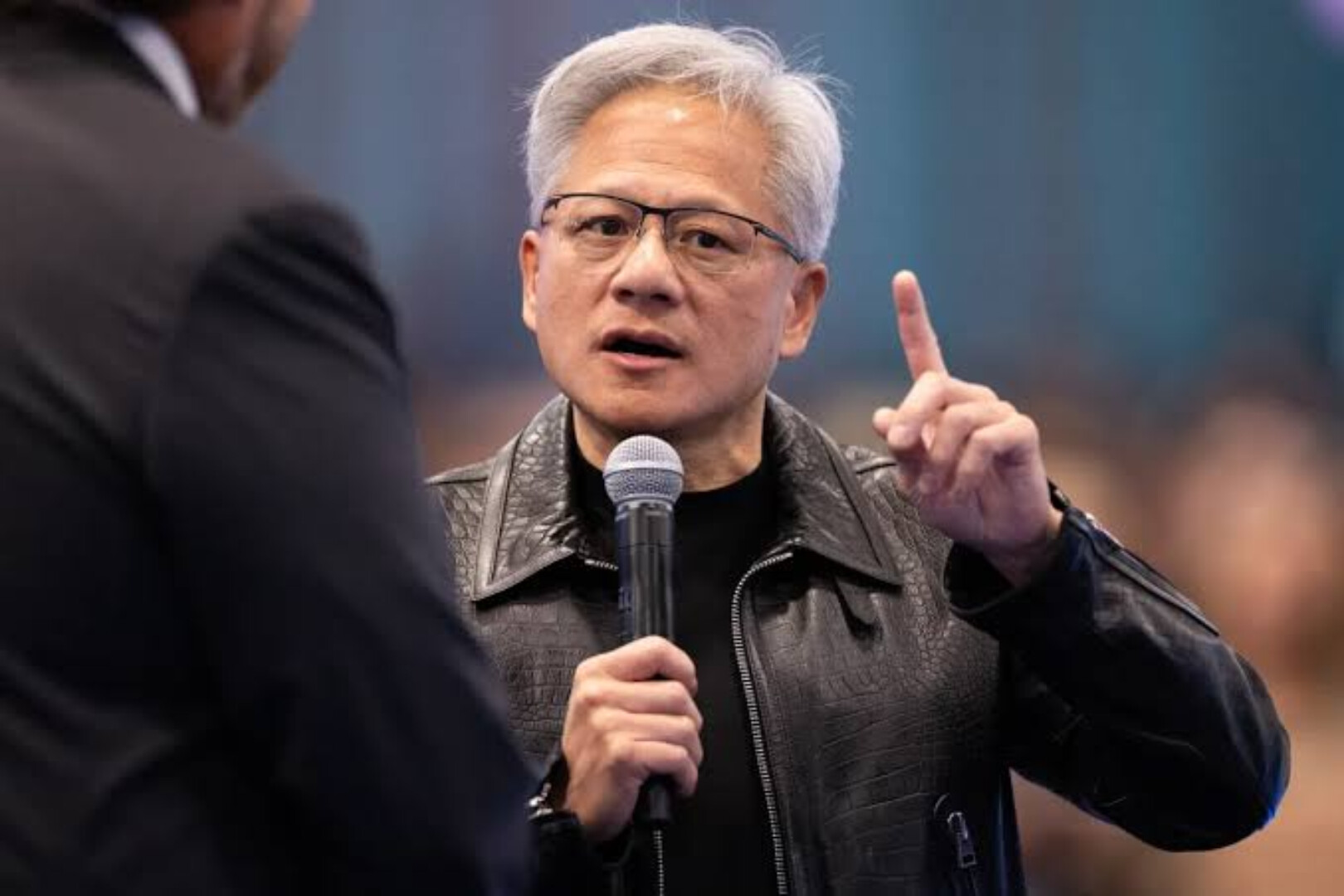
What is truly worth observing about Nvidia this time is not just the final 4.34% decline, but the 14.35% intraday plunge and the subsequent pronounced recovery. According to the company's announcement, Jensen Huang resigned from his roles as President, CEO, and board member, effective immediately; CFO Colette Kress assumed the role of interim CEO, former Synopsys CEO Harvey Jones became Chairman of the Board, and the board simultaneously launched a search for a new CEO. After the news was released, Nvidia opened at $151.01, touched a low of $148.80, at one point down 14.35% from the previous trading day's close, before the decline rapidly narrowed and the stock finally closed at $166.19 (see Figure 1 for position changes over the past 40 trading days).
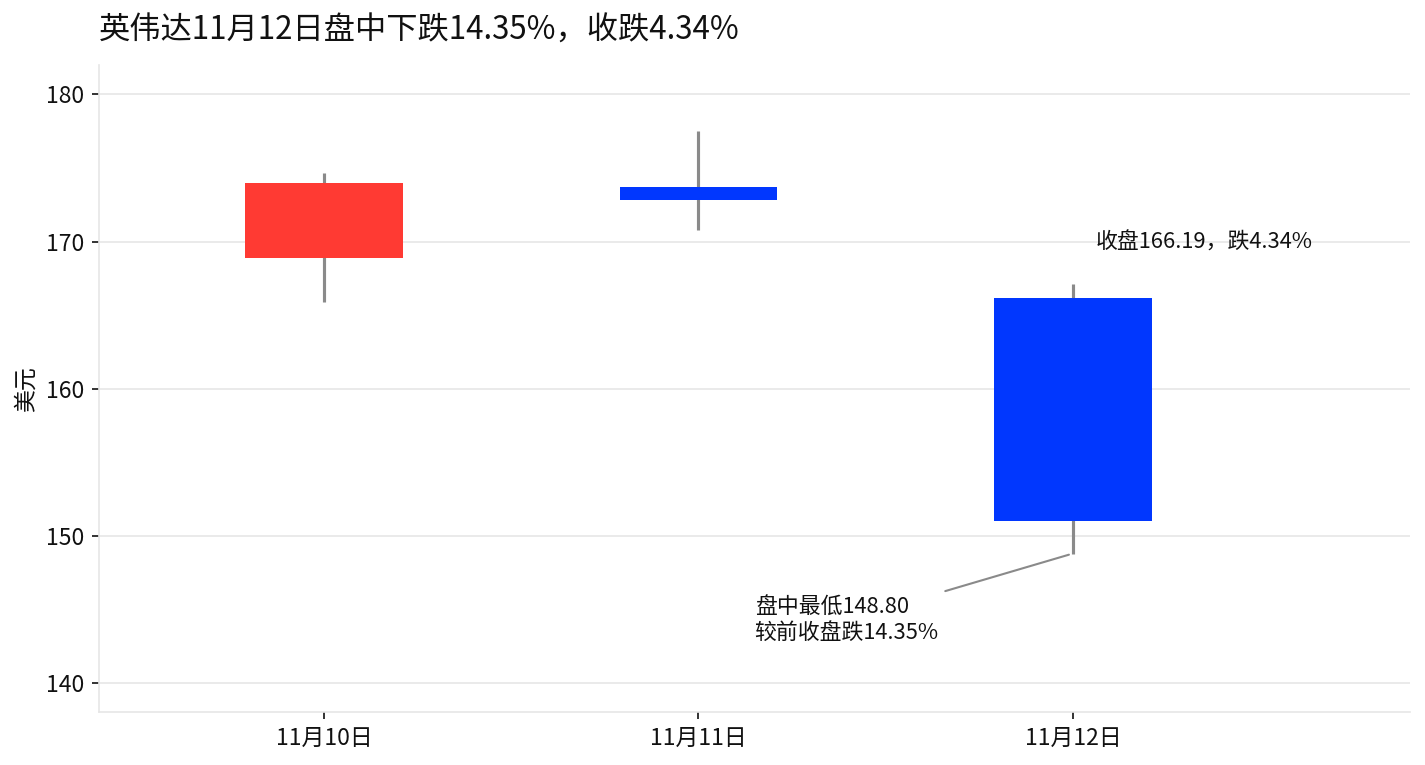
This price action itself already provides an important signal: what the market sold off first was probably not "AI demand" but governance risk.
If investors broadly believed that Nvidia's fundamentals had undergone a fundamental change, the intraday plunge would typically not have recovered so noticeably. The price climbing back above $160 suggests there are still funds that believe GPU demand, data center capital expenditure, and Nvidia's existing ecosystem have not immediately disappeared because of the CEO's departure.
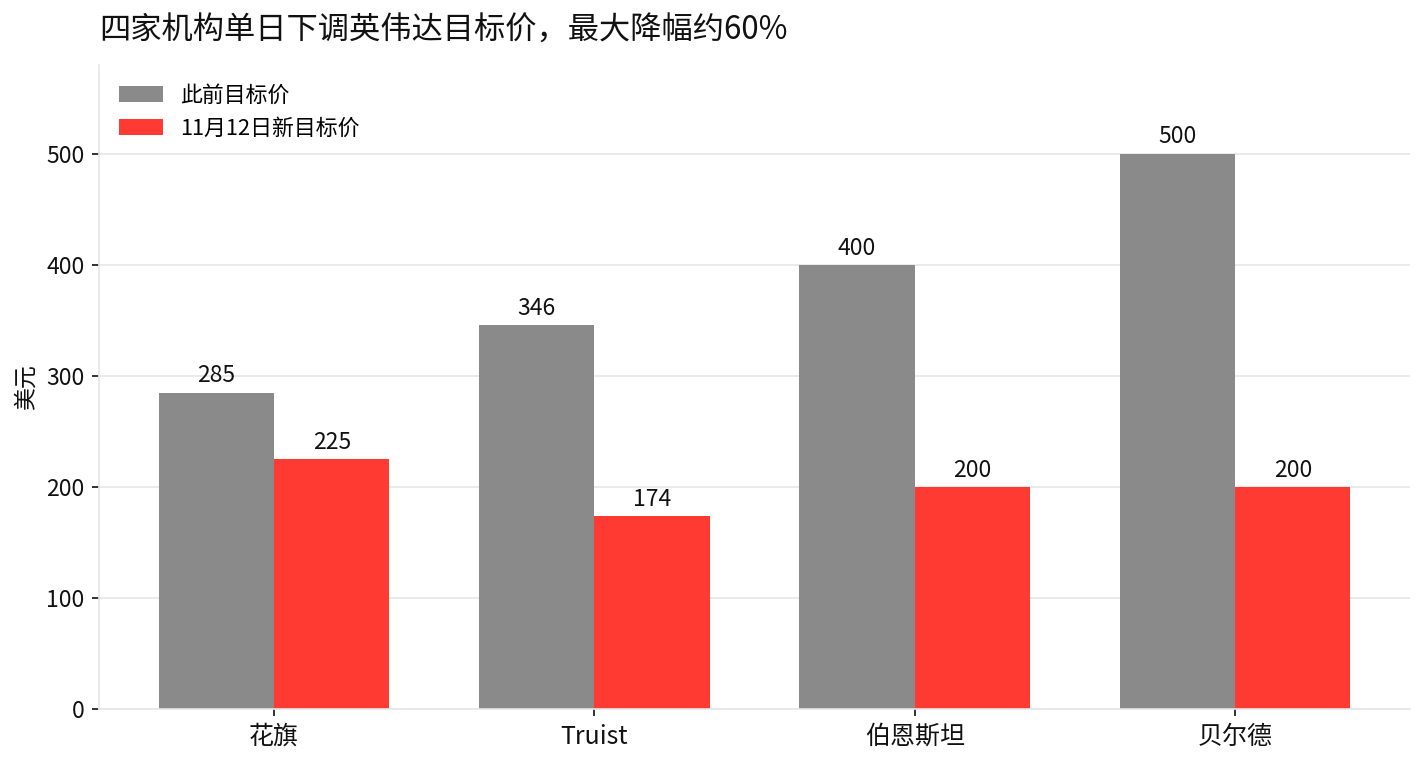
What truly changed quickly was the valuation. According to media reports, Baird cut its Nvidia target price from $500 to $200, Bernstein from $400 to $200, Truist from $346 to $174, Citi from $285 to $225, and Goldman Sachs to $220 (see Figure 2 for the five institutions' new target prices). The rapid reshuffling of target prices shows the market is trying to answer a question rarely discussed on its own in the past: how much of Nvidia's valuation premium was attributable to Jensen Huang himself?
This does not mean Nvidia's competitive advantages will disappear with the leadership change. GPU product iteration, the CUDA ecosystem, customer relationships, supply chain coordination, and data center demand remain the fundamentals. What truly needs to be re-verified is whether this system can maintain its past decision-making speed and execution efficiency without Jensen Huang personally at the helm.
Therefore, the importance of the November 17 earnings report is no longer just "whether revenue beat expectations," but whether management can convince the market that the leadership change will not alter the pace of realization in the AI compute cycle.
2. Why Does Nebius Fall the More Its Results Improve? The Market Has Started Charging for Delays
If Nvidia is trading governance risk, then Nebius is trading a more direct "time risk."
Nebius's third-quarter revenue reached $981 million, up 571% year-over-year, above the market expectation of $908 million; adjusted EBITDA reached $466 million, above the expected $357 million; adjusted net income was $90.9 million, while the market had previously expected a loss of about $271 million.
Looking at the third-quarter report alone, this is clearly not a set of results that should have been sold off. The problem is that the market is no longer looking only at the past three months, but is recalculating capital returns for the next 12 months.
Full-year 2026 revenue guidance landed at the low end of the $3.0 billion to $3.4 billion range, below the market's previous expectation of about $3.35 billion; at the same time, capital expenditure was raised from the previous $20 billion to $25 billion to about $27 billion, and is set to reach $40 billion to $45 billion in 2027. More critically, the company's previously expected timing for annualized revenue to exceed $7 billion was pushed back from December 2026 to February 2027, and some third-party data centers, due to construction and power supply delays, will see compute capacity originally scheduled to come online in 2026 delayed to the first half of 2027 (see Figure 3 for a comparison of guidance and expectations).
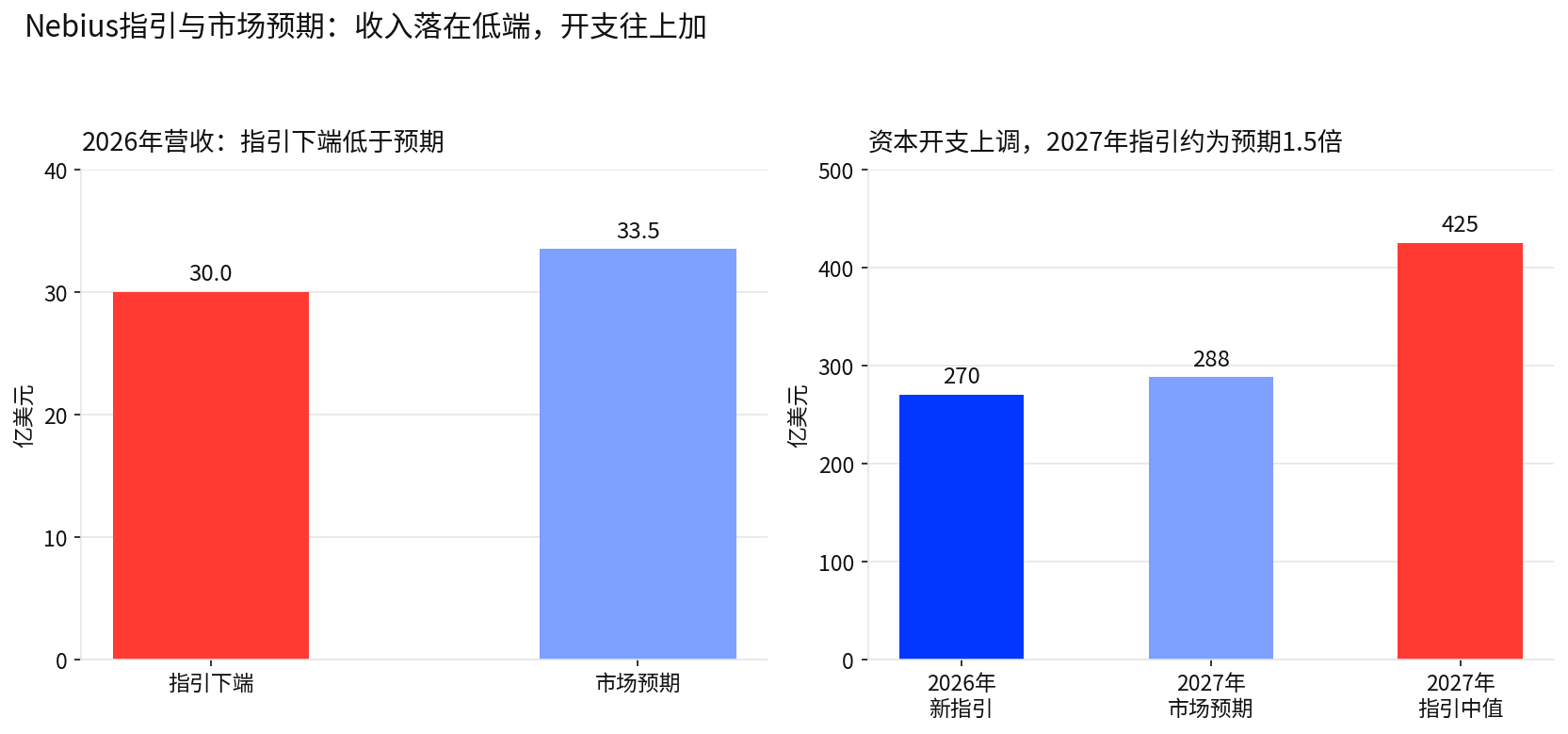
So the market saw a very realistic calculation: revenue realization was delayed, but capital expenditure not only did not be postponed in tandem, but continued to increase. That is why Nebius's stock did not rise despite the earnings beat.
The stronger AI compute demand is, the larger infrastructure investment tends to be; the larger the investment, the higher the capital tied up; the higher the capital tied up, the more important the project commissioning timeline becomes. When the risk-free rate is very low, the market can be patient with revenue six months or even a year out; when the 10-year US Treasury yield approaches 5%, waiting itself has a cost.
Therefore, Nebius this time is not telling the market "AI demand is bad," but telling the market: even if demand is good, if revenue comes six months late and capital expenditure continues to rise, shareholders may need to bear more costs for that waiting period.
That is the true meaning of the "time tax."
3. Nvidia Looks at "Who Does It," Nebius Looks at "When It Gets Done": AI Valuation Rules Are Changing
Looking at the two companies together, the November 12 price action is no longer two isolated events. What was repriced for Nvidia was governance continuity; what was repriced for Nebius was realization timing. See Figure 4 for the divergence across the entire chain on the same day.
In the past, these two variables were easily obscured by rapid growth: as long as the market believed AI demand would continue to explode, who the CEO was could be discussed later, and capacity being a few months late could be understood as demand being too strong.
It is still willing to pay for growth, but no longer willing to pay the same price for all forward growth. Investors are starting to ask more specifically: when will revenue appear? How much capital expenditure is needed? Does the project have power, and how much capacity has actually been commissioned? Can customer contracts convert into cash flow? Does management have the ability to execute at the original pace?
That is also why November 12 cannot simply be defined as "the end of the AI bull market." If AI demand had truly suffered a structural decline, the first things to be hit should be supply chain revenue and orders themselves. But these two cases at present seem to illustrate something else: AI demand remains strong, but the market is starting to lower its tolerance for "it will definitely be realized in the future."
This has a big impact on stock-picking logic going forward. In the past, one could focus on finding companies with "the largest AI opportunity"; now it is necessary to further distinguish: who has already started making money, and who is still waiting for capacity; whose capital expenditure can quickly convert into revenue, and who needs to keep raising funds; who has a stable governance and execution system, and whose core competitiveness is highly dependent on a key individual.
4. This Calculation Will Propagate Along the Supply Chain: AMD and Broadcom Benefit, but Not Unconditionally
After Nvidia's leadership change, the most direct relative trade has already appeared in the supply chain. On November 12, AMD rose 5.86% to close at $585.30; Broadcom rose 5.54% to close at $364.36, forming a clear contrast with Nvidia. When the market was reassessing Nvidia's governance risk, it naturally shifted some funds' attention toward second-source suppliers.
But two concepts need to be distinguished here: a reshuffling of supply share does not equal an increase in total AI demand. If Nvidia's governance risk is only a short-term event and data center capital expenditure continues to grow, then AMD and Broadcom may indeed gain higher relative attention; but if Nvidia's subsequent earnings prove that AI capital expenditure itself is slowing, then "funds flowing from Nvidia to AMD and Broadcom" will be hard to sustain as a logic.
Nebius and CoreWeave represent another kind of risk. They are highly sensitive to compute demand and also more dependent on financing conditions, data center construction, and capacity deployment. Once rates remain high, companies with larger capital expenditure will be more sensitive to funding costs and project delays. On November 12, CoreWeave fell 6.86% to close at $56.60, while Nebius fell even more, indicating the market is重新 distinguishing between "AI demand beneficiaries" and "AI capital-intensive executors."
In other words, what the AI supply chain truly needs to watch in the next stage is not just how many orders there are, but whether orders can convert into revenue on schedule, and then from revenue into cash flow. That is also why Nebius's reaction this time is more noteworthy than a simple earnings miss.
5. Tonight's PPI Is an Amplifier: The Higher the Treasury Yield, the More Expensive the "Time Tax"
The two selloffs on November 12 did not happen in a vacuum. October CPI had already come in above expectations, and the market's pricing for the December rate decision clearly leaned toward a hike. Tonight's October PPI release will further affect the market's judgment on inflation and the rate path.
If PPI continues to come in above expectations, market pricing for higher-for-longer rates may further heat up, and high-valuation, long-duration AI assets will face greater discounting pressure. Conversely, if PPI cools noticeably and Treasury yields fall back, some of the previously compressed AI valuation premium may regain support.
So when looking at the AI market now, don't just stare at how many basis points the Fed will hike next time; watch how the 10-year US Treasury yield moves. Because for AI companies that need years of capital investment to realize profits, what interest rates determine is not a small decimal change of one percentage point, but how much of a discount future cash flows should receive.
That is also why Nvidia's November 17 earnings report sits in a very sensitive position: PPI first sets the tone for the rate environment, and then Nvidia uses its earnings to verify AI demand and profit realization. With these two variables stacking, the market's tolerance for high-valuation AI assets could continue to change rapidly.
6. Nvidia's November 17 Earnings Report: Don't Just Look at "Beat Expectations"—These Are the Things to Really Watch
Nvidia will release its fiscal 2027 third-quarter earnings after the market close on November 17. According to media reports, the market currently expects revenue of about $108.8 billion and earnings per share of about $2.47.
But after the leadership change, this earnings report can no longer be read as an ordinary one. The most important things remain the data center business and next-quarter guidance. If revenue growth and orders remain strong, it will show that the AI capital expenditure cycle itself has not been noticeably affected by the management change; if gross margin also remains stable, the market's concerns about "the leadership change hitting fundamentals" will ease noticeably.
The new variable comes from governance. How will interim CEO Kress explain the transition arrangements? Does the board have a clear timetable for a formal successor? Can the market see a candidate who is sufficient to prove strategic continuity? The answers to these questions determine whether the previously cut "governance premium" can come back.
Ecosystem commitments are also worth watching. These include the subscription commitment to Anthropic and the shareholdings and partnerships with ecosystem companies such as Nebius. If there are noticeable adjustments, the market will further question Nvidia's future capital allocation logic.
On the price level, $166.19 can serve as an important observation area before earnings, while $148.80 is the intraday low of the extreme event on November 12. These should not be simply understood as mechanical "support levels," but are better seen as two observation points for how far the market has priced in governance risk. If fundamentals remain strong after earnings and the succession arrangement is clear, the market has a chance to gradually recover part of the governance discount; if fundamentals also start to change, then the previous intraday low could again become a reference point.
The same logic applies to AMD, Broadcom, Nebius, and CoreWeave: don't rush to conclusions based on one day's relative strength or weakness; watch whether that relative strength or weakness can persist after November 17.
Final Thoughts: Maybe the AI Bull Market Isn't Over, but "Free Waiting" May Be
The two cases on November 12 expressed very directly the changes taking place in AI valuation. Nvidia told the market that governance continuity, once taken for granted, now also needs to be repriced; Nebius told the market that even if the business has already started making money, as long as the revenue realization timeline is delayed and capital expenditure continues to rise, the market will likewise demand a discount.
So what has truly changed in this market may not be AI demand, but how much the market is willing to pay for the future, and how long it is willing to wait. In an environment where the 10-year US Treasury yield is approaching 5%, PPI is about to be released, and Nvidia's earnings report is approaching, judging AI assets going forward can no longer just ask "whose AI story is the biggest," but must further ask: who has already turned growth into revenue, who has already turned revenue into cash flow, whose capital expenditure can generate returns on time, and who still needs the market to keep waiting patiently.
This is also the most noteworthy dividing line for the AI market going forward. If Nvidia's November 17 earnings report proves that demand remains strong, while the succession arrangement is clear and ecosystem commitments are stable, then this adjustment is more likely to be a repricing of the governance premium rather than a reversal of the AI industry trend. Conversely, if governance uncertainty continues to expand, compounded by high rates and a lengthening payback cycle for capital expenditure, then the "time tax" that has already appeared at Nebius could spread from an individual company's problem into the valuation rule for the entire AI infrastructure sector. AI can still grow, but the market is starting to require it to deliver on time.
Disclaimer:
This content is for general informational and market commentary purposes only, based on public information available as of the time described in the article, and relevant market data, expectations, and probabilities may change with market conditions. The views and investment strategies of third-party institutions, analysts, or other persons cited in the article represent only those third parties' views at specific times and do not represent BIT's views or recommendations. This article does not constitute investment advice, investment research, an offer, solicitation, or recommendation of any securities, investment products, or trading strategies, nor should it serve as the basis for any investment decision. Financial markets involve risk, securities prices and market performance may fluctuate, and historical performance and past market trends do not represent or guarantee future results. Investors should independently assess relevant risks based on their own circumstances and seek professional advice when necessary.