


The market's focal question: Is AI capex "peaking" or undergoing a "mid-cycle correction"?

Author: Dong Jing
Source: Wallstreetcn
The behavior patterns of financial markets are increasingly resembling a peak in the AI capital expenditure cycle, even though there is currently no convincing "real-economy evidence" to support this judgment. Jefferies believes that the core divergence in the current market is: is this the true peak of the AI capital expenditure cycle, or a mid-cycle correction within an upcycle?
According to Wind Trading Desk news, Jefferies stated in its latest research report released on November 19 that around this core judgment, multiple risk signals are fermenting simultaneously.
Nvidia's role as the "central bank" of the AI ecosystem faces pressure from a governance shift; once its massive off-balance-sheet financial exposure contracts, it will have a systemic tightening effect on the entire AI financing chain;
At the same time, the earnings quality of hyperscalers is being scrutinized more strictly by the market—after excluding non-cash book gains from AI-related investments, their core earnings growth is far below the headline figures;
In addition, the U.S. Department of Commerce's Bureau of Industry and Security (BIS) announced license requirements for AI chip exports to several Southeast Asian countries and Brazil, further reshaping the geographic distribution and pace of expansion of global computing power capital expenditure.
The firm believes that the above three logical threads are intertwined, jointly constituting the core controversy over the characterization of the current AI capital expenditure cycle.
Market Signals and Cycle Characterization: Pricing Ahead of "Ground-Level Evidence"
The Jefferies report explicitly points out that the behavior patterns of financial markets are increasingly resembling a peak in the AI capital expenditure cycle, but there is still a lack of convincing "ground-level evidence" proving this judgment holds.
The report continues the analytical approach of its previous research report on November 5, tentatively taking market signals as the benchmark and framing the current situation as a debate between two scenarios:
First, this is the true peak of the AI capital expenditure cycle; second, this is merely a mid-cycle correction within an upcycle.
The report believes that before more fundamental evidence emerges, this judgment remains unresolved and is the most critical characterization issue facing investors today.
Nvidia's "Central Bank" Role: Massive Off-Balance-Sheet Exposure and Governance Shift Risk
Nvidia has deeply served over the past two years as the "financier" and "guarantor" of the entire AI ecosystem, and the scale of its financial exposure far exceeds the market's previous general understanding. According to a compilation published by Tomasz Tunguz on November 12, Nvidia's related commitments include:
$42 billion in technology acquisition commitments;
$61 billion in equity investments, covering 229 startups and 13 public companies;
$164.5 billion in lease guarantees and cloud computing capacity backstops, requiring corresponding capital reserves;
$63.1 billion in customer accounts receivable, with payment terms of up to one year.
Changes at the governance level are drawing market attention. Colette Kress, who served as Nvidia's Chief Financial Officer for 13 years and now also serves as interim CEO, holds reservations about the above large-scale financial risk exposures. The report believes that once Nvidia shifts from an aggressive matchmaking model to more prudent financial discipline, Nvidia—as the "bellwether" of AI trades—will have a clear tightening transmission effect on the entire AI capital expenditure and financing chain.
"Neoclouds" are under particularly prominent pressure. Nvidia previously regarded "neoclouds"—data center startups—as an important source of alternative computing demand beyond hyperscalers. It is worth noting that, including Google parent Alphabet's TPU, all major hyperscalers are advancing self-developed chips.
As the related turmoil fermented, CoreWeave's stock price has pulled back 25% since the news emerged, and its dollar bond yield has risen to about 15.7%, showing strong credit and survival pressure.
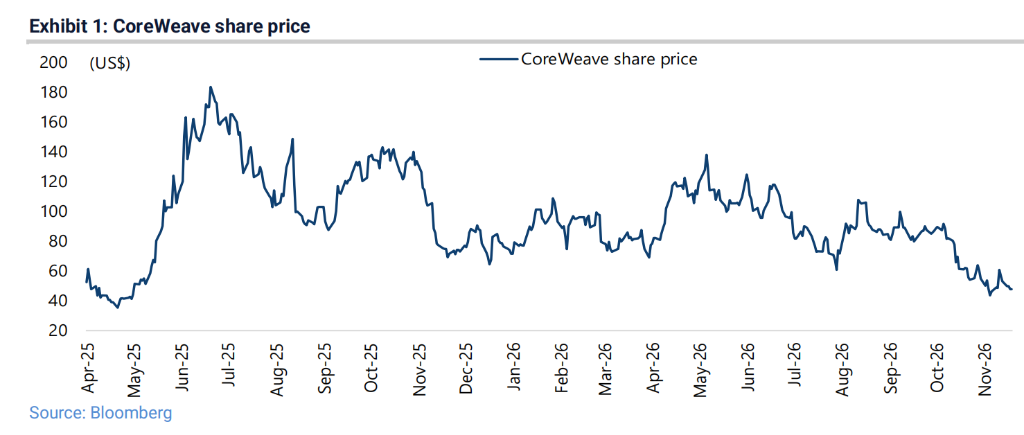
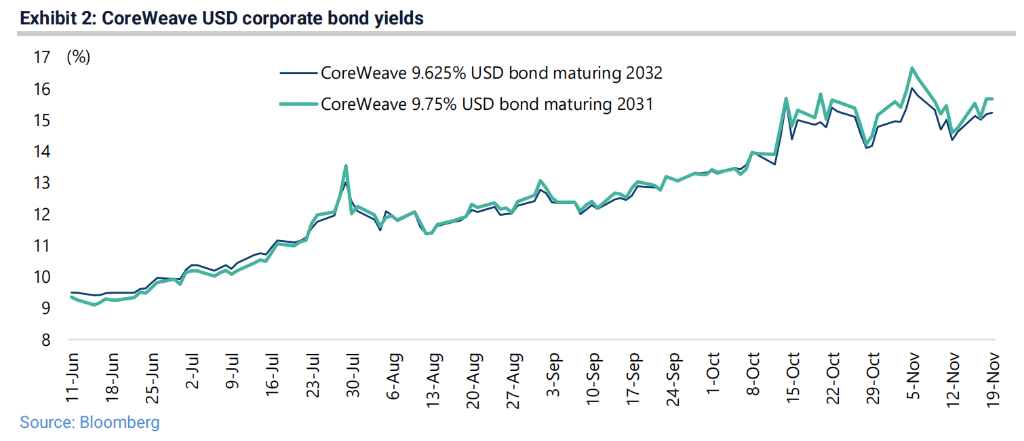
The report believes that if the most speculative segment of computing demand shrinks, it is expected to depress computing prices for other participants, thereby putting pressure on repricing the entire AI computing supply-demand landscape.
Deconstructing Hyperscaler Earnings: A "Reflexivity" Warning on Capital Expenditure Returns
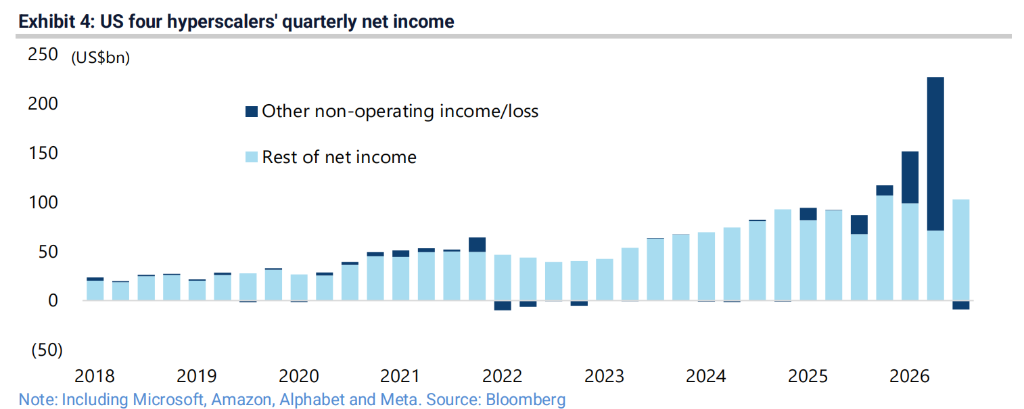
The Jefferies report conducts an in-depth decomposition of the profit structure of four hyperscalers—Microsoft, Amazon, Alphabet, and Meta—revealing that earlier earnings growth relied to a large extent on non-cash book gains from AI-related investments, rather than substantive improvement in core operating profit.
The "other non-operating gains/losses" item tracked by the report mainly includes non-cash items such as unrealized book gains/losses on unlisted AI-related investments. The quarterly aggregate for this item abruptly reversed from +$155 billion in 2Q26 to -$9 billion in 3Q26, directly reflecting the book giveback brought by the recent decline in AI-related asset prices.
On an annualized basis, the data is equally telling: for the trailing 12 months ended 3Q26, the combined annualized net profit of the four companies rose 73% compared with the 12 months ended 1Q25, an increase of $248 billion (from $340 billion to $588 billion). However, within this increment, annualized "other non-operating income" soared 18-fold from $12 billion to $209 billion, contributing the vast majority of the increment ($198 billion); while the remaining annualized net profit after excluding this item grew only 15%, an increase of $51 billion (from $329 billion to $379 billion).
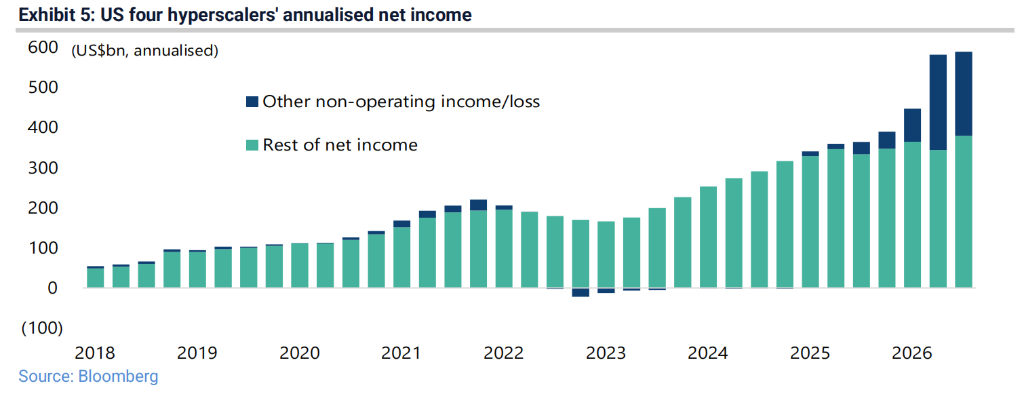
The report points out that this highlights the amplifying effect of the "reflexivity" of the earlier AI bull market on book profits, and also makes the market increasingly sensitive to the actual return on massive capital expenditure. As AI-related asset prices adjust, this "reflexivity" is now operating in the opposite direction.
At the same time, the U.S. Department of Commerce's Bureau of Industry and Security (BIS) announced export license requirements for AI chip exports to Southeast Asian countries and others.
The triple pressures of tightening export controls, upgraded regulatory scrutiny, and a tightening financing environment mean that cross-border computing expansion and some data center projects relying on external funding will face higher compliance and funding thresholds. The report believes this will affect the geographic distribution and expansion slope of global AI capital expenditure.