HIP-4 무허가 배포 개방, Hyperliquid가 Polymarket을 무너뜨릴 수 있을까?

Original | Odaily Planet Daily (@OdailyChina)
Author | Golem (@web3_golem)
As soon as the World Cup ended, Hyperliquid dropped a "nuclear bomb" into the prediction market赛道.
On July 20th, Hyperliquid announced that HIP-4, like HIP-3, will support permissionless deployment in the future. The staking requirement for HIP-4 deployers is also 500,000 HYPE, which will be locked for 6 months. HIP-4 deployers can set a fee split of up to 50% in deployed markets. This feature will first be released on the testnet before going live on the mainnet.
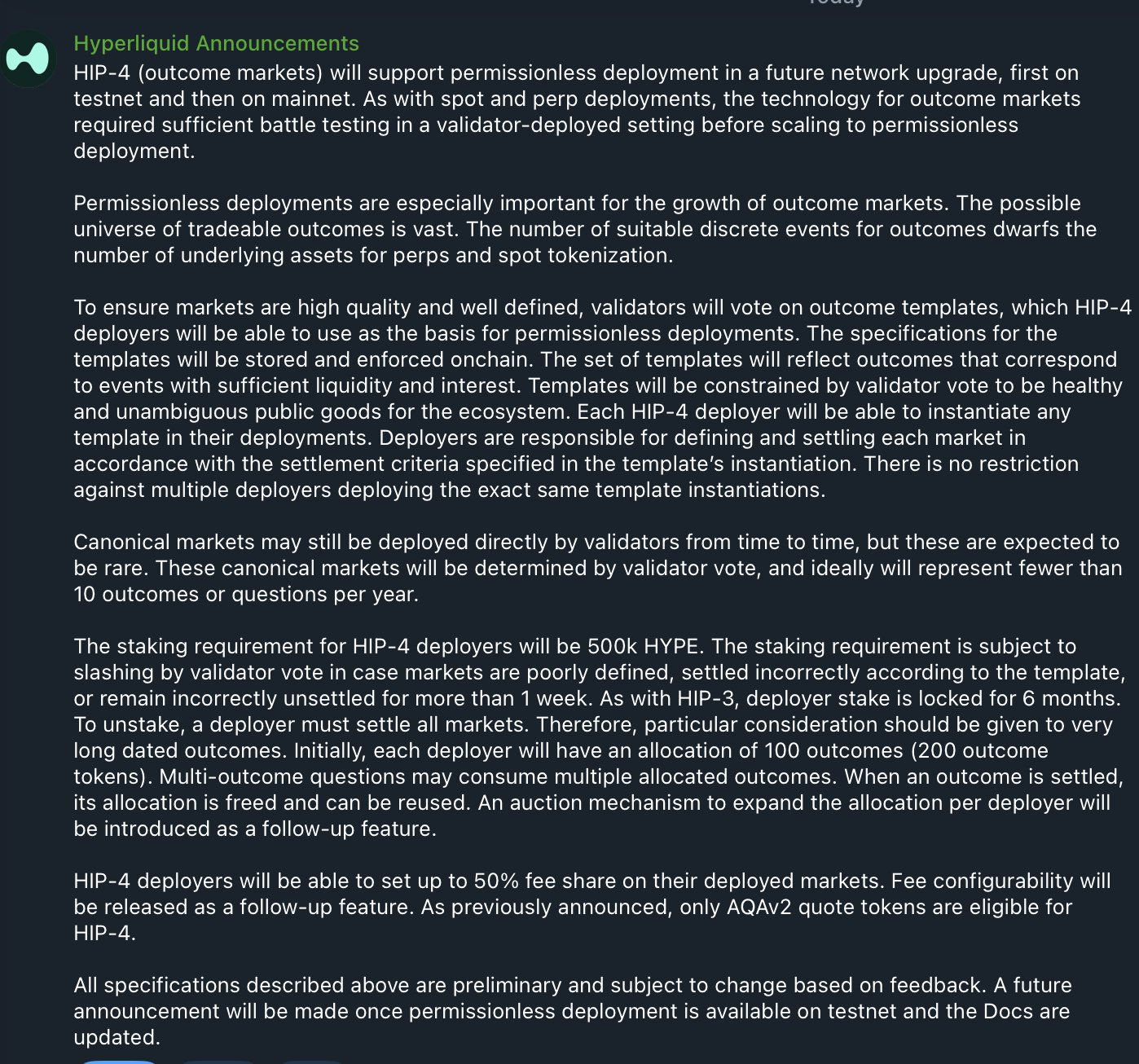
Hyperliquid announces permissionless deployment for HIP-4
Although Hyperliquid's announcement is just a preliminary notice and the specific launch date for HIP-4's permissionless deployment hasn't been confirmed, the market has already become excited following the news.
Hyperliquid's rise to become the world's largest platform for equity tokens and on-chain perpetual futures for commodities, even beating traditional financial markets to the punch for IPO pricing, is largely thanks to launching HIP-3 in October 2025 and opening up permissionless creation of perpetual futures markets for third parties.
Therefore, this time, investors believe Hyperliquid can once again leverage the power of "decentralization" to leapfrog all the leaders in the prediction market sector.
Who Will Be the Next Trade.xyz?
Hyperliquid launched the HIP-4 market on May 2, 2026, marking its official entry into the prediction market arena. Before its launch, the market had high hopes it would become Hyperliquid's next core narrative. However, nearly three months since its actual debut, its performance can only be described as poor.
According to official data from Hyperliquid, the cumulative trading volume of the HIP-4 market over the past three months was only $216 million, with an average daily volume of just $10 million, a peak daily active user count of only 7,000, and total fee revenue of just $442.38. In comparison, according to DeFiLlama data, Polymarket's trading volume in the past month alone reached $4.587 billion, generating $50 million in fees.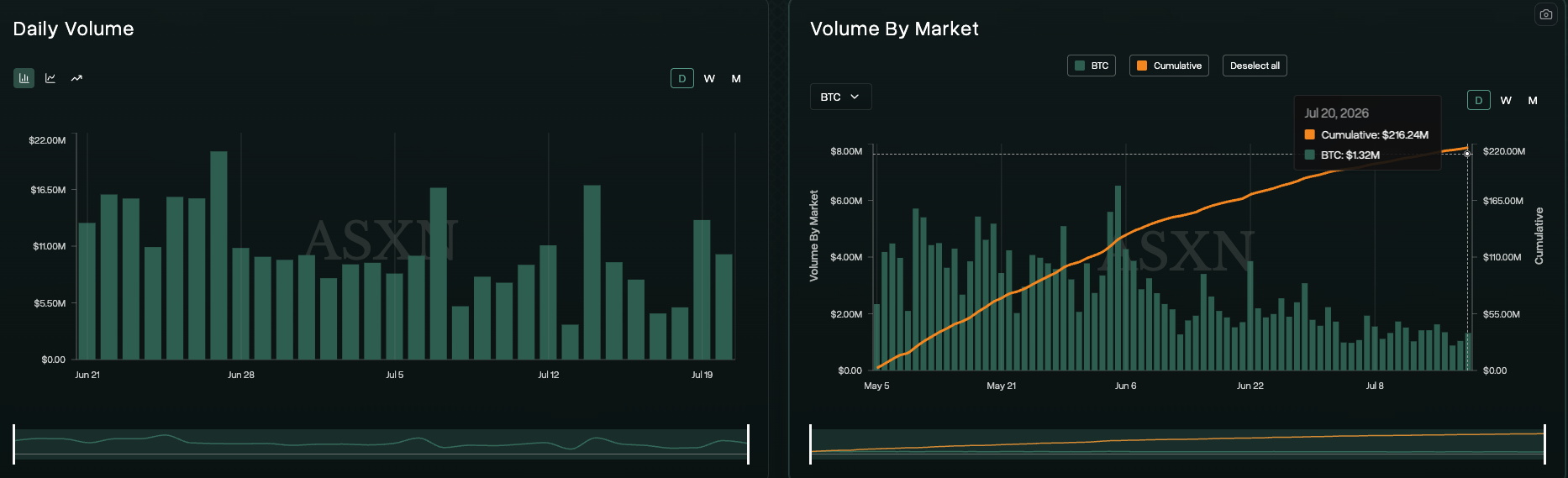
HIP-4 Average Daily & Total Trading Volume
Beyond the low user count and trading volume, the number of events with tradable outcomes on HIP-4 is also quite limited. Currently, the entire HIP-4 market features only 6 prediction markets, which is a drop in the bucket compared to Polymarket in terms of both quantity and variety.
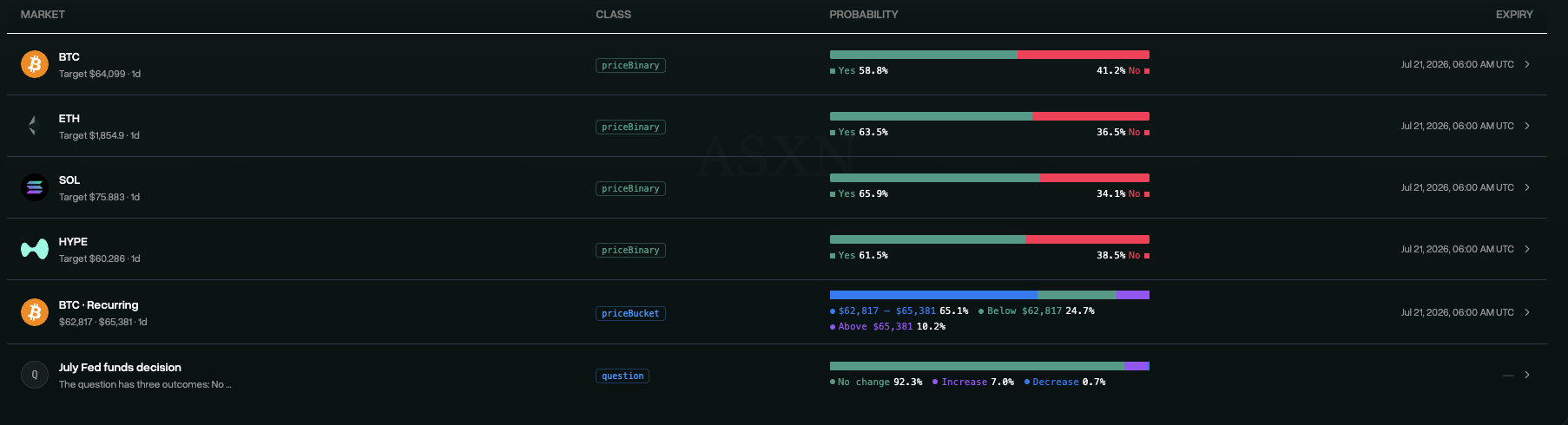
Currently tradable events on HIP-4
Faced with such a vast disparity in scale, Hyperliquid chose path dependency, following the successful playbook of HIP-3. Since it couldn't build it up internally, it decided to hand the stage over to the community and create another Trade.xyz within HIP-4.
Hyperliquid opening permissionless deployment for the HIP-4 market is akin to Polymarket allowing users to independently create prediction market events. Hyperliquid founder Jeff also stated that permissionless deployment is particularly important for the growth of outcome markets (HIP-4), as the range of tradable outcomes is extremely broad, and the number of independent events suitable for outcome trading far exceeds the number of underlying assets used for derivatives and real-world asset tokenization.
Furthermore, having the community or third parties deploy prediction market events offers greater flexibility. Currently, the creation of prediction market contracts is primarily handled by the core team or relies on community vetting. This process lacks sufficient decentralization, and team members cannot possibly cover all areas of interest. Especially for trending events in the real world, this model slows down the time from reacting to a trend to its final implementation and launch.
In the HIP-4 market, as long as they stake enough HYPE tokens, third parties can launch prediction market events according to their own standards without needing review from the Hyperliquid team. Hyperliquid has also stipulated that it will not restrict multiple deployers from launching identical events simultaneously. This is expected to incentivize healthy competition within the HIP-4 market, where only those offering users more comprehensive events and deeper liquidity will succeed.
Hyperliquid's product philosophy consistently revolves around a win-win strategy. The HIP-3 market has already nurtured the behemoth Trade.xyz, which commands over 90% of the HIP-3 market share. The top 10 perpetual contract assets launched on it have all seen trading volumes exceed $10 billion.
Perhaps many teams are already preparing. On the day Hyperliquid's mainnet opens up permissionless deployment for HIP-4, we may well witness a spectacular "clash of the titans."
Can Hyperliquid Disrupt the Prediction Market Landscape?
But can Hyperliquid really "rely on one trick to win them all"?
First, Hyperliquid is not the same as before. With the HYPE price stabilizing above $60, the requirement for HIP-4 market deployers to stake 500,000 HYPE (approximately $30 million) effectively locks out small startup teams. A crypto project's funding round today might not even reach $30 million, and a prediction market project capable of raising $30 million would likely prefer to develop its own prediction market platform.
Therefore, the excessively high staking threshold for HIP-4 deployers may drastically reduce the number of third-party competitors. Ultimately, only "well-funded" prediction market projects may come to cross-pollinate users, limiting the number of tradable independent events and severely hindering the innovative drive of the entire HIP-4 ecosystem.
Second, Hyperliquid missed the boat entirely with the timing of launching permissionless deployment for HIP-4. A primary reason why 2026 has become a golden opportunity for the prediction market sector is the密集 schedule of sports events in recent years, especially the quadrennial World Cup. Prediction markets have been heavily focused on World Cup matches. For example, on Polymarket alone, the total trading volume for the Argentina vs. Spain match on July 20th reached $83.75 million.
But Hyperliquid completely failed to capitalize on this critical World Cup window, which is undoubtedly a major strategic oversight. Even the success of the HIP-3 market resulted from a confluence of favorable factors, timing, and human effort. The volatility in international oil prices sparked by the US-Iran conflict in February of this year served as a key catalyst for the HIP-3 market's development. The first day of the war coincided with a weekend. With traditional markets closed, traders needing to urgently adjust positions and hedge were forced to find new tradable markets, making Hyperliquid's HIP-3 market the prime choice.
When Hyperliquid launched HIP-3, it didn't emphasize its creation for equity tokens and commodity tokenization. Yet, it eventually led to the rise of Trade.xyz and Hyperliquid's current dominant position in the tokenized trading market. Had Hyperliquid not capitalized on the opportunity presented by the US-Iran conflict, it might not hold a place in today's tokenized trading market.
Similarly, having missed the World Cup timing, how confident can Hyperliquid be now in disrupting the giants of the prediction market?