

Huobi Zhu Jiawei: Blockchain - a new mission under the positioning of new infrastructure | 2020 new district trend

Many authoritative experts and professors from financial institutions such as funds, securities, banks, and industry leaders gathered here to share new information on financial technology and explore the future potential of blockchain. (Link to the live broadcast of the summit:
Editor | Hao Fangzhou
Produced | Odaily
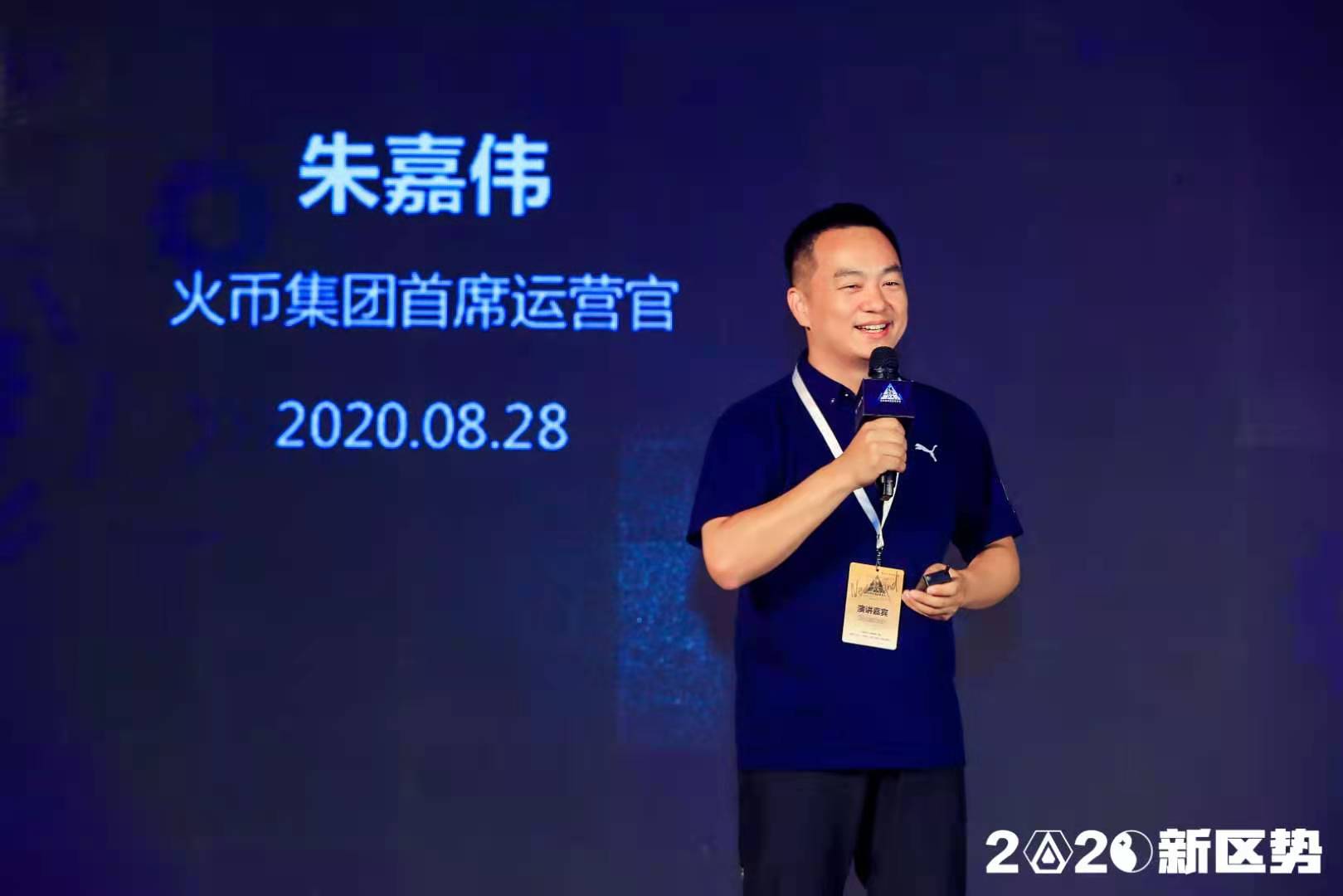
On August 28, the "2020 New District Potential Blockchain Technology Finance Summit" was held in Beijing.
This summit is co-hosted by Huobi Group, 36kr and Odaily, sponsored by Behelix & HBTC, strategically sponsored by ChainUP, specially sponsored by PayPal Finance, Conflux, BitUniverse, WaykiChain, XnMatrix, Hashi Co-sponsored by Technology, Mixpay, COCOS, and Shanghai Diyi.
Many authoritative experts and professors from financial institutions such as funds, securities, banks, and industry leaders gathered here to share new information on financial technology and explore the future potential of blockchain. (Link to the live broadcast of the summit:https://play.yunxi.tv/pages/27c9b4494d09487c8e9c9866e38895e8#/)
In the morning event, Zhu Jiawei, COO of Huobi Group, gave a keynote speech on "Blockchain--New Mission under the Position of New Infrastructure".
He said that China should have the right to formulate standards in the global blockchain competition. Master the pricing power of core assets and build the underlying blockchain financial infrastructure. Zhu Jiawei added that Huobi will also contribute its own strength. At present, Huobi China has implemented empowerment practices in more than 20 industries.
The following is the full text of the speech, organized by Odaily:
The following is the full text of the speech, organized by Odaily:
Hello everyone, I am very happy to share blockchain knowledge and observations on blockchain with you.
The theme shared with you today is called "Blockchain-New Mission Under the Positioning of New Infrastructure", which consists of four parts: one is policy trends, the other is development status, the third is application cases, and the fourth is 2020 highlights.
(1) Policy trends
On October 24, 2019, after Chairman Xi proposed the blockchain strategy, governments at all levels, business departments, and units are constantly promoting the development of blockchain.
Last month, the National Development and Reform Commission also held a press conference, defining blockchain as a new financial infrastructure. They compared all other infrastructure with the blockchain infrastructure, and divided them into several layers according to the strength of digitalization, including traditional infrastructure high-speed rail, supporting application voltage, industrial Internet, data centers, and so on.
The blockchain is the data sharing transmission layer, and the entire national strategy defines it as the transmission infrastructure, so what is the transmission? What is conveyed is value; if you go to the next level, what the standard Internet conveys is information.
Our country has adopted the blockchain as a national strategy, so we must establish our own system and establish standards, and we must lead it.
In each month of this year, many ministries, commissions and provinces have successively issued related policies on blockchain. For example, the Ministry of Industry and Information Technology issued the "Opinions on Promoting the Deep Integration and Development of the Express Industry and Manufacturing Industry". To create smart logistics and accelerate the deep integration of blockchain and other technologies with the manufacturing supply chain... We have also compiled some policy documents, as follows:
The blockchain is not only concerned by our country, almost all developed countries in the world are concerned about the development of the blockchain. We have created legal currency digital currency (DCEP), and dozens of central banks across the country are doing it; the blockchain industry is not only in our country, but also in Silicon Valley, and many start-up companies are also doing it. In this industry, we resonate with the world at the same frequency .
(2) Development Status
Next, we introduce the development status of the blockchain industry.
First, let me give you an overview of the development process.
In the early days, digital currencies focused on wallets, mining, exchanges, and more.
In 2014, an alliance composed of dozens of well-known financial institutions around the world was established, including giants such as Standard Chartered Bank, Deutsche Bank, and Ping An of China. But later, these banks all withdrew, because this alliance was just a group of people sitting together and discussing it, and everyone refused to accept the other.
In 2015, another alliance of traditional giants was established, including IBM, Intel, Hitachi and other companies, and they developed a project called Hyperledger (super ledger). At present, Hyperledger has been applied by many technology and financial companies.
During the same period, the Central Bank’s Digital Currency Research Institute was established, and we began to discuss whether legal currency digital currency would work, and what solutions should be used.
This year, we found that the central banks of many countries are discussing the necessity of digitizing legal currency, not only in China, but also in many European countries. Moreover, our country's central bank digital currency has also been put on trial.
In addition, decentralized finance has also achieved certain development this year, mainly in pledged lending and decentralized exchanges. At present, the amount of funds has reached billions of dollars, or even tens of billions of dollars.
In addition to the development of blockchain technology, stable coins and more new things have begun to appear, and on-chain financing is also in progress.
From 2015 to 2019, the amount of investment has been rising, but the trend has changed during the rising process. The original companies of this kind are more in Western countries, and now the transactions are gradually shifting from west to east: 51% of the investment targets 4 years ago It is an American company, and the Chinese company is only 2%; now, the American company has dropped to 31%, while the Chinese target has risen to 22%
From the comparison of non-enterprise blockchain and enterprise blockchain, there are more and more financing projects in non-enterprise blockchain. Cryptocurrency projects have also exceeded the financing amount of enterprise blockchain, which shows that the blockchain industry is still in the stage of building the underlying infrastructure, and more capital is going to the bottom layer, and there is no application to the upper layer, only the underlying foundation Only when the facilities are done well can the application to the upper layer be done well.
What does the underlying infrastructure include? Including public chains and alliance chains based on various forms.
The public chain can support the operation of digital assets, such as stable coins. At present, the number of global compliant stablecoins is about 10 billion US dollars. If it is popularized by 2.7 billion users around the world, the infrastructure will go up to a higher level. In a few years, stablecoins may reach the level of 100 billion US dollars, and many people will get used to it. Use stable currency for transfer, payment, and trade.
From the perspective of the distribution of blockchain industry applications, supply chain finance is the most common scenario, and it is also a very good landing scenario for blockchain. Blockchain can provide it with guaranteed credit endorsement.
As can be seen from this picture, blockchain applications are still very complicated and can be used anywhere.
Why is there such a phenomenon? The main reason is that the blockchain itself is the underlying technology, and it can be used for anything. The question is whether our application scenario is just needed? How to judge whether it is just needed? In our application scenario, can it work without blockchain? If it doesn’t work, we think it’s just needed, otherwise it’s just using the blockchain to hype the hot spots.
Every industry needs to have such a stage. The development of the Internet was the same more than 20 years ago. Everyone didn’t know what was just needed in the Internet field, so they made some things, and then continued to do it in the vertical field, and slowly discovered what was just needed.
In 2016, when I talked about the blockchain, I would talk about what Bitcoin is and what mining is. No need to talk about it now, everyone has basic background knowledge. Therefore, it is very important to discuss what rigid demand is now. This requires all industry practitioners and giants in traditional fields to discuss and practice together, and finally dig out rigid demand.
We expect that star-level applications may appear in the next 3-5 years. We have not seen them in the short term, and everyone is trying.
Judging from the current difficulties encountered by the industrial blockchain, the biggest difficulty is the scene, followed by funds, policies and talents. Talents are very scarce in the blockchain industry. If you want to change careers, I suggest you not wait any longer. Because the blockchain industry is currently in short supply of talents, we found that the supply of talents in this industry is in short supply, especially the technical talents of the blockchain, which are very important. I can tell you that because I also have a technical background, blockchain technology is actually not difficult and quite simple, so it is recommended to hurry up if you want to enter the blockchain.
After we have solved all these problems, the industrial blockchain can develop more abundantly. The Huobi Group has also been building. We have Huobi University. Huobi University and global universities jointly run schools to cultivate batch after batch of emerging talents.
You can imagine why China's Internet is so powerful today? On the one hand, because we have a large number of people, we can push Internet technology to a new height; on the other hand, it is because the mechanism and system for cultivating Internet talents in colleges and universities is sound.
Therefore, we now hope that more colleges and universities will introduce the discipline of blockchain and build the entire education system together. Cultivate more new talents within 3-5 years, and directly come out of colleges and universities to engage in this industry, and this industry will undergo new changes. This is what Huobi has been working on.
(3) Application scenarios
What are the current application scenarios of blockchain? Give some simple examples.
Recently, a memo from the U.S. Senate showed that the U.S. epidemic is very serious, so the infrastructure of Ethereum was used to vote, because there is no way to cheat and it is transparent. Possible applications of blockchain voting.
Huobi has also practiced blockchain implementation in the global blockchain industry.
We have implemented the application of blockchain points with the Petroleum Group. Through the points, the partners, customers, and the company itself of the Petroleum Group are tied together. The issuance and exchange of points can form a healthy operation and improve the company's performance and sales.
"One item, one code" blockchain management is a landing case of Huobi China. Through the blockchain traceability solution, the traceability of commodities, inventory management, and marketing platforms can be tied together, combined with the management of blockchain in the supply chain, it is possible to create a business scenario for the whole process of tracking.
In addition, Huobi has also developed blockchain + supply chain, blockchain + energy, blockchain + retail, and blockchain + finance. We have tried in every industry, but our own attempts are not enough. I hope to call on practitioners and companies in the blockchain industry to try together in different fields.
(4) What to watch in 2020
What are the key words in 2020? I have summarized a few: regulatory acceleration, institutional admissions, compliant stablecoins, digital identities, and blockchain infrastructure.
From a global perspective this year, many countries and regions are legislating. Russia already has legal support for digital currency transactions. This bill will be implemented in January 2021; in June this year, the United Kingdom required all blockchain and digital currency companies to register; this year Singapore also issued their bill to issue digital currency Exchange license; Hong Kong has also proposed a digital currency automated exchange license. A while ago, Hong Kong approved an enterprise in principle. This is a global trend.
Huobi Group holds digital currency exchange licenses in Japan, Thailand, Gibraltar and other countries. We hope to be able to conduct our business in these countries in a compliant manner, and to help these countries to build blockchain infrastructure together.
We found that in China, institutions enter the market more from the application of blockchain; on a global scale, financial institutions enter the market more from the perspective of investment. The well-known Grayscale Fund in our industry has also won the top spot in the field of digital investment, and its asset transaction volume has doubled this year; CME has launched Bitcoin futures trading in 2017, and Bakkt is also doing it. Compliant investment channels have become a high-speed railway for institutions to enter the market.
Compliant stablecoins are led by the central bank currencies of various countries. The central bank's digital currency is an innovative monetary policy that can improve the efficiency of currency delivery and accelerate the development of a cashless society.
In China, everyone may not realize it, because everyone has WeChat and Alipay. But in underdeveloped countries, many people do not have bank accounts, so we use the blockchain to go directly to digital payment. Once there is a legal digital currency, "helicopter money" can be easily realized, and it can be accurately distributed to every place. This is also a very good infrastructure for the internationalization of China's renminbi.
Once the stable currency is released, the 2.7 billion users around the world will feel the explosiveness of this matter. Argentine users use Facebook, and their supermarkets have QR codes to pay. What kind of changes will this country bring? This change may have been felt in China in 2015.
In terms of digital identity, take an example. At present, there is already a precise poverty alleviation application based on the identity chain. The identities of 300,000 citizens in Qingzhen City, Guiyang have been put on the chain, and the poverty alleviation funds can be tracked throughout the process, so that resources can truly help the needy. The other is the Dubai Airport Digital Passport,
In terms of blockchain infrastructure, we have also built the supervision-oriented Huobi Financial Public Chain. We will leave supervisory nodes in the supply chain, so that supervisory nodes can participate in the governance of the supply chain; at the same time, on the basis of the supply chain, we will implement anti-money laundering, etc.
The problems we solve are similar to those that Facebook wants to solve, except that Facebook targets many developed countries, and we may start from underdeveloped countries to improve their financial infrastructure. After this infrastructure is built, not only can the blockchain be brought to thousands of households, but also a cashless society can be realized, or a world without thieves.
What should China do in the global blockchain?
We should have the right to formulate standards, the pricing power of core assets, and build the underlying financial infrastructure of the blockchain. Huobi Group will also contribute to this process.
That's all for my sharing today, thank you all!