

Dismiss Jensen Huang: Is NVIDIA at $158 Really a "Buy the Dip" Opportunity?

After hours, the Wall Street Journal reported that the board is preparing to oust CEO Jensen Huang, and the stock fell about 8%, hitting a low of $158.76 and breaking below the one-year low of $164.27. The current price corresponds to about 13.1x FY2028 consensus EPS and a $3.83 trillion market cap. With Nvidia already down more than 34% from its $240 high, is now the time to buy the dip?
13x forward P/E—are the odds good enough?
The stock closed at $173.73 on 11-11 and traded at $158.76 after hours, a 34.8% drawdown from the October high of $243.37. The market is trading two things: whether the board will replace the CEO, and whether AI capex will slow in 2027.
Odds: base case $240, corresponding to 20x FY2028 EPS of $12. Bear case $97.50. Bull case $364, corresponding to 26x EPS of $14.
Probabilities of 45/35/20 give a probability-weighted value of $214.93, expected return of 35.4%, bear-case downside of 38.6%, and odds of 0.92. The expected return is sufficient, but before the board reaches a conclusion, any precise target price is false precision. $145 is the price condition for 2:1 odds, not a forecast.
The biggest problem right now: AI demand isn't broken, but governance is
Q2 FY2027 revenue was $96.2 billion, with data centers at $89 billion, or 92.5%. Gross margin was 75%, and operating margin was 66.2%. Operating cash flow was $24.08 billion, and free cash flow was $21.34 billion. There is no new bad news at the business level.
TTM free cash flow was $127.06 billion, a conversion rate of about 66% of net income; FY2026 free cash flow was $96.7 billion, with an FCF margin of 44.8%. The balance sheet has $23.2 billion in net cash and $33.37 billion in debt; net cash here excludes $42.78 billion in marketable equity securities, and strategic holdings are not treated as cash.
What to watch is working capital. Inventory was $31.58 billion, up 47.5% from the end of FY2026; accounts receivable was $63.06 billion, up 64%, with days sales outstanding of about 60 days. Whether inventory build and collections can keep up with the Q3 guidance of $108 billion says more about the truth of demand than an even higher gross margin.
It took only three days from investigation to removal agenda
On November 8, Jensen Huang admitted to employees that he had been unfaithful to his wife. The board announced an independent investigation and said it had no reason to believe national security or company secrets had been compromised, and that it still had confidence in the management team. On November 9, the stock fell 4.27%, and shareholders filed a securities class action in the federal court for the Northern District of California. On November 10, the stock fell another 5.47%, and the board hired former federal prosecutor Joon H. Kim and Wachtell Lipton to advance the investigation.
On November 11, the stock rose 2.87% to $173.73 during regular trading. After hours, the Wall Street Journal, citing people familiar with the matter, said the board was preparing to oust Huang, with a meeting possible as soon as that evening, and had approached outside recruiters to find a successor; the New York Times reported the same day on a second extramarital relationship with a company executive. Nvidia declined to comment, and as of the premarket on 11-12 there was no official decision. This is a media report, not a fact disclosed by the company.
On the same day, Baird cut its rating from Outperform to Neutral and slashed its target price from $500 to $200; Morgan Stanley removed Nvidia from its top-picks list while maintaining Overweight and a $300 target. Baird's reasons included government investigations, possible action after congressional briefings, potential financial impact, and the possibility that data center spending growth could slow to 40% or below in 2027.
The market is betting on the governance conclusion, not next quarter's GPU shipments. The 62 analysts' FY2027 revenue consensus is $412 billion and EPS $9.32; the average target price is $311.51 as of the November 12 snapshot. That average includes pre-scandal targets; Baird's $200 and Morgan Stanley's $300 are closer to current information.
Cash and valuation: a 16.4% FCF growth requirement
The reverse DCF uses $158.76, 24.15 billion shares, and $23.22 billion in net cash.
TTM free cash flow is $127.06 billion, over 5 years, with a 9% WACC and 3% perpetuity. The implied annual FCF growth rate is 16.43%, with a sensitivity range of 9.6% to 22.1%.
That requirement is below the FY2027 consensus revenue growth of about 91% and also below FY2028 EPS growth of about 29%. The market is not pricing infinite growth; it is pricing slowing growth and a governance discount.
The base case of 20x is a post-governance-discount multiple, below the pre-crisis 22x; if the board replaces the CEO, the 13x bear-case multiple is more reasonable; if the investigation clears things up and the CEO stays, the 26x bull-case multiple holds.
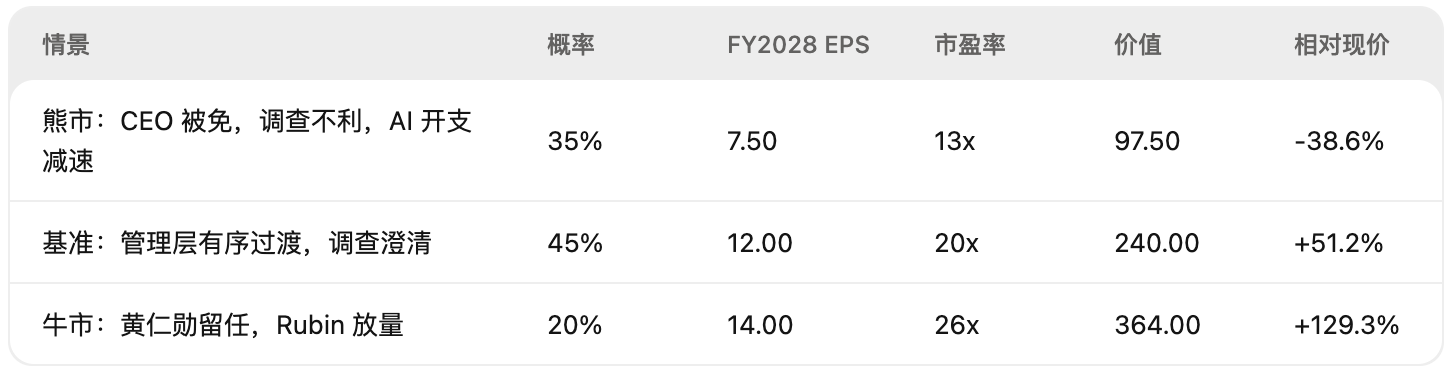
Probability-weighted value is $214.93, expected return 35.4%, bear-case downside 38.6%, and odds 0.92.
Buy the dip? Wait for the board or wait for $145
The current price is $158.76; don't chase. To get the odds back to 2:1, using the base case of $240 and bear case of $97.50, the price needs to fall below $145. Alternatively, if the board explicitly keeps the CEO and Q3 results beat expectations, lifting base value above $280, then the current price is worth recalculating.
Hard invalidation conditions:
- The board removes the CEO and there is no credible succession plan;
- The investigation finds a leak of national security or company secrets;
- Q3 guidance is below $100 billion and gross margin falls below 70%;
- Export controls expand to allied supply chains.
Risk points: three downside paths
Governance comes first. If the board removes the CEO, strategic continuity, customer relationships, and export-control lobbying would all be affected. Dan Ives warned that Huang's departure could cut market cap by another 30%. Leading indicators are board statements, 8-K filings, congressional briefings, and investigation progress.
National security comes second. The core of the investigation is whether Huang leaked secrets. The company currently says there is no evidence, but the investigation is not over. If an adverse conclusion emerges, export controls and customer trust would be damaged at the same time.
AI capex comes third. Baird estimates that AI spending growth by large cloud providers could slow to 40% or below in 2027; if Q3 guidance is below $100 billion, or Q4 guidance no longer grows sequentially, the base-case EPS of $12 does not hold.
Working capital and valuation also need watching. Inventory and receivables are growing far faster than revenue; if they deteriorate further in Q3, it would indicate problems with channel stocking or collection quality. Analyst target prices are being cut; Baird's $200 and Morgan Stanley's $300 have already written the governance discount into their models.
What to do in the coming week? Still need to wait patiently!
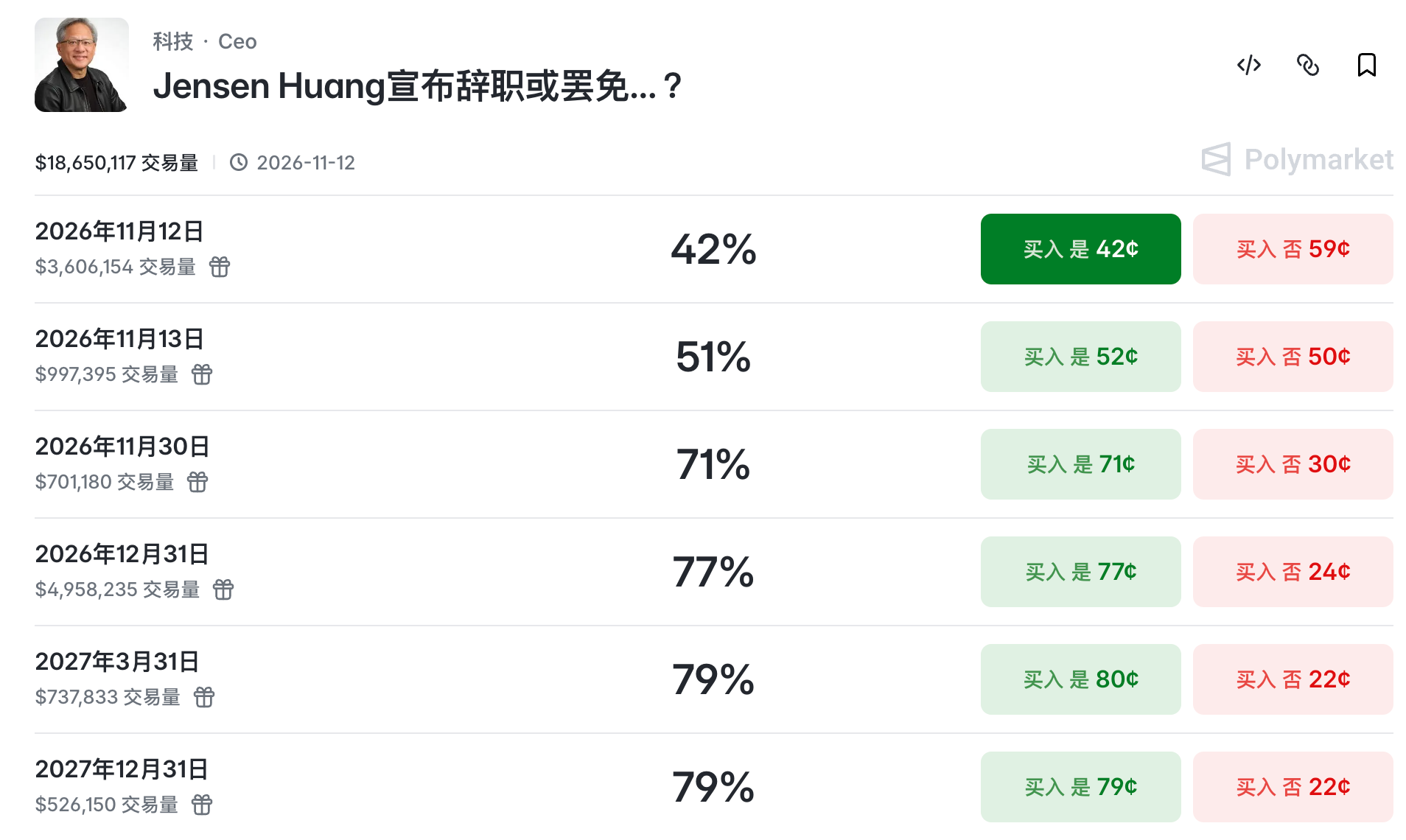
The board may meet on November 12, and as of the premarket on 11-12 there was no announcement. Any conclusion will move the price before earnings do. But Polymarket's probability that Jensen Huang resigns or is ousted is already close to 80%, which is not good news for Nvidia's stock price.
After the close on November 17, Q3 FY2027 earnings. Watch three things: whether revenue reaches $108 billion, whether Q4 guidance continues to grow sequentially, and whether gross margin holds at 73%. This guidance excludes data center compute revenue from mainland China and Hong Kong.
On November 18, according to media reports, a House committee asked Huang to attend a closed-door briefing. This is the first public test point for governance risk.