

Bian Songhua of Inspur Group: The development of financial technology covers five sectors | 2020 New Area Summit

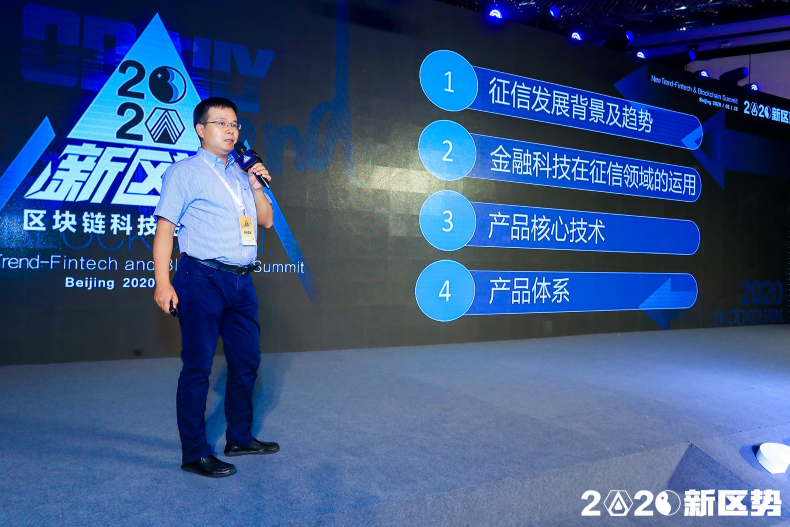
On August 28, the "2020 New District Potential Blockchain Technology Finance Summit" was held in Beijing. This summit is co-hosted by Huobi Group, 36kr and Odaily, sponsored by Behelix & HBTC, strategically sponsored by ChainUP, specially sponsored by PayPal Finance, Conflux, BitUniverse, WaykiChain, XnMatrix, Hashi Co-sponsored by Technology, Mixpay, COCOS, and Shanghai Diyi.
Many authoritative experts and professors from financial institutions such as funds, securities, banks, and industry leaders gathered here to share new information on financial technology and explore the future potential of blockchain. (Click to enter the video replay of the summit)
On August 28, the "2020 New District Potential Blockchain Technology Finance Summit" was held in Beijing. This summit is co-hosted by Huobi Group, 36kr and Odaily, sponsored by Behelix & HBTC, strategically sponsored by ChainUP, specially sponsored by PayPal Finance, Conflux, BitUniverse, WaykiChain, XnMatrix, Hashi Co-sponsored by Technology, Mixpay, COCOS, and Shanghai Diyi.Click to enter the video replay of the summitbyin the morning,Bian Songhua, Chief Risk Control Expert of Inspur Group Tianyuan Big Data Credit Management Co., Ltd.
by
"Comprehensive application of blockchain, big data, and AI in the field of credit investigation"
Give a speech on the topic.
Bian Songhua said that the current development of financial technology basically covers five sectors, namely data sorting platform (data governance, data management, index processing), feature processing platform (algorithm support, model training, feature management), model Management platform (model management, model iteration, model output), business policy engine (policy rule management, rule set, full lifecycle management, version control), intelligent monitoring and iteration (online monitoring, self-iteration).
The following is the full text of Bian Songhua's live speech, edited by Odaily, enjoy~
Hello, leaders, colleagues, and guests, the topic of my speech today is the comprehensive application of big data AI blocks in the field of credit investigation. Because I work in risk control at Tianyuan Big Data Company, I see guests discussing big data, AI, and blockchain technology. In fact, one thing everyone is doing in the end is credit.
I mainly divide it into four parts to make a brief introduction. The first is the development background and trend of credit investigation, the second is the application of financial technology in the field of credit investigation, the third is Tianyuan core technology, and the fourth is Tianyuan University. System of data products.
Now, everyone is doing big data, AI, and blockchain, all for the purpose of solving one thing: to achieve complete and reliable transmission of information in the upstream and downstream, and even in the middle. What we really want to do is to use big data, AI and blockchain technology to empower and realize online, digital and intelligent.
Let’s talk about big data first. Big data is the bottom layer, and everything is for the aggregation of data. The second is AI, including machine learning technology, neural network technology, and deep learning technology. Data mining and modeling are inseparable from AI. The third is the blockchain, which has the characteristics of traceability and non-tampering, and it is also inseparable from the algorithm of AI.
Our purpose is to optimize the entire credit supervision process. We can see that the current development of the entire financial technology revolves around four directions:
The first is intelligent risk control, including JD Digits and Sinochem. They basically want to go their own way in risk control. Tianyuan Big Data is also doing its own life-cycle platform management on intelligent risk control.
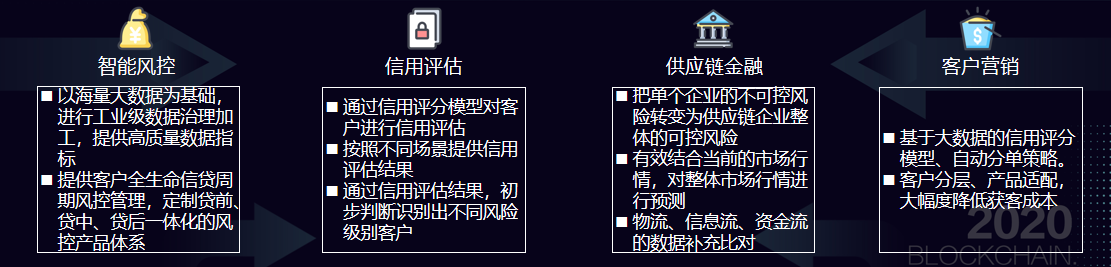
The second is credit evaluation. Intelligent risk control is more biased towards finance, and credit evaluation is more biased toward enterprise-level or business fields.
The third is supply chain finance. I believe that those who do blockchain are moving towards supply chain finance. We want to realize the upstream and downstream data traceability of the entire supply chain, and at the same time, it can be decentralized.
The fourth is customer marketing. We want to use the credit model of big data to reduce the cost of customer acquisition.
The current development also includes five sections:
First, the data governance platform. Many large companies now have the concept of large and medium-sized platforms, which are doing data governance.
Second, feature processing platform, including algorithm support, model training and feature management.
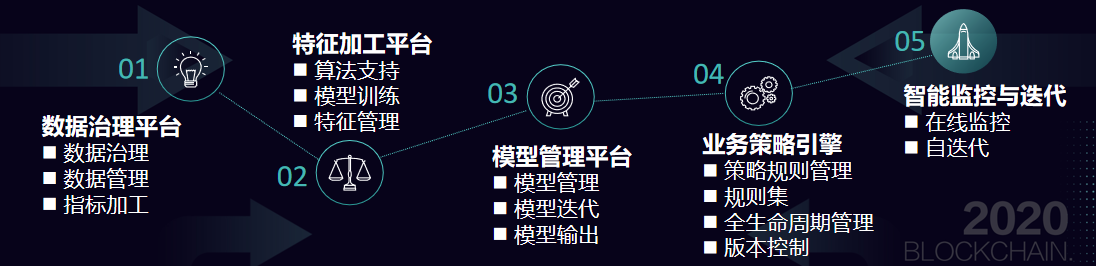
Third, the model management platform. We need to manage and output the model established by the entire AI algorithm through the model management platform.
Fourth, the business strategy engine, all modeling and algorithms must be combined with different scales through business scenarios, and finally full life cycle management is required.
Fifth, intelligent monitoring and iteration.
Next, let me introduce the core technology of Tianyuan big data products. Now our data factory has achieved 11 layers of data governance. On the far left is the digital government of the Internet. The data includes government and Internet data, which are collected, processed, and accumulated over a long period of time. Just now Sinochem also said that industry association data can be shared. It is the indicator library that does the overall processing. The core part of the indicator library includes both financial indicators and non-financial indicators, which we will process. Finally, we will collect the feature library. We will run indicators through the model for different scenarios, which is called the feature library.
The more important part is called feature engineering. At present, the entire feature center first needs to select features. You will see that the corresponding algorithm is used to mine features here. In the part of model building, we need to do model fitting. There is model building, fitting and regression. The establishment of the entire scorecard and the conversion of data are the ones that everyone cares about, and large rating companies have some weight.
AI changes the entire credit system, through samples, through algorithms, and finally to build this real-time scorecard. It can be adjusted accordingly according to the user's dynamics, which is a very big change.
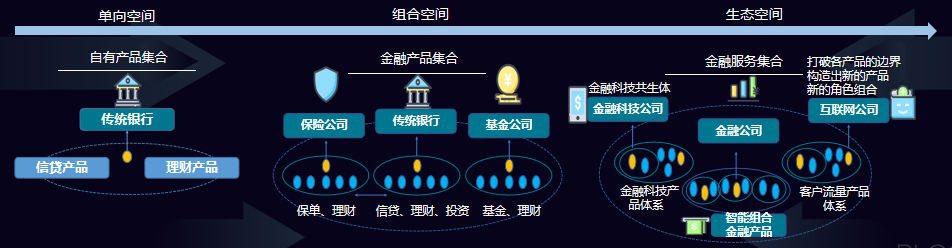
The following introduces the product system, and we propose three major concepts: one-way space, combined space and ecological space.
In the one-way space, you can see traditional banks. The collection of self-owned products includes credit products. Among them, bancassurance has already cooperated in depth, including fund companies.
Combination space is a collection of financial products. Insurance companies have insurance policies and wealth management, traditional companies also have credit, wealth management, and investment, and fund companies have fund wealth management. This part can be opened up after they have assembled the products.