

Read the UMA ecological uGAS project in one article, a simple way to hedge and speculate on high Gas prices

Editor's Note: This article comes fromBabbitt Information (ID: bitcoin8btc), compiled by: Kyle, published with permission.
background
Editor's Note: This article comes from
Babbitt Information (ID: bitcoin8btc)
Babbitt Information (ID: bitcoin8btc)
, compiled by: Kyle, published with permission.
first level title
background
Over the past few weeks, uLABS has taken an idea from the community (thanks to Ali Atiia) and deployed a UMA contract to its mainnet with little to no help from the UMA engineering team. Kevin, a former trader, helped design the token, while Sean, with a tech consulting background, browsed UMA's documentation to set up and build the contract. Today, they launched the uGAS token. Over the next few weeks, keep an eye out for their Medium articles on how to take an idea and build it on UMA.
Why choose gas as the building object?
The DeFi boom has been accompanied by rising Ethereum gas prices, as well as rising volatility and uncertainty in transaction costs. uLABS’ synthetic gas futures token (uGAS) aims to solve this problem by allowing “users” and “providers” of gas to lock in their costs or revenues. The uGAS token can provide a hedge for these natural users, but can also be easily used as a tool to speculate on gas prices.
Existing contracts such as Gas Token and Chi Gas Token provide a partial solution to this problem. However, they do not allow for pure hedging or speculation and may be too complex for the average crypto player. UMA takes a very different approach, borrowing concepts from well-established futures markets in the traditional financial world. The uGAS token is designed and used like a futures contract for crude oil, gold or fed funds.
What is uGAS?
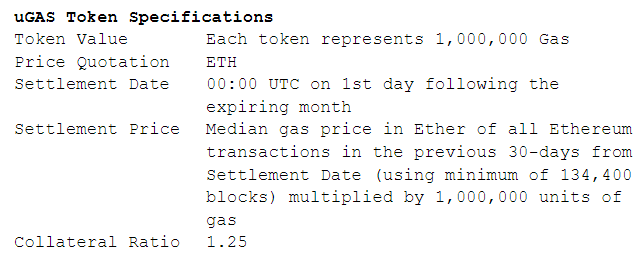
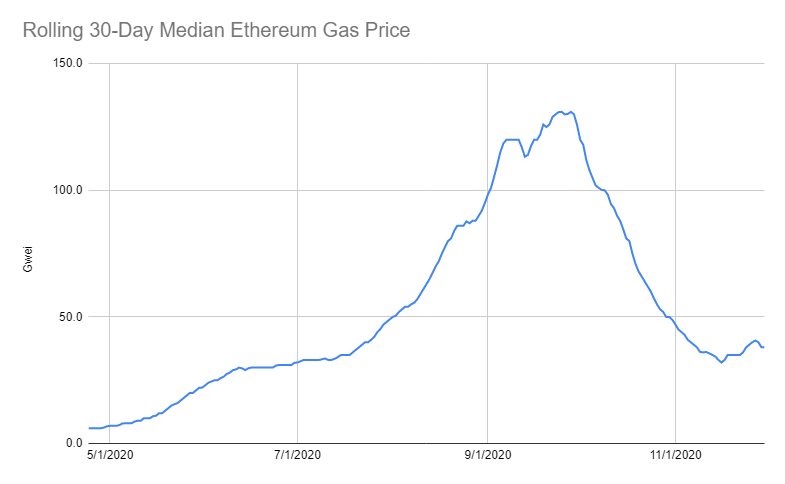
uGAS-JAN21 tokens will be settled at the median gas of all Ethereum transactions in January (calculated on a 30-day basis). With such a simple contract, market participants can effectively buy and sell contracts today and lock in the median gas value for January. You can create and redeem these tokens on uGAS Station.
How do we use uGAS?
The best way to understand how uGAS works is to walk through some detailed examples with natural buyers and sellers.
Alex - trader
Alex is a trader who believes that the ETH gas price will increase in January, so she decides to buy uGAS-JAN21 tokens. She connects her wallet to Uniswap and is going to buy 100 uGAS-JAN21 with her ETH.
The price on the UI shows 1 uGAS-JAN21 = 0.070 ETH. This effectively means that Alex will be long ETH gas price at 70 Gwei. To clarify this further, each token represents 1,000,000 Gas, and 1,000,000,000 GWei equals 1 ETH. Ignoring transaction costs, she will need to sell 7 ETH to buy 100 uGAS-JAN21 tokens.
Expectations for an increase in the price of ETH gas have grown, and uGAS-JAN21 tokens can now be exchanged for 0.100 ETH per token (equivalent to 100 Gwei). Alex sells her 100 uGAS-DEC20 tokens and gets 10 ETH in return for a 3 ETH profit (or 0.03 ETH per token or 30 Gwei/1 million units of gas)
Brad - Yield Tillage Farmer
Brad is an active farmer who works on many trades to manage his portfolio of crypto assets. It is now early December and he expects uGAS-JAN21 tokens to trade at 70 GWei and wants to lock in that price for gas usage in January.
Brad conducts 10,000 simple transactions per month (21,000 gas/transaction), which is equivalent to 210,000,000 gas (10,000 transactions x 21,000 gas/transaction).
Given that each uGAS token is equivalent to 1,000,000 gas, to fully hedge his usage Brad would need to purchase 210 uGAS-JAN21 tokens (210,000,000 gas / 1,000,000 gas per token)
Brad connected the wallet to Uniswap and found that 1 uGAS-JAN21 = 0.070 ETH (equivalent to 70 Gwei). Ignoring transaction costs, he will need to sell 14.7 ETH to buy 210 uGAS-JAN21 tokens.
Brad continued farming as usual in January and consumed 210 million gas by the end of the month as expected. However, he paid an average gas price of 105 GWei for all these transactions in January, which is much higher than the gas price he expected in early December.
Brad retained his 210 uGAS-JAN21 tokens at token expiration on February 1, 2021 at 00:00 UTC, the 30-day median ETH gas price prior to that date (this is January 2021 most of the time) at 110 Gwei, the price at which the token will expire.
Brad can now exchange each uGAS-JAN21 token for 0.110 ETH. After doing this, he will receive 23.1 ETH, which is a profit of 8.4 ETH (or 0.04 ETH per token or 40 Gwei per 1 million gas units). However, this 8.4 ETH profit was offset by the higher gas price he paid in January. In fact, Brad used uGAS-JAN21 tokens as a hedge against rising Ethereum gas prices.
Clare - Miner
Clare runs an Ethereum mining operation. The uGAS-JAN21 token is trading at 70 Gwei. She believes that Ethereum gas prices will drop in the next two months and wants to use the token as a hedge and secure her future income now.
Clare’s monthly mining is equivalent to 50,000 simple transactions (21,000 gas/transaction), which is equivalent to 1,050,000,000 gas (50,000 transactions x 21,000 gas/transaction)
Given that each uGAS token is equivalent to 1,000,000 gas, to fully hedge her mining revenue, Clare would need to mint and then sell 1,050 uGAS-JAN21 tokens (1,050,000,000 gas/ 1,000,000 gas/token)
Clare connects her wallet to uGAS Station and selects uGAS-JAN21. She clicks on "Manage Positions", selects "Create - Mint New Synthetic Token". Enter "1,050" under "Tokens (uGAS-JAN21)" and "MIN" under "Collateral (WETH)". With a Global Collateral Ratio (GCR) of 2.5, this results in a figure of 183.75 WETH (2.5 x 1050 tokens x 0.070 ETH per token). Clare clicks "Create" and mints 1050 uGAS-DEC20 tokens, depositing 183.75 WETH at the same time. Note that the token has a collateral ratio of 1.25, so she can currently withdraw her collateral without worrying about liquidation since she has a collateral ratio of 2.50.
Clare then connects her wallet to Uniswap and sells her 1050 uGAS-JAN21 tokens at 0.070 ETH (equivalent to 70 Gwei) each for 73.5 ETH. Note that Clare net is now committed to paying 110.25 ETH (183.75 of WETH collateral - 73.5 ETH received). As long as she maintains a collateralization ratio of 1.25, she can draw down more collateral to be more capital efficient.
Token Sponsors and Collateral
in conclusion
Compared to existing tokens created using the EMP contract, uGAS tokens use a new method to monitor collateralization ratios. Previous tokens used an independent price source to ensure the value of the token was collateralized. The unique and forward-looking design of the 30-day median gas price identifier presents two challenges. First, there is no independent price source to predict the 30-day median gas price, and second, using a rolling 30-day median gas price to stake a forward-looking token could expose it to undercollateralization. We devised a special price identifier approved in UMIP 20, which enables uGAS to monitor collateralization ratios using the 2-hour time-weighted average price (TWAP) of the uGAS token itself. The uGAS token is the best forward expectation of final 30-day median gas price settlement, and a 2-hour TWAP is chosen to prevent manipulation.
Developer mining and dApp mining
In addition to being a useful product for the ETH community, uLABS and uGAS aim to provide an example of how anyone can use UMA's Developer Mining program to reward users of their product and incentivize others to develop with them.
uGAS Station, uGAS-JAN21 on Uniswap
uGAS-JAN21 token address, uGAS-JAN21 contract
uGAS-JAN21 2hr TWAP, 30-Day Rolling Median Gas Price , Historical Daily 30-Day Rolling Median Gas Price Data