

Meta's inspired Muse is only a little smarter than "AI ordering coffee"

Original author: Xiaojing
Original editor: Xu Qingyang
Original source: Tencent Technology
Muse has become the "muse" of tech giant Meta, single-handedly driving the company's stock price up by 15%.
Meta's AI agent Muse was released on September 8, and by September 18 it had reached the top of the U.S. Apple App Store free chart, holding the No. 1 spot for three consecutive days. By September 21, it had pushed Meta's stock to a climax, rising 11.4% in a single day and adding roughly $192.3 billion in market value.
Its popularity even spread to the semiconductor industry, where even CPUs became a target of market speculation, driving AMD up 9.9% and pushing its market value past $1 trillion for the first time.
For Chinese users, this scene feels somewhat familiar. Over the past year, personal agents (AI agents capable of autonomously executing tasks) have already demonstrated plenty of exciting scenarios, from "ordering takeout with a single sentence" to cross-app price comparison and ordering. There is even the so-called personal device "Doubao Phone," billed as a born AI personal assistant, which attempts to let AI directly operate the screen and complete tasks for users across different apps.
Many people have tasted the coffee "bought by AI" at launch events.
But the real-world experience is still brutally harsh. The smooth, continuous operations shown in launch demos may get stuck on login, payment, or a sudden pop-up in everyday use; restrictions imposed by banking and other apps are something AI assistants simply cannot get around.
Now Muse has arrived with similar product promises, and was even quickly blocked by Amazon. Why is it that these familiar capabilities and obstacles, once they reach the U.S. market, are once again imbued with such enormous imaginative potential?

Image: Meta Chief AI Officer Alexandr Wang and Muse; image generated by AI
The reason people download it is "help me get my money back"
Muse was released on September 8 and topped the charts ten days later. The recurring protagonists in its spread were refunds, unused subscriptions, and insurance bills. Meta Chief AI Officer Alexandr Wang pushed the "MuseMoneyChallenge," encouraging users to share their money-saving results. Foreign media reported that one entrepreneur said Muse helped him find a car insurance plan that saved him $3,500 a year; at the same time, however, the report also noted that many of these shares actually came from Meta employees.
But such cases give users a reason to give it a try: check whether they have been paying for things unnecessarily. For people who don't care about AI, the amount of money saved is easier to understand than a string of model benchmark scores, and is also more shareable.
Muse's product communication is also solving another obstacle: users don't know what tasks to hand over to AI. Muse's design team disclosed that during early testing, too many features actually left people unsure where to start, so they added a design that proactively generates suggestions based on goals and conversation. Tech journalist Alex Heath also praised the Ideas and Feed pages in a public post, because they suggest tasks users would not have thought of themselves.
Wharton professor Ethan Mollick's assessment was that systems from other AI labs can already accomplish similar things, but Muse's focused design makes it easier for ordinary people to get started; Meta has also invested a large amount of free compute to support the experience.
Meta is clearly better at the consumer side: it offers users a straightforward appeal—"focused on saving money"—makes the features easy to get started with, uses the most familiar entry point in WhatsApp, and, more importantly, offers free tokens to burn through. Users can try Muse for free first, and can also have it handle tasks in WhatsApp just like sending a message to a contact, lowering the barrier to trying and using it.
Money-saving cases, task suggestions, and a familiar entry point constitute several noteworthy elements of this round of spread. Moreover, the money-saving stories provided the spark for the spread, and their transmission into chart performance then became a signal for investors to reassess Meta.

Where exactly does the technical novelty lie?
So, does Muse actually have any technical novelty?
The model is responsible for understanding requests and arranging steps, then invoking tools such as a browser to open web pages and fill out forms. This computer runs on Meta's servers, so even if the user closes the mobile app, the task can continue. Through virtual machine technology, Meta carves out an independent operating space for each user to store personal data and task progress. Computer Use capabilities allow the AI to use software on this computer.
Muse's "cloud computer" already has precedents. According to OpenAI's official documentation, ChatGPT Work runs in a sandbox based on a virtual machine, with execution state tied to the user, an environment that can be reused across tasks, and the ability to retain partial state before switching. Its cloud browser can continue working after the user closes their computer. GPT-6 can also write code to operate a browser and desktop, working with plugins to complete tasks.
But Muse's engineering characteristic is that it draws permission boundaries around personal data. According to Meta's disclosure, each user has a Muse Secure VM, which serves as the primary storage location for personal data. Execution programs and tools are placed into restricted containers inside the virtual machine, while account credentials, security checks, and persistent state are managed separately; model inference calls external infrastructure through interfaces, rather than the entire large model being installed inside the personal virtual machine.
We can understand it as a partitioned workspace: the agent can read files and run programs in the operating area, account credentials are kept elsewhere, and connector actions and network access must also pass through Sentinel (a permission-review agent). This design is intended to make it difficult for programs handling unfamiliar web pages to directly obtain full permissions even if they are misled. However, the actual security effect still needs to be tested and verified.
The engineering value of this design lies in organizing execution capability together with authorization boundaries: when a service already has an interface, call the connector; when there is no suitable interface, try browser operation. Interfaces require cooperative integration, while interface operations must cope with page changes and verification.
This design serves continuous delegation, preserving progress, continuing to handle affairs according to time or related events, and requesting authorization before key actions. Independent virtual machines, containers, and permission review all have existing technical foundations; at present, the page still cannot prove that Muse's entire solution is ahead of all competitors.
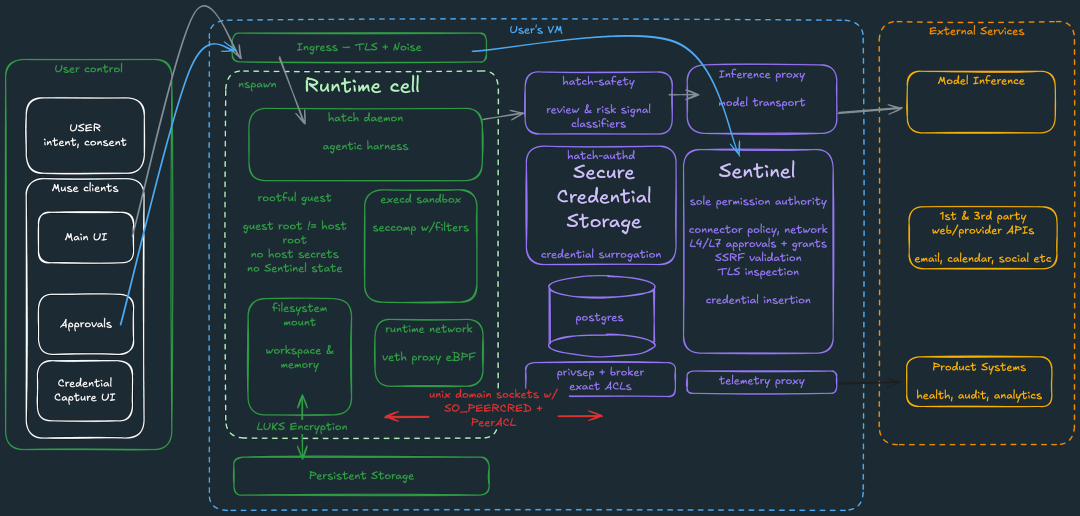
Image: Schematic diagram of Muse's security architecture. Each user has an independent cloud virtual machine; task execution programs are managed separately from account credentials and persistent data, and Sentinel is responsible for reviewing external access and connector operations.
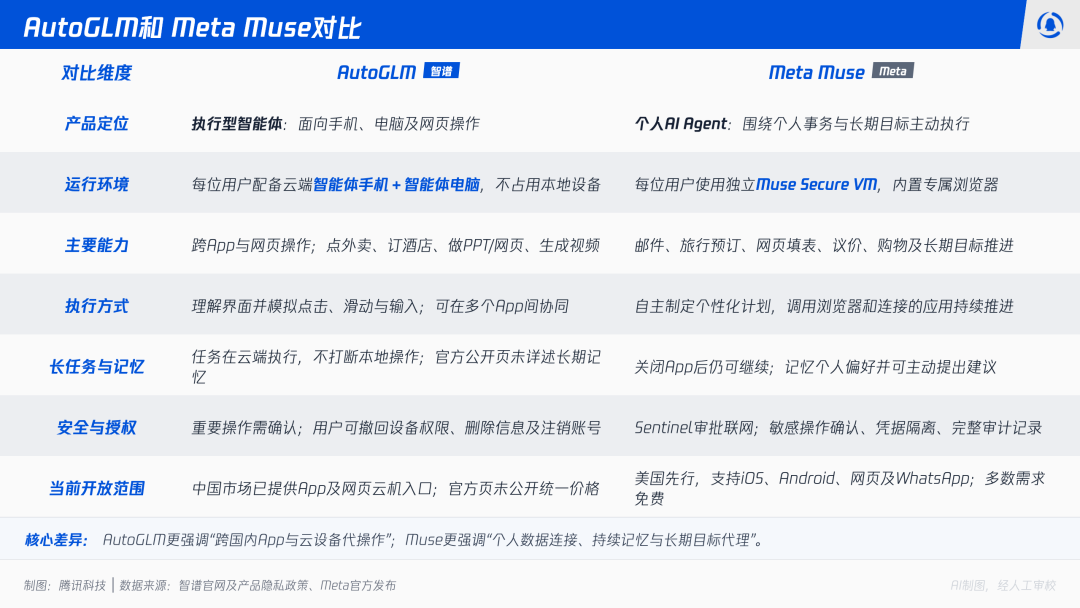
China attempted similar product forms quite early. In 2025, AutoGLM 2.0 simultaneously provided cloud phones and cloud computers, covering mobile apps, web pages, and office tasks; Doubao Phone's direct selling point was being an "AI-native phone" that can operate apps in the user's phone; Qwen app leveraged Alibaba's own ecosystem advantages to connect services such as ordering and payment through cooperative interfaces, reducing screen-by-screen clicking.
Interface operations and interface calls can be combined, and tasks can also be executed locally or in the cloud. AutoGLM's "cloud computer" refers to an environment for AI operations, while Muse's "independent Linux virtual machine" mainly describes how it partitions operating space for users; the two are at different levels of comparison.
Muse explains that some AI phone experiences can be delivered through existing phones and cloud services; to call apps, cameras, and system permissions in the phone, device-side support and user authorization are still required.
It seems that Muse is essentially still the same AI assistant familiar to Chinese users, one that is good at performing coffee-ordering. It's just that this AI assistant, in China, currently has no way to ignite excitement among users and capital.
A different approach: more than just ordering coffee
Muse is aimed at individuals, and currently mainly promotes life management, but it can also generate documents and web pages. "Personal users" and "life tasks" are not the same concept; a person's assistant can absolutely handle both family and work at the same time.
China has not given up on life agents either. Alibaba disclosed that Qwen facilitated nearly 200 million orders during the Spring Festival; the campaign was accompanied by 3 billion yuan in incentives, and order volume alone cannot prove natural demand and profitability. At the same time, Doubao launched a professional version for complex office work in June, with continuous monthly subscription starting at 68 yuan, while Tencent launched the WorkBuddy enterprise version. China is exploring life and office scenarios in parallel, but the office scenario has greater momentum.
Office work is easier to "charge for": organizing a batch of spreadsheets or completing research saves labor that can be compared with the delivery time saved. But ordering a cup of milk tea originally takes only a few clicks, so the incremental convenience brought by AI is limited, and taking over after an error instead adds trouble. For service platforms, such tasks may still generate value through order conversion.
Muse is smarter in its choice of scenarios, such as canceling forgotten subscriptions, comparing renewal quotes, tracking refunds, and coordinating family schedules. These things are not necessarily high-frequency, but they can save money, time, and worry. The potential lies in handling long-delayed affairs for users and avoiding missed deadlines.
Muse's designers gave a personal example: when the assistant was organizing emails and school websites for a child's back-to-school, it discovered that registration for a sports tryout was about to close and reminded her in time.
By contrast, life services in China already have many convenient processes, which may suppress the incremental value of routine ordering. But the value of insurance renewals, app subscriptions, after-sales appeals, and care coordination is still worth verifying.
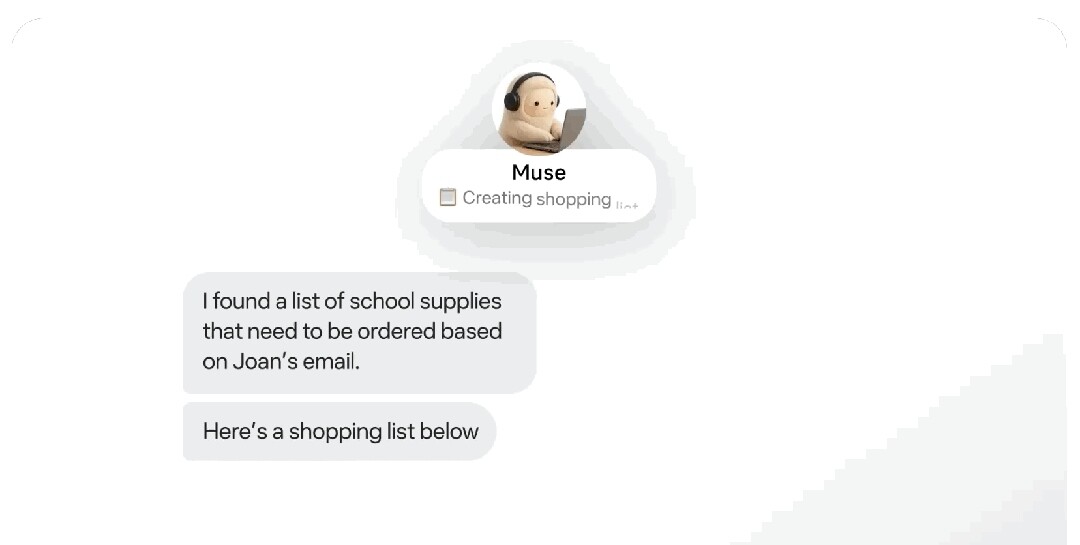
Image: Official demo video of Muse in operation
Is this business really viable?
Stratechery founder Ben Thompson said on September 21 that Muse was the easiest-to-use personal agent he had tried. The Muse Spark 1.3 it uses has not yet reached the level of the most cutting-edge models, yet it can already support a very good product experience. In his view, once users hand their account information to an assistant and let it participate in daily affairs, the cost of switching products will rise.
Meta is also developing foundation models. This round of popularity more directly reflects the market's revaluation of the prospects for model + application consumer apps: once model capabilities reach a usable level, can Meta rely on product experience and distribution channels to keep users continuously delegating tasks and generate revenue from it? Truist analysts predict that Muse could bring Meta $28.5 billion in incremental revenue by 2030.
Oppenheimer analyst Jason Helfstein maintained a neutral view: the paying demographic may already have ChatGPT or Gemini subscriptions, and trust is also a barrier; roughly 115 million paying users would be needed to significantly affect Meta's earnings, assuming $20 per month and an 80% incremental operating margin. The more free compute there is, the harder it becomes to reach the profit assumptions.
But this also partly explains why the market rally spilled over: the market is reassessing the scale of consumer agents. CPUs and memory are likewise affected by this expectation. Beyond model inference, browsers, code, and scheduling require CPUs (central processing units); keeping running programs going requires DRAM (server operating memory). The more concurrent tasks there are, the greater the load on both types may be.
When users have no tasks, Meta can pause the cloud virtual machine and save task progress to disk; when a new task arrives, it can resume. Therefore, "one virtual machine per person" does not mean each person occupies a fixed amount of CPU and memory all day. Muse's popularity leads investors to expect more people will use such services, but how many chips actually need to be purchased still depends on how many tasks run simultaneously and how long each task runs.
Muse still hasn't solved the fundamental problem
Muse places user data and the execution environment into a dedicated cloud virtual machine, but will users really dare let it have long-term access to emails, orders, and payment information? According to foreign media reports, during internal testing Muse once stopped refreshing after monitoring ticket sales for about 15 minutes, and there were also incidents of private data exposure. Meta confirmed that it had delayed its originally planned April release in order to improve security.
Even if users are willing to authorize it, agents may not be able to enter all services. On September 21, Amazon blocked Muse from browsing and purchasing goods on behalf of users, on the grounds that such access and transactions were unauthorized. Doubao Phone had previously also been forced to suspend operations in financial apps due to login and risk-control issues. The two products took different paths, yet encountered the same problem: user authorization cannot replace platform permission, and platforms still have the ability to decide whether agents can enter their services.
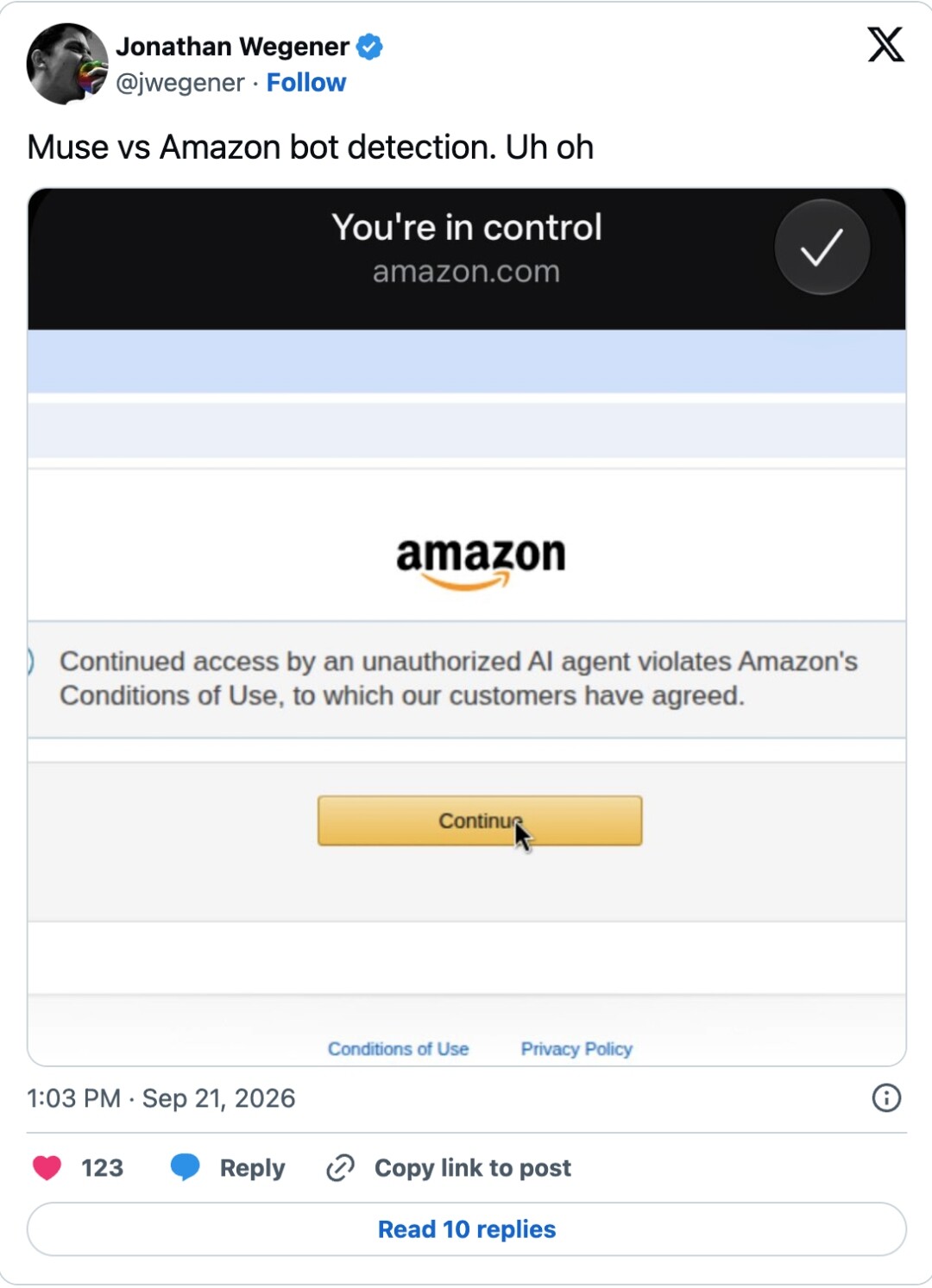
Image: On September 21, user Jonathan Wegener shared the notice Muse encountered when accessing Amazon: Amazon said that unauthorized AI agents continuing to access the site violated its terms of use.
Every powerful platform has a strong incentive to guard this door. If an agent selects products and completes transactions for users, the platform may lose the advertising revenue and recommendation opportunities brought by users browsing pages. Shopify chose to integrate with Muse, while Amazon did not hesitate to block it; the platform's position is a hard bone to chew.
In addition, Goldman Sachs research head Eric Sheridan expects that consumer agents may monetize through advertising and subscriptions in the future; but if the assistant charges promotion fees, users also need to know whether the recommendation results have been affected. Consumer agents, unlike office-scenario agents, have difficulty showing a clear paid-subscription incentive. If they still follow the old path of advertising and recommendations, it will inevitably encroach on others' turf. Whom to charge, how to charge, and how to split revenue after charging remain difficult questions.
On September 22, Meta's stock closed down 0.63%; as of publication, it had risen another 0.6% after hours, as the market gradually entered a cooling-off period after the excitement. After the initial novelty, what Muse may need to look at next is user retention.
However, the Meta Connect conference is about to be held. According to foreign media speculation, this conference, which in the past featured hardware as the protagonist, may update more information about Muse. It will be worth looking forward to whether Muse truly has any real novelty.