


Bizai Research Institute: Is algorithmic stable currency a currency revolution or a speculative game?

first level title
1. Overview
In the past few weeks, the hottest topic in the industry has been algorithmic stablecoins. In particular, the soaring prices of representative projects such as Ampleforth, Basis Cash, and ESD have attracted everyone's attention to this kind of currency experiment that tries to use algorithmic mechanisms to achieve value stability.
Algorithmic stable currency, as the name suggests, is a method of adjusting the total amount of market currency based on an algorithm, increasing the market supply when the price of the stable currency is higher than the anchor price, so as to realize the value falling back to the target value; reducing the value when the price of the stable currency is lower than the anchor price Market supply to realize the increase in value to the target price; or to provide arbitrage space to balance the stable currency price. The establishment of this model does not anchor real legal currency and does not need to mortgage stable currency. It is regulated by market will and algorithms, and the market calls it elastic currency.
2. Background of Algorithmic Stablecoins
secondary title
2.1 Demand for Stablecoins Increases Significantly
As the only digital currency out of the circle in 2020, stablecoins have received widespread attention from industries including the traditional economy. We can see that in the past year, the total issuance of stablecoins has grown from 2.5 billion US dollars to 2 billion US dollars, an eightfold increase.

image description
Source: Debank
Why has the overall circulation of stablecoins increased so much? We believe there are three main reasons behind this:
1) Cryptocurrencies are too volatile, and stablecoins are urgently needed for pricing. Before 2017, the main pricing system of cryptocurrencies was Bitcoin and Ethereum, which fluctuated greatly, and the shortcomings were obvious. Therefore, cryptocurrency speculators and traders have a huge demand for stablecoins. They need to frequently convert cryptocurrencies into stablecoins to temporarily "lock in" profits, thereby transferring risk exposure to relatively stable assets.
3) In addition, the use of stablecoins avoids the potential friction caused by the blocking or temporary holding of funds that may occur when KYC procedures reintroduce funds into the traditional financial system. For example, cryptocurrency trading firms or hedge funds often choose to use stablecoins to implement value across countries in a more flexible manner.
secondary title
2.2 Classification of decentralized stablecoins
Source: Bizai Research Institute
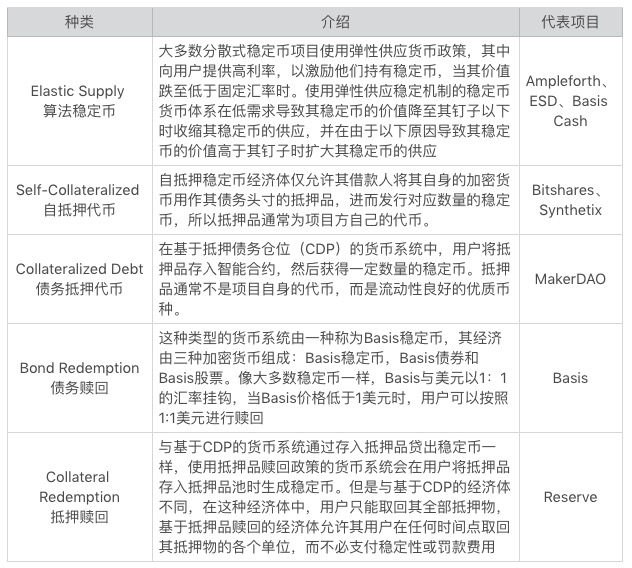
Source: Bizai Research Institute
secondary title
2.3 Why Algorithmic Stablecoins Are Produced
Before the generation of algorithmic stablecoins, whether it is a centralized stablecoin or an algorithmic stablecoin, in fact, there needs to be a manager to manage the issuance of the currency. For example, USDT, the real controlling party is Tether; while MakerDAO, although the issuance of DAI is decentralized, it is still very dependent on the demand side of DAI and the opener of CDP, as well as MakerDAO related governance parameter settings, etc. . In addition, their mechanisms for price anchoring of stablecoins are essentially the same, that is, the reliance on collateral.
Will there be a stable currency that can be achieved only by relying on smart contracts: 1) No one can interfere with the issuance and governance of the stable currency to achieve complete decentralization; 2) No collateral is required.
The algorithmic stable currency hopes to achieve this goal. They do not require any collateral, nor do they rely on the human governance of any institution or project party. Only rely on the relationship between price and supply adjustment to achieve relative stability between stable currency and legal currency.
The main price stabilization mechanisms of algorithmic stablecoins in the current market are as follows:
When the price is above $1, reduce the price by increasing the supply (direct airdrop/bond dividend);
When the price is below $1, stabilize the currency price by reducing the supply (evaporating tokens / issuing bonds).
Of course, the algorithmic stablecoin is not a very innovative idea, but in fact came from two academic papers in 2014: one by Ferdinando Ametrano, "Hayek Money: A Solution to Cryptocurrency Price Stability, and another is Notes on Cryptocurrency Stability: Seigniorage Shares by Robert Sams.
3. Major stablecoin projects
3.1 Ampleforth
secondary title
The Ampleforth project, established in 2019, was the first to conduct an IEO on Bitfinex. Its investment institutions are also very luxurious. Investors include Pantera Capital, Arrington XRP Capital, Slow Ventures, FBG Capital, The Spartan Group, and Coinbase CEO Brian Armstrong .
Ampleforth defines itself as a new synthetic commodity in the white paper: Ampleforth: A New Synthetic Commodity. As the most attention-grabbing project among algorithmic stablecoins, and currently the project with the largest market value, Ampleforth has been widely discussed since June 2020. Many people were amazed by its unique design, and many people criticized it as an excellent target for speculation.
The name of the stablecoin issued by the Ampleforth project is AMPL, its price is anchored to $1, and it focuses on the "elastic supply" economic model, that is, the total amount of AMPL will change with the unit price. The basic principles are as follows:
1) At 10:00 Beijing time every day, the Ampleforth smart contract will increase or decrease the total amount of AMPL. This behavior of daily total adjustment is called Rebase.
2) All wallet balances receive supply adjustments proportionally. After the rebase, the proportion of token holders' holdings in the entire network is the same as before the rebase. Rebasing is not dilutive because all account balances are adjusted proportionally, whether positive or negative.
3) There is no airdrop or transaction related to the balance change in the wallet, only the AMPL smart contract function is in effect.
4) The daily rebase is determined according to the market price of AMPL:
If the AMPL transaction price is higher than the target price by more than 5%, the AMPL holdings in the wallet will increase after the rebase; (the total amount will increase)
If the trading price of AMPL is between -5% and +5% of the target price, no rebase will be performed on that day;
If the AMPL transaction price is lower than the target price -5%, the AMPL holdings in the wallet will decrease after the rebase. (total amount decreases)
The core of the Ampleforth project is the rebase mechanism. According to the white paper, AMPL’s daily rebase is calculated according to the following formula:
Rebase supply change=IF[(market price captured by oracle machine-target price)/10>-10%, (market price captured by oracle machine-target price)/10,-10%]
However, judging from the actual operation situation, AMPL has not achieved good stability, and the price often shows sharp rises and falls. In the past 90 days, most of the time did not achieve the ideal price range [0.95, 1.05], as follows As shown in the figure:

image description
And through the market value performance, we can also see that it has skyrocketed in a short period of time and plummeted in a short period of time, as shown in the figure below:

image description
Therefore, AMPL still has a long way to go from its functional positioning as a stablecoin. On the contrary, due to its rebase mechanism, which is prone to skyrocketing and plummeting phenomena, AMPL has become the best target for capital speculation. At present, the main usage scenario of AMPL is not payment, but various related incentive mining projects.
3.2 ESD
Empty Set Dollar (ESD), like Ampleforth, is also the main elastic currency, and the name of the stable currency it issues is ESD. ESD is both a stablecoin and its governance token. Different from AMPL, ESD itself will not automatically scale, and the number of ESD held by users will not change automatically. Because ESD’s token adjustment is not a global adjustment through smart contracts, ESD’s token supply adjustment is done actively by users, and it is ESD’s incentive mechanism that stimulates user behavior. This incentive mechanism is the main difference between ESD and other stable coins, that is, when the price is higher than 1 USDC, users can choose to pledge ESD, so as to have the opportunity to obtain more newly issued ESD rewards. This will increase the ESD circulation, which will cause the ESD price to fall back to 1USDC. When the price is lower than 1USDC, the ESD protocol will issue debt tokens, which can be purchased by token holders. ESD will issue Coupon (coupons), and ESD holders will get coupons by destroying ESD.
image description
Source: ESD official website
Users are willing to buy coupons because there is a discount for buying coupons. When the future ESD price is higher than the target price (1USDC), more ESD can be redeemed with coupons. When the amount of ESD agreement debt is larger, the amount of ESD that users can exchange is more, because the original discount is greater. As the debt increases, the discount increases, which incentivizes token holders to burn more ESD and buy coupons, thereby reducing the token supply and increasing the token price.
The advantage of this mechanism is that it can reduce user panic to some extent, and it is not easy to produce a death spiral. In AMPL's rebase mechanism, when the price of the token is lower than the anchor price, people will have a greater psychological panic. While decreasing, the price is also falling, which will cause some users to sell, which will further cause the price to drop, and the number of tokens in the wallet will further decrease. In ESD, the tokens in the user's wallet will not decrease, so there will be no visual and psychological impact caused by the reduction in the number of tokens in the wallet.
ESD is a second-generation algorithmic stablecoin. On the basis of AMPL, there are some improvements.
1. After rebase, if additional tokens are issued, ESD holders need to pledge or provide liquidity to obtain newly issued ESD
There are two pledge modes. Pledge single currency ESD into DAO, and DAO will get 77.5% of the newly allocated ESD, and 15 epochs are required for unlocking; or pledge ESD-USDC-LP into the LP Reward Pool, and the pool will get newly allocated ESD. 20%, unlocking requires 5 epochs. (Note: 1 epoch = 8 hours)
To put it simply, staking or providing liquidity can be rewarded, because these two behaviors are conducive to improving the "stability" of ESD.
2. After rebase, if deflation is required, deflation will not be carried out, but more funds will be attracted through bonds
By checking the ESD/USDC trading pair on Uniswap, we can find that its price has shown a huge ups and downs. And AMPL once plummeted to around 0.6USDT.

Source: Uniswap
3.3 BAC
secondary title
Basis Cash was born out of Basis, the earliest algorithmic stable currency project, which raised more than 100 million US dollars in 2018. The earliest name was Basecoin, but it was later reviewed by the SEC and withdrawn. Basis Cash, to a large extent, refers to the design of Basecin, and at the same time relies on the distribution method of liquidity mining.
In the Basis Cash protocol, three tokens are designed:
1) Basis Cash (BAC) is a stable currency against the cash dollar;
3) Basis Bond (BAB) benchmark bonds, holders can redeem BAC at a ratio of 1:1. Compared with ESD bonds, the improvement is that BAB has bond dividends.

image description
Source: Basis Cash official website
When the BAC price is lower than $1, users can purchase BAB bonds at the price of BAC*BAC to ensure that there are enough funds in the system to maintain the stability of the BAC price. When the BAC price is higher than $1, the BAB bonds purchased by users can be redeemed 1:1 with BAC.
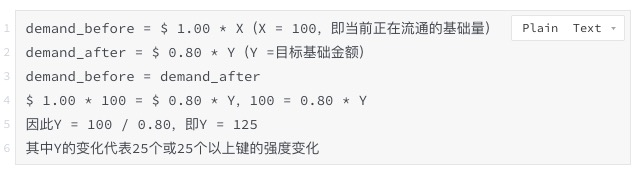
When the BAC price is higher than $1, the contract will first adjust the price of BAC by redeeming BAB bonds. If the BAC price is still higher than $1 after redemption, the contract will mint new BAC, redeem BAB first, and then distribute For users who pledge BAS in the Boardroom (that is, 3 pools of LP. BAC has 3 types of LP pools, 1 pool consists of 5 stable coins, and lasts for 5 days; 2 pools are BAC-DAI-LP output BAS, 3 pools are BAS -DAI-LP produces BAS, 2 pools and 3 pools continue to mine for 1 year).
By looking at the BAC/DAI trading pair on Uniswap, we can find that its price has shown a huge surge and plunge, and the highest price has risen to 2.6USDC. Similar to ESD, BAC has a relatively stable downward price range compared with AMPL, generally maintaining above 0.9USDC, which may have a certain correlation with the redemption mechanism it designed.

image description
Source: Uniswap
4. Future Outlook
By analyzing the status quo of the three algorithmic stablecoins of Ampleforth, ESD and Basis, we can see that the algorithmic stablecoins are still not very mature, especially their stability is particularly poor, and there are often phenomena of skyrocketing and plummeting. And this phenomenon should not be what a stablecoin should appear. This will greatly affect everyone's willingness to use it as a stablecoin.
These are also the three current projects. The most discussed is still not its stability. Instead, it is expected to be unstable. It is best to keep it higher than $1, because this can maximize the interests of the holders. This also makes the three projects a target for good capital hype.
We artificially believe that the current performance of the three algorithmic stablecoins has seriously deviated from the original intention of the project design, especially the two scholars Ferdinando Ametrano (Ferdinando Ametrano) and Robert Sams (Robert Sams) hoped Elastic money design concept. However, it may be too early to make such a judgment. After all, currencies such as gold and silver have gone through a long process from the beginning to the final consensus currency.