

Bizai Research Institute: Ethereum will become the strongest engine in the bull market in 2021

first level title
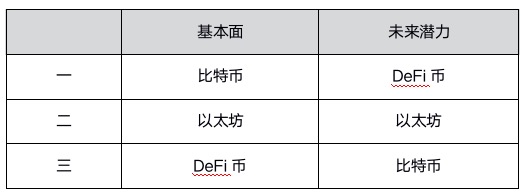
In just 10 months from March 12, 2020 to the present, the sentiment of the digital currency market has undergone a rapid transition from despair to enthusiasm. The highest profit of Bitcoin and Ethereum has reached 99.99%. Now, the perception in the market has changed from "is this a bull market" to "who will perform best in a bull market". Many people think that this bull market is "different" from the past, but which one of the digital currencies can be called the strongest engine of the bull market needs to be considered from the perspective of fundamentals and future potential. The conclusions that can be drawn from different starting points are actually different. The final conclusions are as follows:
Source: Bizai Research Institute
2. Bull market logic
2.1 Fundamentals
image description
Source: Bizai Research Institute
From a fundamental point of view, the bull market logic of Bitcoin is stronger than that of Ethereum, and the bull market logic of Ethereum is stronger than that of DeFi coins.
2.1.1 Bitcoin
The incoming U.S. President Joe Biden announced a $1.9 trillion stimulus plan aimed at saving the U.S. economy from the ravages of the novel coronavirus. While this stimulus could help the U.S. economy recover and ease the financial burden for many Americans, it may also come at a cost. To pay for the stimulus package, the U.S. government may need to print more money. In turn, this could eventually lead to inflation and a fall in the value of the dollar.
The facts are consistent with the inferences. Chainalysis data shows that since September, new large investors have purchased a total of about 500,000 bitcoins, with a total value of about $11.5 billion. In addition, the number of small and medium-sized buyers is also increasing. Since the beginning of this year, there have been more than 38 million Bitcoin transactions transferred to personal wallets with a single amount of less than $1,000, nearly double the 20 million transactions in 2017. What is different from 2017 is that institutions are concentrating on entering the market to buy Bitcoin, propping up the fundamentals of Bitcoin with a large number of buying orders.
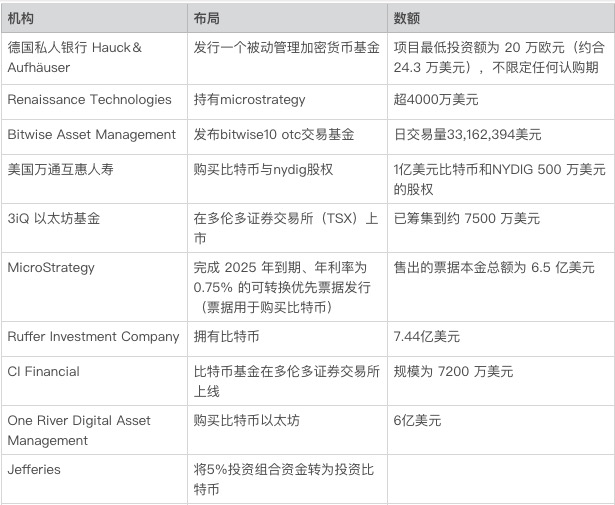

image description
Source: Bizai Research Institute
This fundamental aspect of Bitcoin is unique to it, and there is a clear gap between the attractiveness of other cryptocurrencies for such institutional funds. Robert Gutmann, CEO of New York Digital Investment Group (NYDIG), said in an interview with The Scoop, a podcast under The Block, “Recently, when I was talking to some investors who needed to allocate assets ($50 million), I found that 100 % of the talk was about Bitcoin and not a single one was about other cryptoassets.”
First of all, it needs to be clarified that we are talking aboutEthereumEthereum
At the time, we were only talking about the value of Ethereum itself, not the value of the Ethereum ecosystem. The fundamentals of Ethereum are not as good as Bitcoin, and besides Grayscale, there are not many institutions establishing trust funds for it. Although Ethereum has its early limitations, its efficiency has been astonishing. In just five years, thousands of high-potential applications have been produced. Its largest use case, DeFi, has also exploded rapidly this year. As the carrier of the value of these assets, Ethereum The value has also gone up. Ethereum is processing more than $1 trillion in transactions this year, including the vast majority of transactions in the nascent DeFi and "cryptocurrency" space. It has been so successful that eth1.0 is now at maximum capacity and must scale orders of magnitude rapidly to maintain its market share with newcomers and keep its vibrant ecosystem cost-competitive.
ETHAnd that's exactly the problem with it: it's the beginning of a bull market, and it's the shackles of a bull market.
The concept is too complex for itself. If Bitcoin is a black hole that attracts different storytellers into the same underlying asset, Ethereum is the opposite: too many stories. It can be said that with the explosive growth of stablecoins, the "demonetization" of functional tokens such as Ethereum is already a gradual process.
image description
Source: Token Terminal
2.1.3 DeFi
In a research article by Multicoin Capital, a DeFi stack (DeFi stack) logic is proposed, which divides DeFi into six layers from low to high, which are value units, value delivery, oracles, DeFi prototypes, aggregators, and Wallet and front entry. In the DeFi stack, at the bottom, that is, the fundamentals of the entire DeFi are stablecoins.
image description
Source: Multicoin Capital
The existence of stablecoins means a lot to DeFi, they represent the beginning and end of a complete transaction lifecycle. The strength of stablecoins is their attractiveness as a means of payment. Low cost, global reach and speed are all huge potential benefits. Furthermore, stablecoins enable seamless payment of blockchain-based assets, and due to their open architecture, it can be embedded in digital applications as opposed to proprietary legacy systems of banks. If DeFi is compared to an ocean, then stablecoins are the sea water in the ocean. It greatly reduces the cognitive threshold for new users, and connects Dapps with this value scale.
In addition, the development of DeFi will create a cash flow model similar to [companies] for various Native Crypto assets, and this makes the various Tokens of DeFi have the same value support as stocks and become an interest-earning asset. When a type of asset has an interest-earning model, it will become the target of various types of capital, such as company stocks, real estate markets, etc. There is no doubt that the landing of DeFi has allowed the majority of institutional investors to see another narrative of future finance, which is a financial building supported by a solid cash flow model, rather than various types of public chains in the bull market in 2017. Cash flow model token.
secondary title
2.2 Future Potential
2.2.1 Bitcoin
The short-term potential of Bitcoin is to become an alternative investment product, and the long-term potential is to become part of M0 in some countries. In 2020, there have been amazing developments in the adaptability of Bitcoin. From Square investing $50 million in Bitcoin to PayPal allowing its users to buy and sell Bitcoin, there is market acceptance. In 2021, we are likely to see an extension of this mainstream embrace. At least one major U.S. or European bank has come to announce the inclusion of bitcoin into their system, where they either enable bitcoin purchases or agree to hold the digital asset for their clients. In the final vision, Bitcoin may become a medium of value exchange, and eventually enter the consumption system of some countries, and assume a certain role of value exchange when the value of legal currency in some countries collapses, that is to say Be part of M0 in some countries.
The short-term potential of Ethereum lies in increasing throughput, retaining the assets accumulated so far, developers and DeFi players from being robbed by exchange smart chains and other public chains, and Eth2, which will be launched in the long term, is essentially a brand new one with better performance. Superior and more centralized blockchain.EthereumEthereum
Developers are attempting to migrate the Eth1 "state" to the Eth2 chain with minimal disruption to the tens of thousands of applications already built on top of Ethereum.
It may take several years to complete the full multi-phase migration, but if successful, Ethereum could increase its transaction throughput by more than 1000 times, while enhancing its "store of value" by reducing the long-term network inflation rate to 1-2%. "The authenticity.
Compared with other Layer 1 projects today, Ethereum has such a huge infrastructure advantage that it is difficult for competitors to take away market share. But the 3-5 year development deadline has seriously hurt the potential of Ethereum, because Eth1 to Eth1.5 +Rollup migration is not much different from bridging Eth1 to Cosmos, PolkaDot, Algorand, Cardano, etc. brand new protocols. Polkadot's prosperity on full displayEthereumEthereum
Competitors are trying to use Polkadot's cross-chain function to try to get a piece of Ethereum, thereby taking away Ethereum's assets and popularity.
But at present, DeFi, the largest landing application in the entire Crypto world, that is, decentralized finance, the most important feature is safety and stability. Among the various public chains, there is no doubt that Ethereum has become the largest fund settlement layer, because Ethereum has been verified as the most stable and secure public chain after years of development.
2.2.3 DeFi coins
The potential of DeFi is huge. Whether it is its network wealth effect or the revolution of traditional entity finance, its potential is unparalleled.
In a world full of intermediate systems and highly isolated financial systems, users have little control over or even understanding of the financial system. Users have no control over anything from how banks spend money in savings accounts to how much money the government prints. Multiple intermediaries (government, banks, insurance providers, and other financial institutions) control the system, which also implies indirect costs for users, such as handling fees, poor information, and other frictions, which also increases the risk of financial crises, Examples include market crashes, inflation and scams.
first level title
3. Conclusion
The two concepts of digital currency and blockchain complement each other, and the prosperity and development of DeFi are inseparableEthereumEthereum
The platform support provided, the appeal of vitalik and the asset injection of Bitcoin. In addition, due to the development of DeFi, BTC has entered the Ethereum network through assets such as WBTC or renBTC, and has become an underlying asset in the Ethereum network, participating in asset mortgage lending or liquidity mining in DeFi. If there is no DeFi and Ethereum, you will suddenly find that BTC has only very limited usage scenarios, and it seems that most of them can only be hoarded, telling the story of digital gold. It is precisely because of Ethereum and DeFi that the usage scenarios of BTC have become more abundant, which will directly stimulate everyone's demand for BTC.
Therefore, through our above analysis, we can easily draw an obvious conclusion, whether it is the development of BTC or DeFi, it is impossible to leave Ethereum. As the second-tier network of BTC and the underlying network of DeFi, Ethereum has become the de facto money. This is also the reason why ETH has recently broken through its historical high and became the first non-BTC asset to break through ATH. And, we will see that Ethereum continues to lead the digital Huobi bull market, because neither BTC nor DeFi can leave Ethereum, because they have become an important part of the Ethereum ecosystem.