Editor's Note: This article comes fromEditor's Note: This article comes fromOfficial HashKey Hub (ID: HKeyHub)
, Author: Zheng Jialiang, Research Director of HashKey Capital, reproduced by Odaily with authorization.2021 is a year of mutual integration of mainstream institutions moving towards encrypted assets, and encrypted assets becoming mainstream. There are two paths:1. Mainstream institutions directly purchase encrypted assets or join the queue of encrypted asset services, which is a mode for institutional investors to "adapt" to encrypted assets;2. Companies engaged in encrypted assets directly package the business they engage in to become acceptable to institutional investors, such as listing the business on the stock market or being merged by a listed company.In this article, we discuss the mode of reverse mainstreaming of encrypted companies, and briefly discuss the impact of various modes on mainstream assets and the encrypted asset market.
There are four paths for crypto companies to mainstream:
Very orthodox IPO;
Direct listings (like Coinbase);
Go public through a SPAC (Special Purpose Acquisition Company);
1.1 Most mining machine companies choose IPOIPO is a mode often used by mining machine companies: For example, Canaan Technology and Yibang Technology are listed through the IPO mode. Bitmain submitted listing documents to the Hong Kong Stock Exchange in 2018. News reports that Shenma Mining Machine may also IPO listing. In addition to some other requirements, the Nasdaq listing rules generally require a pre-tax income of at least US$750,000 and a pre-tax income of US$1 million in the previous fiscal year, which mining machine companies can easily meet.1.2 Direct listing is mainly due to the fast process and low costDirect listings have been listed in the United States for a long time, but earlier cases were negotiated on a case-by-case basis. For example, the streaming media provider Spotify was negotiated by the NYSE and the SEC on a case-by-case basis. In 2019, the New York Stock Exchange submitted an application to the US Securities Regulatory Commission to amend the direct listing rules in accordance with Article 19(b)(1) of the Securities Exchange Act of 1934). The NYSE rule application was approved, while Nasdaq subsequently submitted a rule application for the direct listing.The advantages of direct listing are that the cost is low, the process is fast, and there are no underwriters in the middle.
No underwriters and therefore no price stabilization mechanism
No fixed tradable quantity
For example, in addition to the locked part of an IPO, the new shares issued can be sold directly. In direct listing, since there is no sale of new shares, all the trading volume in the market comes from the sale of shares of registered shareholders and existing shareholders, so the number of shares available for sale in the market is uncertain.
No lock-up period for all shareholders
Unlike an IPO, all shares can be sold at any time, and the selling pressure in the market may be relatively large at the beginning. In a traditional IPO, most stakeholders of a listed company will have a 180-day lock-up period.
Because there is no financing, there is no need for investment banks to set prices, and there is no listing price. The price is completely determined by the secondary market transactions after the opening of the market.The requirements for a direct listing are actually no lower than for an IPO, and some requirements are even higher than for an IPO. If a directly listed company sells stocks with a market value of no less than US$100 million after the first day of listing, or the sum of the total market value sold on the first day and the market value held by the public on the previous day is no less than US$250 million. In addition, some other IPO regulations, such as the number of shares held by the issuer to the public not less than 1.1 million shares, and the stock price not lower than US$4 per share, are consistent with traditional IPOs.SPAC is the abbreviation of Special Purpose Acquisition Company. Its purpose of initiation is to acquire private companies after establishment, so as to realize the rapid listing of private companies. SPAC has a long history, and examples of listing through SPAC have begun to flourish in 2020.
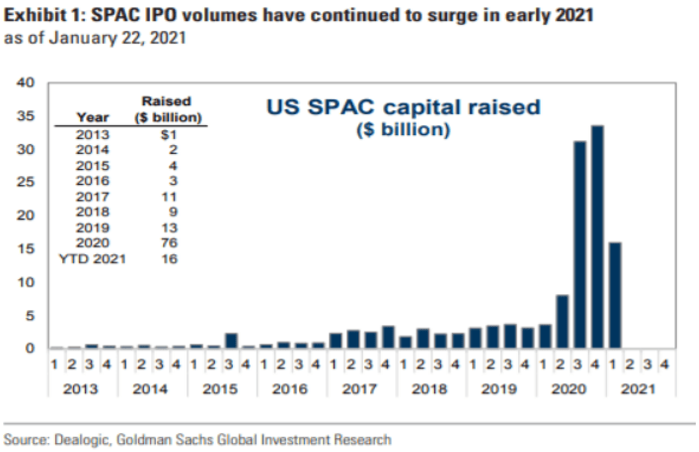
image description
The cycle of SPAC is relatively short. The establishment of its SPAC entity only needs 25,000 US dollars. A shell SPAC can be established in 3-4 weeks, the SEC review can be completed in 1 month, and it can be listed after 15 days. After listing, you can look for potential acquisition companies . Specific targets cannot be locked at the beginning of SPAC listing, but can only be carried out after listing, and the acquisition target needs to be determined within 12-24 months, otherwise it will be postponed or the funds in the escrow account will be returned directly to shareholders. The funds raised when the SPAC goes public are all deposited in the SPAC’s escrow account and used to pay the consideration for the SPAC’s potential acquisition targets.image description
The blockchain companies that currently choose SPAC for listing include: Figure, a loan service company driven by blockchain technology, and Figure Acquisition I, the main body of the SPAC, has completed listing financing; Bakkt, a digital asset futures exchange under the Intercontinental Exchange, and VPC Impact, the main body of the SPAC Acquisition has announced its merger and acquisition; the financial technology company SoFi announced that it has accepted the invitation of the fifth SPAC-Social Capital Hedosophia Holdings V of the American entrepreneur Chamath to conduct mergers and acquisitions and listing through it. SoFi is an Internet personal financial institution that can also serve customers Provide trading services for cryptocurrencies; Diginex, a blockchain and digital asset service company, has been listed through SPAC earlier.In addition to the companies mentioned above, there are at least 5 more SPACs that have been established, and the acquisition targets are all blockchain and digital asset service companies, such as eToro.This is an option for recently listed companies, such as 500.com's acquisition of mining pool btc.com. This is a typical acquisition of the assets of an unlisted company. 500.com announced on February 16th that it will acquire the mining pool business under BitDeer, and it is expected to be completed on April 16th. Of course, there are also those like Riot Blockchain or MarathonPatent who directly purchase mining machines to expand power plants. The mainstreaming of such assets is generally initiated by listed companies, and the acquisition targets are mining farms, or directly purchase mining machines. There are also cases of listed companies like Canaan Technology that have moved from selling mining machines to building their own mining business.The similarities and differences of the four listing models- Pattern summary
- The IPO of mining machine companies has become a precedent, and it is expected that mining machine companies will still choose IPOs in the future.
- Under the influence of Coinbase, exchange-type companies may choose to list directly. However, since direct listing cannot raise funds, it depends on whether the company's profitability is strong enough. There are still a few companies in the industry that can reach the size of Coinbase. Coinbase is likely to be one of the few examples of direct listings.
- The types of mergers and acquisitions are relatively free, but the acquired entity generally gives up control and chooses a small part of the shares of the listed company, which will have a certain impact on the follow-up operation of the acquired assets. The listed company's own business still exists, and if it completely transforms the blockchain business, follow-up processing is required.
02 Impact of the mainstreaming of encryption institutions2.1 Positive impact - speeding up the circleCrypto businesses gain more exit routes. In previous encryption start-ups, issuing Token has always been an important solution. Especially for those equity financing projects, it is really difficult to exit and can be solved by issuing Token, but there are many hidden dangers.Small, medium and micro start-ups can also exit. According to the four plans we have summarized, the liquidity plan has actually been enriched. Even if the volume is not enough to go public or be acquired by a listed company, you can also choose to be acquired or merged by other entities, because the path to final listing is relatively clear.Companies engaged in encrypted asset-related businesses will become an important industry in the equity market. In other words, it has become an important type of asset, connecting the equity market and the Crypto market. At present, encryption start-ups can be briefly divided into Token-related and technology-related, and the categories are relatively single.It is expected that from 2023 to 2025, it will become a relatively mainstream industry. Token-related companies will be the first to go public in this cycle, and technology service companies will appear in the next cycle.More funds participate in crypto corporate financing. A large amount of funds will enter this track through the VC situation, because the exit channels are becoming more and more clear, mainstream funds are more interested in encryption start-ups, PE will also participate, and the spin-off and listing of the blockchain part of large enterprises will also become possible .Negative effects also exist.would lead to inflated valuations. After the listing path is clear, start-ups will go public in one go, resulting in inflated valuations and triggering bubbles, which will be transmitted to the encrypted asset market.Listing mode may not be stable. The madness of the SPAC market in 2020 is obviously related to the macro environment, mainly due to the unprecedented bull market in US stocks + ultra-low interest rate environment. Due to the hot market, setting up a SPAC is a good investment for the promoters, and the high market value after the merger will bring double return on investment. If the acquisition of the investment target is not completed within 2 years, only the raised funds + interest need to be paid when exiting, which is equivalent to the sponsor raising low-interest loans from the public.Mainstreaming means that blockchain business is viewed with a magnifying glass. Listing is the step of mainstreaming. Encryption companies will be more carefully examined by mainstream institutions, and all kinds of doubts, confusion, and information asymmetry will be smoothed out, and they will also be subjected to the most acute inquiries.The allocation value of encrypted assets may be transferred to listed companies. Due to the increasing number of start-ups engaged in encrypted business and the increase in the choice and configuration range of traditional enterprises, native encrypted assets may become less attractive to institutional investors. The competition of the public chain may be more brutal.For blockchain companies, obtaining listing status is a very important milestone. When there are not many listed companies in the initial stage, listing has multi-level meanings and will also receive a high premium. With the increase of listed companies or businesses, the range of available targets will increase, and the question of how to continue to develop after listing will be in front of us.For example, Coinbase will achieve the best performance in history in the fourth quarter of 2020 and the first quarter of 2021. However, due to the cyclical nature of digital assets, we can easily imagine that after the second quarter of this year, the performance may have a cyclical trend.The main problems of crypto companies in the short term are still: highly profitable businesses are still related to tokens; the cyclicality of tokens leads to very unstable earnings; investors still regard token-related companies as proxies of Bitcoin, which do not provide new added value.