

MixMarvel was invited to participate in the AMA event organized by YGG to introduce the latest project LeCube to users
On April 13th, MixMarvel Global Marketing Director and Spokesperson Nicolas Zhu accepted the invitation of YGG, the world's largest game community, to participate in its AMA event. This event is an opportunity for all YGG members to learn about MixMarvel and its latest project, LeCube: Who is MixMarvel? What do they do?
"MixMarvel is the world's leading blockchain game publishing platform and content community. It links players and developers through the release of high-quality content." After Nicolas briefly introduced MixMarvel, he went directly to the AMA topic - LeCube. LeCube is one of the important projects that MixMarvel is currently incubating. It is called "blockchain version of Lego" and "art version of GitHub". In LeCube, users can use "blocks" to freely build and create NFT assets that are completely based on the blockchain and have traceable copyright.
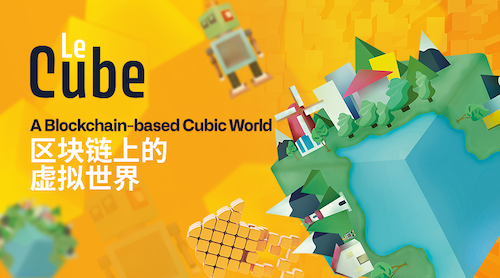
Nicolas said that LeCube is committed to changing the low life cycle of collectibles. In LeCube, both NFT code generation and NFT visual image building are created and stored through Ethereum’s smart contracts. Therefore, NFT assets created through LeCube get rid of the dependence on centralized servers, making NFT a longer-lasting digital collection. The duration of the LeCube NFT is with the Ethereum network.
Nicolas also emphasized that LeCube is currently being tested, and many players have joined and created very outstanding works.
LeCube Token
Kookoo, the host of the event from YGG, raised the first question: what exactly is a "block" and how can players earn money by playing games? Nicolas explained this in detail: "blocks" are the basic materials for creating LeCube works. Users can obtain "blocks" by staking the currency that has passed the consensus of the community in the block pool; users can obtain corresponding liquidity rewards by providing liquidity for "blocks" on Uniswap; block" to generate NFT assets and receive LCT token rewards. He also mentioned that some of the works created by users are very attractive, and these works are being showcased on MixMarvel's social media.
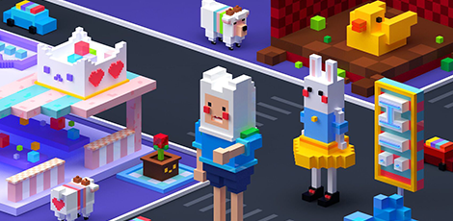
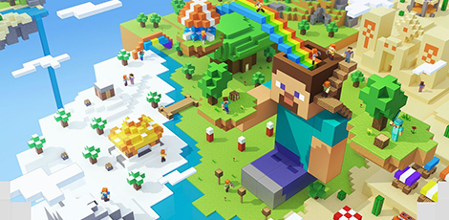
In the follow-up discussion of this topic, Nicholas mentioned that in LeCube, each "block" is not only an FT asset (Fungible Token) with actual value, but also the smallest unit of visual elements. In the process of combining "blocks" (Fungible Token) into NFT (Non Fungible Token), the value of all FT is transmitted to NFT, which constitutes the precise basic value of NFT, and also constructs all visual representations of the NFT. The whole process is completed directly using the Ethereum network, which has a higher asset value.
At the same time, the behavior of users building blocks can also be regarded as a pledge of "blocks", which is conducive to the deflation of block volume and the preservation of block price. Users can upload their own NFT works to the copyright center, and get corresponding LCT rewards when other users quote the work. The whole process is completely on the chain, and there is no limit to data storage. Therefore, users can dismantle low-quality NFTs at any time and return to the "block" form with better liquidity. This two-way convertible feature brings better liquidity to LeCube's NFT and also provides a good application scenario for FT, which can have the effect of continuously promoting each other. Nicolas provides the flowchart below to illustrate the process.
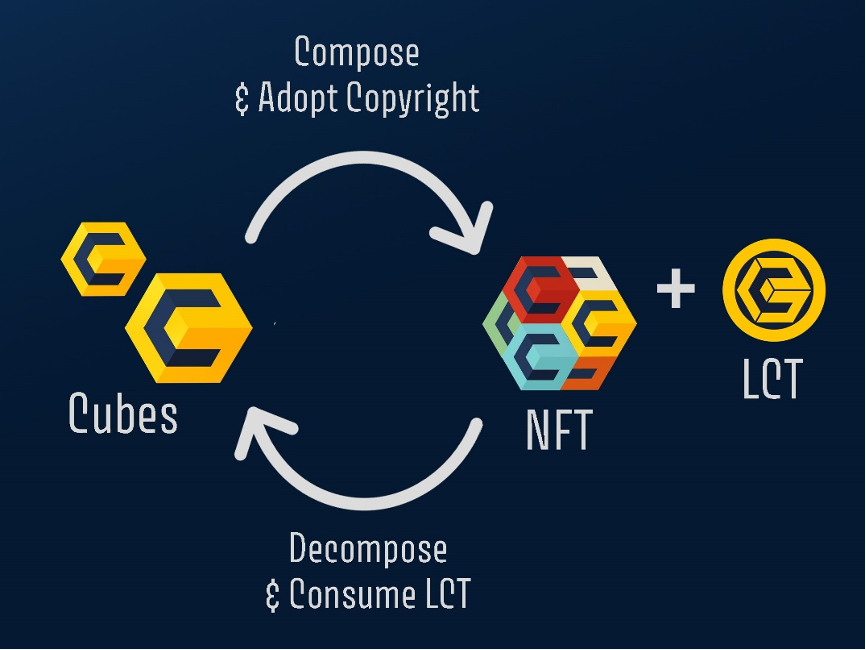
He described in detail that "Block", NFT and LCT each undertake different missions, forming a stable ecosystem in which resources are continuously recycled. At the same time, assets are also converted to each other, forming a stable ecological structure. The role of "blocks", NFT and LCT will also evolve with the development of LeCube.
At the same time, the design of the halving cycle will also enable the ecology to have the ability to self-evolve step by step: as the output of blocks decreases, the number of LCT rewards decreases, and the basic value of NFT increases, and the society will gradually form a consensus - build NFT Works are the most profitable behavior. "The generation of this consensus is also the mission of the LeCube project," Nicolas added.
block pool
Let's start to introduce LeCube. Kookoo asked about one of the main modules of LeCube, "Block Pool", and how users can participate.
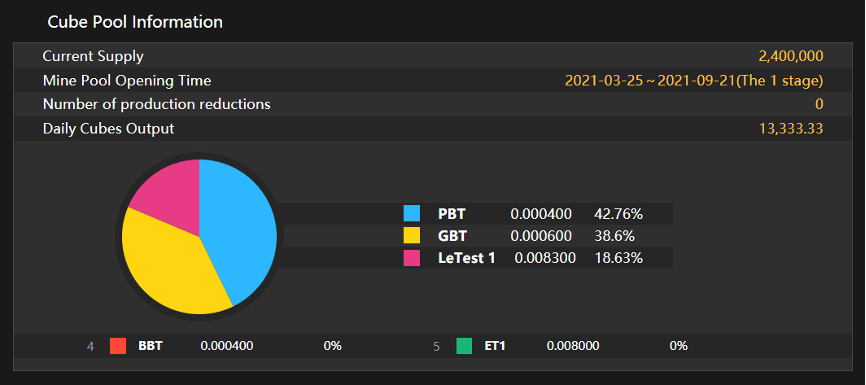
When answering this question, Nicolas elaborated, “Users can mine “blocks” by staking almost all tokens in the LeCube “block pool”, and the tokens pledged for mining do not require any centralized organization license". The community initiates an application to the pre-selection contract and votes by staking their preferred currency. Finally, the top 21 tokens in terms of pledged value will receive mining rights.
Blockchain infrastructure
Blockchain infrastructure
When talking about the details of "blocks" in the blockchain, Kookoo is more interested in whether LeCube plans to use Layer-2 solutions in view of the problem of ridiculously high GAS fees. For this problem, LeCube has a solution. This solution proposes a cross-chain based, Ethereum-compatible blockchain infrastructure dedicated to systematically solving vertical industry problems.
Although many blockchain infrastructures also provide some solutions, Nicolas believes that these solutions do not have sufficient performance, such as verticality, compatibility, and ease of use, but often replace Ethereum's infrastructure status in the DeFi field as the primary goal. The solution to this problem is Rocket Protocol, another project incubated by MixMarvel.
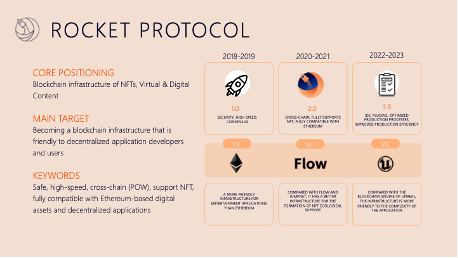
Rocket protocol integrates cross-chain protocol, NFT protocol and EVM protocol, which allows developers to freely create complex decentralized applications that can adapt to various scenarios, while providing users with an experience similar to Internet applications. In short, the Rocket Protocol solves the problem of high-frequency transactions through an effective VRF+BLS consensus mechanism; solves the problem of data heterogeneity through a cross-chain solution based on the relay chain. Solve the diversity problem through horizontal expansion, and solve the interaction problem through real-time transaction confirmation.
In the long run, images stored on centralized servers and assets whose origin is difficult to identify can hardly be called actual digital collectibles. Therefore, LeCube hopes to further develop in the direction of NFT to make digital collections more decentralized, coded and assetized. LeCube will provide a brand-new NFT creation and application paradigm, which allows the creation of artworks to be natively on the chain, enabling pictures to be expressed in a decentralized manner. After LeCube's docking with the Rockets agreement is completed, MixMarvel and LeCube promise to speed up the process. At the same time, the cost will also be greatly reduced, allowing the presentation of NFT works with higher definition.