

ETH Weekly | The price of ETH broke through 3500USDT, and the market value once surpassed Visa; the European Investment Bank used Ethereum to issue 100 million euro bonds (4.26~5.5)

Author | Qin Xiaofeng
Editor | Hao Fangzhou
Editor | Hao Fangzhou
1. Overall overview
Produced | Odaily
In terms of the secondary market, the current ETH price may continue to drop in the short term, with a support level of $3,000 and a resistance level of $3,500.
Second, the secondary market
1. Spot market
According to OKEx market data, the price of ETH once rose above $3,500 last week and closed at $3,305.2 during the week, a month-on-month increase of 41%.
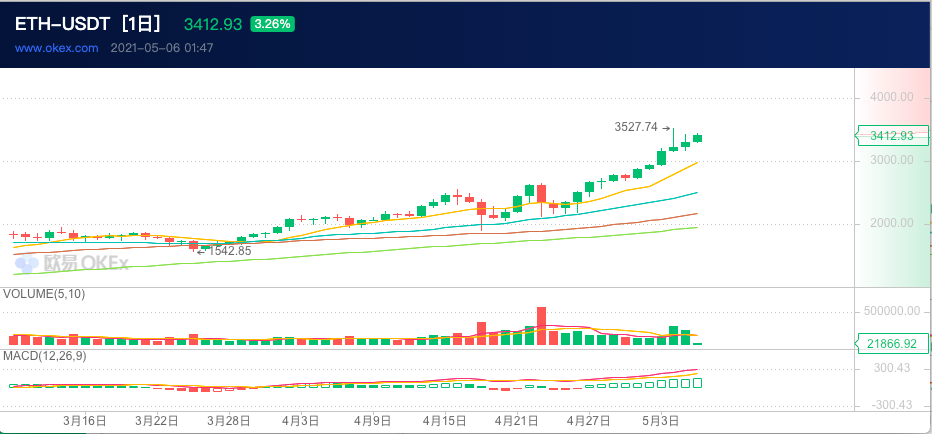
(ETH daily chart, picture from OKEx)
image description
(ETH daily chart, picture from OKEx)
The daily chart shows that the moving average is currently arranged in a long position, and the price is expected to continue to rise to the line of 4,000 US dollars; the lower support levels are 3,000 US dollars and 2,600 US dollars (the middle track of the Bollinger Band).
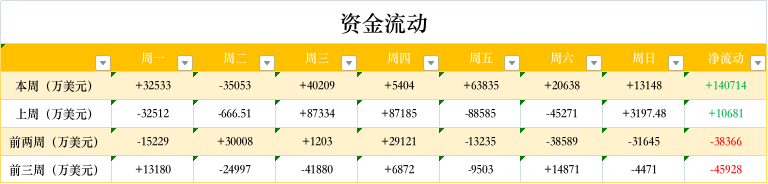
In terms of funds, the largest net outflow was 350 million U.S. dollars (April 30), and the largest net inflow was 640 million U.S. dollars (May 3); ETH’s net inflow of funds across the network last week was about 1.4 billion U.S. dollars, a month-on-month increase of 1217%. In the coming week, The price level will continue to fluctuate or be slightly corrected.
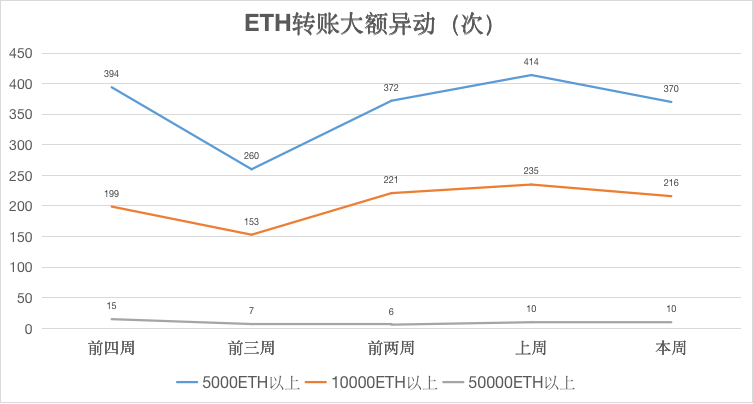
image description
Tokenview dataTokenview data
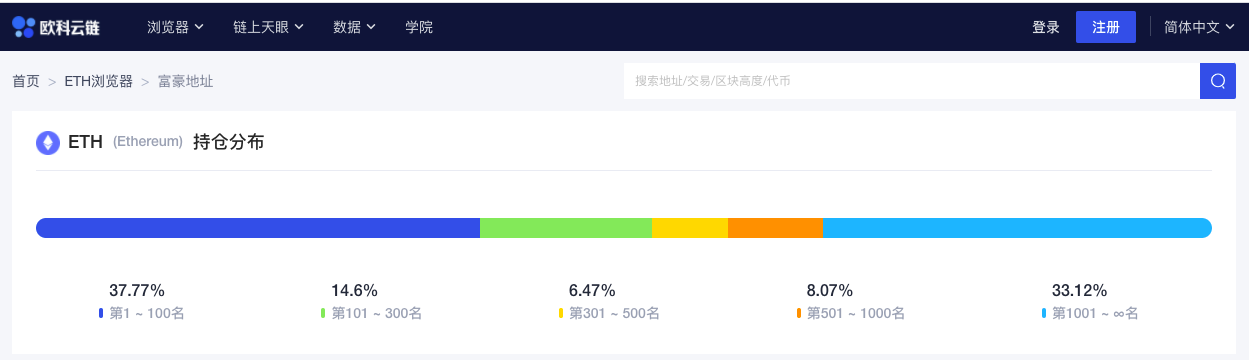
OKlink dataIt shows that the current top 300 ETH holdings hold a total of 52.37% of ETH, a month-on-month decrease of 0.02%. 0.06%; 101st to 300th, accounting for 14.6%, up 0.05% from the previous month; 301st to 500th, accounting for 6.47%, up 0.08% from the previous month; 501st to 1000th, accounting for 8.07%, up 0.05% from the previous month; After the 1001st place, they accounted for 33.12%, a decrease of 0.1% from the previous month.
3. Ecology and technology
1. Technological progress
1. Technological progress
(1) The first Eth1-Eth2 merged developer test network Steklo is released
On April 30, protolambda launched the first experimental Eth1-Eth2 merged testnet. There are currently 7 clients on the network, and while the Steklo developer network is very vulnerable, this is a big step forward in testing the merger. The network currently has 4 consensus clients: Teku, Lighthouse, Prysm, and Nimbus; 3 execution clients: Besu, Geth, and Nethermind.
Protolambda said the merger was a fork of ethereum development researcher Alex Stokes, with just a few changes to the eth1-eth2 combination. The testnet is limited to the launch day, and it is planned to iterate and deploy a new and longer testnet within a week.
According to previous news, protolambda announced the launch of the Rayonism project on March 31, planning to use Eth1 and Eth2 clients to build an Ethereum merged test network and build a sharding prototype on it.
(2) Data: The number of Ethereum 2.0 pledges exceeded 4.1 million ETH
Vitalik Buterin, the founder of Ethereum, proposed in the Ethereum Research Forum that based on the interactive verification protocol Truebit, Optimistic Rollup, an Ethereum layer-2 expansion solution, can be built to solve the problem of repeated verification, and gave a basic solution. Truebit enables smart contracts to safely perform complex calculations in a standard programming language to reduce gas costs. The protocol was launched on the Ethereum mainnet on April 21.[Original link]
2. Voice of the Community
2. Voice of the Community
(1) Ethereum conservatively plans to end PoW mining by the end of 2021
(2) ConsenSys founder: Ethereum’s energy problem will be resolved within 9-12 months
3. Project trends
3. Project trends
On April 27, the Ethereum Foundation disclosed the projects and fields of the R&D teams it is supporting. Among them, the teams and technologies involved in "applied zero-knowledge proof" are the most, with nearly 14 projects. In addition to zero-knowledge proofs, the Ethereum Foundation also supports research on ETH2, the official website of the Ethereum Foundation, Ewasm, formal verification, Geth client, Javascript team, Remix, stateless client, Solidity and other fields.
(2) Swarm will release version 0.6.0, adding functions such as token payment and light nodes
On April 27th, Swarm, a decentralized storage protocol based on Ethereum, announced that it will soon release version 0.6.0 of the client Bee, which will be previewed publicly at 15:00 Central European Time on April 27th. In addition to improving the network infrastructure, this version will also add several important functions, including allowing users to use gBZZ to pay for postage stamps; adding light node functions, allowing Bee to give up storage and forwarding capabilities; improving Performance of Swarm website hosting.
On April 27, the on-chain derivatives protocol Opium was deployed to the Ethereum expansion program Polygon (formerly Matic Network) to reduce transaction fees, and launched a highly leveraged derivative product Turbo with a short maturity date. The first product is Turbo ETH. Turbo is currently based on Opium call options, and perpetual Turbo will be introduced later. In addition, Opium is developing version 2.0, which allows anyone to create financial primitives (Financial Primitives) or even financial markets with one click. In addition, Opium 2.0 will be compatible with different order books, etc.
(4) Layer 0 extension project Marlin enables Cosmos-oriented gateways and relays
On April 28, according to official news, Layer 0 expansion project Marlin stated that Marlin Larvanet has been running for about 3 months, and the gateway and relays for the Ethereum blockchain are operating smoothly. It is now officially announced that gateways and relays for the Cosmos network are live. Specifically: Marlin node operators will now also be able to transmit Cosmos data; Cosmos validators and full nodes can install Marlin gateways and interact with the Marlin network.
(5) Ethereum scaling solution Polygon launches $100 million fund to support DeFi adoption
(6) Lido, the Ethereum 2.0 pledge protocol, raised $73 million, led by Paradigm
4. Borrowing
DefipulseOn May 5, Lido Finance, an Ethereum 2.0 pledged liquidity solution, completed a financing of US$73 million. Paradigm led the investment, and Coinbase Ventures, Three Arrows Capital, Jump Trading, Alameda Research, Digital Currency Group, etc. participated in the investment. It is reported that Paradigm paid 15,120 ETH to purchase $51 million worth of LDO tokens from LidoDAO Treasury. Lido chief market officer (CMO) Kasper Rasmussen said that Lido plans to use the funds to facilitate the integration of stETH in the Ethereum DeFi ecosystem and other PoS blockchains such as Solana and Terra. (The Block)
5. Mining
5. Mining
(data from etherchain.org)
etherchain.org(data from etherchain.org)
4. News
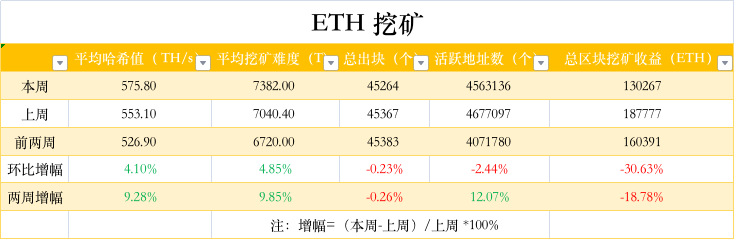
The data shows that the average computing power rose by 4.1% month-on-month, temporarily reported at 575.8 TH/s; the average mining difficulty rose by 4.8% month-on-month, reaching 7382 T; the activity on the chain decreased by 2.5% month-on-month; network congestion decreased slightly, and Ethereum Gas fees On May 2, it was only 4022 ETH, the lowest level in a single day since December 2020, and the total mining revenue fell by 30% month-on-month.
4. News
Ou Yi OKEx market shows that ETH rose to 3527 USDT on May 3. According to data from AssetDash, the market capitalization of Ethereum once rose to the 13th place in the global assets, and now it ranks 18th, surpassing UnitedHealth Group, the largest health insurance company in the United States, and approaching Wal-Mart.
(2) CI Global Asset Management Company Launches Ethereum Mutual Fund
The CI Ethereum Fund's investment objective is to provide unitholders with exposure to Ethereum through an institutional-grade fund platform. It invests all or nearly all of its assets in the CI Galaxy Ethereum ETF. The fund is open to retail investors in Canada in Series A, F and P. CI GAM is the manager of the Fund, with CI Galaxy Ethereum ETF and Galaxy Digital Asset Management (“GDAM”) acting as sub-advisors. As a sub-advisor, GDAM executes Ethereum transactions on behalf of the ETF. (Coin Gape)
Last week, the European Investment Bank (EIB) used blockchain technology for the first time to issue a digital bond, issuing 100 million euros ($121 million) in two-year notes. The two-year bond was issued on the Ethereum public blockchain and settled the next day, with a maturity date of April 28, 2023. Bankers on the deal include Goldman Sachs, Santander and Societe Generale. (Cointelegraph)
(4) The JP Morgan report mentions "Why ETH will outperform the market"
On April 28, Eugene Ng, head of Gemini's business development department in Asia, tweeted: "When Wall Street banks start to pay attention to altcoins such as ETH, then we are not far from the altcoin season." A screenshot from JPMorgan Chase's "North American Fixed Income Strategy" report released on April 27. This part talks about why ETH outperformed the market.
The JPMorgan Chase report gave 3 reasons why Ethereum outperformed Bitcoin:
First, Ethereum’s liquidity is more elastic. Liquidity shocks in the encrypted derivatives market have caused huge liquidations. During the shocks, the Bitcoin futures market was far more affected than the Ethereum futures market. During the market recovery phase, the Ethereum transaction depth recovered rapidly.