

Hong Kong post-00s musician Zheng Zhuoxi released music and video NFT on Openlake
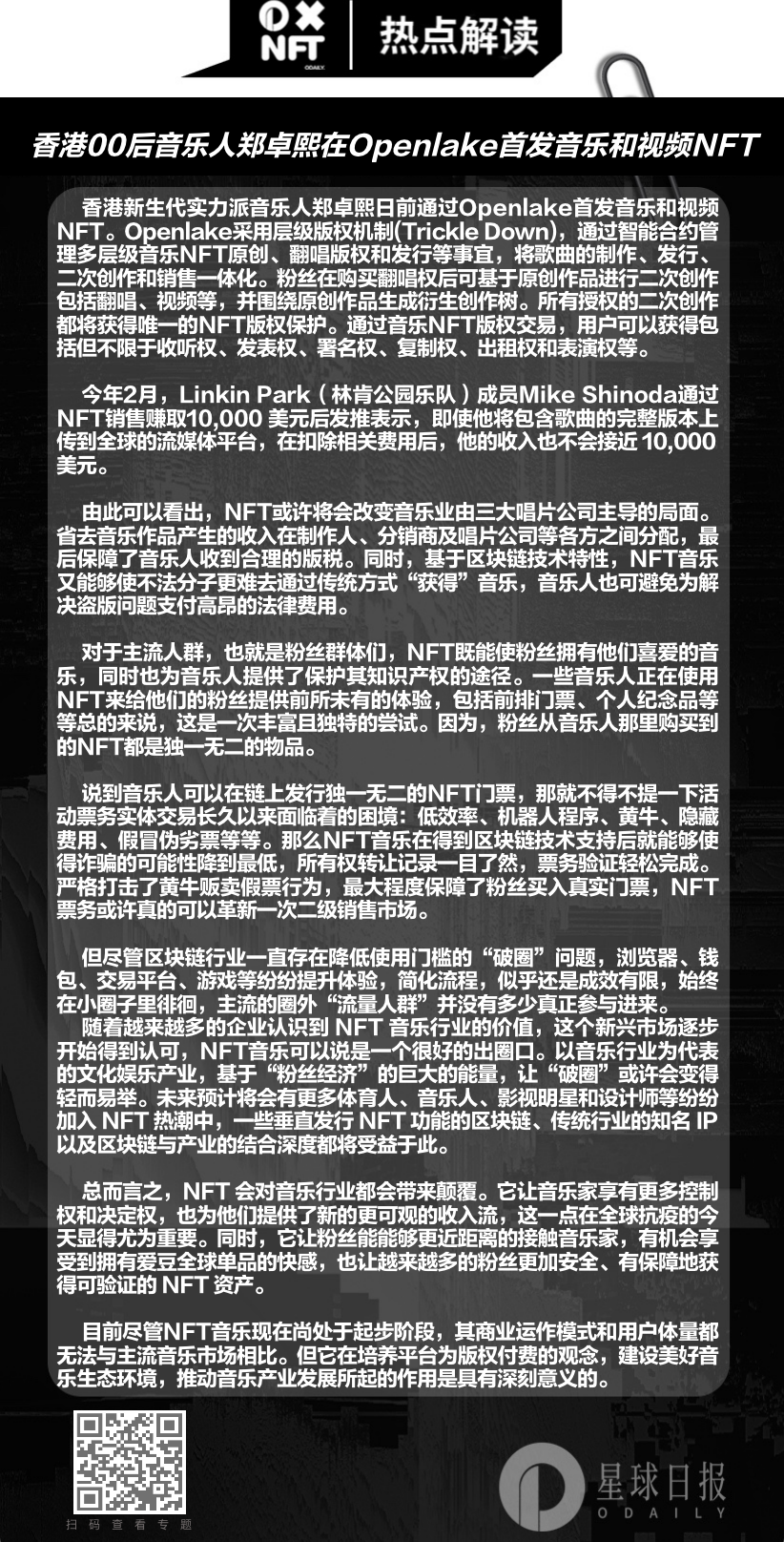
Interpretation of Hot Spots—Hong Kong Post-00s Musician Zheng Zhuoxi Debuts Music and Video NFT on Openlake
Cheng Zhuoxi, a new generation of powerful musicians in Hong Kong, released music and video NFT through Openlake a few days ago. Openlake adopts a hierarchical copyright mechanism (Trickle Down), manages multi-level music NFT originality, cover copyright and distribution through smart contracts, and integrates the production, distribution, secondary creation and sales of songs. After purchasing the right to cover songs, fans can create secondary works based on original works, including covers, videos, etc., and generate derivative creation trees around the original works. All authorized secondary creations will be protected by a unique NFT copyright. Through music NFT copyright transactions, users can obtain, including but not limited to, listening rights, publishing rights, authorship rights, reproduction rights, rental rights, and performance rights.
In February of this year, Mike Shinoda, a member of Linkin Park (Linkin Park Band), tweeted after earning $10,000 through NFT sales that even if he uploaded the full version of the song to streaming platforms around the world, after deducting related fees, his Income won't be anywhere near $10,000, either.
It can be seen from this that NFT may change the situation where the music industry is dominated by the three major record companies. The income generated by the omission of musical works is distributed among various parties such as producers, distributors and record companies, and finally ensures that musicians receive reasonable royalties. At the same time, based on the characteristics of blockchain technology, NFT music can make it more difficult for criminals to "obtain" music through traditional methods, and musicians can also avoid paying high legal fees to solve the problem of piracy.
For the mainstream crowd, that is, the fan base, NFT not only enables fans to own their favorite music, but also provides musicians with a way to protect their intellectual property rights. Some musicians are using NFTs to give their fans unprecedented experiences, including front-row tickets, personal memorabilia, and more. Overall, this is a rich and unique endeavor. Because the NFTs purchased by fans from musicians are unique items.
When it comes to musicians being able to issue unique NFT tickets on the chain, we have to mention the long-standing difficulties faced by event ticket entity transactions: inefficiency, robots, scalpers, hidden fees, counterfeit and shoddy tickets, etc. Then NFT music can minimize the possibility of fraud after being supported by blockchain technology, the ownership transfer record is clear at a glance, and ticket verification is easily completed. Strictly crack down on scalpers selling fake tickets, and guarantee fans to buy real tickets to the greatest extent. NFT ticketing may really revolutionize the secondary sales market once.
However, although the blockchain industry has always had the problem of "breaking the circle" of lowering the threshold of use, browsers, wallets, trading platforms, games, etc. have improved their experience and simplified the process, but the results seem to be limited, and they have always lingered in small circles. Outside the "traffic crowd" did not really participate.
As more and more companies realize the value of the NFT music industry, this emerging market has gradually begun to be recognized, and NFT music can be said to be a good outlet. The cultural and entertainment industry represented by the music industry, based on the huge energy of the "fan economy", may make it easy to "break the circle". In the future, it is expected that more sportsmen, musicians, movie stars, and designers will join the NFT boom. Some blockchains that issue NFT functions vertically, well-known IPs in traditional industries, and the depth of integration of blockchains and industries are all will benefit from this.
All in all, NFT will bring disruption to the music industry. It gives musicians more control and decision-making power, and also provides them with new and more substantial income streams, which is especially important today in the global fight against the epidemic. At the same time, it allows fans to get closer to musicians, have the opportunity to enjoy the pleasure of owning idol global items, and also allows more and more fans to obtain verifiable NFT assets more safely and securely.
Although NFT music is still in its infancy, its business operation model and user volume cannot be compared with the mainstream music market. However, its role in cultivating the concept of paying for copyright on the platform, building a beautiful music ecological environment, and promoting the development of the music industry is of profound significance.