

What will happen after Ethereum moves to PoS?

Compilation of the original text: Bai Ze Research Institute
Compilation of the original text: Bai Ze Research Institute
The Ethereum merger is about to happen, as of press time:

Much controversy has arisen before the merger was officially announced, and they will continue long after the merger.
Ethereum’s move to Proof of Stake (PoS) can be considered one of the most significant events in the crypto industry. Speculation and misinformation are rife. Here we discuss the facts and consequences of this technological experiment.
It should be emphasized that the developer’s decision to switch from the original consensus protocol Proof-of-Work (PoW) to PoS has been several years in the making. The Beacon Chain is the fork of the Ethereum blockchain responsible for using PoS and was initially launched on December 1, 2020 for development and testing.
first level title
Ethereum Becomes Sustainable, But Bitcoin Will Be Unique
Using PoS as a consensus mechanism will result in a significant reduction in the energy required for the Ethereum blockchain.
The fact that several studies have concluded that Ethereum will reduce electricity consumption by 99.95% after implementing PoS due to the merger cannot be ignored.
The first event after the implementation of PoS will be Ethereum’s hash rate plummeting to zero, representing the end of an era. Any user with ETH can become a validator. They can also earn rewards by staking ETH in the protocol.
The most immediate impact of the merger will be how the media pays more attention to Bitcoin and the environmental damage it causes. Investors who like the PoW mechanism blockchain are hesitant to invest in Ethereum. For example, Tesla dropped its original proposal to use Bitcoin as a means of payment due to its carbon footprint.
With PoS, Ethereum offers a clear path for any investor, especially one who must follow ESG criteria (environmental, social and governance standards), inject funds into ETH, or invest in companies related to Ethereum activity.
first level title
Regulators Argument Against Ethereum Set to Fewer
Regulators have long been known to want to intervene or set certain ground rules in the crypto market. On the one hand, it seems that due to the small size of the crypto market, they have not rushed to intervene. But on the other hand, they observed that the long-term growth of cryptocurrencies could endanger national currencies.
But regulating cryptocurrencies is not an easy task due to the versatility among crypto projects. So regulators have to start somewhere, and the question of sustainability seems to have been the number one argument for choosing to regulate cryptocurrencies.
PoW is one of the reasons cryptocurrencies are unsustainable, so regulators are considering banning it. Some regulators claim that mining cryptocurrencies via PoW should be banned due to its high electricity consumption.
The European Union's encryption regulatory bill MiCA has already included a ban on PoW mining, although it was eventually delayed. In the U.S., the White House’s latest report states that cryptocurrencies and corresponding blockchain technologies have persistently high impacts on greenhouse gas emissions, pollution, and noise, preventing federal agencies from achieving net-zero carbon pollution in line with U.S. climate commitments and goals s hard work.
first level title
The Exodus of Ethereum Miners: Who Will Benefit?
What happens to miners who mine ETH every day? Like Bitcoin, there are mining rigs dedicated to mining ETH on Ethereum. When Ethereum switches to using PoS as the consensus model, Ethereum mining will disappear completely and the hash rate will drop to zero.
Some ethereum mining groups tried to resist the merger from happening, and some threatened to fork ethereum.
While their efforts appear to be in vain, it shows dissatisfaction among players involved in the crypto industry.
first level title
Are Ethereum Miners Switching to Bitcoin?
Or maybe migrating from Ethereum PoW mining to Bitcoin PoW mining is a good idea. To answer this question, we reached out to Anibal Garrido, a cryptocurrency consultant and expert in trading and mining.
Regarding the final destination of Ethereum miners, Garrido believes they will “migrate to other projects where mining can provide sufficient rewards to continue mining activities.” For example, “RavenCoin, Conflux, Ethereum Classic, etc.”
Garrido added that the equipment of ethereum miners will not be completely obsolete.
GPUs for Ethereum mining rigs can be configured into other projects that support Etash or Dagger Hashimoto (Ethereum's proof-of-work basis) without any drawbacks.
When asked if there would be any Ethereum miners flocking to Bitcoin, Garrido replied:
Due to the current difficulty level of the Bitcoin network, it is not profitable to mine BTC using an Ethereum device (GPU). Years ago, BTC miners abandoned GPUs and migrated to powerful ASIC technology. Since ASICs have a much higher advantage in processing trillions of operations per second than GPUs, GPU mining will not be profitable on Bitcoin.
In addition to the monetization issue, there is also a technical aspect that can pose a big hurdle due to the incompatibility between the two networks:
ETH ASIC miners also experience issues due to incompatible algorithm standards. For example, the powerful E9 ASIC miner will not work after switching to BTC, because it is only compatible with Etash (ETH) and not SHA256 (BTC).
first level title
Layer 1 solutions will lose significant value characteristics
One of the side effects of Ethereum's conversion to PoS will completely affect the competing blockchains of Ethereum, the so-called "Ethereum Killer". Among layer 1 solutions, we can see Solana, Cardano, Avalanche, Tron, Polkadot or Radix to name a few.
However, both layer 1 and layer 2 solutions (such as Polygon) will lose one of the strongest selling points in the competition for Ethereum supremacy: sustainability. For example, Starbucks chose to launch its NFT video game on Polygon, especially because of Polygon's sustainability, and now that argument will change forever.
Ethereum 2.0 will force these protocols to change their marketing strategies to focus on other issues where Ethereum is still faltering. Such as the high cost of network saturation fees, especially the cost of solving scalability problems.
first level title
After the merger of Ethereum: the NFT industry will be clean
The NFT industry and its derivatives are one of the subsectors of the crypto industry that suffers the most from the use of PoW.
NFTs are somewhat more political and environmentally conscious. Currently, NFTs are widely used in fields such as video games, sports or music. However, the use case that pushed them into the mainstream is crypto art.
first level title
Ethereum merger: Centralization is a threat
Ethereum's move to PoS will change its token economics and potentially affect Ethereum's decentralization.
Critics of Ethereum's use of PoS point out that the system will eventually lead to a centralized Ethereum network. Large investors can eventually dominate the network by purchasing large amounts of ETH. Deep-pocketed investors are real, such as Grayscale which bought nearly all of the ETH mined within one phase of launching its Ethereum Fund.
The existing concern is that Ethereum will become more centralized. Let’s take a look at data from Dune Analytics, a blockchain data aggregation platform. The Lido protocol currently has the largest share of ETH with 4,152,128 ETH staked, which is almost 31% of the total staked pool on the Beacon Chain. This number equates to 129,754 validators, since each of them needs to stake 32 ETH on the beacon chain.
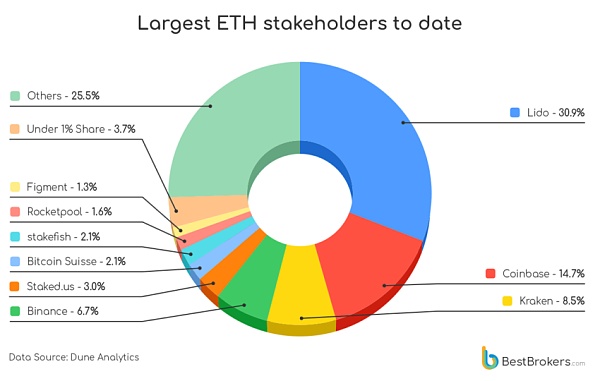
Therefore, it can be concluded that 29.61% of ETH staking is dominated by three cryptocurrency exchanges. The top 4 exchanges have a total stake of 8,160,416 ETH or 60.69% of all staked ETH.
The problem with this kind of centralization is that investors or companies holding these large amounts of funds may be at risk of freezing funds, thereby affecting the Ethereum network. This was a problem that did not need to be considered before. However, the U.S. Treasury Department’s sanctions on mixer Tornado Cash opened a Pandora’s box and set a “dangerous precedent,” according to Cardano founder Charles Hoskinson.
first level title
Ethereum Merger Matters for Every Crypto User
In fact, the Ethereum merger and transition from PoW to PoS may be the biggest event of the year. Moreover, it is also one of the major events facing the encryption industry since the birth of Bitcoin and Ethereum.
On the one hand, this global experiment may be the first of its kind among cryptocurrency developers. If successful, it could even convince Bitcoin maximalists to change their consensus model. On the other hand, if the experiment fails, it may erase Ethereum's original supremacy.
According to the "Notice on Further Preventing and Dealing with the Risk of Hype in Virtual Currency Transactions" issued by the central bank and other departments, the content of this article is only for information sharing, and does not promote or endorse any operation and investment behavior. Participate in any illegal financial practice.
Original link:
https://beincrypto.com/ethereum-merge-migrating-proof-of-stake-what-happens-next/
risk warning:
According to the "Notice on Further Preventing and Dealing with the Risk of Hype in Virtual Currency Transactions" issued by the central bank and other departments, the content of this article is only for information sharing, and does not promote or endorse any operation and investment behavior. Participate in any illegal financial practice.