

How to use the Bitcoin Lightning Network for micropayments?

Compilation of the original text: Bai Ze Research Institute
Compilation of the original text: Bai Ze Research Institute
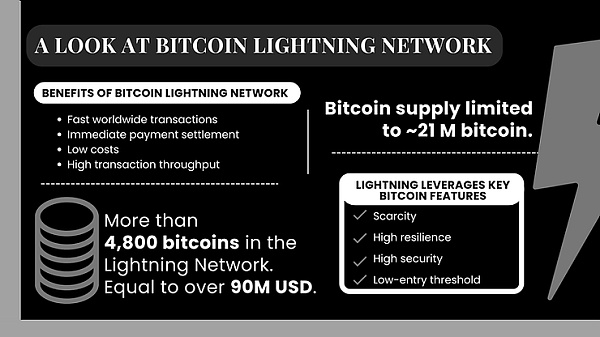
The Bitcoin Lightning Network is becoming more and more popular. The adoption of Lightning is underway: There are now over 4,800 bitcoins worth over $90 million in the Lightning Network. Additionally, there has been an increase in institutional activity surrounding the Lightning Network. For example, Lightning Labs, a major contributor to the Lightning Protocol, raised $70 million in Series B funding earlier this year. The number of companies offering Lightning Network-related services is also growing rapidly.
first level title
Bitcoin as a global payment system?
Bitcoin offers many advantages as a decentralized payment system that can move money around the world without intermediaries.
Foremost among these is the low barrier to entry for participation: anyone in the world with an internet device can use Bitcoin, no one can be excluded, which has a positive impact on financial inclusion. Moreover, Bitcoin represents a scarce digital asset, a kind of "digital gold". Each bitcoin can be divided into 100 million satoshis, just like you can divide a dollar into 100 cents. Unlike fiat currencies, Bitcoin has a capped supply of 21 million coins. Therefore, it is impossible to devalue Bitcoin through dilution.
Despite these advantages, the current state of the Bitcoin network has limitations. The decentralization of the network comes at the expense of transaction throughput, which is the number of transactions that the network can perform per second. Currently, the Bitcoin network can confirm up to seven transactions per second.
As a payment system, this low transaction throughput is not enough. Mature payment service providers like Visa or Mastercard can achieve thousands of transactions per second and therefore scale better - even if fully centralized. Transactions on the Bitcoin network typically take longer to be confirmed, making them unsuitable for day-to-day payment transactions.
first level title
Lightning Network can solve this flaw
The goal of developing the Lightning Network is to make Bitcoin an everyday payment method. The goal is to increase throughput without centralization, which is the basis of being a qualified payment network. More specifically, it means users can pay more, cheaper and faster. While the Bitcoin white paper was published by Satoshi Nakamoto back in 2008, the idea of the Lightning Network dates back to 2015 and the first development began in 2016. In 2018, the first users started using the Lightning Network. Since then, the technology has evolved rapidly. However, it is still in its infancy in 2022, despite the volume of transactions and recent gains in adoption.
first level title
How the Lightning Network Works
To understand how the Lightning Network works, consider the following real-world example.
Let's say you're going to a bar with some friends for a fun night out. You want to buy them a drink, but paying for each drink separately is too much trouble for you. So, you hand your credit card to the bartender. For every drink you order, the bartender keeps a tab. At the end of the reception, the bartender will sort out the tabs and give you the final bill for payment.
first level title
How to use the Bitcoin Lightning Network?
1. Set up wallet
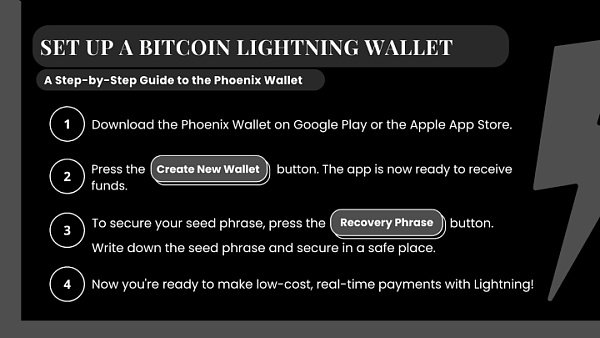
The first step requires you to download and set up Lightning Wallet on your smartphone or computer. Setting up a Lightning wallet is relatively simple, similar to setting up a self-hosted Bitcoin wallet, where you have your own private keys.
Today, there are various Lightning wallet providers such as Zeus, Bluewallet, Phoenix or Breeze. Let's take Phoenix as an example:
After downloading Phoenix Wallet from the app store, click the "Create New Wallet" button.
Afterwards, the wallet will be ready to receive funds. To do this, you need to click "Receive".
Note that the first payment you receive will be at least 10,000 Satoshi (0.0001 BTC).
Since the app provides a self-hosted wallet, it is your responsibility to secure and store the seed phrase. By clicking the "Recover Phrase" button in Phoenix Wallet, the seed phrase will appear, please write it down and store it in a safe place. This seed phrase is required to recover the private and public keys.
2. Deposit funds into wallet
The next step is to deposit funds into the Lightning Wallet. Therefore, you need to transfer bitcoins from a self-hosted bitcoin wallet or your account with a custodial service provider such as Coinbase and Binance to a Lightning Network wallet. All you have to do is enter the Lightning Network receiving address and authorize the payment by signing it with your private key.
For security reasons, you should wait for multiple confirmations from the Bitcoin blockchain (usually 6 confirmations, which takes about 60 minutes) to ensure final settlement of the deposit.
3. Open a payment channel
Next, you need to open a payment channel with your trading partner. For example, if you want to pay for coffee with the Lightning Network, you can open a payment channel at the cafe.
During the process of opening a payment channel, your funds are deposited into the payment channel. The deposited funds can be used for payments within the payment channel.
4. Start payment
Summarize
Summarize
Setting up a Lightning wallet takes only a few minutes; initial deposits to Lightning wallets and payment channels take an average of about an hour each. Once the Bitcoin assets in wallets and payment channels are available, payments can be made to each other in real-time via Lightning. In this way, the main advantage of the Lightning Network will be fully realized: fast payments with low transaction fees. This is especially important when you want to make small payments (for example, a cup of coffee).
According to the "Notice on Further Preventing and Dealing with the Risk of Hype in Virtual Currency Transactions" issued by the central bank and other departments, the content of this article is only for information sharing, and does not promote or endorse any operation and investment behavior. Participate in any illegal financial practice.
risk warning:
According to the "Notice on Further Preventing and Dealing with the Risk of Hype in Virtual Currency Transactions" issued by the central bank and other departments, the content of this article is only for information sharing, and does not promote or endorse any operation and investment behavior. Participate in any illegal financial practice.