

The data on the ETH chain is picking up, and Staking supervision is good for decentralized pledge
Data on the ETH chain continues to pick up
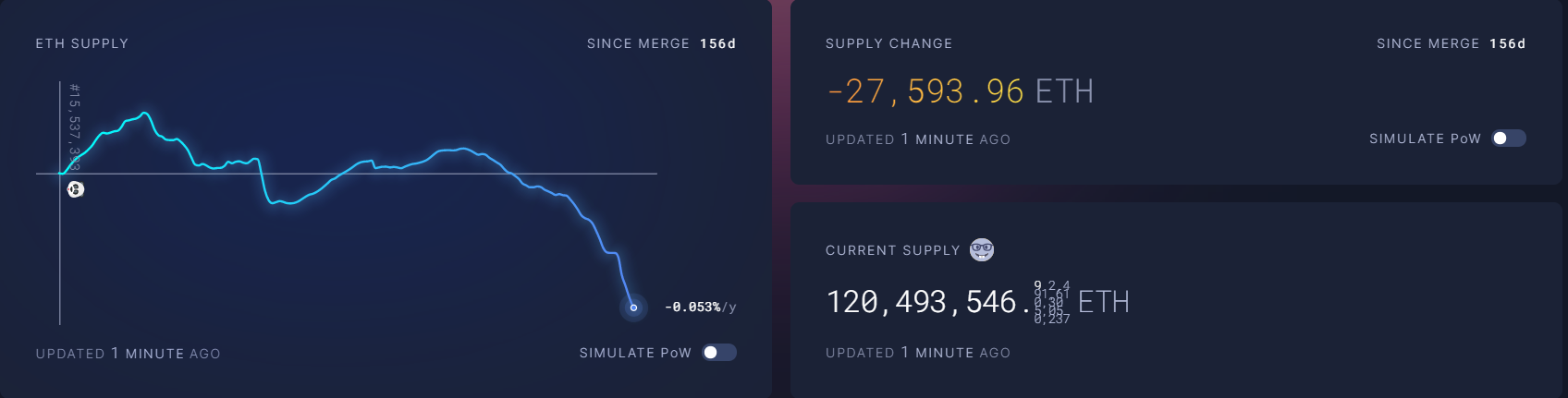
Since the Ethereum Merge, instead of increasing, the total amount of ETH has decreased by more than 23,700 through burning, and the current annual inflation rate is -0.053%.
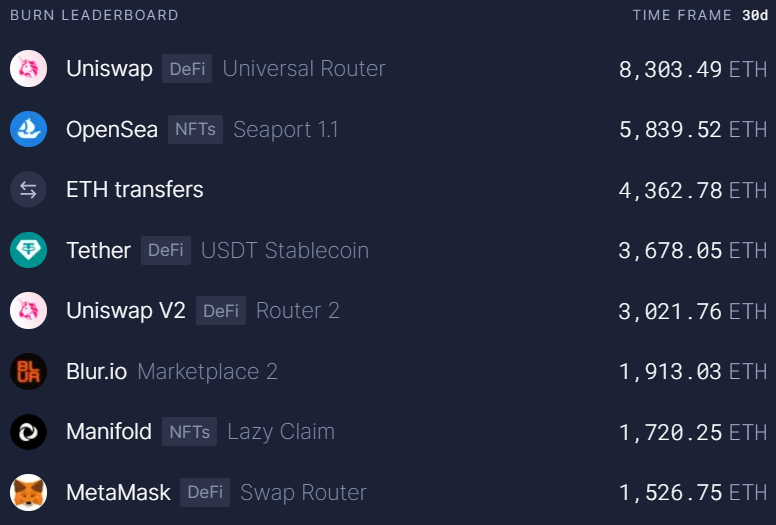
In the past 30 days, besides conventional DEX, ETH transfer, stable currency, and wallet, NFT applications have also become active driven by Blu.io. Since November 2020, Ethereum’s DeFi market share has dropped from about 96% to about 60%.
In terms of NTF, Polygon and Solana have become two potential competitors of Ethereum in the long run. Polygon is working hard to attract Web2 giants such as Disney and Meta to the NFT space, while Solana is slowly recovering after the FTX incident and is welcoming new users and artists to try NFT. Of course, the Ethereum blockchain is still the best choice for the vast majority of NFT premium collectibles.
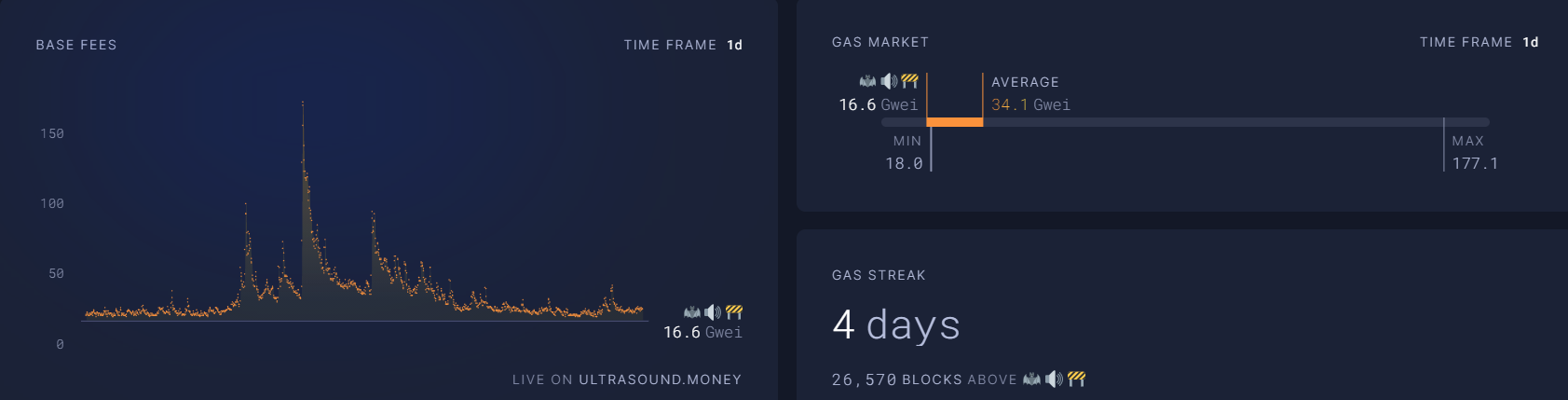
From the perspective of gas costs, the entire second half of last year was in a slump, and the gas costs have risen slightly recently, indicating that the activity on the chain has begun to pick up.
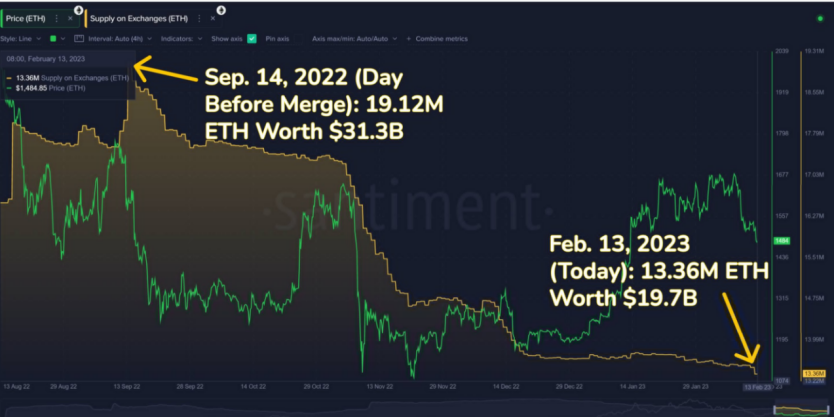
The amount of ETH stored on exchanges continues to decline, according to crypto analytics firm Santiment. Since the Ethereum merger in September 2022, the amount of ETH on all exchanges has decreased by 37%. A sustained decline in supply on exchanges is often considered a bullish sign.
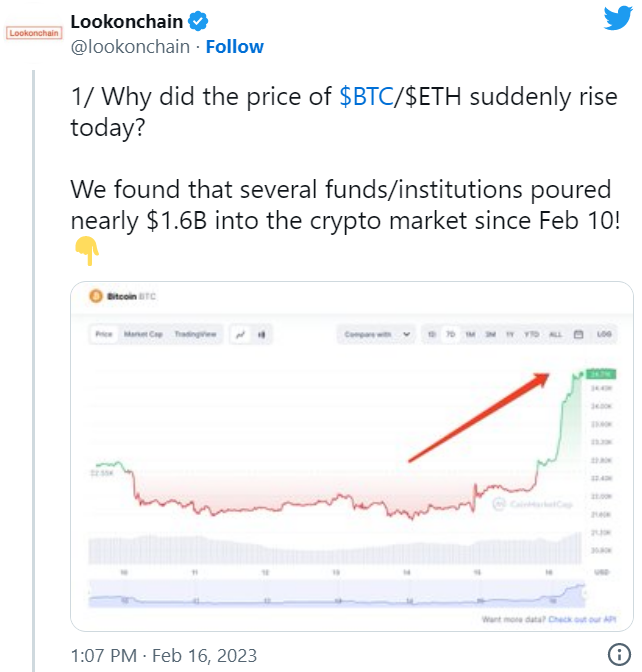
Recently, on-chain data analysis site Lookonchain pointed out that institutions have been buying BTC and ETH over the past week.
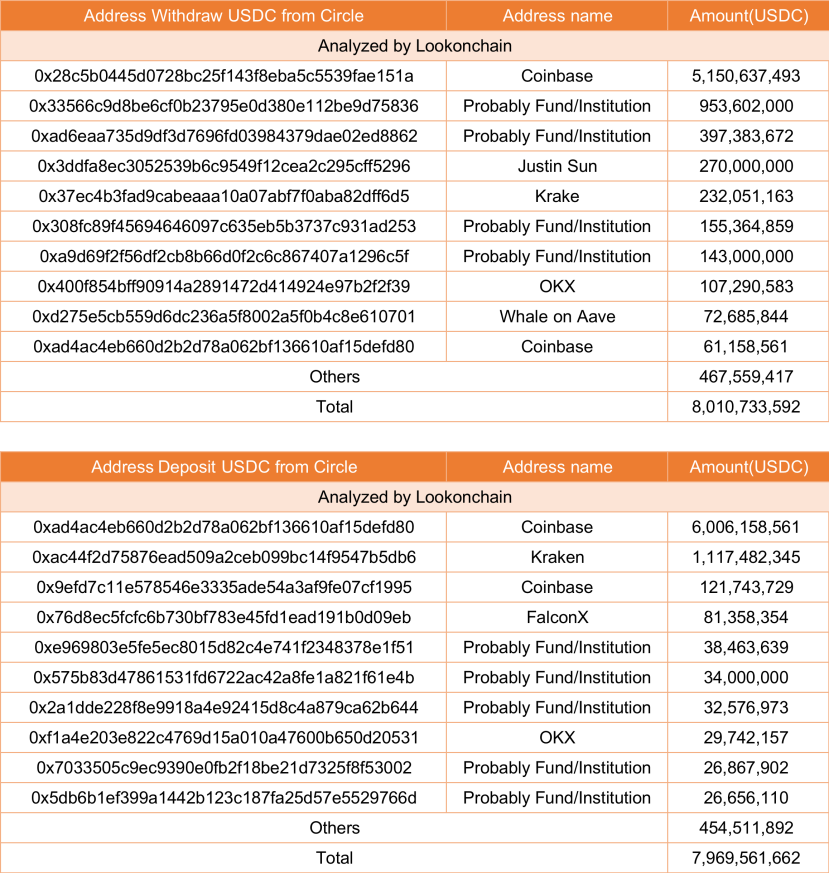
Since February 10, multiple funds and institutions have invested nearly $1.6 billion in the cryptocurrency market, which may be one of the important reasons for the recent improvement in the market.
How will the stakers respond to the Shanghai upgrade?
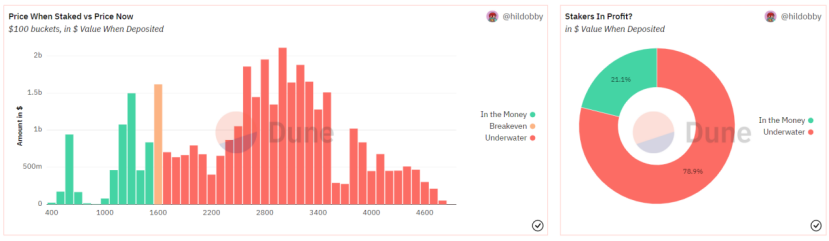
Compared with the price at the time of pledge, only 21.1% of the currently pledged ETH is below $1,600, while 78.9% of the ETH pledged is at a price higher than $1,600. As can be seen from the above figure, the price of most of the ETH participating in the pledge Concentrated in the range of 2500-3500 dollars.
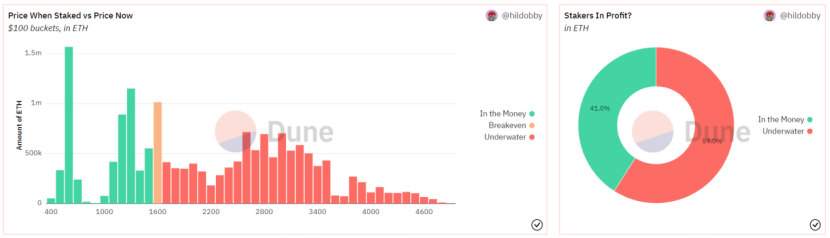
From the perspective of principal and interest, that is, the pledged ETH principal + the rewards obtained for the pledge, 59% of the pledgers are still in the "underwater" state. From the perspective of the pledgers, those who participated in the pledge of the beacon chain are basically optimistic about the Ethereum network for a long time. They participated in the pledge during the bull market cycle and did not get huge profits. Therefore, it is unlikely that Shanghai will choose to withdraw from the pledge of ETH after the upgrade.
Binance’s latest Shanghai upgrade research report also noted that most ETH stakers are losing money, with little financial incentive to sell ETH at current prices. The report also noted that about 2 million ETH were staked at a price in the $400-$700 range — representing the earliest stakers in December 2020, and since liquid staking was little known at the time, most of this ETH is illiquid.
The Shanghai upgrade will eliminate liquidity risks and uncertainties during the lock-up period, and it will most directly affect impulsive short-term investors. Moreover, the Shanghai upgrade changes ETH from "long-term lock-up" to "current income", which may attract a large number of new participants, bringing a certain amount of potential buying pressure on ETH, especially when ETH has long-term interest for institutional investors. case of attraction.
Strong Regulation Vs Decentralization
On February 9, the U.S. Securities and Exchange Commission (SEC) accused the cryptocurrency trading platform Kraken of irregular staking services, violating securities laws, and ordered it to stop all staking services for U.S. customers. Kraken was forced to agree to pay a $30 million fine and Follow SEC requirements. Although this supervision has not yet affected other centralized trading platforms such as Coinbase, exchanges may have to start reassessing the compliance of their pledge services.
After the thunder of centralized institutions such as FTX, Celsius, Voyager, and BlockFi last year, the trend of more stringent supervision of cryptocurrency centralized platforms will be inevitable, and the DeFi protocol has the characteristics of decentralization and borderless. It uses smart contracts and Other automations designed to provide users with anonymity would be potential beneficiaries. Therefore, the encryption community believes that this incident will have a long-term impact on the distribution of ETH pledge data, which will benefit decentralized pledge service providers such as ETH, and is also of great significance to the decentralization of the Ethereum consensus layer.
Pros and Cons of Centralized Staking and Decentralized Services
Generally, the pledge service of the centralized trading platform has the advantages of low threshold and convenient operation. The disadvantage is that the exchange intercepts 30-40% of the pledge profits. According to Coinbase, its staking service revenue in the third quarter of last year was $62 million, accounting for 10% of its total revenue during the same period. In addition, users entrust their funds to the exchange, which also bears the potential "third party" risk of the exchange.
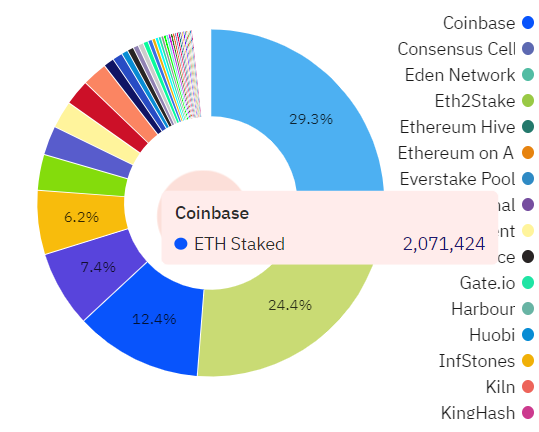
At present, Coinbase is the centralized trading platform with the highest amount of pledged ETH, currently pledged 2.07 million ETH, accounting for 12.4% of the total pledged amount.
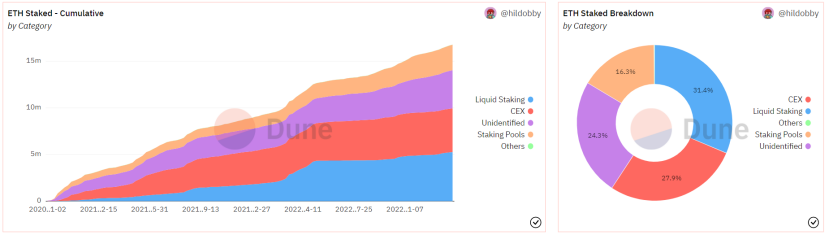
As shown in the figure, ETH pledge can be roughly divided into 4 categories, namely liquidity pledge (31.%), centralized exchange pledge (27.9%), pledge pool (16.3%) and unidentified individual or entity pledge (24.3%).
At present, the amount of ETH pledged on the centralized platform is relatively considerable, reaching 4.68 million, accounting for 27.9% of the total pledged amount. If the SEC continues to supervise the pledge of centralized platforms, it can be expected that more ETH will leave centralized exchanges and turn to decentralized liquidity pledge or pledge pool services.
Although the decentralized platform is not perfect, it is still the future development trend for users to control their own funds instead of entrusting funds to centralized exchanges. This will strengthen the long-term prospects of Ethereum and is more in line with the blockchain itself. The spirit of antifragility.
Pledge service pattern
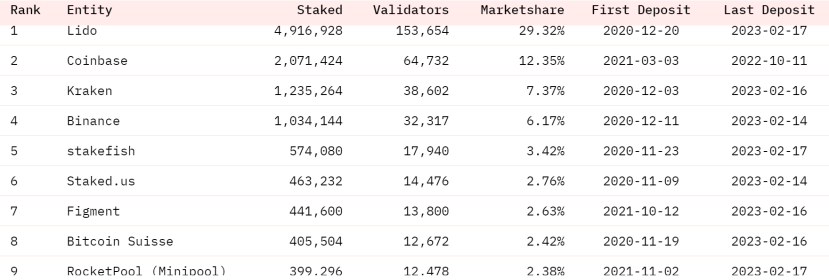
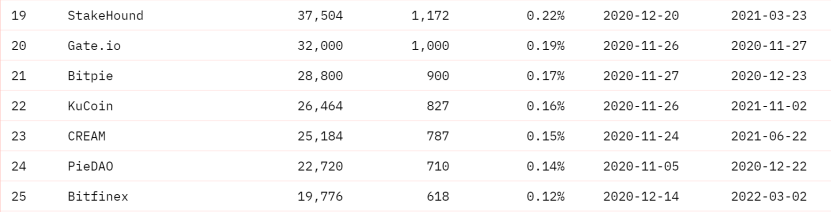
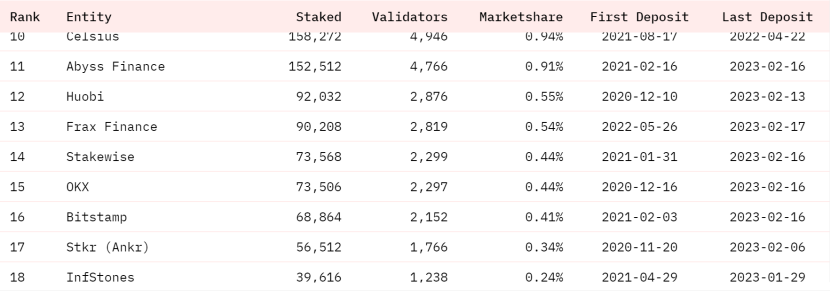
From the perspective of the number of pledges, Lido leads with 4.91 million, accounting for 29.32% of the market. In addition to Lido, other liquidity solutions (LSDs), including RocketPool, Frax Finance, and Ankr.
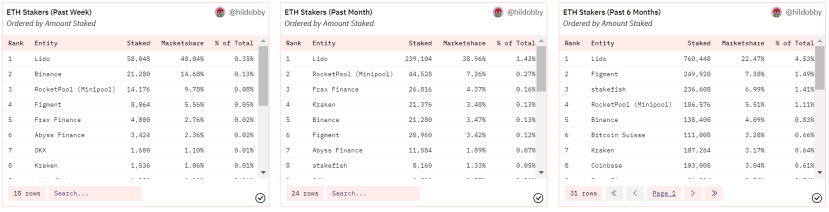
Judging from the number of pledges in the past week, nearly a month, and nearly half a year, Lido’s top effect continues to be strong, and the number of pledges in RocketPool and Frax Finance has also maintained a good growth momentum.
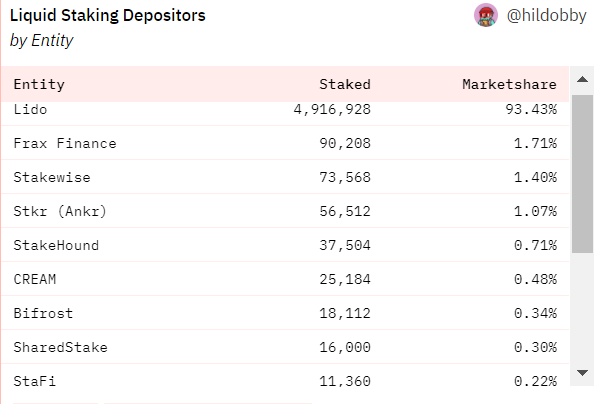
Liquidity staking service projects with more than 50,000 ETH pledges currently include: Lido (4.91 million), RocketPool (399,000), Frax Finance (90,000), Stakewise (73,000), and Ankr (56,000).
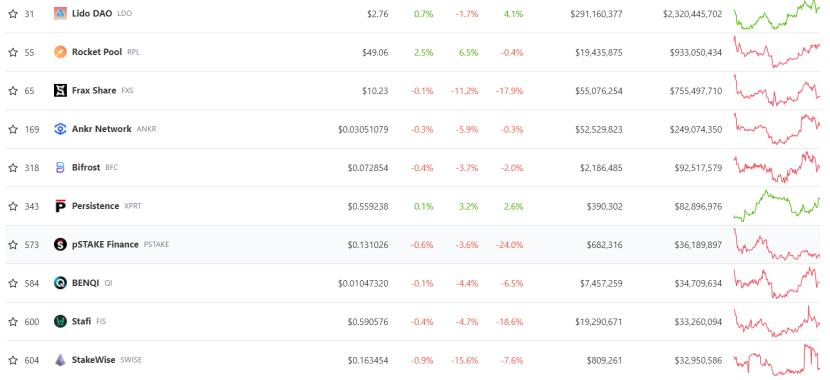
Comparing the market value rankings of liquidity pledge governance tokens, it can be found that the market value of these projects is basically proportional to the pledge amount.
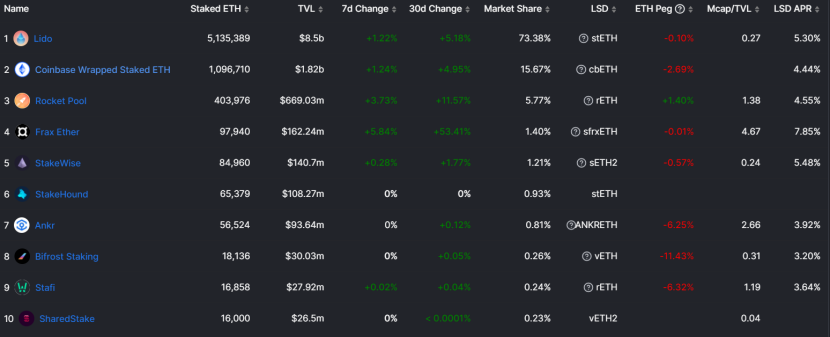
Among the above-mentioned projects, from the perspective of token market value/TVL ratio, the value of Stake Wise is 0.24, Lido is 0.27, Rocket Pool is 1.38, Ankr is 2.66, and Frax is 4.67. The smaller the value, the greater the TVL behind each Token.
Frax's Ethereum liquidity pledges have grown rapidly. Since its launch on October 21, 2022, it has grown from 0 to about 90,000 pieces, mainly due to its high rate of return. The current annualized rate of return is 7.85 % (slightly higher than the 4-5% average yield of other protocols), so it continues to attract users to invest in ETH. In addition, Frax’s pledge amount is much less than that of Rocket Pool, but its market value is comparable to it. The reason behind this may be that Frax is also supported by a matrix of Defi products such as stable coins, which reflects part of its market value.
Stake Wise has the lowest market capitalization/TVL (0.24), and its annualized rate of return of 5.48% is higher than the market average. However, the pledge growth in the past 30 days has been relatively slow, and its follow-up performance needs further observation. On the other hand, Lido, even though it has the highest amount of pledges, still maintains a yield of 5.3% and a low market value/TVL ratio of 0.27. Compared with other competing products in the market, TVL has grown steadily, so it still has enough strength to maintain pledges in the short term leading position.
In addition, there are some non-custodial staking solutions, including Pools such as Ebunker, P2P, and Stakefish. Because they are non-custodial solutions, they cannot provide passbooks like stETH, but they allow users to control the private key for withdrawal without handing it over to a third party, which maximizes the security of Staking.
Ebunker official website: https://www.ebunker.io
Ebunker official website: https://www.ebunker.io