

zkSync Head DEX Showdown: Syncswap vs iZiswap

Original source: Mint Ventures
Original source: Mint Ventures
This issue of project overview focuses on the emerging L2 ecological zkSync head Dex dispute, trying to answer the following questions:
Why is it necessary to pay attention to zkSync and its Dex track?
What is the current status of zkSync's trading track project?
The content of the following article is the author's staged opinions as of the time of publication. There may be errors and prejudices in facts and opinions. They are only for discussion purposes, and we also look forward to corrections from other investment and research peers.
The content of the following article is the author's staged opinions as of the time of publication. There may be errors and prejudices in facts and opinions. They are only for discussion purposes, and we also look forward to corrections from other investment and research peers.
Why you should care about zkSync and its Dexs
zkSync: a great year for L2, a strong contender for the top L2
2023 is the big year of L2.
image description
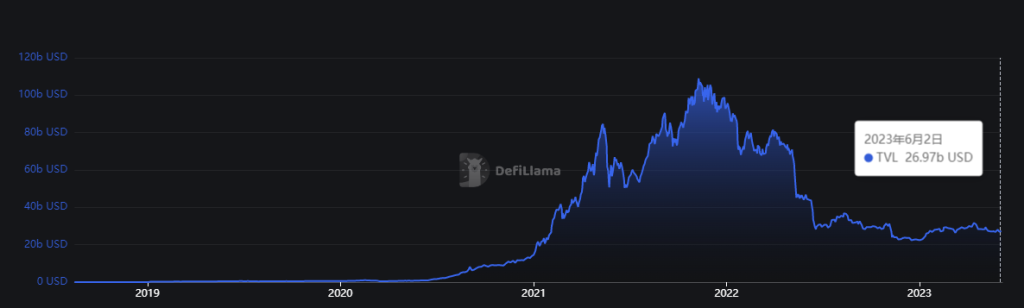
image description
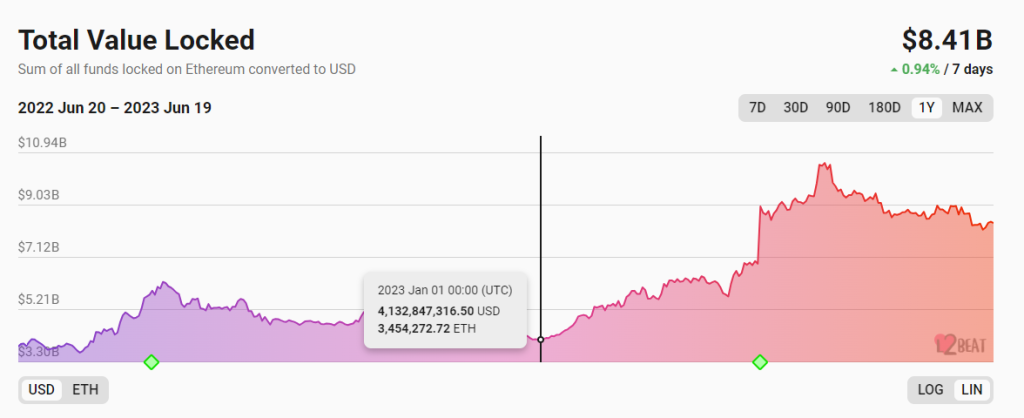
Source: https://l 2b eat.com/scaling/tvl
In addition to the funds on the chain, the active data on the chain also confirms this point. Since the actual TPS of the L2 network effectively surpassed that of Ethereum in October last year, the data has further increased rapidly this year. At present, the actual TPS of the L2 network is already Ethereum’s It is about 3 times, and this data will obviously continue to rise in the future.
image description
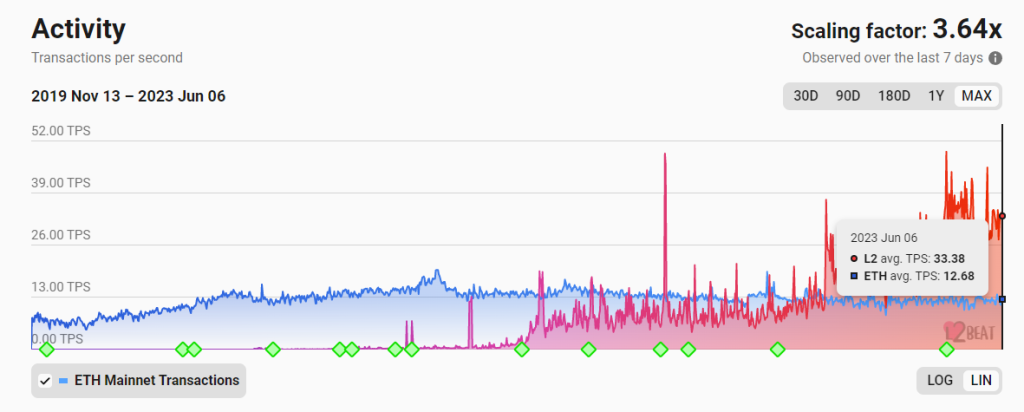
Source: https://l2beat.com/scaling/activity
In addition to business data, the Cancun upgrade coming in October this year will also significantly reduce the cost of L2, and promote the further migration of users and applications to L2.
As far as the competition landscape is concerned, L2 is similar to L1. The network effect built by users, developers and funds is so powerful that it is second only to stablecoins in the Web3 world, and the first-mover advantage is very obvious.
In the field of OP Rollup, Arbitrum and OP are initially determined. In the future, there may be a battle. There may be L2 Base built by Coinbase based on the OP stack, but there may not be too many new players who can enter the poker table in the short term.
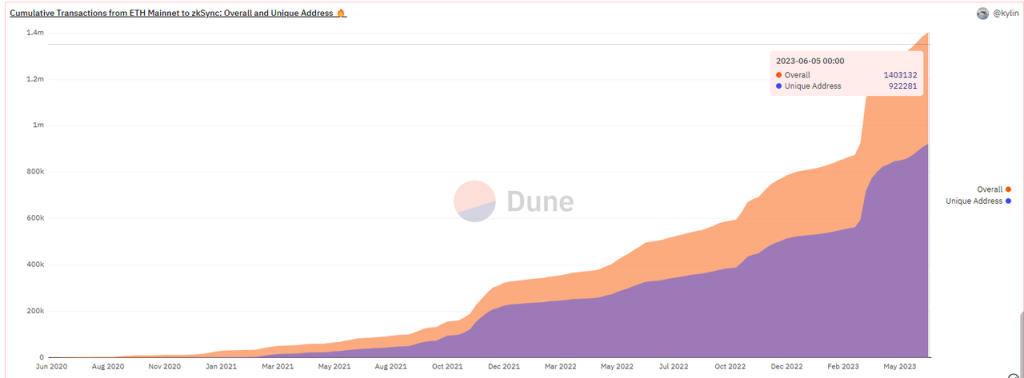
The battle in the field of ZK Rollup has just begun. As the long-term direction supported by the Ethereum Foundation and Vitalik, ZK is bound to occupy a place in the intensified L2 war in the future. After Arbitrum completed the airdrop this year, zkSync has become the next highly anticipated L2 airdrop project. Its TVL and active user numbers continue to rise. It has become an L2 TVL second only to Arbitrum and Optimism, and is also a TVL And the ZK Rollup project with the largest number of users, the types of projects on the chain are also gradually enriched, including DeFi infrastructure and meme projects such as Cheems.
On the whole, zkSync has taken the lead in the competition of ZK L2.
Dexs: Infrastructure for the aggregation of users and funds
Dex, lending and stable currency are the most basic financial three-piece set of L1&L2. However, referring to the development of L1 and L2 in the past, it is easy to find that there is often only one "native Dex" head of each chain. The author defines two standards for "head" here, at least one of which is satisfied:
Business data such as TVL and transaction volume are much higher than competitors, and at least one market share exceeds 50%
image description
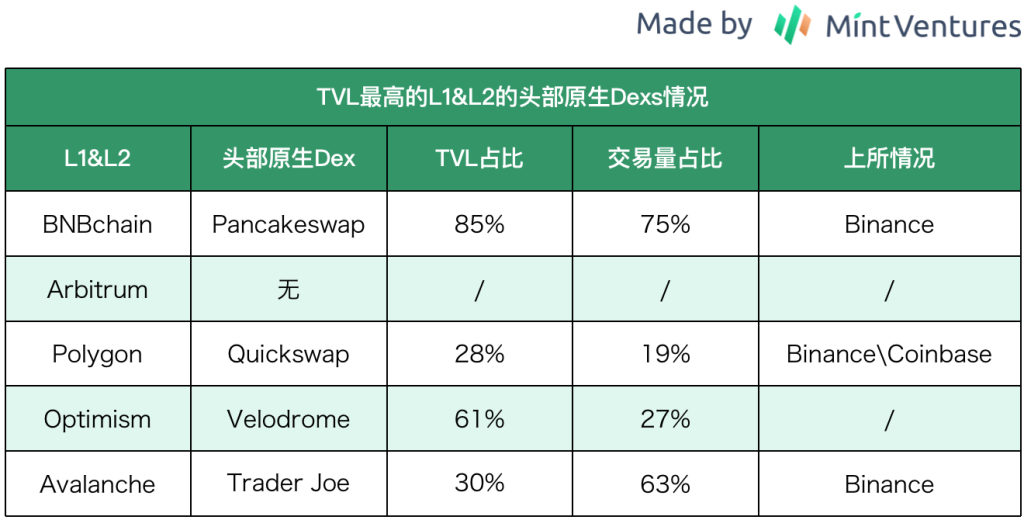
Data source: Defillama Date: 2023.6.7 Tabulation: Mint Ventures
As the head of the chain, Dex enjoys more advantages than other competitors, such as:
Mind occupies the front, it is easier to become the priority platform for user transactions and market-making behaviors, and has a higher degree of trust
Business advantages, it is easier to win the favor of other partners, become the first stop of mobility arrangement or cooperate with launchpad business
The traffic is convenient, and the top Dex is easier to get mentioned and cited in various business rankings, news, and research reports, and get more free exposure and natural traffic
Cross-border network effect advantages formed by leading liquidity and trading volume
It is easier for tokens to land on top Cex, gain liquidity premium and more token holders
As a relatively new L2 ecology, zkSync is in the early stage of growth in users, funds, and developers. The market structure of each track has not yet solidified, and brand projects of other chains have not yet completed cross-chain deployment (such as Uniswap V3 and Aave). The project also has time to contend and consolidate positions.
However, the future Dex structure of zkSync will most likely be like other L1&L2, with only one native Dex at the head (or occupied by Uniswap V3).
So the question is, who will be the head native Dex of zkSync in the future?
zkSync Dexs Track Pattern
image description
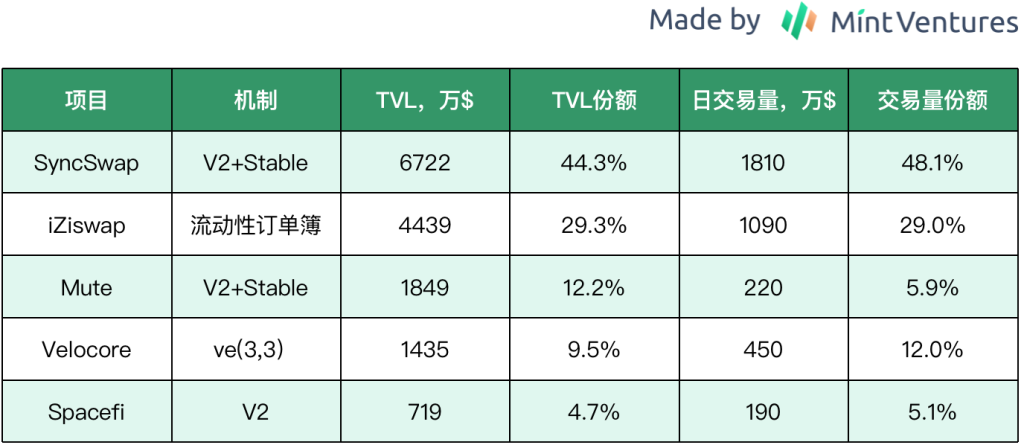
Data source: Defillama and project official data Time: 2023.6.6 Tabulation: Mint Ventures
PS: [Share] here is calculated based on the total business volume of the top five Dex
In terms of business mechanism, 3 of the top 5 Dex (SyncSwap, Mute, and Velocore) have adopted the V2 dynamic pool + steady-state pool model, and Velocore also uses ve(3, 3 ) similar to Velodrome in terms of economic model Mechanism, concurrently operating liquidity market business.
However, judging from the two core business data of TVL and transaction volume, the Dexs in the first echelon of zkSync are SyncSwap and iZiswap, and the future top Dex is most likely to be born from these two.
Syncswap vs iZiswap
Next, the author will sort out and compare the basic situation of these two first-line Dex in zkSync ecology, mainly covering the mechanism design, business indicators, economic model and team situation of the project.
Syncswap
mechanism design
Pool type
Generally speaking, Syncswap does not have too much innovation in the product mechanism of Dex. It adopts the multi-pool mechanism commonly used by ve (3, 3 ) projects. At present, it is mainly based on the Classic Pool of Uniswap v2 (mainly suitable for exchange rate fluctuations. Large trading pairs), and Curve-based Stable Pool (suitable for trading pairs with stable exchange rates).
image description
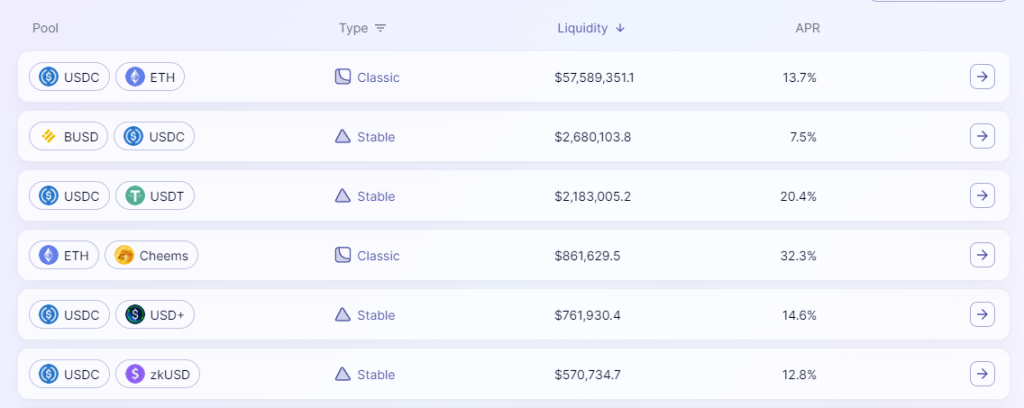
transaction fee
transaction fee
Syncswap calls its handling fee mechanism "Dynamic Fees", but in fact it is not the dynamic handling fee mechanism we understand (the higher the asset price volatility, the higher the handling fee rate to compensate for the impermanent loss of LP), perhaps more The accurate expression should be "custom handling fee".
Specifically, the handling fee of Syncswap includes the following functions:
Adjustable fee: different pools can set different rates of handling fees, the upper limit is 10%
Direction fee rate: Set different fee rates according to the transaction direction (buy\sell), such as 0.1% for buying and 0.5% for selling
Rate discount: Reduction of transaction fees based on token mortgage
Fee Allocation Proxy: Pool fees can be directly allocated to external addresses
It can be seen that Syncswap's Dynamic Fees has nothing to do with "dynamics", but the custom permissions are more abundant.
business performance
We conduct a statistical analysis of Syncswap's business situation from four perspectives: transaction volume, number of users, liquidity, and transaction fees (LP fees and protocol revenue).
Transaction volume and number of users
Syncswap itself does not provide a complete trading volume data dashboard. Based on the data on the chain, the 7-day and 30-day trading volume of Syncswap is counted. Its trading volume in the past 30 days (2023.5.8-6.7) is 431, 351, 415 $, The corresponding daily average trading volume is 14,378,380 $; the 7th (2023.6.1-6.7) trading volume is 103,743,812 $, corresponding to the daily average trading volume of 14,820,5444 $.
The above transaction data is roughly consistent with the 24-hour transaction volume statistics of Dexscreener and the official 24-hour transaction volume statistics of each Pool.
image description
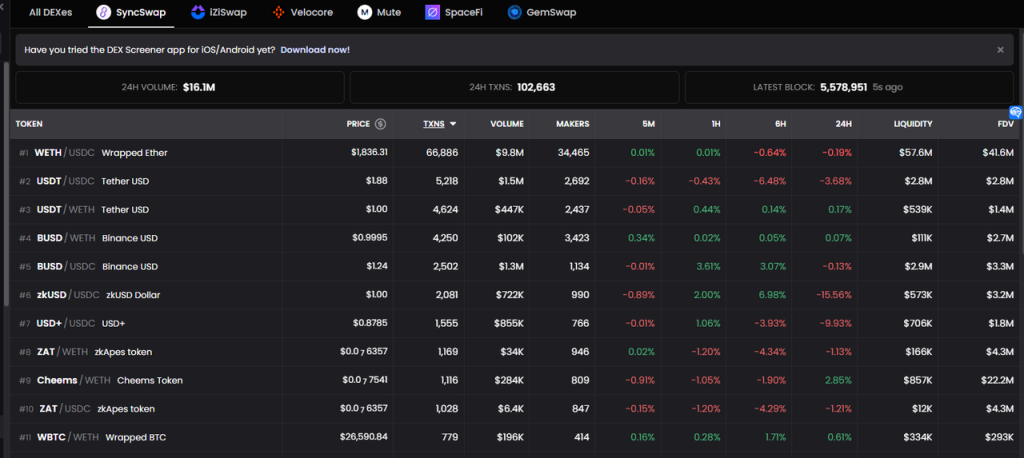
Source: https://dexscreener.com/zksync/syncswap
image description
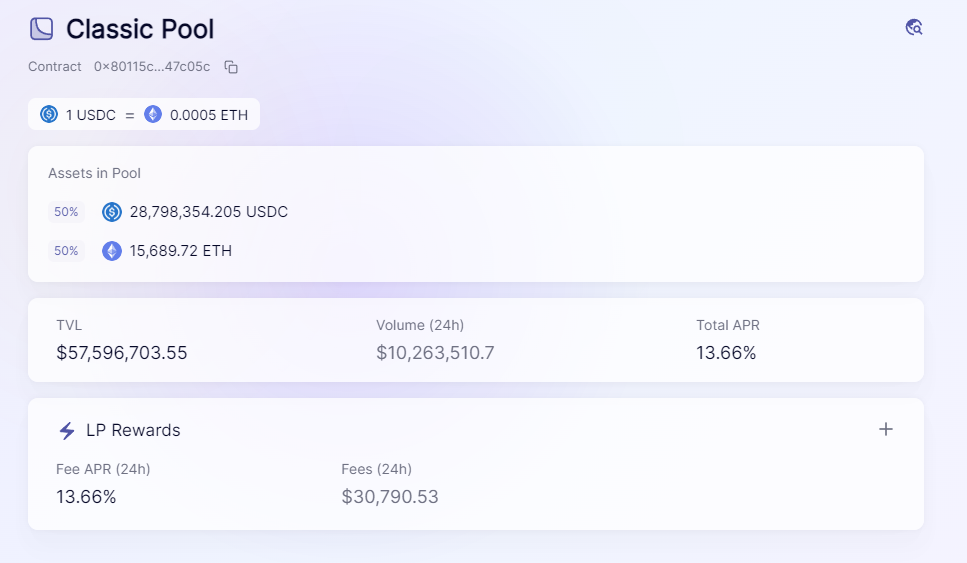
Source: https://syncswap.xyz/pool
In terms of transaction volume, the ETH-USDC Pool accounted for the largest share, accounting for 60.8%, followed by stable coins, and the real zkSync native asset transaction volume accounted for less than 5%.
image description
fluidity
fluidity
image description
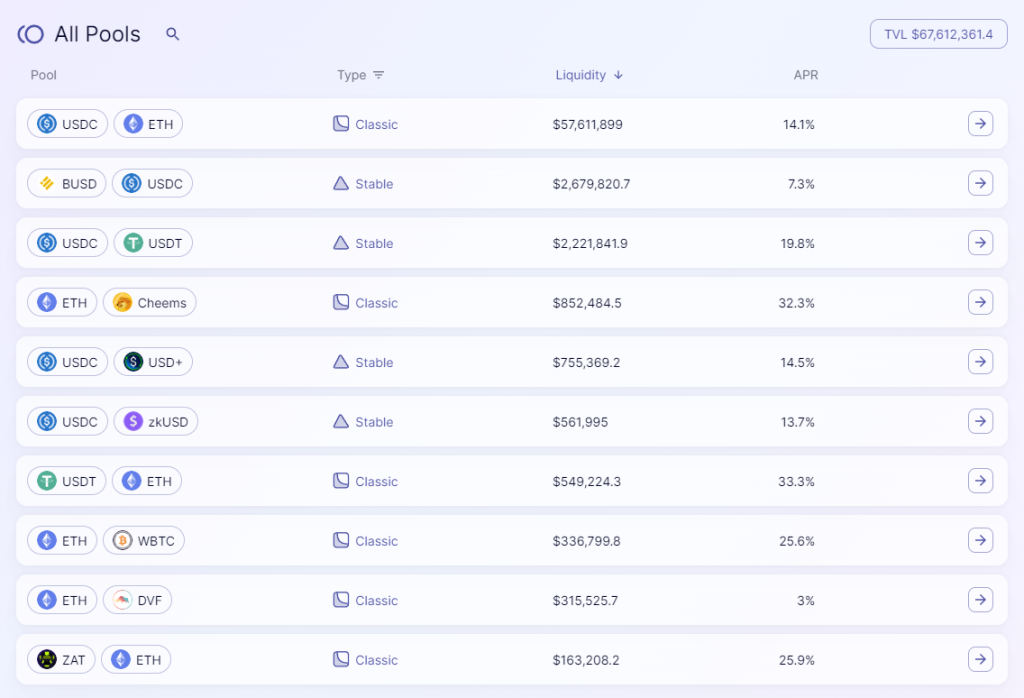
Source: https://syncswap.xyz/pools
Among the top 10 pools with liquidity, zkSync's native non-stable currency assets are Cheems (meme) and ZAT (NFT), accounting for only 1.5%.
Transaction Fees and Protocol Revenue
image description
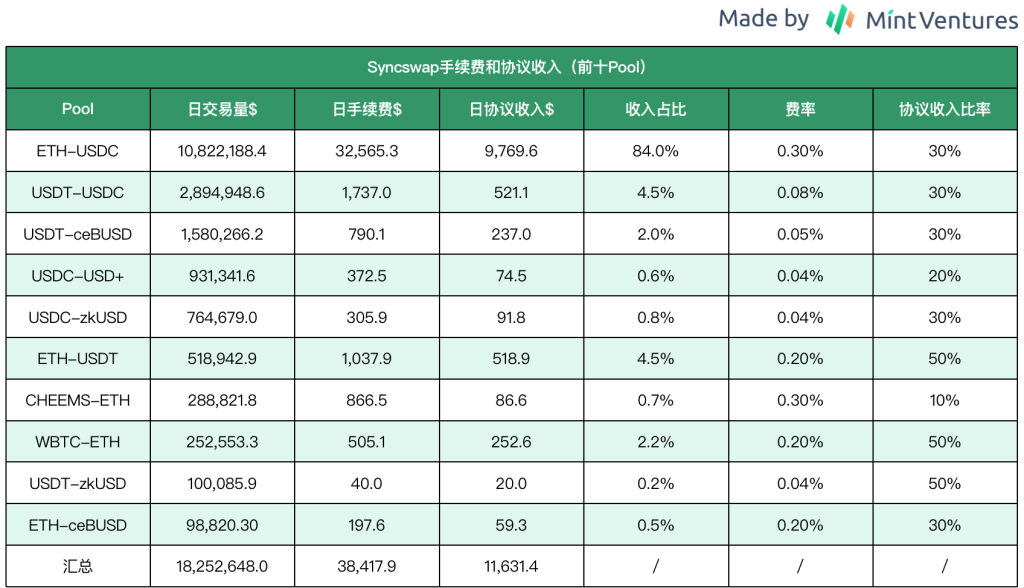
Data source: Syncswap Official time: 2023.6.9 Tabulation: Mint Ventures
According to the above table, it can be found that the agreement revenue of ETH trading pairs has reached 90.6%, which is the bulk of the fee and revenue. In addition, Syncswap's fee sharing ratio for Cheems and USD+ (Tangible's stable currency) is only 10% and 20%, giving most of the income to LPs, and there is an obvious intention to strive for this part of liquidity.
economic model
economic model
Although Syncswap has not yet officially issued tokens, it has announced some information about the tokens. Its token is SYNC, with a total of 100 million pieces.
In terms of token rules, Syncswap partly refers to Curve’s ve model. Token holders need to convert SYNC to veSYNC to obtain token utility, including:
voting governance
Protocol Fee Dividend
Discounted transaction fees
However, the specific unlocking mechanism is different from Curve. veSYNC has a linear unlocking period of 6 months after choosing to unlock. 50% of the tokens can be obtained on the 20th day after choosing to unlock, and the remaining 50% will be Continue to unlock linearly.
Nevertheless, the disclosure of Syncswap's token economic model is still incomplete, such as the ratio of token distribution, the speed of release, and whether the ve model is used to guide the Pool emission of tokens, etc., are not mentioned. But as far as the overall mechanism of the current project is concerned, Syncswap is more like a ve(3, 3) Dex project.
image description
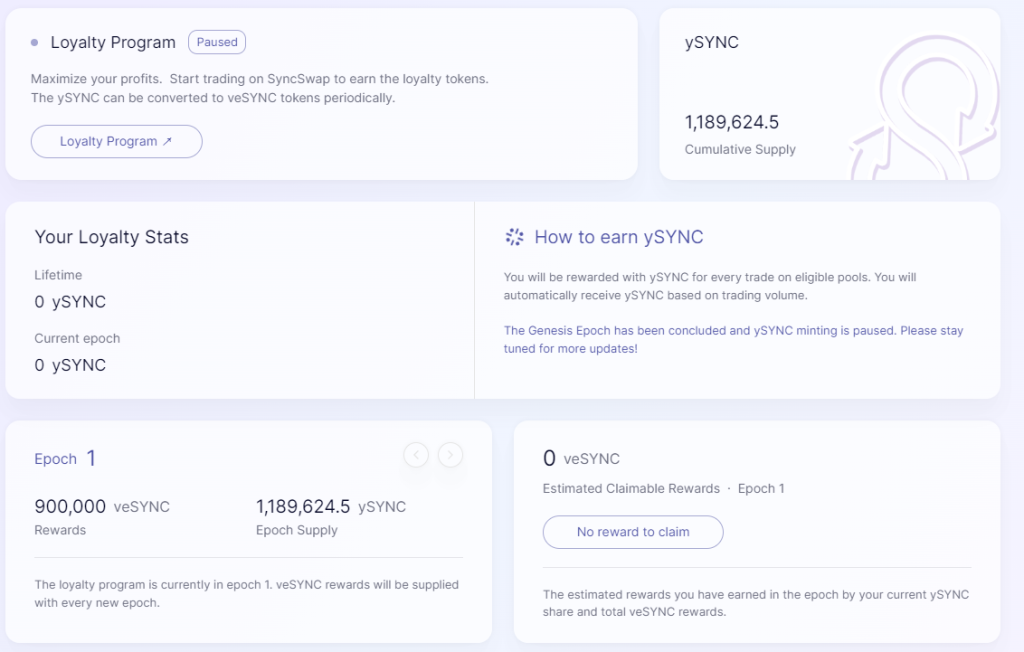
Source: https://syncswap.xyz/rewards
The token mining rules for the loyalty program are as follows:
The more transaction fees a user generates in a specified trading pair, the more activity reward certificate tokens ySYNC will be obtained, and the amount of ySYNC obtained = the transaction fee contributed by the user
A planning cycle is called epoch, except for the creation epoch (epoch 1) which is one month, and subsequent epochs are all one day
Users exchange rewards based on ySYNC, but rewards are issued in veSYNC. If users need to sell, they must first unlock veSYNC
The genesis epoch of the loyalty program is from April 10th to May 10th this year, the total reward is 900,000 veSYNC, and the ySYNC obtained by the final participating users is 1, 189, 624.5, which means that during the event, users have a total of A transaction fee of 1,189,624.5 $ was paid, corresponding to the acquisition cost of 1 veSYNC ≈ 1.32 $.
However, the loyalty program is currently on hold for one period in total.
team and financing
The Syncswap team is anonymous, the team size and personnel are not clear, and no financing information has been disclosed so far.
iZiswap
mechanism design
iZiswap is one of the products of iZUMi Finance. iZUMi is a DeFi project that provides multi-chain liquidity services (Liquidity as a service, LaaS). iZiswap is the Dex product of its liquidity services. Other products that are currently launched include :
LiquidBox: Liquidity incentive service based on centralized liquidity (Uni V3 and its derivative models) mechanism, which can help project parties customize liquidity incentives according to price ranges
Bond financing service: provide project parties with a financing method similar to convertible bonds in traditional finance
This article mainly focuses on the top Dex competition in the zkSync ecosystem, so it will mainly focus on the related situation of iZiswap in the zkSync network.
The main innovation of iZiswap lies in the proposal and implementation of DL-AMM.
DL is Discretized Contentrated Liquidity (discretized concentrated liquidity), DL-AMM does not use the constant product formula, but puts liquidity at different discrete price points, and each price point follows the constant sum formula L = X* √ P + Y/√P .
image description
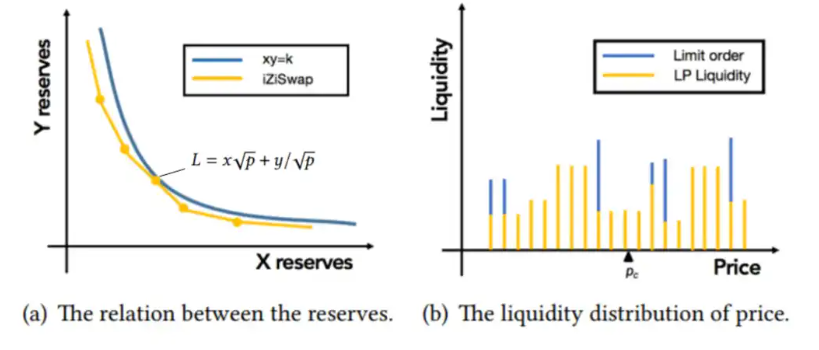
Source: https://assets.iZUMi.finance/paper/dswap.pdf
The liquidity in DL-AMM will be divided into two categories: LP liquidity and limit order liquidity. The two are combined and superimposed and distributed in different price areas, as shown in the figure on the right.
The former is a dual-token liquidity, while the latter is a single-token. The goal is to exchange another token at a specific price. Once the target price is reached, it will be exchanged and will not be exchanged back (Uni V3 can also be linked to the inter-community The unilateral liquidity realizes the limit order logic, but when the price returns, it will be exchanged back to the original token), which will remain in the contract until the user withdraws it.
image description
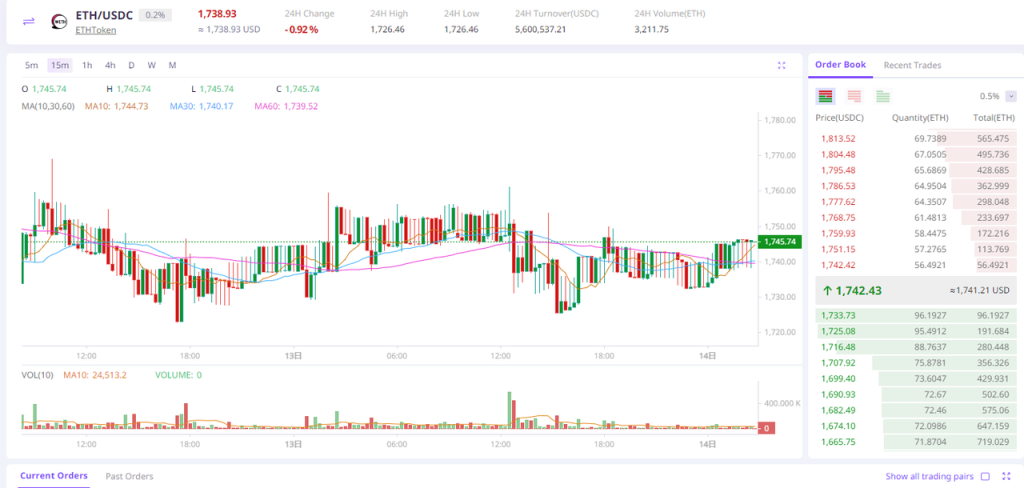
Source: https://iZUMi.finance/trade
Speaking of the liquidity order book, it is easy to think of the more well-known Dex project Trader Joe, which launched the Liquidity Book (LB for short) in November 2022, which also distributes the liquidity pointwise, and the liquidity at specific price points Again the constant sum formula is used instead of the constant product.
For the specific situation of Trader Joe, you can read the author's research report "Usher in a second spring with Arbitrum? Comprehensive analysis of Trader Joe's business status, token model and valuation level》。
In fact, the concept of Trader Joe's liquidity order book is likely to have originated from the DL-AMM proposed by iZUMi. iZUMi's paper on DL-AMM "iZiSwap: Building Decentralized Exchange with Discretized Concentrated Liquidity and Limit Order" was published on November 2021. and iZiswap will be launched in May 2022 (first launched on BNBchain), which is much earlier than the launch of Trader Joe's LB function. Trader Joe also marked the acknowledgment and reference to iZUMi in its V2 white paper.
In addition to DL-AMM, iZUMi also designed LiquidBox, a liquidity incentive service based on centralized liquidity. V2-based liquidity mining incentives are very simple. Users can get token rewards by staking LP certificates, which is tantamount to motivating liquidity in all price ranges. But the incentive design of centralized liquidity such as V3, DL-AMM and BL is much more complicated.
Assuming a token with a price of 100 US dollars, a certain LP provides liquidity in the range of 95-105 US dollars with 1000 US dollars, and another LP also provides liquidity in the range of 10-20 US dollars with 1000 US dollars (unilateral pending order), the former's liquidity The utilization efficiency of liquidity is much higher than that of the latter. It is obviously unreasonable to provide the same reward directly according to the liquidity value with reference to the V2 model.
For users, LiquidBox is a place for them to deposit liquidity and receive incentives, and for incentive parties (usually token project parties and iZUMi), they can distribute the obtained liquidity in differentiated intervals to achieve project The desired liquidity target.
LiquidBox’s solution is to provide three solutions, and the liquidity incentive party (usually the token project party and iZUMi) jointly decides which one to adopt:
1. One-sided mode (oneside): The project tokens in the liquidity deposited by users will not be deposited into the Pool, but pledged separately, so as to reduce the number of project tokens in the pool and reduce the resistance when rising; The other half of value tokens (ETH or stablecoins) will be allocated to the left of the current token market price to reinforce buying on dips. For the project side, this actually achieves the effect of "increasing token buying and reducing token selling". For users, if the price of project tokens rises, there will be no impermanent losses caused by "selling all the way up". Of course, if the tokens fall, because the project tokens have not been sold at a high level, it will magnify the impermanent losses of users caused by the decline. So this can be understood as a common (3, 3 ) market-making mechanism that encourages users to pledge tokens without selling them.
image description
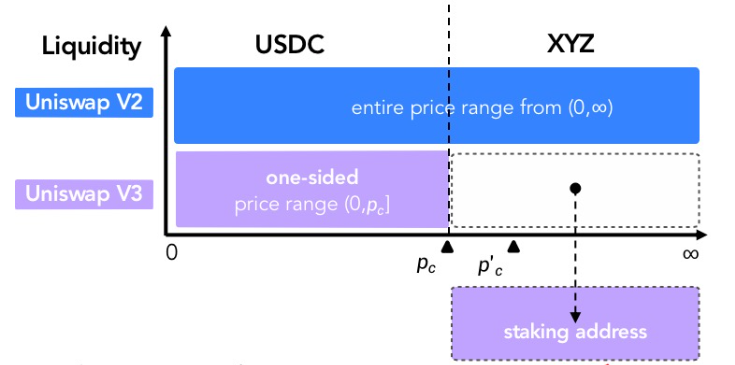
Source: iZUMi Documentation
image description
Incentives for fixed intervals, source: iZUMi Documentation
3. Dynamic Range: Users participate in liquidity mining by providing liquidity within the (0.25 Pc, 4 Pc) range of the current price (Pc). The width of the price range can also be set by the project side, such as (0.5 Pc, 2 Pc). The advantage is that there will be better liquidity around the market price range, but if the token price fluctuates sharply beyond the user's initial market-making range, While bearing impermanent losses, users also need to frequently re-draw LP and re-stake, resulting in high operational loss.
In reality, the currently active LiquidBox basically chooses the dynamic mode.
In addition, LiquidBox supports Uniswap V3 and iZiswap LPs to participate in pledge incentives, and most of the activated incentive pools are on the zkSync network.
business performance
Transaction volume and number of users
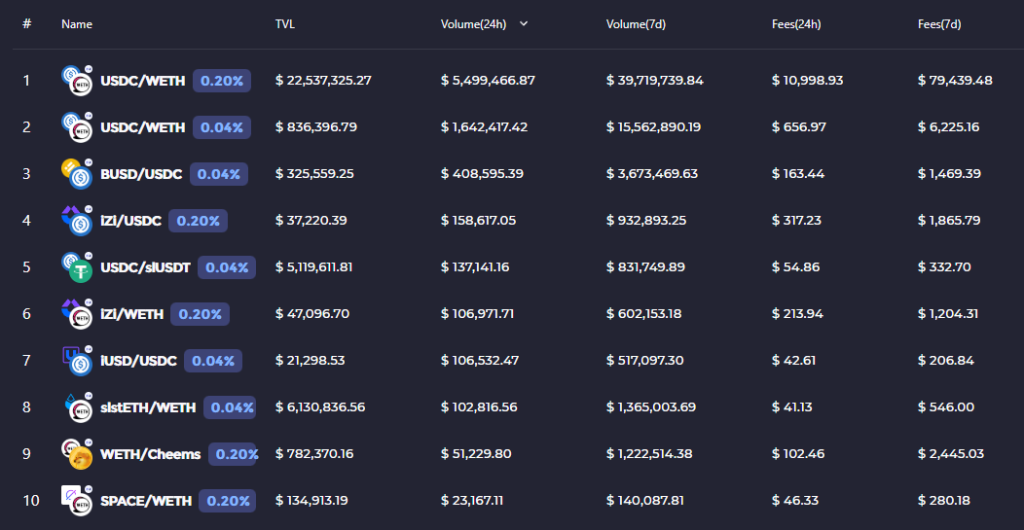
The author also uses on-chain data to compare iZiswap's data over the same period with Syncwap's data. Its trading volume in the past 30 days (2023.5.8-6.7) is 195,025,494 $, corresponding to an average daily trading volume of 6,500,849 $; 7 days (2023.6.1-6.7) trading volume is 60,007, 769$, corresponding to an average daily trading volume of 8,572,538$.
image description
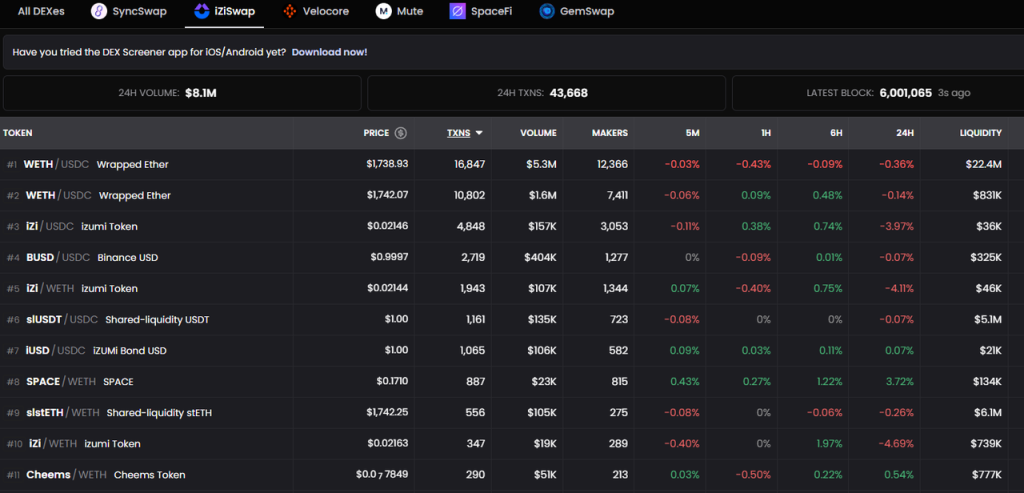
image description
Source: https://analytics.iZUMi.finance/Dashboard
Similar to Syncswap, iZiswap's ETH-USDC transaction volume ratio is more extreme. The transaction volume of the two Pools accounted for 85.8% of the total daily transaction volume, followed by stable coins and its own token IZI.
fluidity
fluidity
image description
image description
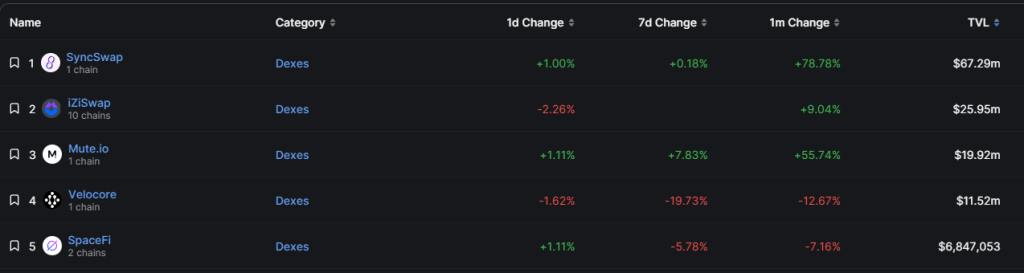
Defillama ranks for Dex TVL statistics on zkSync
The reason is that the official statistics of liquidity include many stablecoins and encapsulated assets issued by iZUMi itself, such as iUSD (debt financing stablecoin) and slstETH, slUSDT (encapsulated assets issued across chains based on Ethereum collateral), As shown below.
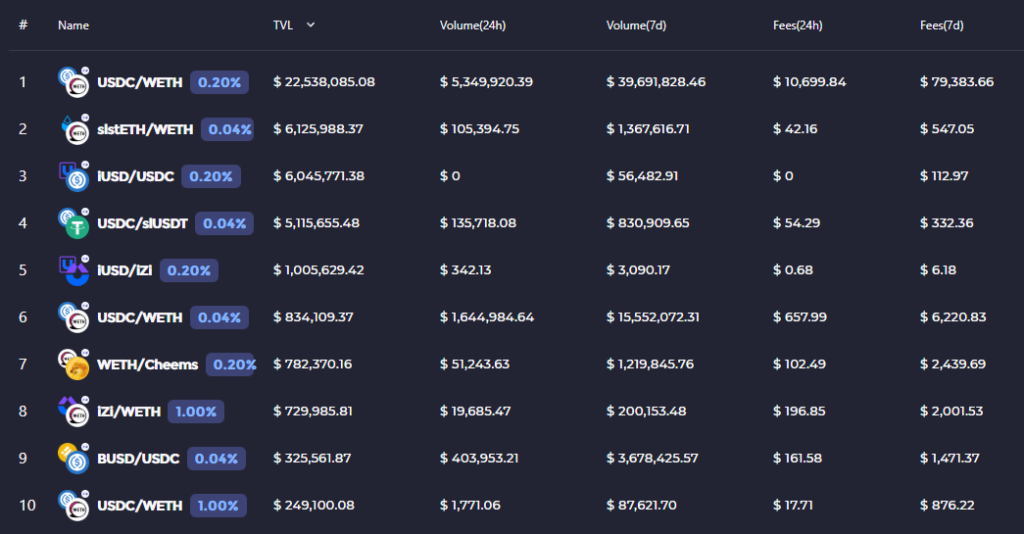
However, in the current market environment, the promotion of self-operated stablecoins and packaged assets is very difficult, because considering the single-point risk of third parties in the acceptance of assets, most users and mainstream DeFi do not accept packaged assets issued by third parties. At the same time, according to feedback from iZUMi, the packaging assets represented by slstETH are still in the preparation stage and have not officially started operations. Therefore, when we observe TVL, we use the statistical data of Defillama as the standard, which is more reference.
After proposing the encapsulation and self-operated stablecoin TVL mentioned above, the TVL of iZiswap is similar to that of Syncswap, and the proportion of ETH Pool reaches 86.8%.
image description
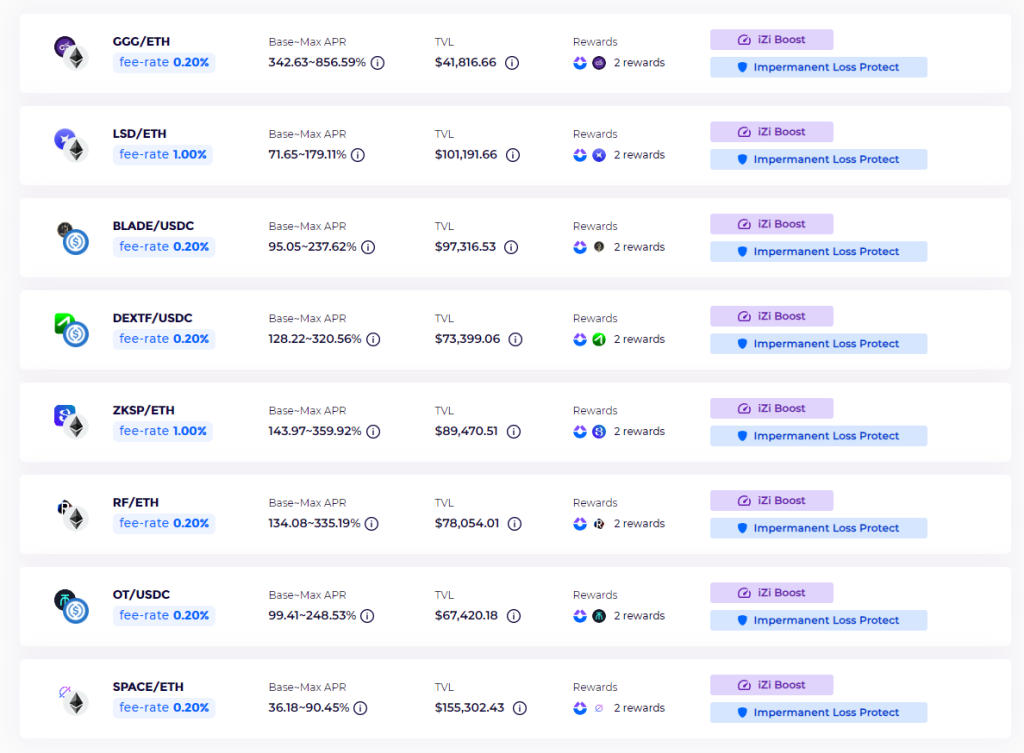
Source: https://iZUMi.finance/farm/iZi/dynamic
The author has calculated the current double-mining token rewards, and found that most of the total token rewards for various liquidity incentives are contributed more by the project party, but there are also a small number of pools due to the decline in the project party’s tokens, and the value of IZI tokens higher.
Currently (2023.6.14) the total amount of IZI's 8 LiquidBox liquidity incentive tokens on zkSync is 60,180 per day, worth about $1,208.
Transaction Fees and Protocol Revenue
image description
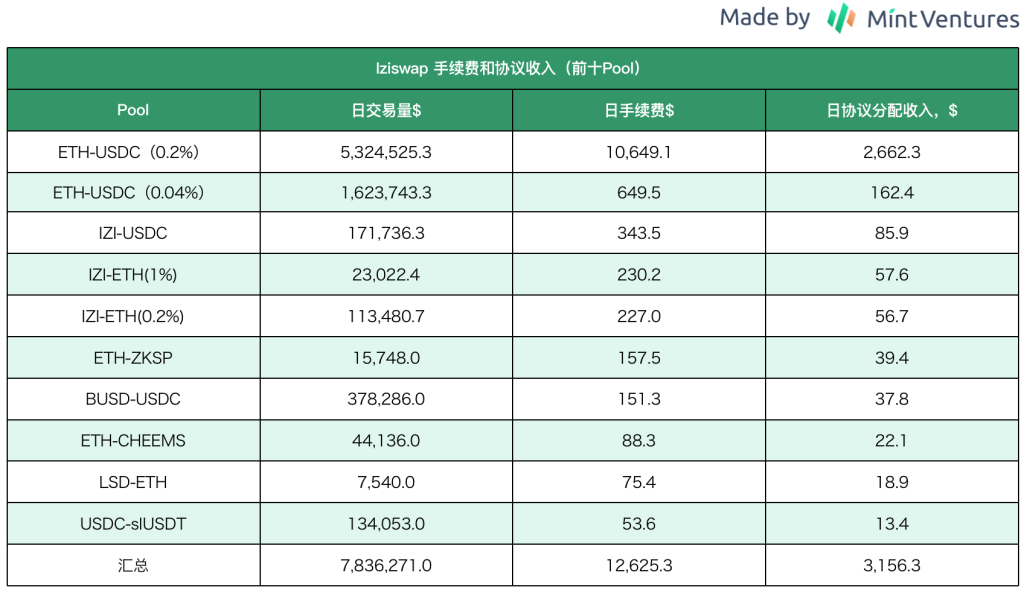
image description
PS: Protocol distribution income refers to the income allocated to users of izi tokens, which is 25% of the handling fee
economic model
economic model
iZiswap is a product module of iZUMi, and it is also the main module for generating income at present. In terms of business volume and development prospects, zkSync is currently the most important position of iZiswap.
Amount, Allocation and Supply
The project token of iZUMi is IZI, with a total of 2 billion, distributed on Ethereum, BNBchain, Polygon, Arbitrum and zkSync.
image description
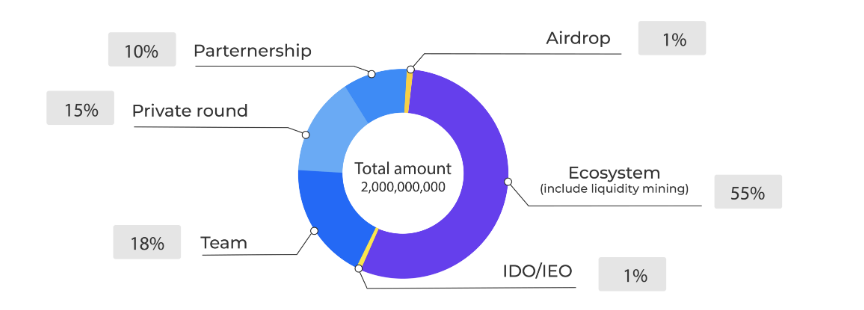
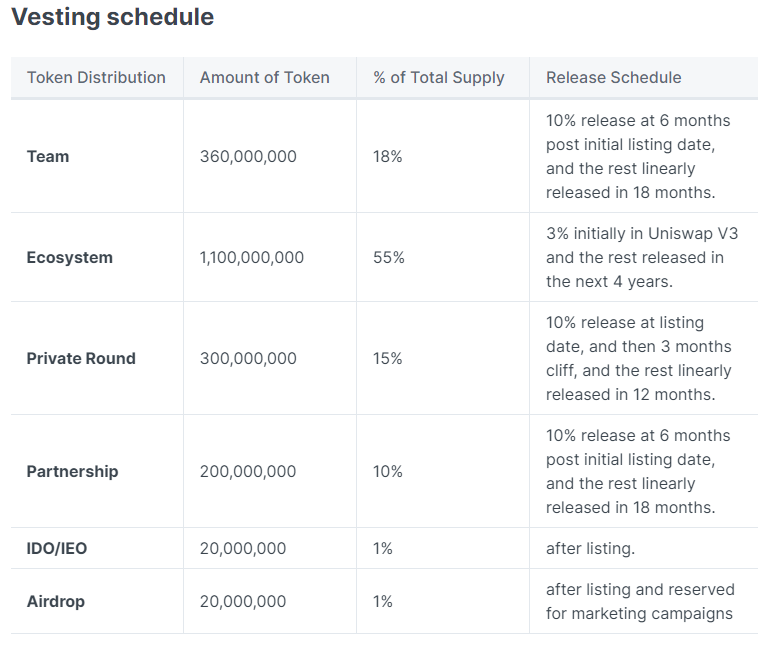
Source: https://docs.iZUMi.finance/tokens/tokenomics
According to CMC data, the total amount of unlocked tokens is 787,400,000, but 276,091,843.3 IZI are in ve pledge.
Token use
There are three planned uses of IZI tokens:
1. Governance voting: used to vote on the whereabouts of token emissions (not yet online)
2. Pledge dividend: After staking, you can get 25% of the IZI distribution of iZiswap fee repurchase
3. Revenue acceleration: After staking, you can accelerate your own mining in LiquidBox, up to 2.5 times, similar to the boost mechanism of Curve
There are two main sources of intrinsic value of Dex tokens in the ve model: 1. The value of governance rights used to command liquidity, whose price is determined by the liquidity price of the corresponding Dex, and is affected by the liquidity procurement needs of other project parties in the chain ; 2. Discounted cash flow of commission dividends.
At present, iZiswap's ve voting function has not yet been launched, and the share of transaction fees is split by half of the bond repurchase module, and the intrinsic value of tokens is suppressed.
team and financing
According to the information disclosed by Rootdata, the founder of iZUMi Finance is Jimmy Yin, who graduated from Tsinghua University, and the current team size is 20+.
According to the data disclosed by rootdata, iZUMi has conducted 4 rounds of financing in the past:
2021.11: Seed round, USD 2.1 million, corresponding to a valuation of USD 14 million
2021.12: A round, 3.5 million US dollars, corresponding to a valuation of 35 million US dollars
2022.5: Convertible bond financing through Solv, 30 million US dollars, for liquidity operation
2023.4: Raise funds in the form of funds through Solv, with 22 million US dollars for liquidity operations
in conclusion
in conclusion
In the competition of zkSync's head Dex, Syncswap is quite satisfactory at the product mechanism level, and there are basically no impressive original innovations, while iZiswap's products have relatively rich original exploration, but whether it can be transformed into the growth of users and funds depends on the current situation. Not optimistic yet. Because from the perspective of specific business data, Syncswap currently occupies a clear leading position in both TVL and transaction volume. In addition, its tokens have not yet been distributed, and the expectation of project airdrops is very attractive to users' funds and transaction behavior. Enjoying lower operating costs (on the contrary, iZiswap still has token-incentive expenses every day).
However, the current common problem faced by both parties is that due to the short birth of zkSync, the number of viable native projects is insufficient, and most of the liquidity and transaction volume of the two Dex are related to ETH.
In the future, more native projects will be born on zkSync. On which platform will these projects choose to deploy initial liquidity? Whether it is zkSync, which has a more advanced business, or iZiswap, which has a richer mechanism and gameplay, this also leaves a certain suspense for the subsequent competition. In addition, Uniswap voted to deploy V3 to zkSync as early as October 2022, and may enter this brand new market at any time, bringing greater competitive pressure.
We will wait and see the follow-up development.