

"The Current Status Update of MakerDAO"

MakerDAO is a decentralized stablecoin lending protocol based on Ethereum. Its core is to back stablecoin DAI, which is anchored to the US dollar at a 1:1 ratio, with over-collateralized encrypted assets. By regulating the stable interest rate for DAI through governance, the market achieves stability in the price of DAI through arbitrage.
LD has previously published a research report before the launch of the Spark Protocol in March this year, titled "LD Capital: The MakerDAO Where Everything Grows, Ignition has Already Started", which provides an outlook on the current situation and future of MakerDAO. Now that the Spark Protocol has been live for over a month, let's review the recent changes in MakerDAO.
1. Spark Protocol Status
MakerDAO's general lending protocol, Spark Protocol, officially launched on May 9th. This protocol is mainly used for borrowing and lending with DAI, ensuring the security of funds and promoting the overall development of the ecosystem.
Spark; is an encrypted asset with a focus. Its first product is Spark Lend, which allows users to borrow DAI at a set Dai Savings Rate (DSR), currently at a rate of 3.49%.Currently, Spark lending market supports assets including DAI, wstETH (wrapped version of stETH), WETH, rETH, GNO, and sDAI (wrapped version of DSR-contained DAI).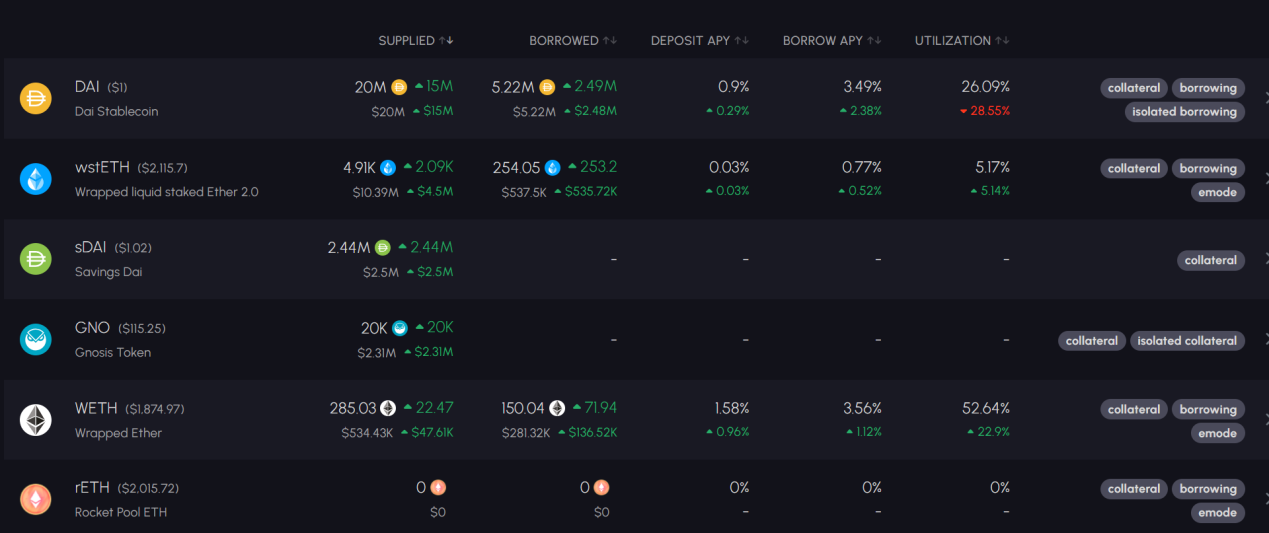
Source: blockanalitica.com
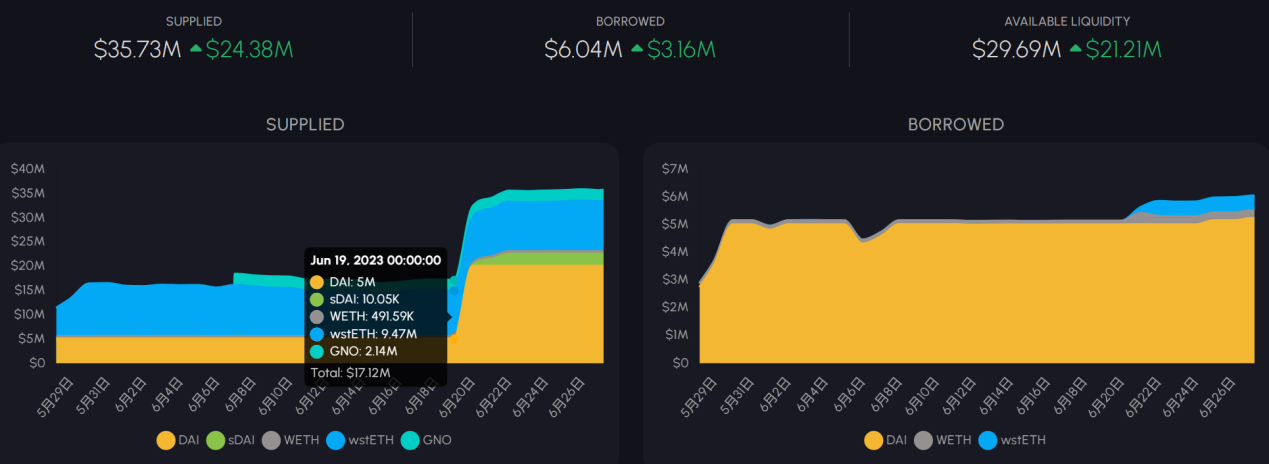
TVL currently reaches 2,969 million US dollars, with DAI and wstETH having the highest asset supply. As shown in the asset supply curve below, the increase in asset supply has exceeded 110% since Maker announced an increase in DSR interest rates. However, the lending scale is only around 6 million US dollars, with a utilization rate of 17%.
Source: blockanalitica.com
As a new agreement, although endorsed by MakerDAO, the initial asset attractiveness was not strong, and the increase in TVL only came after DSR adjustment. According to data from defillama.com, Spark currently ranks 11th in the Ethereum lending protocol, with a 20% increase in TVL in the past 7 days, and its current TVL accounts for only 0.2% of Aave.
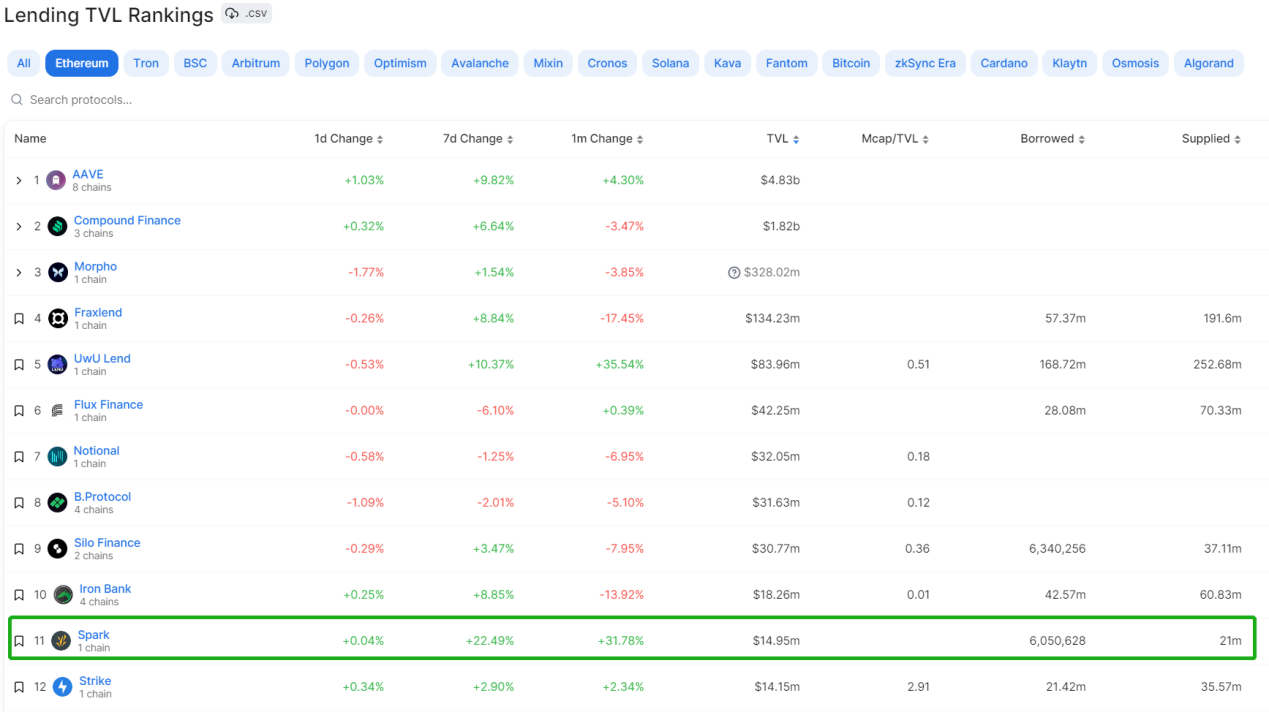
Source: defillama.com
2. DSR Interest Rate Adjustment
DSR stands for the deposit interest rate of DAI. MakerDAO provides a savings contract where users can earn passive income by depositing their DAI. When users borrow DAI using assets such as ETH or WBTC as collateral, they have to pay stability fees, which are the source of DSR earnings. Therefore, adjustments in the DSR interest rate will affect the stability fees for borrowing DAI.
On June 16th, the Maker community proposed to increase the Dai Savings Rate (DSR) from 1% to 3.49%. This proposal officially took effect on June 19th, and the DAI volume within DSR increased from 110 million to 130 million in one day. As shown in the graph below, you can see the growth curve of DAI within DSR, indicating the increase in DAI.
The growth rate has slowed down, but it is still in a growth state. In the past week, the DAI supply has grown by about 68 million, and the current total supply has reached 186 million.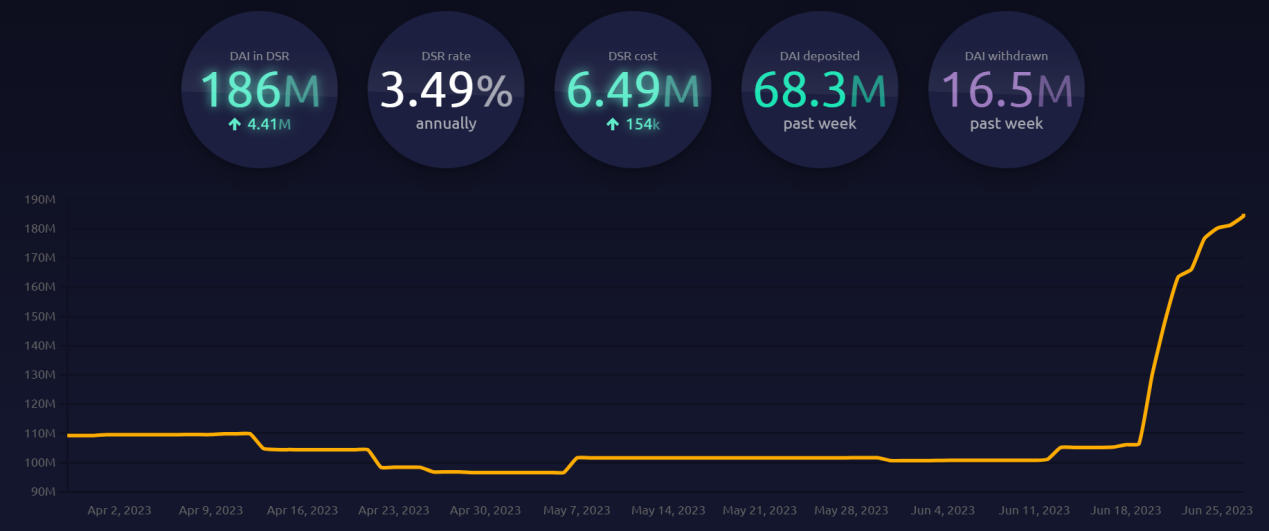
Source: makerburn.com
In Maker's monetary policy, DSR is a key monetary policy adjustment tool that incentivizes or discourages users from locking DAI to help balance the supply and demand of DAI. By adjusting the DSR, short-term changes in the Dai economic market can be addressed. Therefore, as the Dai savings rate increases, Dai ecosystem participants may choose to withdraw from other lending platforms and deposit into the DSR contract, or users may exchange other stablecoins they hold for DAI, resulting in increased demand for DAI. This change can also lead to competitive interest rates for borrowing DAI in external DeFi protocols. The Maker platform will be able to provide more competitive rates and recover DAI into the Maker system.
3. Collateralizing Assets with "USDC"
MakerDAO currently has a total locked value (TVL) of $7.7 billion in collateral assets.
The largest vaults are ETH-A and stETH-A.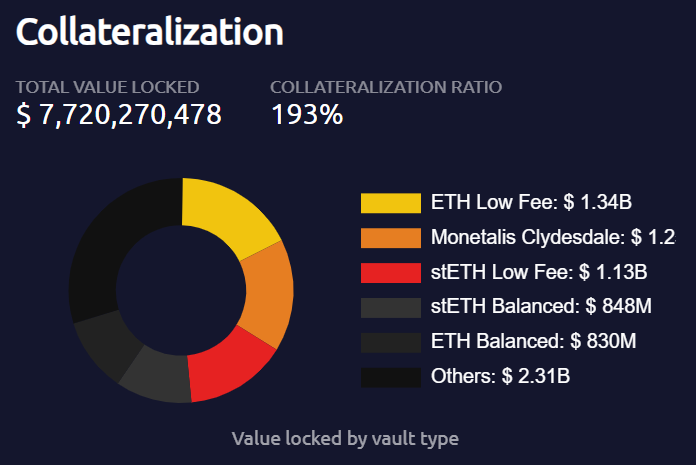
Source: makerburn.com
If we look back at the data for March 2023, we can see that at that time, the TVL reached around $8.4 billion, with about $2.1 billion in the PSM-USDC pool, accounting for about 25%.
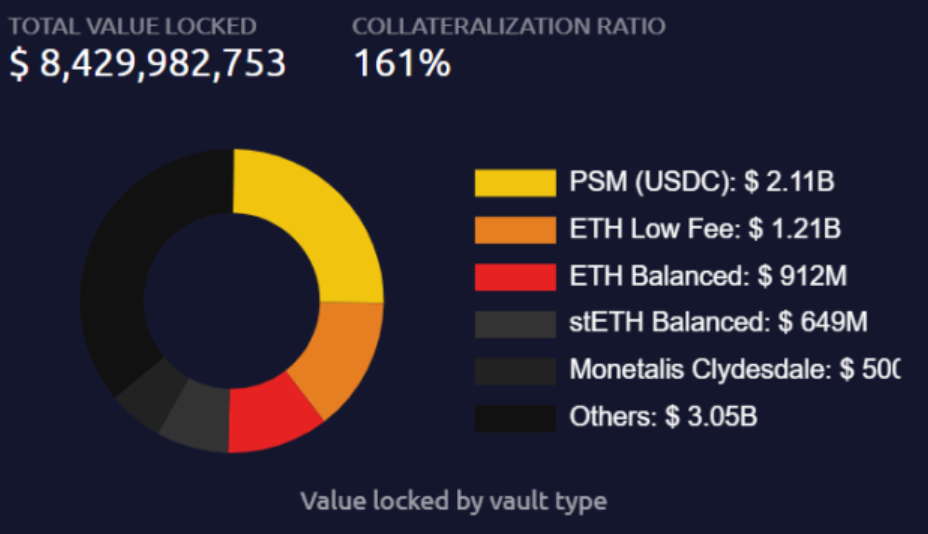
Even when the USD Coin (USDC) suffered an untethering event on March 8th, MakerDAO PSM quickly became a liquidation venue for the fleeing USDC, absorbing nearly 2 billion USD Coin and causing the total scale of USDC within the PSM module to reach 4 billion USD. Fortunately, this untethering event was caused by concerns about the USDC deposit reserves and did not cause substantial losses to Maker. After the USDC peg was restored, the USDC within the PSM module gradually recovered to around 2 billion USD.
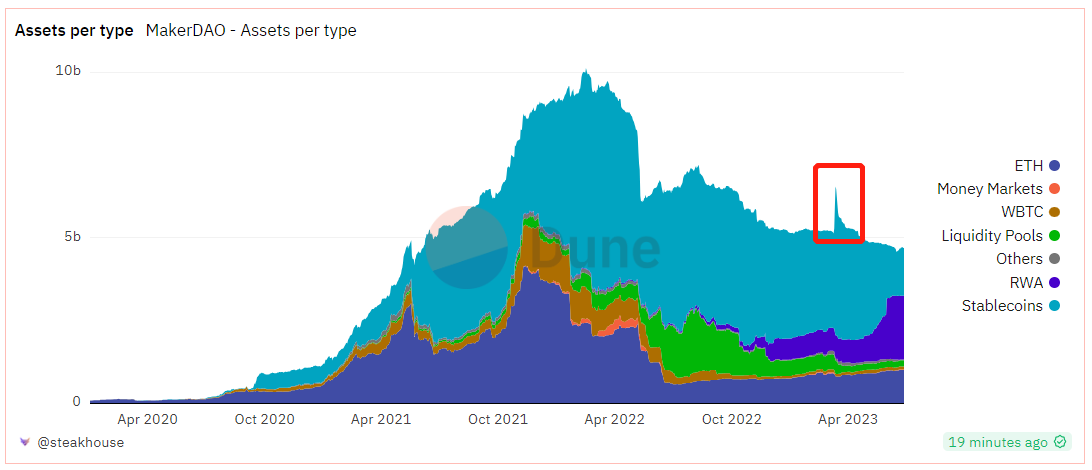
Source: Dune Analytics
After this event, the largest collateral asset in Maker is USDC, which has once again sparked community discussions and concerns. Therefore, MakerDAO is attempting to diversify its balance sheet and decrease the market share of USDC. Currently, the amount has decreased to around 440 million US dollars, a decrease of 80%. Meanwhile, the share of stETH as collateral for DAI has significantly increased from the original 650 million to 1.1 billion, an increase of nearly 80%.
In addition, the Maker community has consecutively passed two proposals. One is to reduce the GUSD debt ceiling from 500 million to 110 million, and the other is to reduce the USDP debt ceiling from 500 million to 0. From this series of measures, it is evident that the Maker community aims to reduce the potential threat of centralized stablecoins to the protocol and is gradually realizing Maker's "Endgame Plan".
4. The Endgame
Updated Roadmap
The purpose of The Endgame is to simplify and parallelize the Maker ecosystem, introduce a new brand identity, and the first batch of 6 SubDAOs. On May 12, 2023, Rune Christensen, the co-founder of MakerDAO, announced a major update to The Endgame roadmap on the community forum. This update aims to "improve efficiency, flexibility, and participation" by using AI tools to assist in building governance processes. It provides further details and clarifies the phased tasks of The Endgame plan that was previously proposed.
The roadmap consists of five phases:
1) Brand overhaul: Launching a new unified brand identity and a new governance website in the coming months. The website will build flexible and parallel governance processes with the assistance of artificial intelligence, without affecting users' existing holdings of DAI and MKR. Users will be able to directly upgrade to NewStable (the new stablecoin) and NewGovToken (the new governance token) when available. The final names will be announced along with the new brand and website.
2) SubDAO Launch: The first batch of SubDAOs will be released.6 Maker SubDAO and the new stablecoin for liquidity mining. SubDAO acts as a decentralized professional department in MakerDAO, and the plan aims to eliminate the costs and complexities associated with daily operations and delegate "most complexities and risks" to others.
3) AI governance tool release: The Maker ecosystem will start enhancing its AI tools for governance monitoring and improvement, including Alignment Artifacts, Governance AI Tools, Atlas, AVC, Purpose Fund, etc;
4) Governance incentive measures initiated: Release Sagittarius Lockstake Engine (SLE), governance mining;
5) Release NewChain and reach the final Endgame state: The chain will be able to use hard forking as a governance mechanism, and it will also have the functionality to optimize its "backend for AI-assisted DAO governance processes and AI tool users, including smart contract generation, state leasing, and protocol-level MEV capture".
Dune Analytics is unifying PSM module data into the Stablecoin category, without categorizing it into USDC, GUSD, or USDP.
Source:
This section can also be referenced in our previous publication, "LD Capital: MakerDAO, the Rising Star of All Beings".
4. RWA Business Scale
The current locked assets value of RWA is around $1.6 billion, with a Dai supply scale of $1.4 billion. The business types include real-world asset collateralized loans in collaboration with Centrifuge, U.S. Treasury bonds, and Coinbase custody. The largest position is held by Monetalis Clydesdale in U.S. Treasury bonds, with a total supply of $1.2 billion, accounting for 76.9% of the total. MakerDAO was initially established in 2022, October.
In June, purchase $500 million worth of bonds and purchase more than $700 million worth of bonds again in June 2023.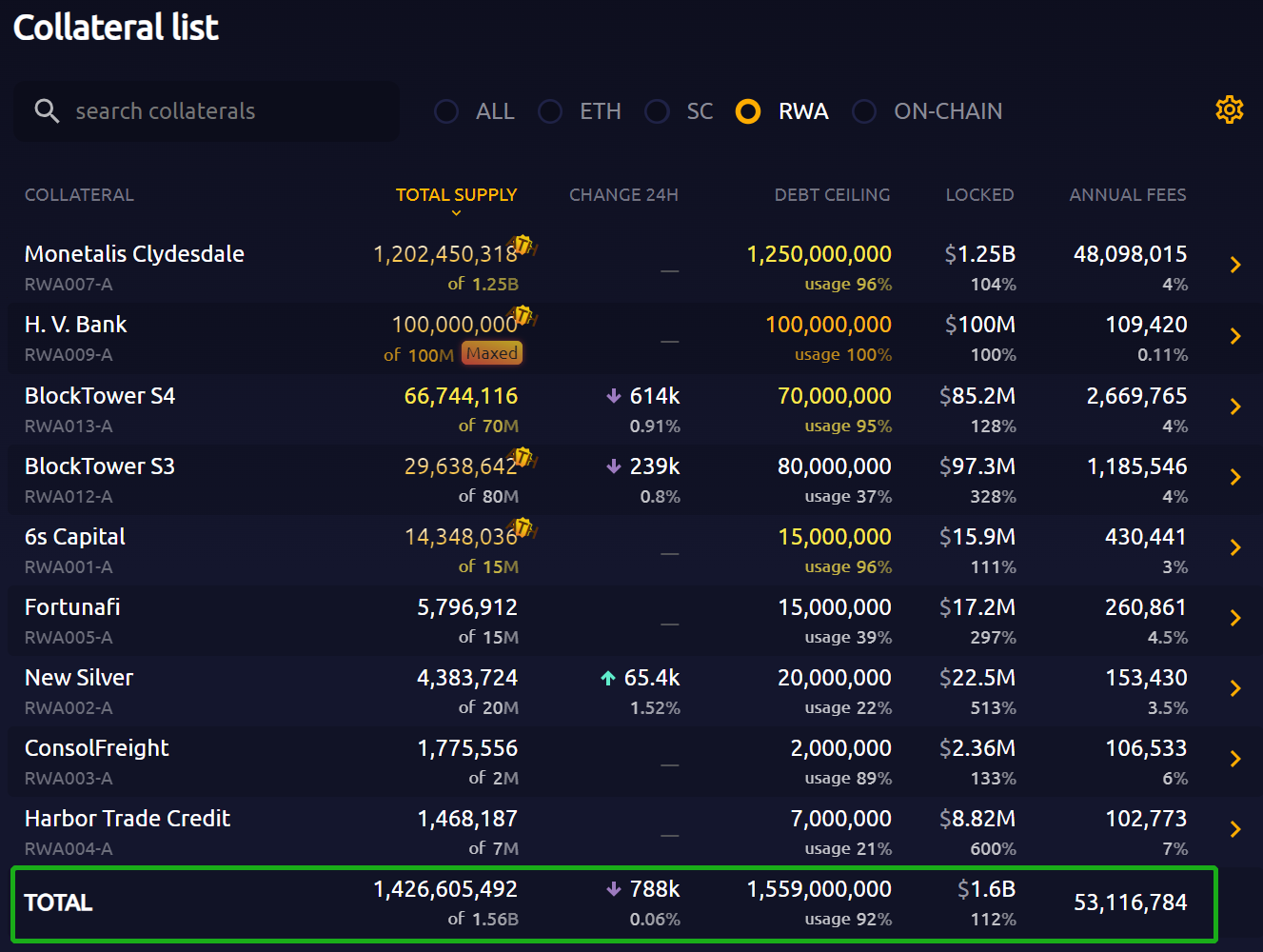
Source: makerburn.com
This data does not include the $500 million USDC provided by MakerDAO to Coinbase Custody. Coinbase's custodial department will pay a 2.6% annual yield on deposits, and USDC rewards will be calculated monthly. Coinbase does not charge any fees for participating in this rewards program or for custodial services of USDC.
RWAs account for only 20.7% of MakerDAO's business but generate $53 million in revenue, accounting for 45% of MakerDAO's total revenue ($118 million). RWAs are the most important source of income for MakerDAO, with US Treasuries being the largest contributor. Therefore, the MakerDAO community has increased its investment in US Treasuries again to maximize income. Since our last report ($23 million in revenue), there has been a 120% increase in income.
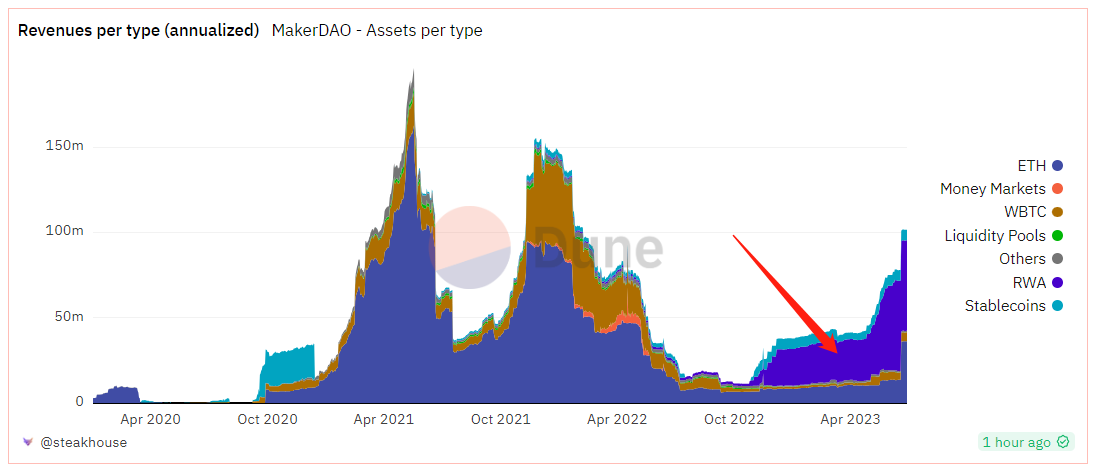
Source: Dune Analytics