

A brief discussion of Celestia’s business ideas: Can it be feasible to divert Ethereum Layer 2?

Original author: Faust, Geek Web3
This article does not involve much technical interpretation, but a matter-of-fact analysis of Celestias current business ideas and situation.
Celestias self-positioning is the best DA layer under the modular blockchain narrative. Celestia has built a public chain, which specifically provides data publishing services for the Rollup project, namely Data Publication. Data release ensures one thing: individuals who need to obtain the latest data can quickly obtain the data they need. In the past, many people referred to data release as data availability, confusing it with historical data retrieval, which is a misuse of the concept. This is being continuously corrected by the Ethereum Foundation and Celestia officials.
If you have simple knowledge about Rollup, then the following content will be easy to understand: Celestia believes that an Ethereum expansion network similar to Layer 2 can publish newly generated data to the Celestia chain instead of directly to Ethereum , which can save more than 90% of handling fees.
Taking Arbitrum Orbit as an example, Orbits sequencer can publish the latest data from Layer 2 to Celestias blocks. Then, the node that needs to obtain this part of data (such as the Orbit full node) can run the Celestia light node to obtain the data published by the sorter from the Celestia full node.
As for Celestias token TIA, the main application scenario is data release fees + POS node staking. If a Rollup project chooses Celestia as the DA layer, a handling fee will be paid each time data is released; at the same time, Celestia is specially used to carry the data released by Rollup. The main chain has up to more than 200 Validator nodes, and TIA tokens are the assets that Validator needs to pledge in advance.
Although Celestias official documentation mentions that TIA tokens can also be used as gas payment tokens for Rollup projects within the Celestia ecosystem, this proposal is not mandatory. At the same time, TIA will also be used for Celestia governance in the future, such as voting on adjustments to some parameters of the Celestia network.
Comparing TIA with ARB and OP, it is not difficult to see that the former has a seemingly more frequent application scenario: as a handling fee for data release. If there are many expansion projects in the future that really use Celestia as the DA layer, and these projects have sufficient liquidity and users and can continue to create application conditions for TIA tokens, then TIA can indeed be strengthened. To take a step back, as long as Celestia is fully recognized by the industry and even the market, and the ecological construction is successful enough, even if TIA is purely a governance token like ARB, it can be fully valued by the market.
But the point I want to make in this article is exactly the opposite: Celestia may not be fully recognized by the market or even the industry. Its attempt to attract liquidity from the Ethereum Layer 2 system will most likely encounter resistance, and its situation may be like that of EigenLayer Same.
The picture comes from TokenInsights article - The King of Restaking: Is EigenLayers business model a gold idea or a waste? 》
Whether the project is successful or not, technology/narrative is not the first priority, the review and assessment of the situation are the most important
If we want to discuss whether Celestia can be fully recognized by the market and industry in the future, it is actually equivalent to discussing a very philosophical question: What are the most important factors for the success of a project? Does Celestia have these elements?
Here, the author briefly discusses the first point. If we look back at history and take Polygon, Flow, Avalanche, Dfinity, Solana, Nervos and other public chains that were established and launched on the main network around the same period as the objects of investigation, it is not difficult to see that the most successful among them is Polygon. Although it is considered by many to be the weakest technology among the public chains mentioned above, it is undoubtedly the most successful one.
Polygons ecological construction is more successful than several other survey targets. Its token market value, DAPPs it carries, and various data are all at the forefront. Previously, Trump chose to issue exclusive NFTs on Polygon. Its Family Bucket includes a series of various things such as Ethereum Layer 2 (Polygon zkEVM), independent public chain (Matic), DA network (Avail), etc. ZK-related teams include Polygon Zero, Polygon Miden, Polygon Nightfall, respectively, explored different technical directions. At the same time, Polygon also has an open source modular blockchain suite, Polygon CDK, which seems to have a more complete modular blockchain stack than Celestia.
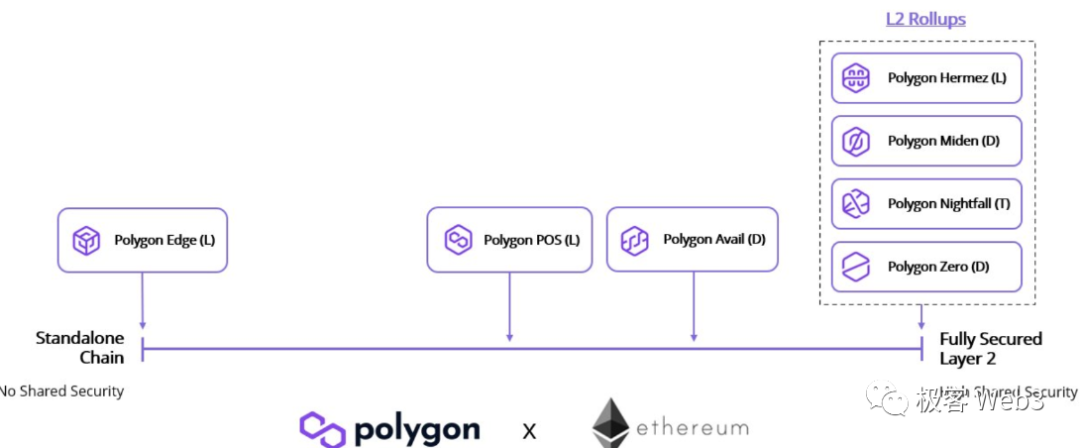
(Image source: Messari)
Polygon likes to follow the general trend, especially in 2020, it branded itself as Plasma to cater to the needs of the Ethereum Foundation, thereby attracting a large amount of liquidity and acquiring considerable resources. In the eyes of many technology supremacists, Polygon, which was originally weak in technology, quickly rose to its status in the world by catering to the Ethereum Foundation, and then spent large sums of money to acquire multiple projects related to ZK and modular blockchains. technical team to build your own business empire step by step.
In comparison, projects such as Flow, Avalanche, Dfinity, and Solana are technically stronger than the original Polygon, but are weaker than Polygon in terms of current comprehensive strength. Among them, Solana has been quite successful with the long-term support of the FTX exchange (Anatoly has spared no effort to promote its project to the latter in order to convince SBF); Avalanche relies on the support of overseas capital, EVM compatibility, and a lot of energy to develop BD. Its also relatively successful. But the two dont seem to be particularly optimistic about Layer 2 narratives, and they havent made a lot of investment in this aspect. To some extent, they are not as good at going with the flow as Polygon.
The last Dfinity, Flow and Nervos tend to weaken due to different reasons and are not as popular as the aforementioned projects:
Dfinity positions itself as a decentralized AWS, and wants to really bring some practical application scenarios to the blockchain. It also launched a targeted reverse gas function that allows users to conduct gas-free transactions. However, due to the times, It has not succeeded due to background restrictions (from 2021 to today, blockchain is not a field suitable for mass adoption, because the upstream supporting facilities are extremely imperfect and user access is restricted).
As for Flow, it has long implemented native account abstraction and has a simple layered design similar to modular blockchain; Nervos used layered expansion and Layer 2 as its core narrative in 2018, trying to label itself as Layer 1 designed specifically for Layer 2, but in the end it also encountered Waterloo (Layer 2 only makes sense when Layer 1 carries excess liquidity, and simply meeting the needs of Layer 2 technically is not the optimal solution) .
In the final analysis, the most important thing for a project is never whether the technology is awesome or whether the narrative is attractive, but whether it can assess the situation in the context of the times and find the most appropriate business operation path. However, this is precisely the shortcoming of many academic teams. In a business world full of intrigues, there is no such thing as technology first or honor and morality first. There is only winners and losers. Many teams with unique technologies/advanced concepts failed to gain their due status in the end, and it was precisely because they were not flexible enough in business operations that they ended up in the northwest.
What’s wrong with Celestia’s business operations?
Let’s look back at Celestia: Are there any problems with its business operations? In other words, is there a good way to assess the situation? It needs to be emphasized that Celestias modular blockchain and DA layer narrative require a public chain with abundant liquidity and overflow phenomena as the corresponding settlement layer, and this public chain is actually Ethereum. If Celestia is completely separated from the Ethereum ecosystem, its modular blockchain narrative will not make much sense, as the Nervos situation mentioned above has long revealed.
However, attracting liquidity from Ethereum without directly empowering Ethereum itself does not seem to be an approach that makes sense. If we carefully observe the changes in the Ethereum Foundations attitude towards Layer 2, it is not difficult to observe this.
In the previous articles of Geek Web3, we have emphasized many times that the Ethereum Foundation and L2B EAT have clearly clarified that expansion projects that do not use Ethereum as the DA layer are not Ethereum Layer 2, because the Ethereum chain is off-chain. None of Celestias DA layers can achieve the same level of availability guarantee as Ethereum, and there is a certain degree of trust assumption (Celestia needs to pre-assume that the main chain will not have downtime failures, but its Validator has a maximum of about 200, which is different from the availability of the Ethereum main chain; EigenDA is essentially independent of Ethereum’s native DA).
In other words, except for real Rollup, other expansion projects are not Ethereum Layer 2 (we can ignore Plasma and status channels, because these two technical solutions have almost disappeared in the Ethereum ecosystem).
(Image source: L 2B EAT)
Regarding the purpose of the Ethereum Foundations approach, many people believe that it is actually using the excuse of differentiating technical solutions to protect its own commercial interests. The reason is self-evident: if the DA layer outside Ethereum such as Celestia and EigenDA If it is adopted on a large scale, the status of Ethereum will inevitably be weakened, and the significance of EIP-4844 and Danksharding, which the Ethereum Foundation has invested a lot of energy in realizing, will no longer exist. Moreover, these independent DA layers cannot empower Ethereum at all, but will bring some systemic risks.
Although there are indeed some Ethereum ecological projects such as Arbitrum Orbit that have announced integration with Celestia, this does not mean that Celestia will be fully recognized, but it makes the Ethereum Foundation feel more and more competitive pressure. For the Ethereum Foundation, which has the supreme authority to speak, it is actually a simple matter to use its own advantages to consolidate its position (this is like the Jewish patriarch easily killing Jesus). As long as Ethereum Layer 2 values the title of Layer 2, it will not consider things like Celestia and EigenDA. Therefore, Celestia is essentially advancing bravely rather than going with the flow like Polygon.
Today, the vast majority of Ethereum Layer 2 liquidity is concentrated on orthodox Rollup projects such as Arbitrum and Optimism, and the main versions of these projects will inevitably not be integrated with Celestia. Arbitrum Orbit is just a minor version similar to Arbitrum Nova, and there is a high probability that it will not be able to compete with several major orthodox Layer 2. Even if Celestia can attract such secondary Layer 2, it doesnt seem to bring much value capture. (Arbitrum Nova currently only has ~$22 million in TVL)
In addition, as a DA layer project with a purely ToB scenario, Celestia is not able to obtain a large amount of liquidity by recruiting DAPPs in a ToC scenario like Solana. If it cannot successfully attract the adoption of many Rollup projects, its ecological construction will weaken. Moreover, Celestia seems to lack a very strong capital promoter. Although its technical narrative itself makes sense, if it cannot take root well in the Ethereum ecosystem, its grand blueprint is likely to become a castle in the air (without the support of FTX and relying solely on technical narrative) Sui still has not made much progress).
The author would like to share two interesting things here:
First, according to an insider, at an offline event in Stanford, Dankrad of the Ethereum Foundation had just finished saying that scaling projects that do not use Ethereum for the DA layer are not Layer 2. Shortly afterwards, Celestia personnel Saying Project xxx is an Ethereum Layer 2 using Celestia as the DA layer made some people laugh;
Secondly, Eclipse, which is supported by Celestia and claims to be the fastest Ethereum Layer 2, has not yet been included in the L2beat website (cannot be found in the Active Projects and Upcoming Projects columns). The project uses Solana VM as the execution layer, Celestia as the DA layer, and Ethereum as the settlement layer (Layer 1).
The above two anecdotes reflect Celestias current situation to some extent. Although from an idealistic perspective, the modular blockchain technology narrative created by Celestia is conducive to the long-term development of Web3, under the constraints of practical factors, everything does not seem optimistic.
Intent may bring different results
But this is only the current situation. In the future Web3 world with Intent as the core, everything may change. In the context of a narrative centered on Intent, chain abstraction, and full-chain operations, Celestias resistance to ecological construction can be resolved in a future where users do not need to be aware of the existence of the chain itself.
The current popularity of Ethereum Layer 2 is essentially because everyone recognizes the Ethereum chain, and everyones recognition has brought ample or even excess liquidity to it. Why does everyone recognize Ethereum? Because I have a general understanding of him. But if the Intent solution blocks the underlying infrastructure, what will new users in the future not know about Ethereum and Solana? Will the liquidity distribution be based on DAPP itself instead of the underlying protocol?
In other words, our current understanding of the development of the blockchain landscape is based on fat protocols and thin applications, but this law may change in the future.
We can imagine this: In the future blockchain world where Intent and full-chain operations are the mainstream narrative, people do not need to be aware of the existence of Ethereum and Layer 2, they only need to perceive the DAPP itself or even its front end, then everything The situation may change: by then the key point to guide liquidity will no longer be public chains such as Ethereum, but major DAPPs. As long as major DAPPs are willing to base themselves on a modular blockchain with Celestia as the DA layer, Celestias ecological construction does not have to rely on the current path to attract Ethereum Layer 2. By then, not only Celestia, but the entire Web3 landscape will undergo tremendous changes.
Perhaps as someone said: Although the success of a person (project) depends on ones own efforts, the historical process must also be considered.