

Beyond ChatGPT: The Rise of AI Automation Tools and a Comprehensive Analysis of Commercialization Paths

In recent months, a quiet paradigm shift has been occurring in the field of AI.
Conversational large models like ChatGPT, Claude, and Gemini are essentially still "suggestion-based AI" — humans ask questions and wait for answers. The emergence of a new class of tools is pushing AI's role from "giving suggestions" to "direct execution": they can autonomously access applications, complete workflows, and collaborate across platforms, truly becoming digital employees for users.
The core of this change is the rise of the autonomous AI Agent framework ecosystem, represented by OpenClaw.
1. What are the Four Major Frameworks?
OpenClaw: Most Feature-Rich, Also Highest Risk
OpenClaw (formerly Clawdbot / Moltbot) is currently the most representative open-source autonomous AI assistant framework, surpassing 200,000 GitHub Stars in just a few weeks. It combines a plugin (Skills) system with large models, enabling AI to truly possess execution capabilities:
- Proactively executes commands: Organizes files, checks emails, schedules appointments
- Controls systems and applications: Automatically sends emails, runs scripts, extracts document content
- Cross-platform access: Supports 15+ channels including WhatsApp, Telegram, Slack, iMessage, Teams
- ClawHub plugin marketplace: 1000+ community extension features
NanoClaw: Security Isolation First
Born to address OpenClaw's security issues. Each Agent runs in an independent Linux container, limiting the blast radius of attacks through OS-level isolation — even if a Prompt Injection succeeds, the attacker can only affect a single container, leaving the host machine completely unaffected. Currently primarily supports the WhatsApp platform.
Nanobot: Minimalist + MCP Standard Protocol
Developed by the HKUDS Lab at the University of Hong Kong. Only 4,000 lines of Python code, fully implements the MCP (Model Context Protocol) — a standardized tool interface protocol led by Anthropic. The core logic is "not doing everything itself, but becoming a host for tools," supporting multiple platforms like Telegram, Discord, WhatsApp.
PicoClaw: AI Assistant on $10 Hardware
Developed by hardware manufacturer Sipeed, a single binary written in Go, designed specifically for embedded devices: memory footprint <10MB, startup time <1 second, supports RISC-V architecture, can run on a $10 LicheeRV Nano. Interestingly, 95% of its core code was automatically generated by an AI Agent.
2. Security Model: This is the Essential Difference
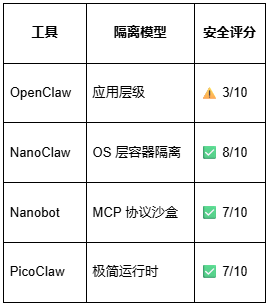
OpenClaw's problem is not "having vulnerabilities," but being "structurally difficult to fix." A security audit in January 2026 found 512 vulnerabilities (8 critical). Cisco officially labeled it a "security nightmare," and Aikido Security bluntly stated "trying to secure OpenClaw is absurd." Root causes:
- 430,000 lines of code cannot be fully audited
- Hundreds of malicious plugins have been discovered in the ClawHub marketplace (some plugins explicitly state they curl data to the attacker's server)
- After token hijacking, attackers can remotely execute arbitrary commands
- Existence of "zero-click attacks" — reading a single Google Doc can trigger a full attack chain
NanoClaw's logic is "isolation is better than defense." It doesn't try to patch application-layer vulnerabilities but uses OS-level containers to hard-limit the worst-case scenario. This is a provable, auditable security property.
Nanobot's security comes from "transparency and minimalism." 4,000 lines of code are "readable in their entirety in 8 minutes," the dependency chain is extremely short, and the MCP standard interface boundaries are clear and auditable.
PicoClaw's security comes from an "extremely minimal runtime." A <10MB binary means an extremely low attack surface, no complex dependency tree, no plugin marketplace. However, it lacks active isolation mechanisms, belonging to the "small target" category rather than "having a shield."
Security scores for each tool (referencing Shareuhack evaluation):
3. Technical Architecture Comparison
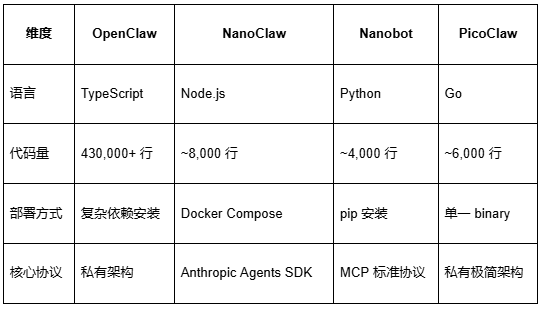
A few easily misunderstood points:
PicoClaw's <10MB does not include the AI model. It is only the Agent runtime; inference still calls cloud APIs. If you want fully local inference (Ollama, etc.), memory requirements immediately jump to 4GB+.
Nanobot's MCP is a structural advantage. The MCP Server you write can be reused by any Host supporting the protocol — if Nanobot stops being maintained, the toolchain can be migrated at zero cost. OpenClaw's ClawHub plugins are a private ecosystem, completely non-portable.
NanoClaw's single-process architecture is deliberately designed. Node.js coordinator + each Agent in an independent container; if a problem occurs, just kill the single container, affecting nothing else.
4. Hardware Requirements
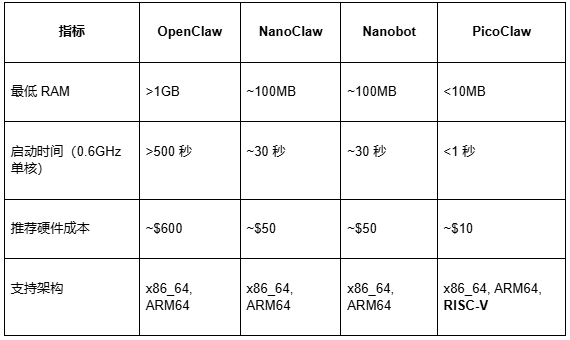
PicoClaw leads in startup speed by 500x — this is not a gimmick; on low-spec devices, OpenClaw can take nearly 9 minutes, while PicoClaw takes less than 1 second. RISC-V support is also currently unique to PicoClaw, with the LicheeRV Nano ($10-15) being its primary target platform.
5. Functional Boundaries: Which Needs Can Only OpenClaw Satisfy
80% of users only need basic chat + tool calling, and lightweight alternatives are completely sufficient. However, the following needs are currently only covered by OpenClaw:
- Browser automation (Playwright): Automatically filling forms, clicking buttons, scraping dynamic web pages — the other three frameworks all lack this
- Multi-Agent collaboration: Decomposing complex tasks for sub-agents to handle concurrently
- Full-stack integration across 15+ platforms: NanoClaw only supports WhatsApp, PicoClaw focuses on Telegram/Discord, OpenClaw is the only option covering iMessage, Signal, Teams
Note: Although ClawHub has 1000+ plugins, hundreds of malicious plugins have been discovered. The original author recommends completely disabling it in production environments (--no-skills mode). This "advantage" is significantly diminished in practice.
6. Four Commercialization Paths
Path 1: Plugin Monetization
Develop exclusive plugins for high-frequency business scenarios (e.g., "Contract Auto-Generation + Review"), selling them within the tool ecosystem or to enterprises. Flexible business models: one-time purchase, subscription, or pay-per-call can all be implemented.
Path 2: Automation Service Subscription
Provide standardized automation service packages to SMEs: intelligent customer service, data analysis, multi-platform content publishing, internal process automation. Monthly or annual subscriptions represent the most scalable monetization method.
Path 3: Custom On-Premises Enterprise Deployment
Target data-sensitive industries like finance and healthcare with custom on-premises deployment solutions where data never leaves the internal network. High customer unit price, strong stickiness, suitable for service providers with technical capabilities.
Path 4: Personal & Small Team Content Operations
Run Nanobot locally to batch-generate multi-version content; optimize formats based on platform differences (Zhihu long articles, WeChat Official Account short posts, Douyin scripts, Instagram posts); monetize through ad revenue sharing, paid columns, or content subscriptions. Low cost, replicable.
7. Selection Guide
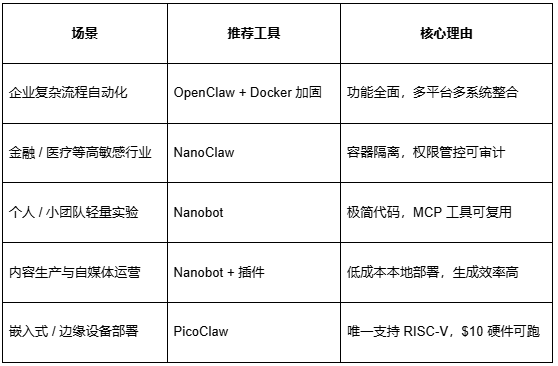
The essence of selection is not choosing the "best," but choosing the "best match for your constraints."
Ask yourself four questions:
- How sensitive is your data? → Sensitive: choose NanoClaw (container isolation is provable) or Nanobot (code is auditable). OpenClaw is a no-go zone for sensitive environments.
- How constrained is your hardware? → RAM <512MB: only PicoClaw; 100MB–1GB: all three lightweight options work; >1GB: can consider OpenClaw.
- Need browser automation? → Only OpenClaw, but must use Docker for strict isolation, not for production environments.
- Value long-term tool reusability? → Nanobot, the MCP ecosystem is the most valuable long-term bet.
Conclusion
AI automation is no longer a "future concept" but a productivity tool that can be directly implemented. Whether for enterprise cost reduction and efficiency improvement or personal content entrepreneurship, this wave of intelligentization provides clear and feasible commercial paths.
The key logic remains consistent: understand the pain points of the scenario, choose the appropriate tool, and design a closed-loop business model.
Achieving these three points makes AI automation not just an efficiency tool, but new infrastructure for creating sustainable economic value.