


Google Cloud Enters the Fray: Can Puffer UniFi Close the Last Mile of Based Rollup?

A major Web2 player's entry has pushed "Gateway"—a new concept previously confined mostly to technical discussions—into the public eye.
On September 22, Puffer announced a partnership with Google Cloud. Google Cloud will serve as a key infrastructure partner, running Gateways through Puffer Preconf, supporting Puffer UniFi's execution layer, assisting with transaction processing, and providing Execution Preconfirmation before transactions are ultimately settled on Ethereum.
More notably, Puffer UniFi will become the first Rollup to use Google Cloud Gateway.
However, interpreting this merely as "yet another Web2 giant entering Web3" would miss the more discussion-worthy aspects behind this collaboration.
Because what Google Cloud is playing this time is not the traditional peripheral role of providing computing power, node hosting, or cloud services for blockchain projects. Instead, it is directly entering Puffer UniFi's real-time execution architecture, becoming one of the Gateway layers connecting transaction processing, Preconfirmation, and final Ethereum settlement.
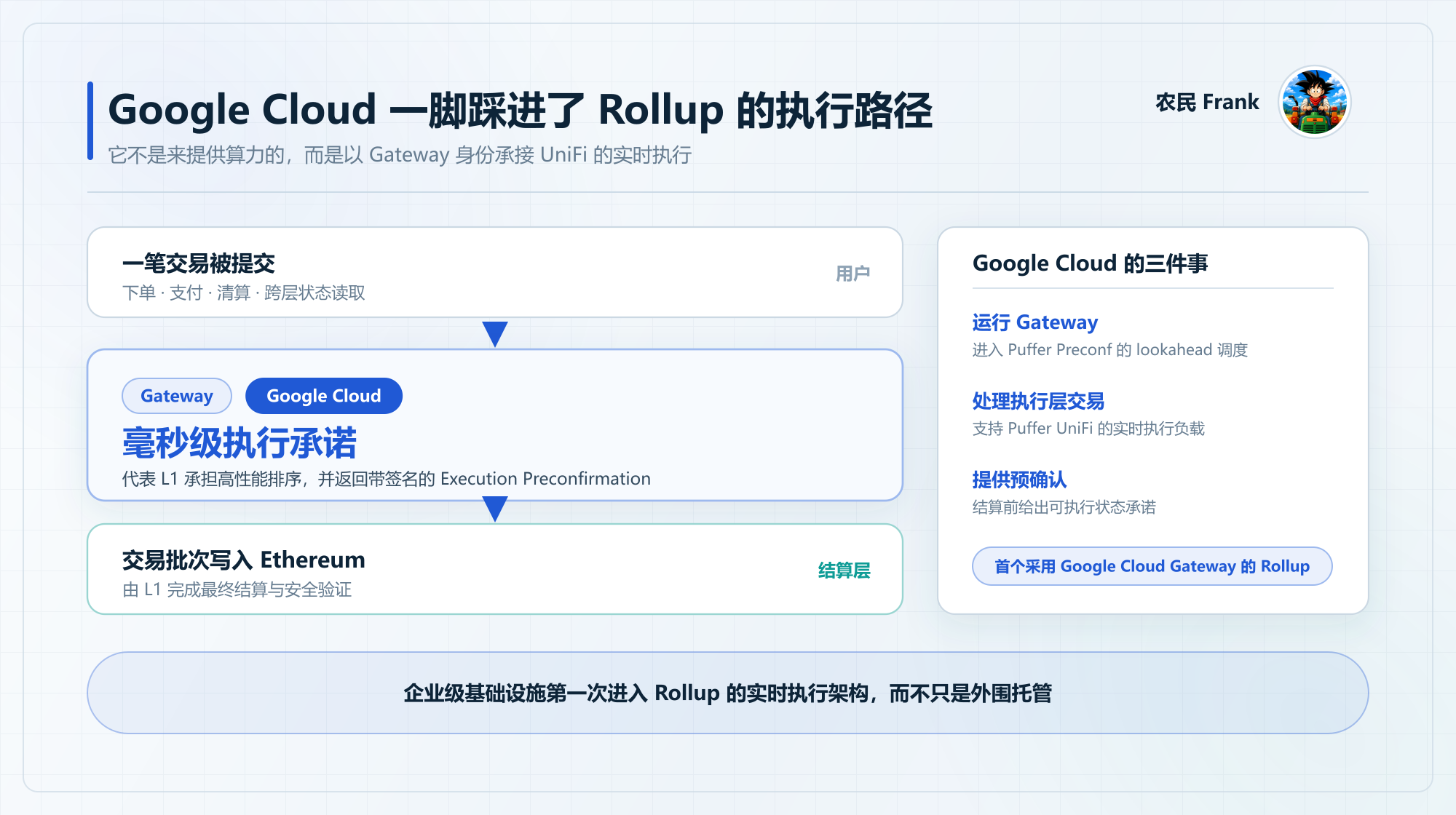
This also raises a bigger question: What exactly is Puffer UniFi building? Why does it need Gateways? And why would Google Cloud choose to enter Ethereum from this relatively low-level position?
The answer may need to start with the new phase that Ethereum L2s are entering.
1. Puffer UniFi: One Answer for Rollups in the Second Half
Entering 2026, Ethereum's Rollup strategy is clearly at a delicate moment.
Since Vitalik Buterin sparked reflection on the L2 path, L2's阶段性 historical mission as an Ethereum scaling tool has been declared complete at both the market and public opinion levels.
A question is becoming increasingly sharp: when L2 is no longer just a scaling tool to relieve congestion pressure on L1, how exactly should it define its own existence? And how should it re-form a more unified relationship with L1 in terms of security, sequencing, liquidity, and composability?
Puffer UniFi is attempting to provide one such answer.
What Puffer UniFi chooses is not to continue operating a relatively independent centralized sequencing system, but to move toward Based Rollup: anchoring the Rollup's sequencing rights more directly to Ethereum L1, with Ethereum's validator set participating in sequencing, and ultimately inheriting Ethereum's own security and neutrality.
This does not mean L2 has lost its meaning.
More precisely, as the阶段性 task of pure scaling is gradually completed, Rollups need to re-answer their value proposition: should they continue to exist as a generalized execution layer, or should they become application infrastructure more closely coordinated with Ethereum, centered around clearer applications, scenarios, and user experiences?
After all, for Ethereum five years ago, L2 scaling was a very realistic and very successful path. But today, five years later, assets and liquidity are scattered across dozens of independent islands, and Rollups need to be repositioned—for instance, toward the application-chain orientation with clear application scenarios and business boundaries advocated by Vitalik.
The significance of Based Rollup lies in attempting to readjust this relationship.
Its core idea is not complicated: since Rollups ultimately still rely on Ethereum for settlement and security verification, sequencing rights can also return more directly to Ethereum L1, with Ethereum's validator set responsible for Rollup sequencing. Theoretically, this can not only eliminate Rollups' dependence on a single sequencer, but also truly achieve synchronous composability between L1 and L2.
In other words, what Based Rollup offers is not "building another faster L2," but an answer closer to Ethereum's native path—making scaling no longer mean fragmentation, and making L2's growth feed back into L1's security and value.
This is a direction that is almost impeccable in theory, but the problem is that the theoretical optimum does not automatically equal a usable system in reality:
- The first real constraint is speed. Ethereum L1's block time is approximately 12 seconds. If Rollup sequencing completely follows L1's rhythm, then every transaction must wait at least one L1 block to obtain relatively reliable confirmation. Ordinary transfers might be acceptable, but for instant payments, order books, perpetual contracts, and even high-frequency DeFi applications, it clearly cannot compare with the sub-second feedback provided by centralized sequencers (Further reading: "The Evolution of Preconfs: From 'Patch' to 'Infrastructure,' How Does UniFi AVS Affect the Game Rules of Based Rollup?");
- The second constraint is execution burden. As is well known, Ethereum has long insisted on lowering the verification threshold, committed to enabling more ordinary hardware and individual nodes to participate in network consensus. But Based Rollup requires L1 validators to directly take on roles such as high-frequency sequencing and low-latency execution, which inevitably raises the hardware, network, and operational thresholds for validators, and may instead create new centralization pressure at the execution layer;
- The third constraint comes from the incentive structure. For many L2 teams, if migrating to a Based architecture means increased technical complexity and insufficient returns, then continuing to maintain their own centralized sequencers remains the more rational choice;
So the problem with Based Rollup has never been that the direction is wrong, but that it still lacks a layer of real-world infrastructure before it becomes truly usable—as long as the system is completely locked to L1's 12-second rhythm, it will be difficult to balance speed; and if, without recentralizing, it wants to preserve mainnet neutrality while obtaining an interaction experience close to that of centralized sequencers, then new role specialization must be introduced at the execution layer.
This is also the core contradiction that Puffer UniFi must resolve.
It is against this backdrop that Puffer Preconf was incorporated into Puffer UniFi's core technology stack—as a set of preconfirmation services built on EigenCloud (formerly EigenLayer). Sequencing rights remain anchored to Ethereum L1, but high-performance sequencing, low-latency feedback, and execution preconfirmation do not all need to be personally completed by L1 validators.
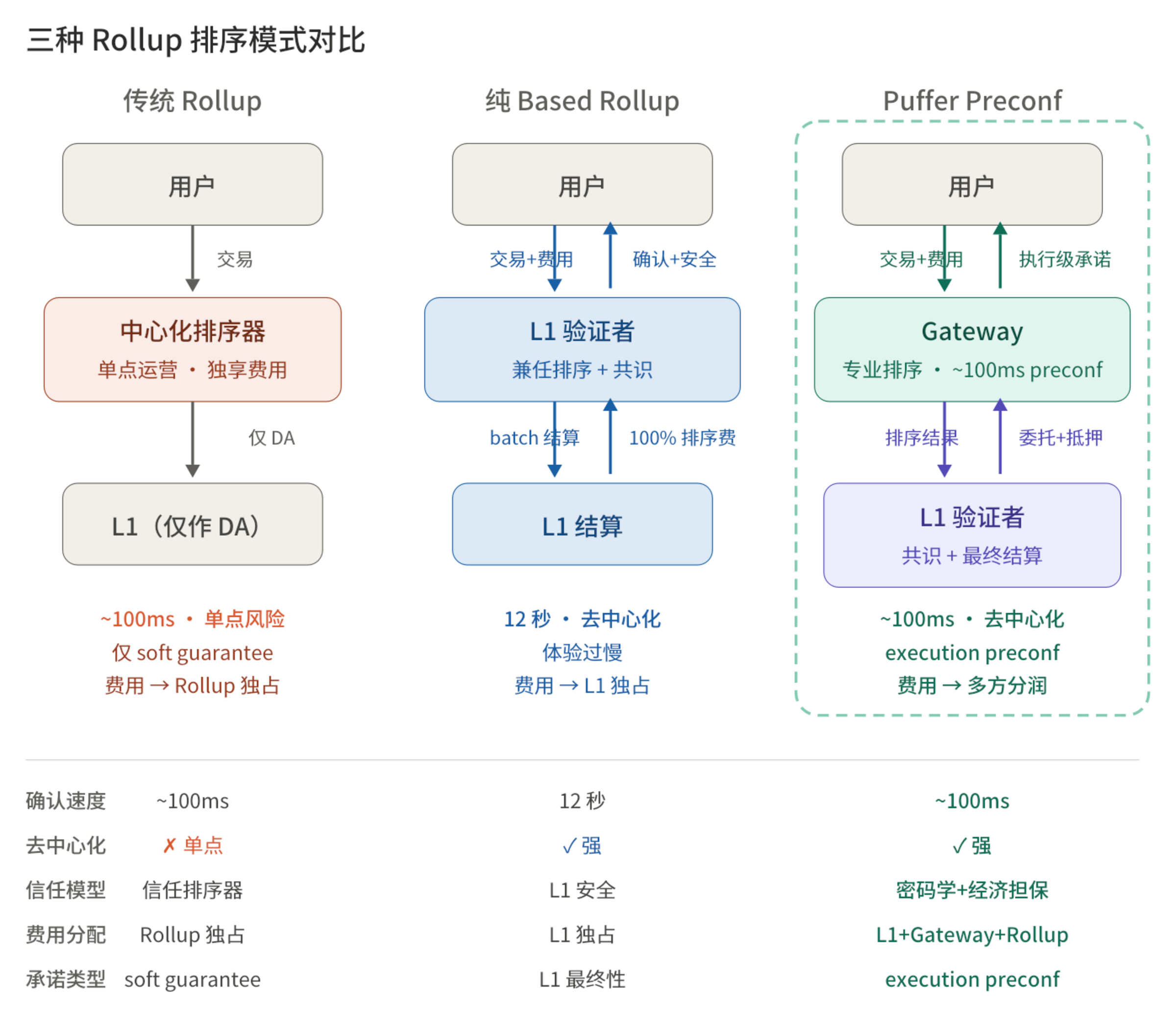
In other words, if Based Rollup answers the question of "whom Puffer UniFi ultimately relies on for sequencing and settlement," then Puffer Preconf solves the question of "how users obtain real-time and trustworthy execution experience before final settlement."
And this is precisely the starting point for understanding Gateway.
2. Real-Time Execution: Why Does Puffer UniFi Need Preconf?
Before understanding Gateway, one must first understand what Preconfirmation is actually promising.
In fact, in mainstream L2s, the reason users can quickly see transaction feedback is often that centralized sequencers first provide a kind of soft guarantee, telling you that the transaction has entered the queue, and the front end quickly displays the execution result, making users feel in their experience that it has "already been confirmed."
But strictly speaking, this kind of fast feedback is built more on trust in a single sequencer.
Once the sequencer goes down, lags, behaves maliciously, or engages in censorship, such promises often lack sufficiently strong economic constraints and verifiable accountability mechanisms. In other words, the "speed" of traditional Rollups largely comes from the sequencer's own reputation.
For Puffer UniFi, this is clearly not enough, and this is precisely the problem Puffer Preconf aims to solve.
It attempts to elevate "fast confirmation" from trust in a single operator into an execution commitment backed by economic guarantees, signed promises, and accountability mechanisms—not just making Puffer UniFi faster, but making that "speed" trustworthy.
To understand this architecture, one must clearly see its division of roles.
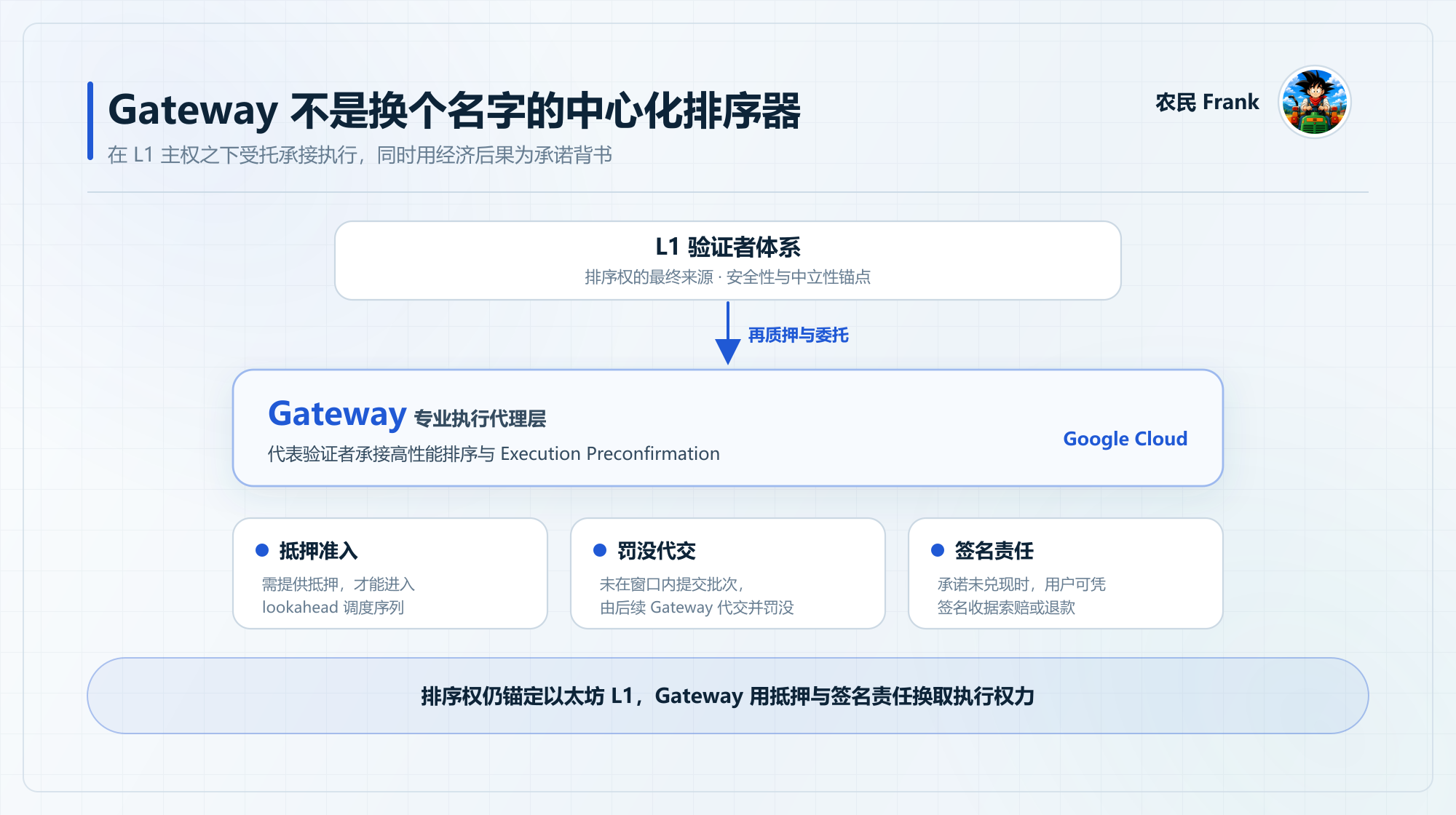
In the design of Puffer Preconf, L1 validators remain the ultimate source of sequencing rights and the anchor of Ethereum's security and neutrality, but they do not need to personally operate a high-performance sequencing system, nor do they need to directly bear all low-latency execution work. Instead, through restaking and delegation mechanisms, validators can hand this complex work to more specialized Gateways, which take on Sequencing and Execution Pre-Confirmation on their behalf.
In other words, the new role of Gateway is what truly takes on sequencing and preconfirmation responsibilities.
It is not a simple renaming of a traditional centralized Sequencer, nor is it an "acceleration plugin" attached to a Rollup. It is more like a professional execution agent layer delegated to undertake sequencing and preconfirmation responsibilities under L1 sovereignty:
- On the one hand, it helps L1 Proposers provide higher-performance sequencing and preconfirmation services;
- On the other hand, through mechanisms such as collateral, signed commitments, slashing, and revenue distribution, it prevents itself from becoming a new unconstrained centralized node;
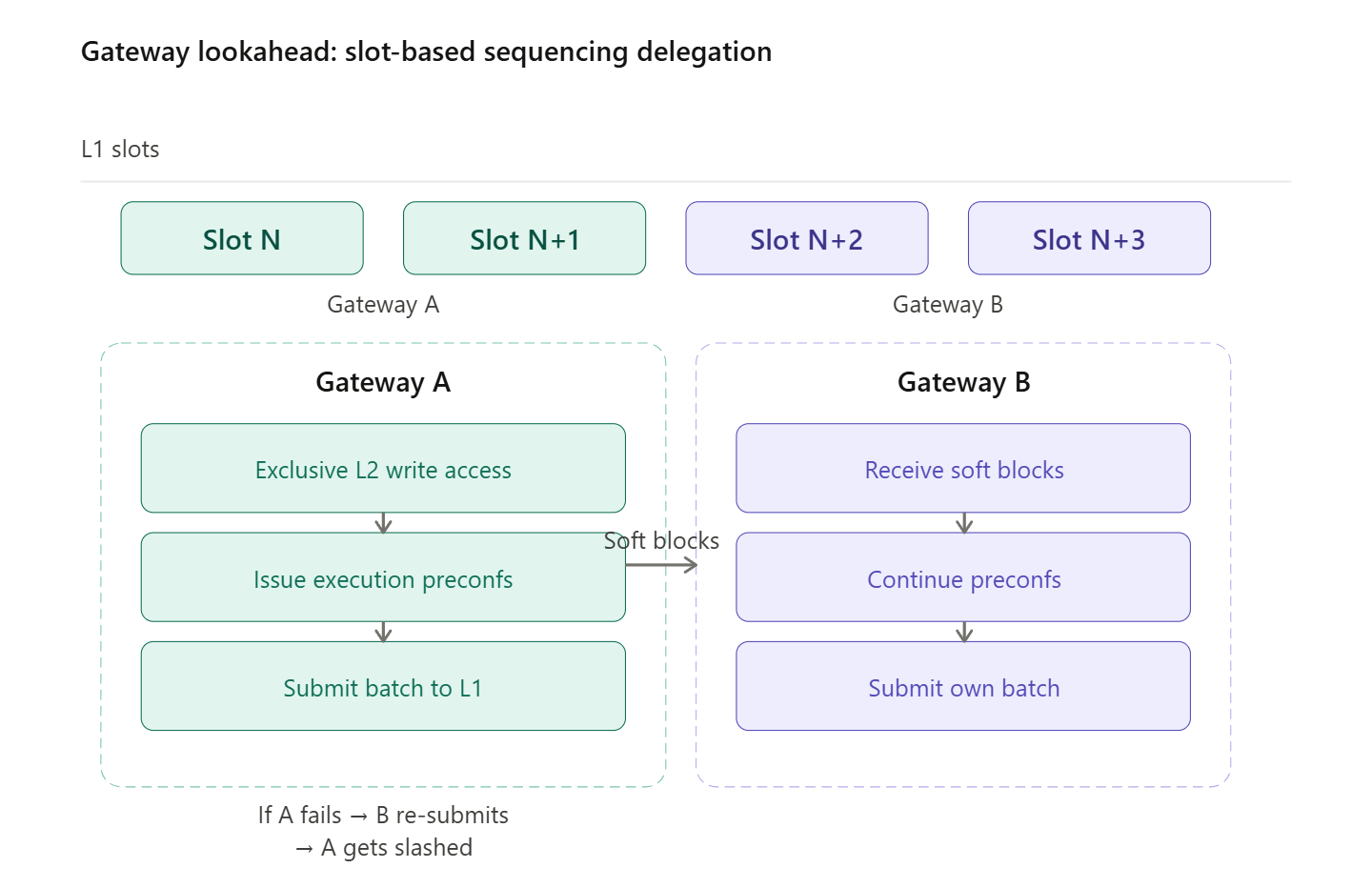
Gateway allows validators to avoid personally operating a high-performance sequencing system, while the ultimate ownership of sequencing rights remains anchored to Ethereum L1.
This also explains why Puffer emphasizes Execution Pre-Confirmation rather than merely Inclusion Promise: Inclusion promise only promises that the transaction will be included in a block, while Execution Preconfirmation further solves the question of "whether this transaction will be executed according to the previously promised state."
This difference is extremely important for high-value on-chain applications.
Take perpetual contract DEXs as an example. For such scenarios, what users fear most is not that the order is not included in a block, but that although it is included, the final execution price, execution order, or liquidation status has already shifted. Against this backdrop, Execution Preconf can guarantee that users transact at the state they saw when placing the order, rather than bearing extra slippage or unpredictable execution results.
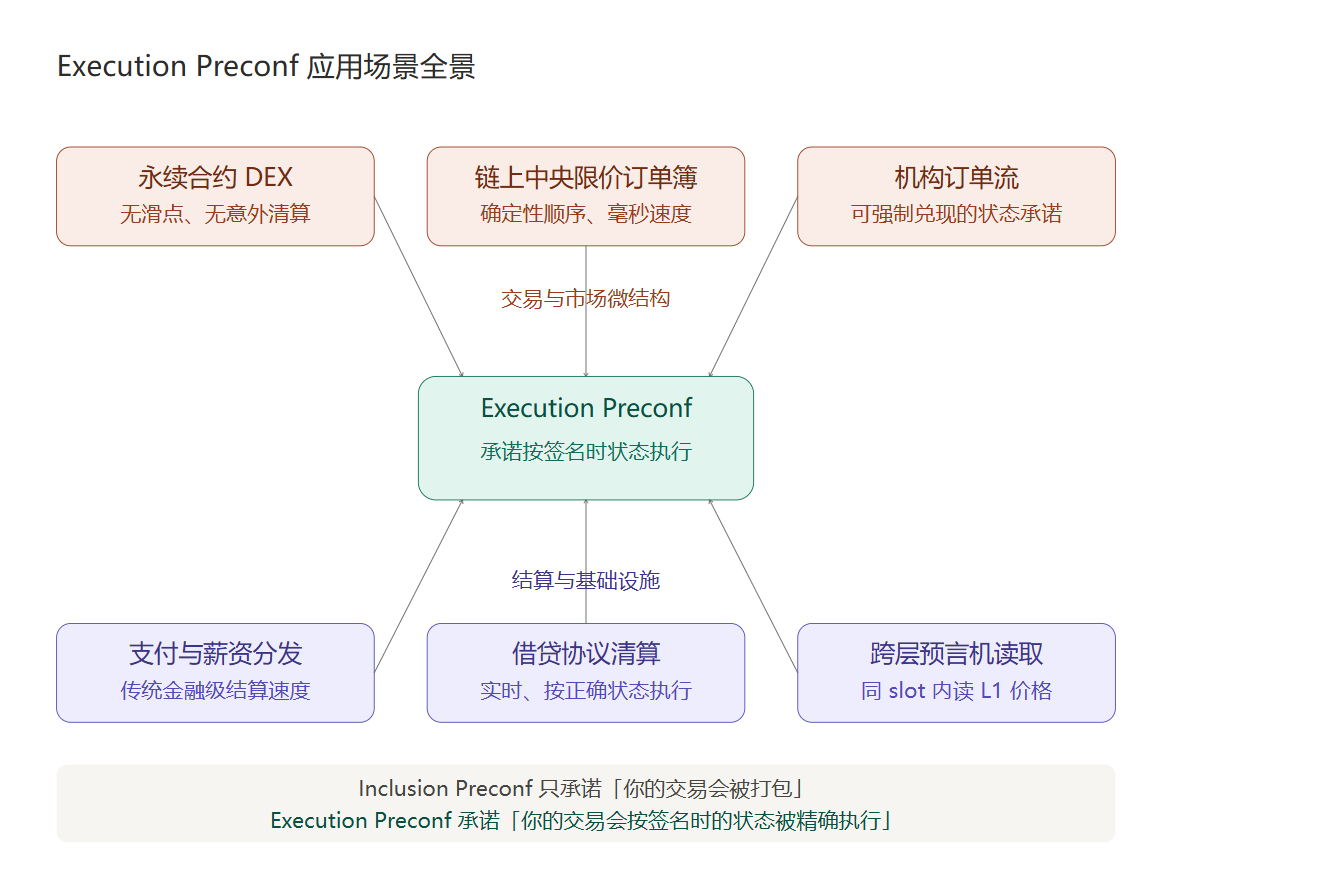
The same logic applies to on-chain central limit order books, institutional order flow, payment settlement, lending liquidations, cross-layer real-time state reads, and other scenarios. CLOBs need deterministic execution order and low-latency feedback, institutional trading needs accountable state commitments, payments and payroll distribution need predictable settlement experiences, and liquidation systems need to minimize state drift as much as possible under volatile market conditions.
Of course, any strong commitment must be accompanied by strong constraints. In architectures like Puffer Preconf, Gateway's credibility does not come from claiming to be trustworthy, but from having to bear economic consequences for its behavior. There are at least two layers of constraints here:
Gateways need to provide collateral to enter lookahead scheduling; if a Gateway fails to submit its batch to L1 in time within its responsible window as required, subsequent Gateways can submit on its behalf and trigger slashing against the former;
From the user's perspective, if a transaction with a preconfirmation commitment is ultimately not honored, users can use the signed commitment receipt to claim compensation or request a refund;
It should be noted that the specific slashing mechanism will evolve with network stages and implementation versions. Therefore, a more accurate statement is not that "Gateway is already slashed in all scenarios," but that the design direction of Puffer Preconf is to replace the unconstrained soft promises under traditional centralized sequencers with collateral, rewards, penalties, and signed accountability.
Beyond the technical architecture, another unavoidable issue is incentives.
After all, under the traditional Rollup model, most sequencing revenue goes to the Rollup operator; under a pure Based architecture, this revenue flows more naturally to L1 validators. Neither side is sufficiently balanced.
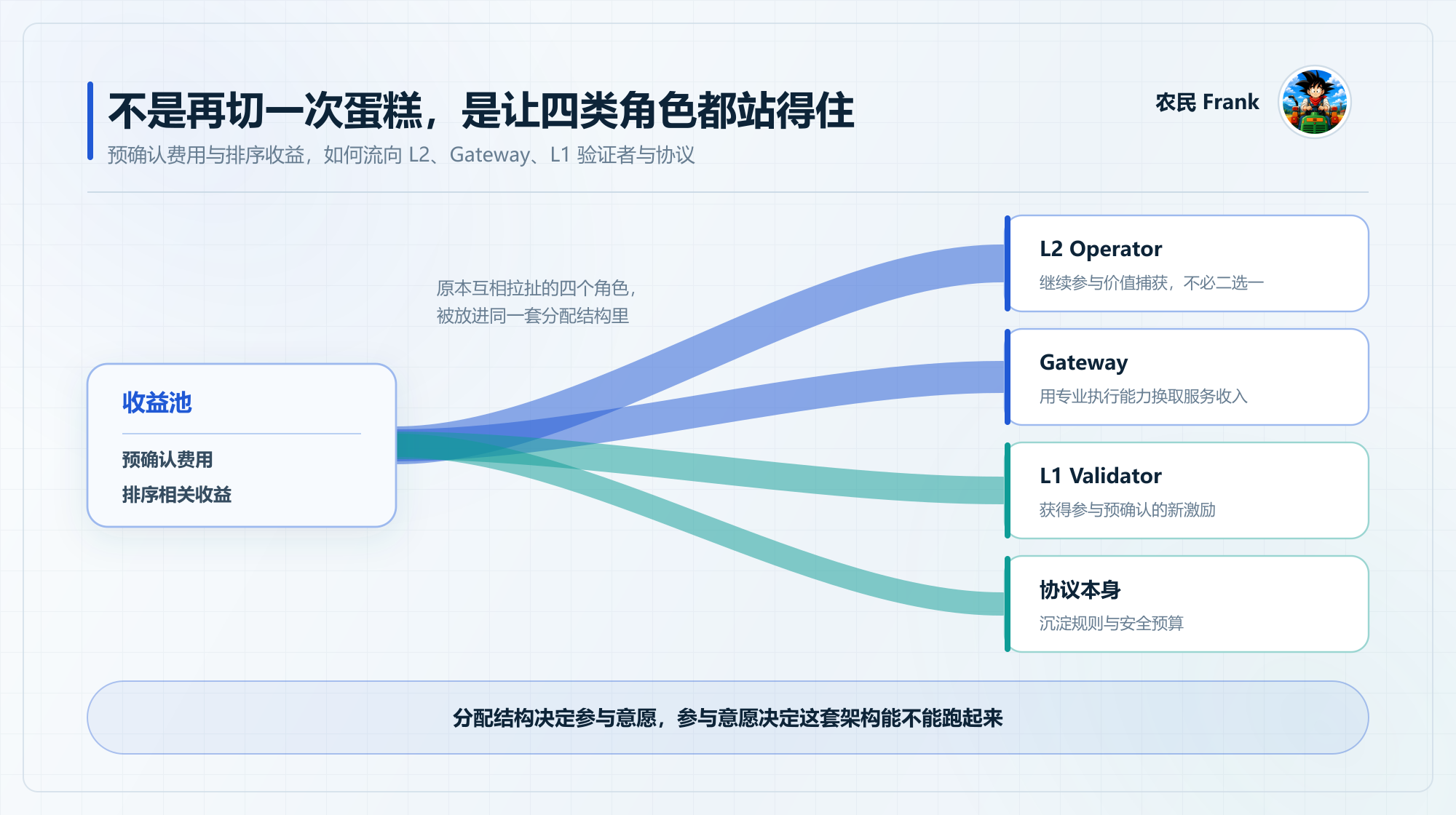
Puffer Preconf's approach is to split preconfirmation fees and sequencing-related revenue among different roles such as L2 Operators, Gateways, L1 Validators, and the protocol itself. In this way, L2 teams do not have to choose between "maintaining experience" and "returning to Ethereum," L1 validators have incentives to participate in higher-performance preconfirmation services, and Gateways become a new economic role undertaking specialized execution capabilities.
The key here is not to "cut the cake again," but to bring several types of roles that originally had conflicting interests into the same collaborative economic model, so that L2s can continue to receive revenue sharing, L1 Validators gain new participation incentives, and Gateways exchange specialized capabilities for service revenue while bearing responsibility through collateral, signed commitments, and potential slashing mechanisms.
At this point, it becomes easier to understand the significance of Puffer Preconf for Puffer UniFi.
The next real question then becomes: who will run the Gateway?
Google Cloud's participation is precisely answering this question.
3. From Architecture to Reality: Google Cloud Completes the Gateway Piece for Puffer UniFi
After understanding the preceding technical relationships, looking back at the collaboration between Google Cloud and Puffer makes its significance even clearer.
What Google Cloud is entering this time is not an isolated Preconf network. It is directly entering Puffer UniFi's real-time execution architecture in the role of Gateway.
According to the collaboration method announced by both parties, Google Cloud will serve as a key infrastructure partner, running Gateways through Puffer Preconf, supporting transaction processing on Puffer UniFi's execution layer, and providing Execution Preconfirmation before transactions are ultimately settled on Ethereum.
This is why this collaboration cannot be simply understood as a Web2 giant "endorsing Puffer Preconf." For Puffer, the more important significance is that enterprise-grade infrastructure has begun to truly enter Puffer UniFi's execution architecture.
After all, if Puffer UniFi hopes to serve the next generation of DeFi, institutional trading, and even AI Agents, then real-time execution will need to face real transaction loads, infrastructure stability, network performance, and continuous operating capability.
Protocols can define rules, but ultimately someone still needs to run these rules steadily, and Google Cloud joining as a Gateway fills precisely this gap.
Taking a broader view, the significance of Puffer UniFi is not merely that it becomes a new Based Rollup itself; it is more like the place where Puffer first productizes the entire architecture.
More notably, if Puffer UniFi can prove that Based Sequencing, Preconfirmation, and Ethereum Settlement can all simultaneously hold true in a real production environment, then what it validates is not just a Based Rollup, but a new Ethereum-native Rollup architecture.
For Puffer UniFi, Puffer Preconf is the key module for achieving real-time execution within it; and from a longer-term infrastructure perspective, this Preconfirmation capability can also be further exported to more Rollups in the future.
For existing Rollups, its appeal is mainly reflected in two points.
First, it can relieve Rollup teams from having to bear the operational pressure of sequencers alone, allowing Sequencing work to be undertaken jointly by Gateways and the L1 validator system, while Rollup teams can still participate in value capture through revenue distribution mechanisms, rather than simply losing all sequencing revenue.
In other words, it does not require Rollups to hand over the entire cake, but redesigns how profits are shared among Rollup owners, Gateways, L1 validators, and the protocol.
Second, it can provide stronger state consistency commitments. For ordinary users, slippage of a few cents or a few dollars in a transaction may not be obvious, but for institutional orders, on-chain order books, derivatives trading, and large liquidations, whether the price seen at signing is consistent with the final execution state directly determines whether the system can carry higher-value transaction flow.
Therefore, from the overall architecture of Puffer UniFi, Puffer Preconf first assumes the role of real-time execution infrastructure: it helps Based Rollup solve the problems of low latency and trustworthy execution commitments, and introduces specialized transaction processing capability into the execution path through Gateways.
But what Puffer UniFi needs to validate is not just Preconfirmation itself, but whether Based Sequencing, real-time execution, synchronous composability, and Ethereum Settlement can truly combine into a usable high-performance Rollup architecture.
In this sense, Puffer UniFi is not a "testing ground" for Puffer Preconf, but the first time Puffer's overall judgment about the next stage of Rollups is truly turned into a product.
Preconf is the real-time execution module within it, Gateway is the specialized infrastructure carrying this capability, and Google Cloud's participation brings Puffer UniFi's architecture one step closer to a real production environment.
Final Thoughts
The Rollup era will not end.
It is just that L2 has completed the first-stage historical mission of "helping Ethereum scale," and new paths such as Based Rollup need to provide an answer closer to Ethereum's long-term trajectory.
This is also the most accurate way to understand Puffer UniFi and Preconf.
As external infrastructure participants like Google Cloud join as Gateways, Puffer UniFi carries real Rollup execution needs, Puffer Preconf provides the preconfirmation and economic security framework, and Gateways bring specialized transaction processing and low-latency execution into the network, while the final state still returns to Ethereum for settlement.
If Puffer UniFi can prove that a Rollup can simultaneously possess millisecond-level execution experience, Ethereum-native Settlement, synchronous composability, and a