


Variational Announces Airdrop Details: How Much Are Your Points Really Worth?

Original | Odaily (@OdailyChina)
Author|Azuma (@azuma_eth)

After a long wait, the highly anticipated Perp DEX protocol Variational has finally unveiled its tokenomics and airdrop plans. For traders who have long participated in protocol interactions and continuously farmed points, the biggest question on their minds is no longer just "when will the token launch," but rather "how much real value can the points in hand actually be exchanged for."
This article will combine Variational's newly released official details, the implied pricing from Polymarket's prediction market, and Dune's on-chain data dashboard to systematically break down VAR's potential valuation and the theoretical value of a single point.
32% for Airdrop, Points Continue Until TGE
According to the preliminary tokenomics published by Variational, the total supply of VAR will be divided into three parts at TGE:
- Genesis Distribution accounts for 32%: Will be airdropped proportionally based on user points, and this portion of tokens will be fully unlocked at TGE;
- Ecosystem Reserve accounts for 18%: Held by the Variational Foundation for ecosystem growth, with specific allocation determined by the foundation;
- Team and Investors account for 50%: Locked for 12 months after TGE, then gradually unlocked over at least 3 years. Team members will also be subject to their own independent vesting arrangements, and the specific ratio between team and investors will be announced before TGE.
Additionally, Variational stated that in the future, 100% of revenue flowing to the treasury will be used to buy back and burn VAR.
For points players, what's more noteworthy is that the points program originally scheduled to end in Q3 did not end as planned. Variational stated that due to a "major strategic partnership" that has redefined the project's subsequent development path, the TGE timeline will be shifted back overall, and the points program will also continue until TGE. Going forward, 150,000 new points will still be added each week until VAR completes its TGE in Q4. Users must hold at least 1 point to be eligible to sign the VAR-related terms and claim the genesis airdrop. Unclaimed airdrop tokens will be burned.
This means that the airdrop ratio has been confirmed at 32%, but how many tokens each point ultimately corresponds to is still undetermined — because the total points supply will continue to grow.
Valuation Game: The Hidden Answer on Polymarket
Prediction markets are often the most sensitive thermometer for reflecting real-money expectations. On Polymarket, for the prediction event "Variational's FDV one day after launch," the probability distribution across various ranges has already formed a certain pricing consensus.
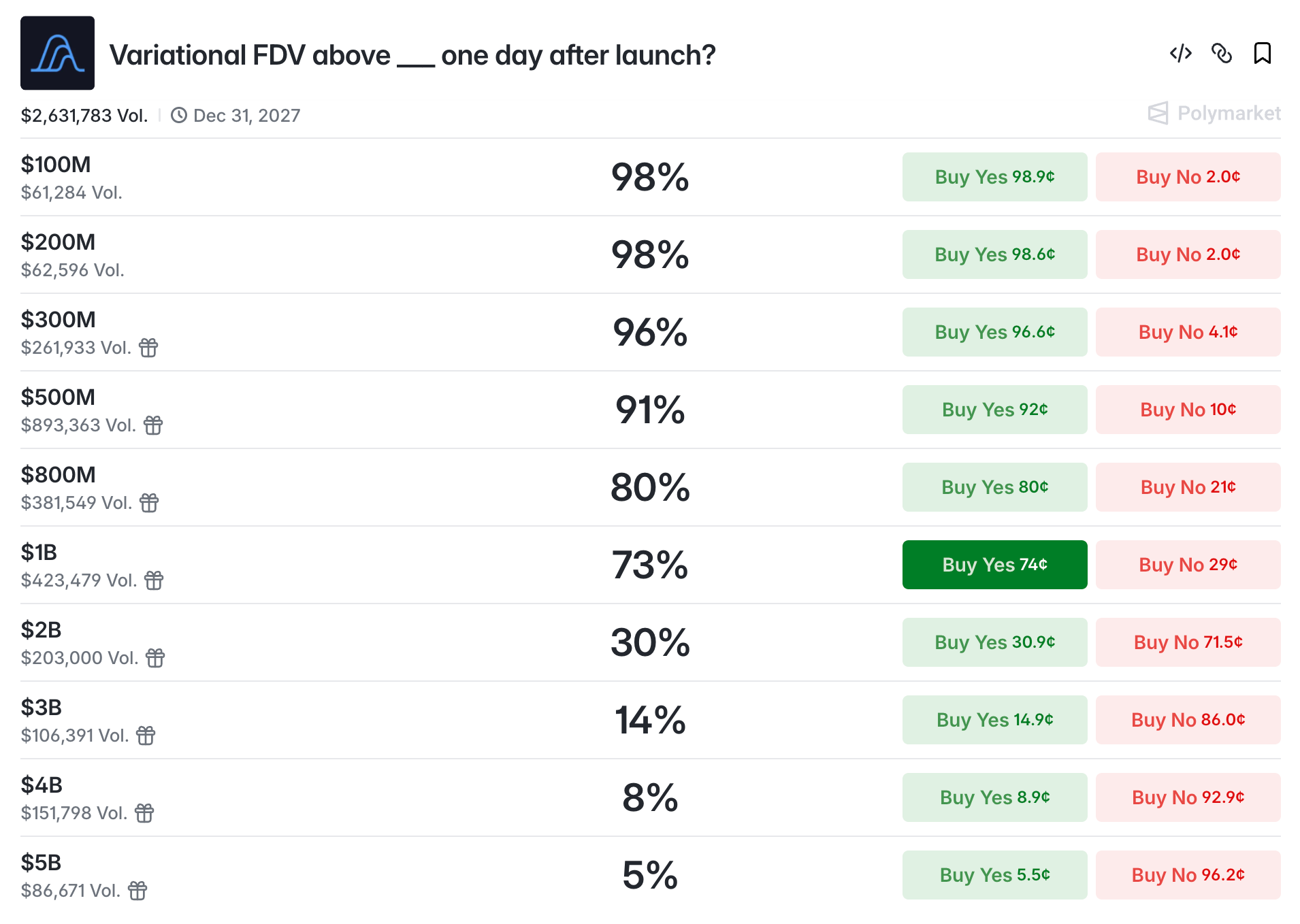
As of 11:35 AM Beijing time on September 24, the probability distribution of Variational valuations on Polymarket is as shown above. Through statistical modeling and weighted calculation of the probability distribution across each tier, we can use two valuation methods to condense the scattered market data into two core anchors.
If we adopt the Median FDV approach, we first need to find the watershed where cumulative probability crosses 50%, namely the "$1 billion - $2 billion" range. Observing the probability distribution on both sides of this range, we can see P(FDV > 1B) = 73%; P(FDV > 2B) = 30%; then using linear interpolation (which can be done by AI), Median = 1B + (73%-50%)/(73%-30%) * (2B-1B) = 1B + 23/43 * 1B ≈ 1B + 0.5349 B ≈ 1.53 B. In other words, the median valuation falls at approximately $1.53 billion.
If we adopt the Expected FDV approach — that is, multiplying the mutually exclusive probability of each range by the midpoint value of that range and accumulating the expected values — the market's weighted expected average falls at approximately $1.85 billion.
Taking both together, the core valuation range currently provided by the prediction market converges roughly between $1.53 billion and $1.85 billion.
How Much Is a Single Point Worth? The Key Is How Many Points There Are in the End
With the FDV range and the 32% airdrop ratio, we can further back-calculate the value of a single point.
According to the Variational Airdrop Simulator data on Dune, as of the end of Q3, the total supply of Variational points is estimated at approximately 9.15 million. However, since the official team has confirmed that the points program is extended until TGE and that 150,000 new points will still be added each week thereafter, the final total points supply will most likely be higher than this figure.
If the TGE occurs in the earlier part of Q4, the final total points supply may be around 9.3 million to 10 million; if it continues until the end of Q4, then at a distribution rate of 150,000 points per week, the final total points supply could approach 11 million.
On this basis, the theoretical airdrop value of a single point can be calculated with a simple formula: Value per point = Total supply × 32% ÷ Final total points × FDV. If calculated separately based on the two valuation anchors mentioned above (the $1.53 billion median FDV valuation and the $1.85 billion implied expected FDV valuation), the theoretical values under different total points supplies are as follows.
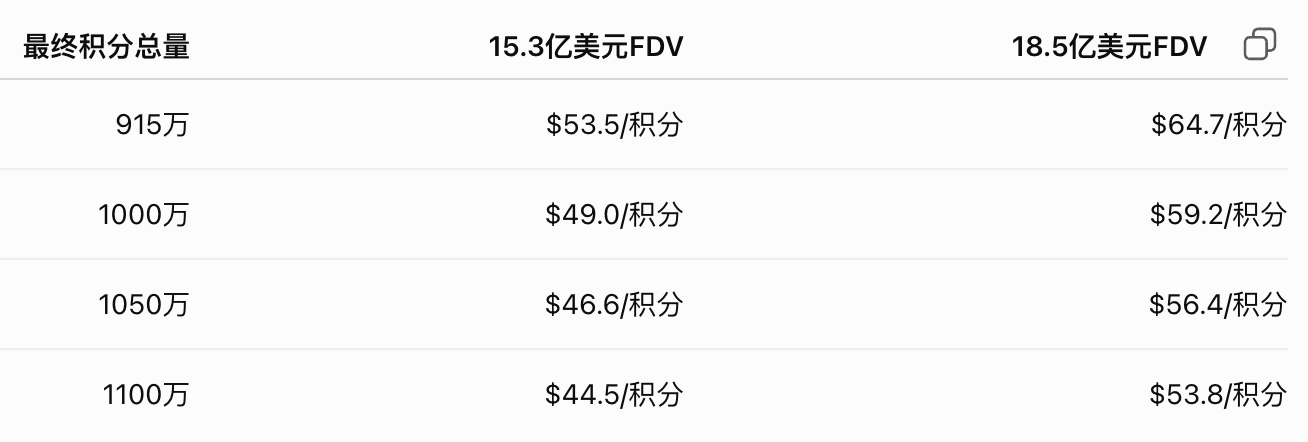
From this perspective, if the final total points supply falls between 10 million and 11 million, then based on the valuation currently provided by the prediction market, the theoretical value of a single point is approximately between $44.5 and $59.2.
Of course, the range here does not mean that once points go live they will necessarily correspond to a fixed price. First, what Polymarket provides is only the current market pricing; as TGE approaches and more information is disclosed, FDV expectations may still change. Second, the larger the total points supply, the more noticeably the fixed 32% airdrop pool is diluted.
In summary, for points holders, the two variables most worth watching next are actually: what FDV VAR can ultimately reach at launch, and how many points will ultimately be issued before TGE.