

Who Is to Blame for the Recent Crash: "Sell-the-Conference," All-American Fault, or Institutional Risk-Off?

Original | Odaily (@OdailyChina)
Author | Wenser (@wenser 2010)

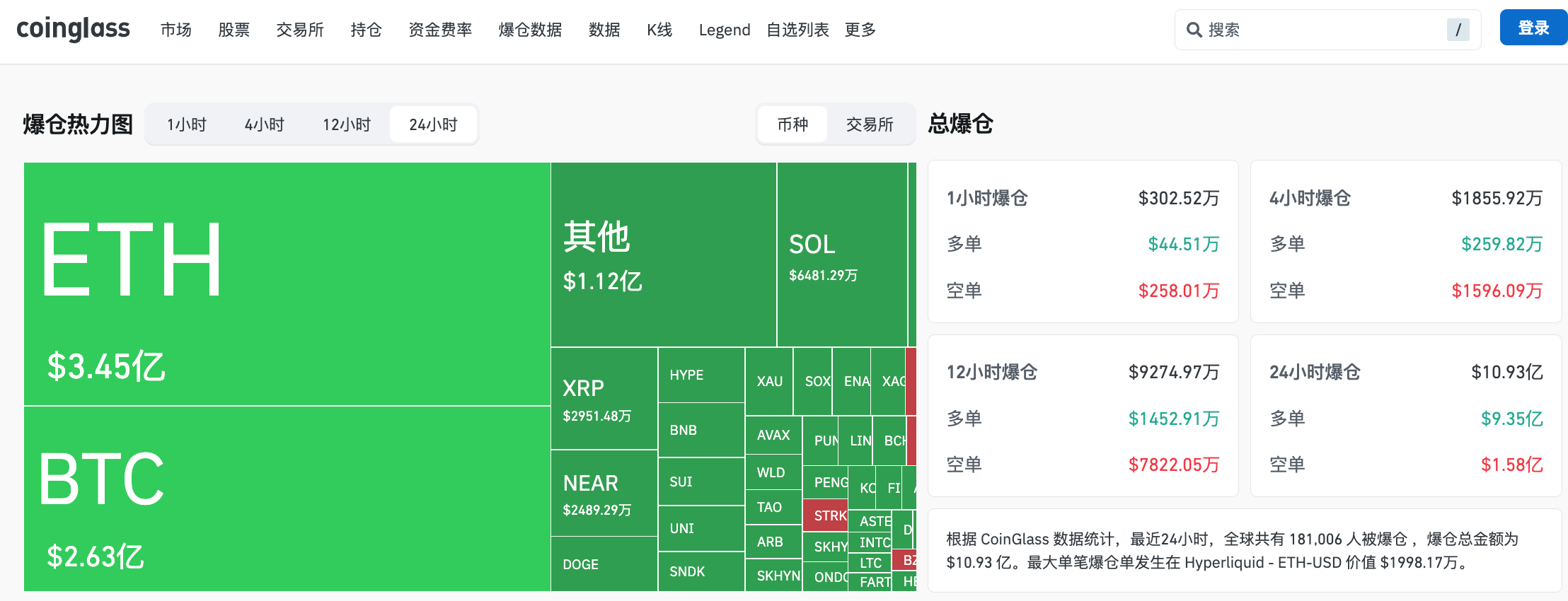
In the early hours of this morning, BTC briefly fell below $81,000 to $80,400, then rebounded above $82,000 and is currently trading around $82,500; ETH briefly dropped to around $2,400 and is now trading below $2,500. Over the past 24 hours, approximately 180,000 traders across the market were liquidated, with total liquidations approaching $1.1 billion, of which longs accounted for roughly $935 million.
Glassnode noted in a recent report that the average daily trading volume of exchange BTC spot and BTC ETF over the past 7 days was approximately $6.8 billion, lower than roughly 90% of periods since January 2024. In the 30 days ending October 5, the crypto market's realized market cap was approximately $12.8 billion, while combined purchases from ETFs, stablecoins, and corporate reserves amounted to only about $4.9 billion. The remainder came from existing market capital rotating chips at higher prices, indicating that the previous rally relied more on buyers taking over at higher prices.
On the other side, selling pressure has surged dramatically: the U.S. government, major mining pool players, short-term BTC holders, and others are all offloading in their own ways, triggering this sharp decline. However, from a medium-to-long-term perspective, the market is still expected to maintain its upward trend in Q4.
Recent Major Sellers: U.S. Government, Mining Pool Veteran, Short-Term BTC Holders
Looking at market data, the past 3 days of decline were likely driven primarily by selling from the following 3 major players:
U.S. Government: Transferred Over $1.54 Billion in BTC to Coinbase in the Past 3 Days, While BTC Fell 6.9%
According to Lookonchain monitoring, the U.S. government deposited 17,733 BTC worth $1.48 billion to Coinbase Prime over the past 3 days, along with 750 WBTC worth $62 million. During this period, BTC price fell 6.9%.
Although Coinbase Prime serves both custody and trading functions, the U.S. government's recent transfers are not necessarily all sales. Additionally, according to Galaxy Research on-chain tracking, the U.S. government currently holds approximately 319,100 BTC, about 71% of which comes from LuBian-related BTC and Bitfinex recovery funds; the BTC assets transferred this time are also believed to be seized assets of the U.S. government. Nevertheless, the U.S. government's transfer activity inevitably made the crypto market jittery, leading to a panic-driven sell-off. Below is the corresponding operation timeline chart.

Mining Pool Veteran Wang Chun: Sold Over $19.3 Million in WBTC During the Dip, Acquiring Over 7,848 ETH
According to on-chain analyst Yu Jin's monitoring, F2Pool co-founder Wang Chun's address (0xF42...2b51) sold 235.5 WBTC on-chain after BTC fell in the early morning, worth $19.31 million, and exchanged it for 7,848.5 ETH. The ETH price was $2,460, with an ETH/BTC exchange rate of 0.03.
Bitcoin Short-Term Holders: Panic Selling, Sell Pressure Hits Nearly 4-Month High
At around 10 PM last night, CryptoQuant analyst Darkfost posted that Bitcoin short-term holders (STH) showed clear signs of panic. Over the past 24 hours, short-term holders transferred more than 50,000 BTC to exchanges at their daily peak. Of that, over 29,500 BTC was transferred to exchanges at a loss, accounting for approximately 59% of all BTC inflows — the largest realized loss by short-term holders in nearly 4 months.
Although BTC price was stable around $82,000 at the time, it then plunged to around $80,500 overnight, demonstrating that short-term holder selling still has a lagging impact on the market.

Overall Market Trend: In a Price Recovery Phase, Long-Term Sell Pressure Sharply Reduced, Liquidation Bands at $81,700, $75,000, and $60,000
Despite considerable short-term selling pressure, from a medium-to-long-term perspective, BTC and the broader market remain in a price recovery phase, with long-term sell pressure significantly improved compared to before August.
First, whale selling momentum is tapering off.
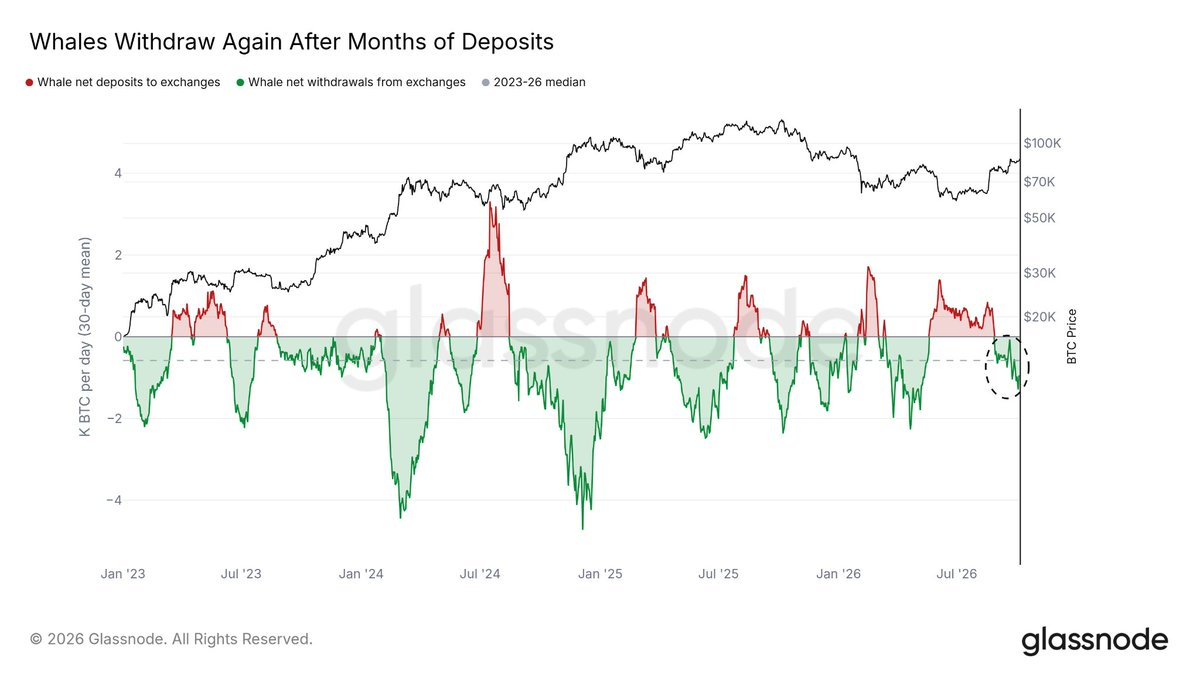
On October 5, Glassnode officially posted that the trend of BTC whales making net deposits to exchanges has stopped. This trend persisted for over three months since summer — twice as long as other similar trends since 2023 — and ended in late August, with capital flows remaining negative since then. In other words, BTC whales' selling spree has come to an end, and long-term holders continue to choose to side with time.
Second, BTC miners have stopped large-scale selling, and the source of sell pressure has notably weakened.
Yesterday, CryptoQuant posted that Bitcoin miners have recently stopped large-scale selling. Since Bitcoin hit a low of $76,000 on August 21 and miners' status shifted from "extremely underpaid" to "fairly paid," there have been no more extreme miner outflows.
CryptoQuant stated that miner sell pressure was once a significant supply source persistently weighing on Bitcoin prices during the 2026 bear market, and the disappearance of this steady selling pressure may help alleviate market supply pressure.
Third, BTC spot demand has notably improved, and the market has passed its risk extreme.
Yesterday, CryptoQuant analyst Darkfost posted that Bitcoin market demand has recently improved significantly, especially with spot demand continuing to recover. Total Bitcoin demand has returned to positive territory, exceeding 14,000 BTC, while futures demand remains relatively stable, recently averaging around 32,000 BTC. Spot demand is currently around negative 17,000 BTC — still in negative territory but a substantial improvement from negative 207,000 BTC on September 20.
In his view, the current situation where Bitcoin prices are declining while market demand is gradually recovering is a positive market signal.
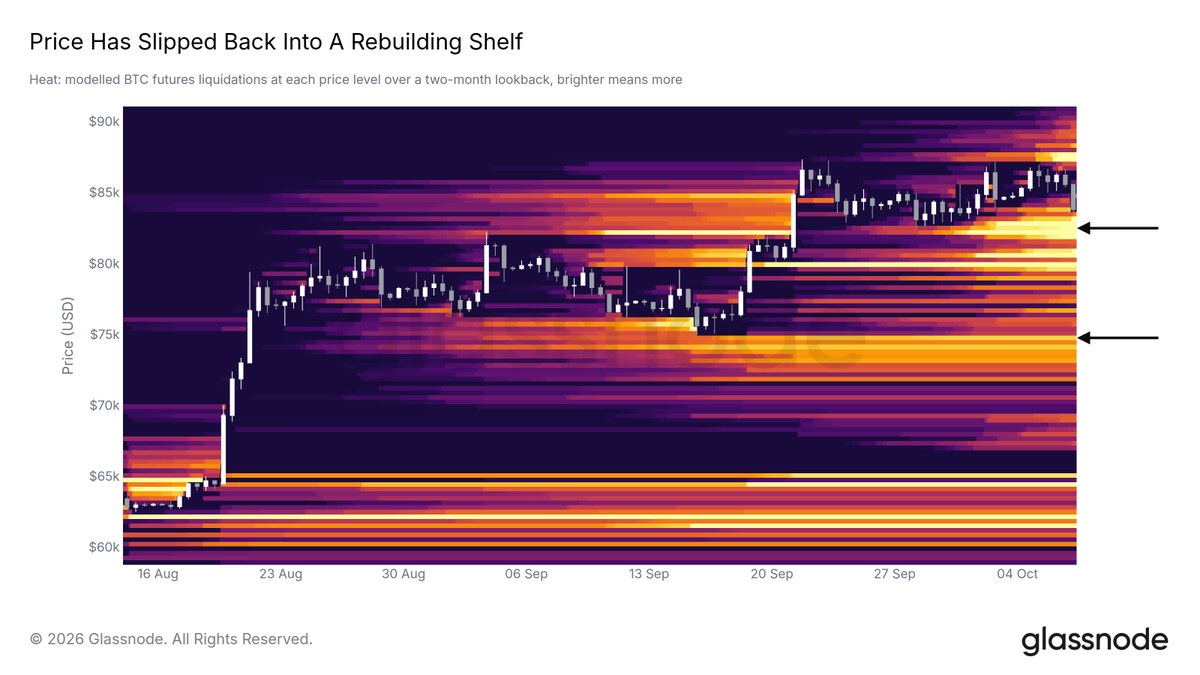
Finally, in a market report published on October 7, Glassnode noted that based on a two-month liquidation heatmap (used to simulate price levels at which leveraged futures positions would be forcibly liquidated), only about 17% of liquidation levels are above the current price, and support levels near BTC price expanded by about half within a week:
- The nearest large-scale liquidation band is positioned just below BTC price, between $81,700 and $83,300;
- The second liquidation level is around $75,000;
- The largest liquidation band is in the $60,000 to $63,000 range.
If BTC price falls further into these ranges, forced liquidation of long positions could further exacerbate the market decline.
Market Outlook: Bear Market Not Yet Over, Bull Market Blueprint Still Lacks Spot Confirmation, Traders Bullish on Q4
Regarding the market's future direction, representative views fall into the following 3 camps:
First, the cautious view from traditional asset management giants.
On October 7, Chris Kuiper, Vice President of Research at Fidelity Digital Assets, stated: "The bear market may not be over yet." He believes that the rebound since August could be either the starting point of a new rally or merely a bear market bounce — "price appreciation does not guarantee the bear market is over." Based on the four-year cycle, November is a key window to watch (the previous bear market bottom was in November 2022), but he also emphasized that historical cycles never repeat precisely. A more positive signal is that volatility was at low levels from June to mid-August before expanding rapidly, a pattern similar to the late stages of previous bear markets, potentially indicating that seller strength is nearing exhaustion, while stablecoin transfers, RWA, and institutional participation continue to grow.
Additionally, investment bank TD Cowen recently raised its Bitcoin price forecast, projecting BTC will reach approximately $109,000 by the end of 2026 and rise to $280,000 by 2029.
Second, crypto analysts believe the bull market blueprint still awaits spot indicator confirmation.
On October 6, crypto analyst Darkfost posted that the Bitcoin Bull Score Index remains in clearly bullish territory at 80/100, with multiple indicators continuing to support BTC's upward momentum.
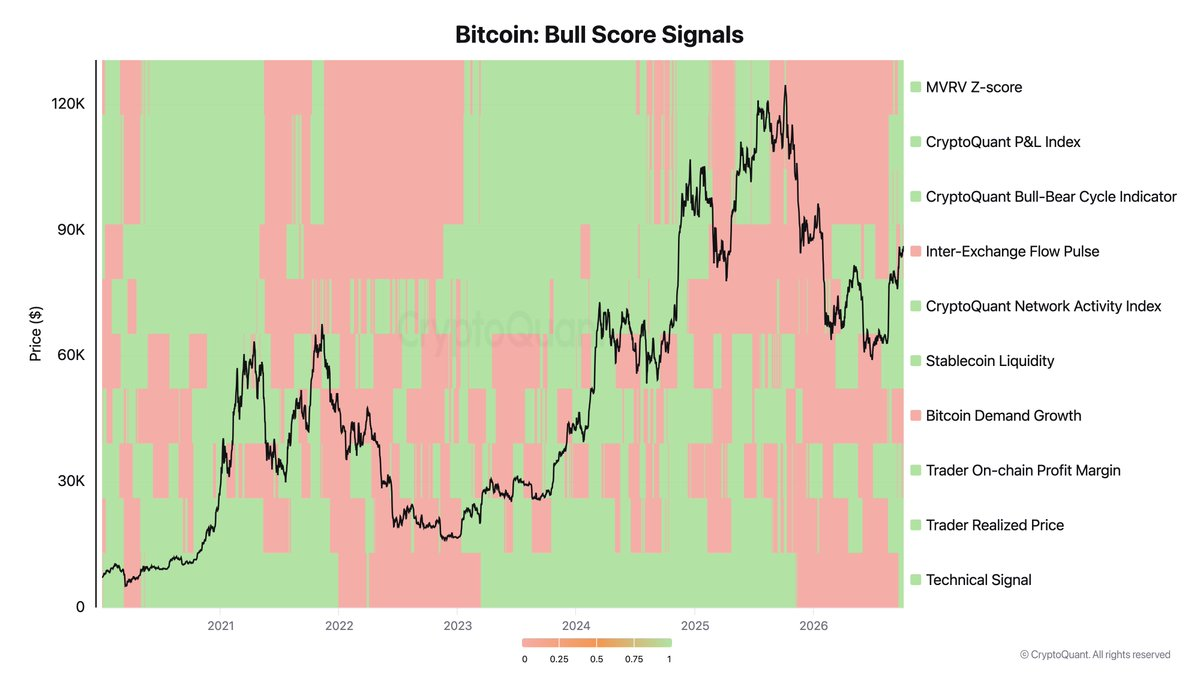
He pointed out that the only relatively lagging factor is spot demand. As previously observed, market spot trading volume remains low, so there is not yet明显的 spot buying demand at this stage. In his view, spot demand is the missing key factor in the current BTC market trend, and this component is typically the last to form.
Third, crypto traders are actively bullish on Q4.
In early October, well-known trader Ansem stated that BTC, ETH, and SOL have all recently held range highs, with relatively healthy price action. Although no large-scale liquidation event has occurred, most market participants remain in wrong positions, and further upside is expected. He also noted that October may see a pullback and open interest (OI) flush, but the market is still in an early bull phase — high-leverage chasing carries elevated risk, while high-conviction spot positions are relatively advantageous.
Crypto trader Killa also posted yesterday that Bitcoin once again failed to break above $87,000, and a 10x long position established on the expectation of a breakout after a second retest of the high was stopped out at breakeven. Due to the failed breakout and price returning to the entry level, he is now watching the $80,000 to $82,000 range and considering re-establishing a 10x long. He also said he still holds BTC longs at $62,600 and $76,400, sees no reason to rush into new long positions for now, but remains bullish and expects prices to move higher. The current market is low-timeframe consolidation, while he primarily trades high timeframes and emphasizes the importance of risk management.
Of course, where there are bulls, there are bears — the crypto market never lacks counterparties and traders who flexibly adjust direction.
"Set Ten Big Goals First": Will Begin Reducing Positions if BTC Falls Below $79,000, Will Close All Longs if Daily Close Breaks $78,000
Whale "Set Ten Big Goals First" posted today that recent macro headwinds including rising U.S. Treasury yields, strengthened rate hike expectations, and rising oil prices emerged in concentration, yet BTC only pulled back about 5%. Therefore, he believes the market is still in a relatively strong trend and does not think BTC will directly fall to $78,000 or $74,000 for now. However, he also mentioned having set stop-loss conditions: if BTC falls below $79,000, he will begin reducing positions; if the daily close breaks below $78,000, he will close all remaining long positions.
Yi Lihua: Leans Toward BTC Falling Below $79,000, Bull Market Watching for Pullback but Not Shorting
Yi Lihua also posted today that Bitcoin has lost the $82,000 level, with the next support at $79,000. However, given the pace of decline over the past two days, the current pullback is far from over, and he leans toward a break below $79,000, after which he will assess the $75,000 level.
He also stated that he has consistently maintained the view that BTC would pull back at the $86,000 level but has not shorted; because he believes this is still a bull market trend and the pullback is normal bull market fluctuation. He adheres to the principle of "watching for pullbacks in a bull market but not shorting," patiently waiting for the pullback to complete before buying the dip.