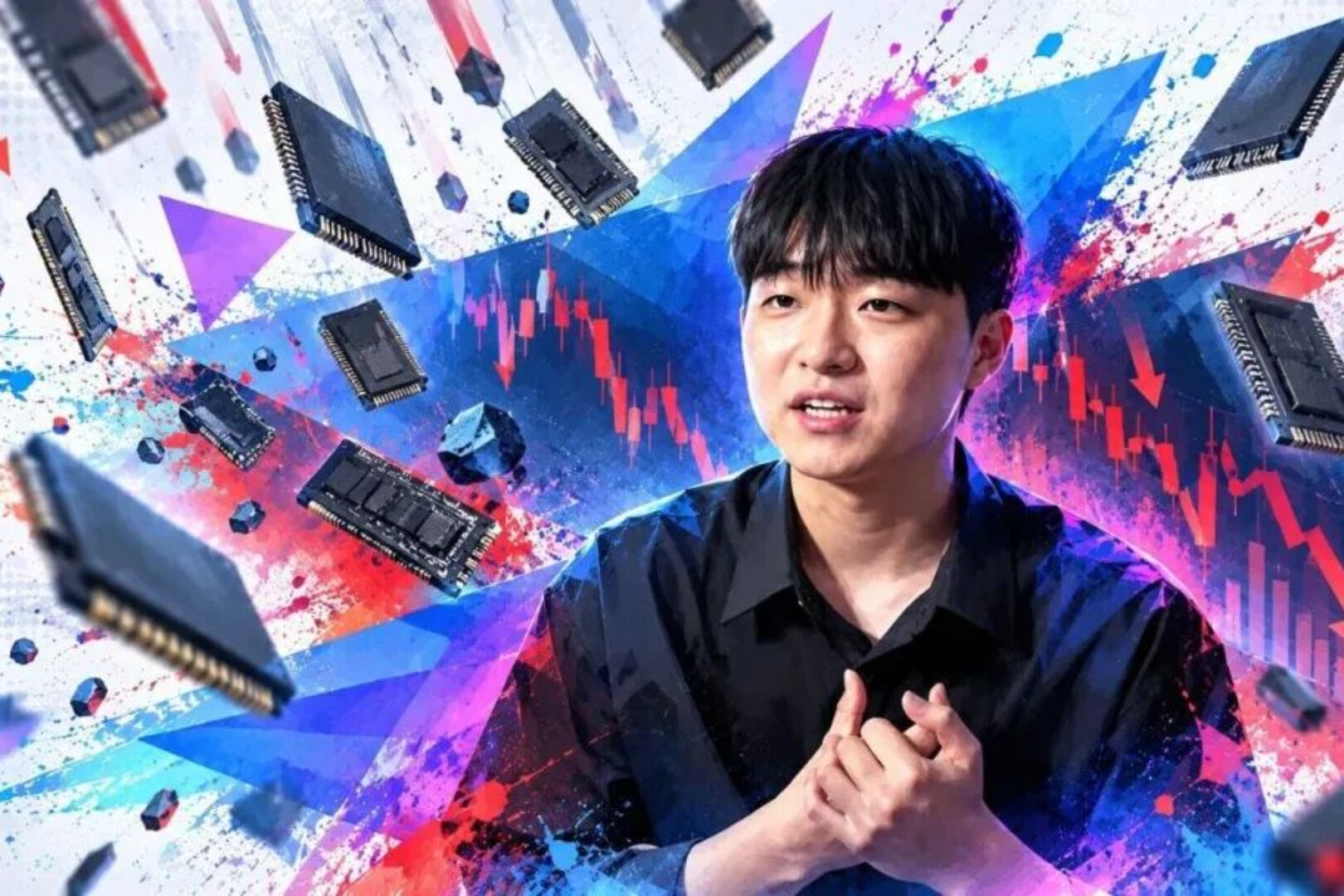
Storing "Deleveraging," Korean Retail Investors Grapple with "Liquidation Fear" Again

Original author: Su Yang
Original editor: Xu Qingyang
Original source: Tencent Technology
On October 12, the South Korean stock market suffered a sharp pullback. The Korea Composite Stock Price Index (KOSPI) closed down 3.65% at 6,384.25 points. The semiconductor sector underperformed, with Samsung Electronics closing down 4.39% at 250,500 won and SK Hynix falling 4.52% to 1,605,000 won. In the following trading session on October 13, Korean stocks continued to decline, with program selling briefly halted mid-session.
Looking back, since hitting a high of 9,385.59 points on June 22, the KOSPI had fallen nearly 32% over roughly four months.
This decline can be explained as a technical correction triggered by profit-taking at elevated levels. However, when shifting focus from this grand capital feast to the micro-level nodes of the AI industry chain, the pressure facing the market may extend beyond short-term capital flight.
This encompasses three layers of concern: first, whether the continued expansion of AI infrastructure investment can smoothly translate into actual revenue and profits; second, whether rising prices for upstream equipment and components are rewriting the investment return expectations for the chip industry chain; and third, whether the high revenue growth rates of frontier large-model labs can remain sustainable.
Once earnings expectations begin to loosen, adjustments to elevated valuations could reinforce foreign capital outflows. Combined with margin trading and leveraged funds amplifying market volatility during a downturn, this could easily trigger margin calls and forced deleveraging, once again sounding the "liquidation alarm" for retail investors.
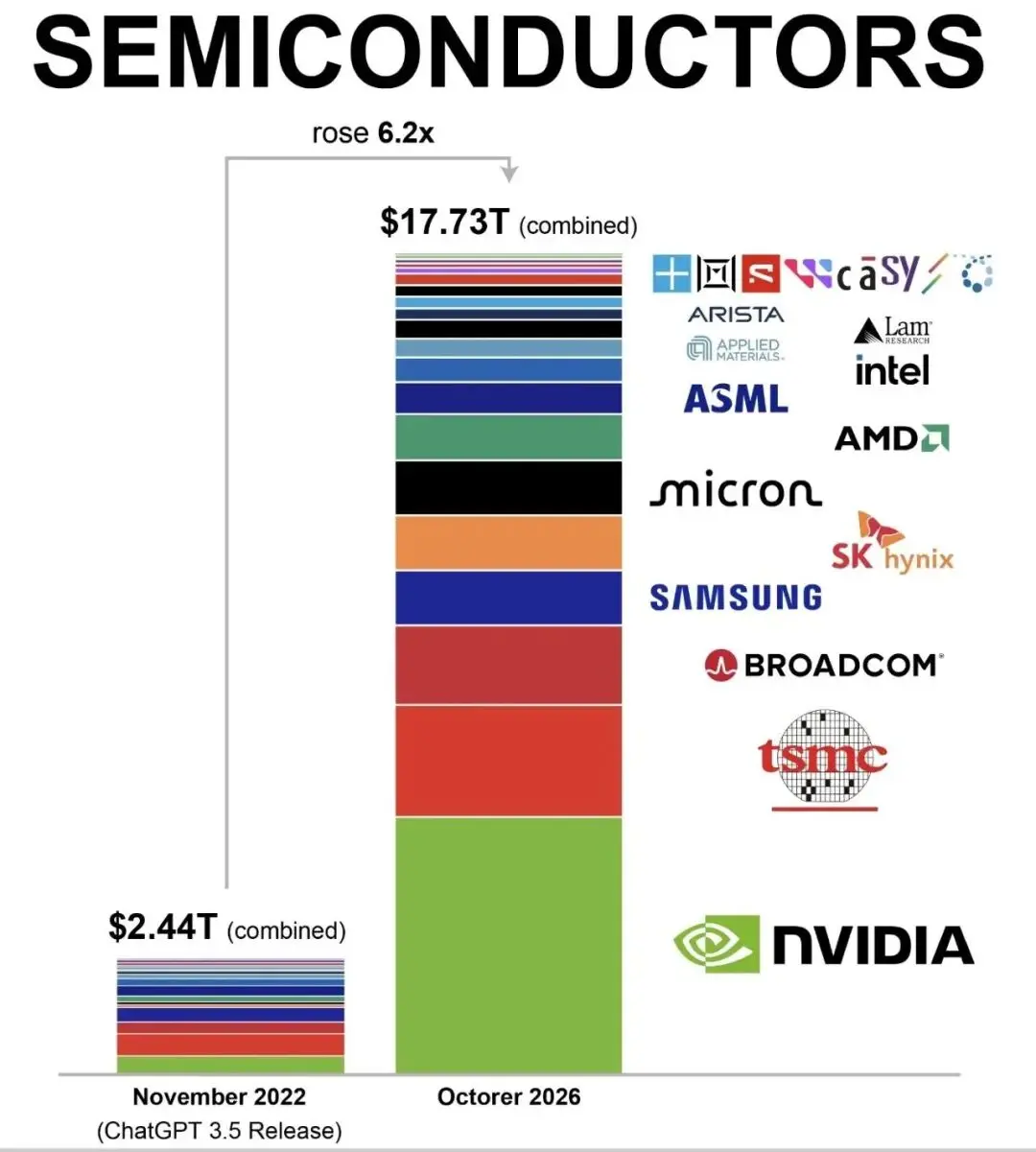
Since the release of ChatGPT 3.5, the total market capitalization of the global semiconductor and AI industry chain has surged 6.2 times, with the chip sector becoming the core winner of this AI super-cycle.
01 The Anxiety of "Peaking Cycle"
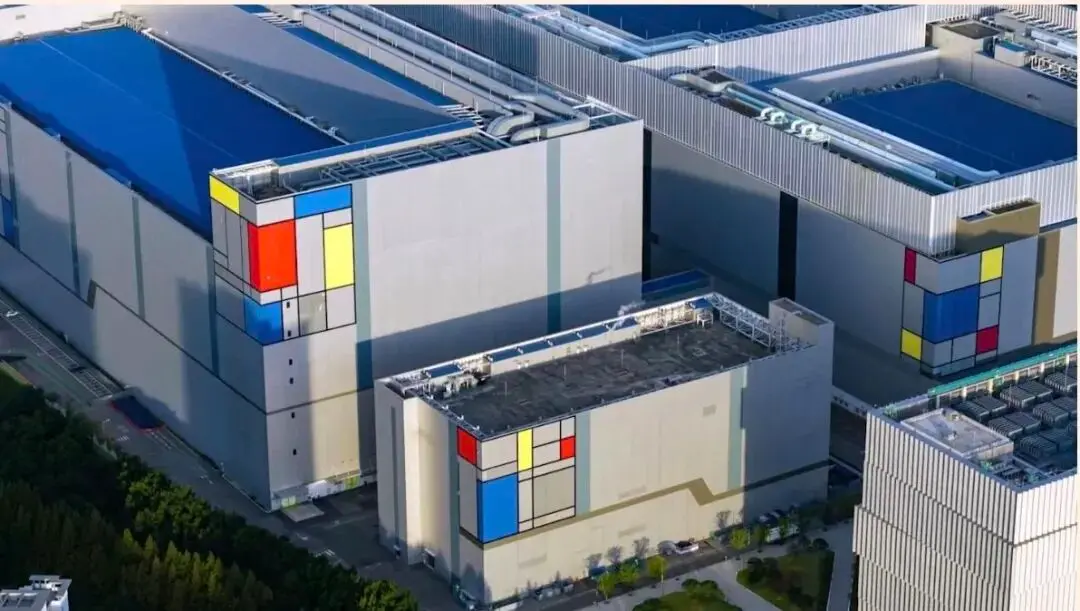
Samsung Electronics' chip factory in South Korea
The trigger for the recent weakness in Korean stocks and the memory sector was precisely a "stunning" earnings preview.
On October 8, Samsung Electronics released its latest third-quarter earnings guidance: consolidated sales for the quarter were approximately 195 trillion won (estimated range of 194 trillion to 196 trillion won), and consolidated operating profit was approximately 10.74 trillion won (estimated range of 10.73 trillion to 10.75 trillion won), representing significant year-over-year growth and landing at the upper end of analysts' prior expectations.
The strong results were mainly attributed to sustained robust demand for AI-driven HBM and DRAM. Samsung Electronics and SK Hynix jointly dominate the HBM and DRAM markets, fully enjoying the structural dividends brought by global AI infrastructure investment.
However, the market did not greet the news with the expected cheers.
Following the earnings preview, Samsung Electronics' stock price fell accordingly, dragging down the KOSPI index and semiconductor heavyweight stocks such as SK Hynix in tandem.
The reason investors reacted cautiously to record-breaking figures, or even chose to take profits at highs, lies in a reassessment of the sustainability of the memory boom cycle. Multiple institutional analyses indicate that third-quarter profit growth may have approached the cyclical peak, with quarter-over-quarter growth expected to slow to approximately 8% in the fourth quarter.
As the pace of memory price increases flattens and new industry capacity is gradually released, "whether the supply shortage can persist until 2028" has become the market's core question.
To put it plainly, what people used to fear was a memory shortage; now they worry about a memory glut.
This can also be seen as a kind of anxiety about "peaking cycle," given that memory is a highly cyclical industry.
02 The "Messy" Bill
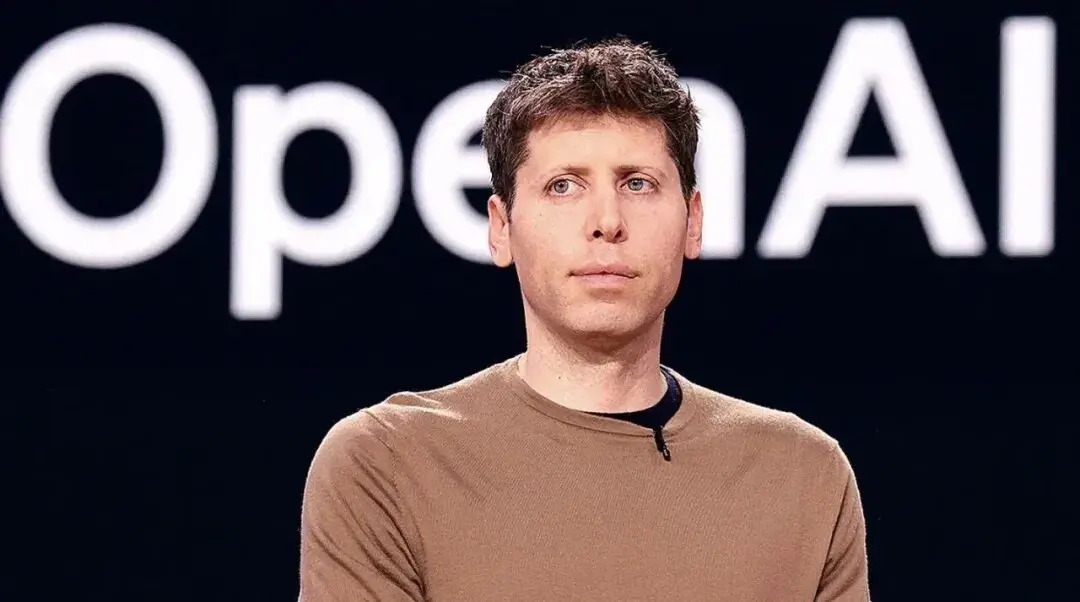
OpenAI CEO Sam Altman
The "messy" revenue calculation methodologies of frontier labs were also a key trigger for this pullback.
According to disclosures by the Financial Times and multiple financial media outlets, as of the end of September 2026, OpenAI's true annualized revenue was approximately $50 billion. This represents an expectation gap of about $20 billion compared to the $70 billion figure that had been circulating on Wall Street and in some media outlets in prior weeks.
In other words, the market had previously overestimated the revenue-generating capacity of frontier labs.
The key to this discrepancy lies in calculation methodology — peers like Anthropic count sales through cloud partners on a gross basis, while OpenAI only counts its own revenue, i.e., the net amount after deducting channel commissions. Some primary-market investors adjusted OpenAI's figures to seek a direct comparison between the two companies, thereby arriving at the $70 billion result.
After the news broke, on October 8 US Eastern Time, US semiconductor and cloud services stocks broadly declined: Nvidia closed down 2.94%; Oracle, which has computing power cooperation expectations with OpenAI, fell more than 6%, closing down 5.48%; Micron Technology closed down 4.79%, SanDisk closed down 4.90%, and CoreWeave closed down 7.77%. The Nasdaq Composite Index extended its decline to 1.25%.
Memory stocks, as a core link in the AI hardware chain, saw particularly pronounced sentiment transmission.
According to Financial Times reports, as of the end of September this year, OpenAI's annualized revenue was approximately $50 billion, far below the widely expected $68 billion. Similar situations exist at other AI companies.
On October 9, another person familiar with the matter told Bloomberg that OpenAI expects annualized revenue to still reach or exceed $70 billion by the end of this year, mainly driven by enterprise business growth. This "news" alleviated short-term panic to some extent, but the market has raised higher demands for the comparability of AI revenue narratives.
Analysts pointed out that this turbulence largely stemmed from information asymmetry.
OpenAI's revenue data as a private company is already sufficient to influence the stock prices of public companies such as Microsoft, Oracle, and Nvidia, indicating that it has become an important reference for global AI asset pricing. Brokerage surveys show no signs of cloud infrastructure vendors reducing capital expenditures at present.
In other words, the brief selloff in the secondary market looks more like profit-taking at highs and emotional stampeding rather than a comprehensive collapse of fundamentals.
Reports from institutions such as Morgan Stanley and Goldman Sachs still project that combined capital expenditures of global core cloud giants will reach $1.2 trillion to $1.4 trillion by 2027. There is a natural "sedimentation time lag" between the massive capital expenditures on AI hardware infrastructure and the monetization speed of upstream AI software applications.
Thus, some have concluded that the memory super-cycle is still intact, but the era of "buying with eyes closed" is over.
03 Valuation Discount and Massive Capital Expenditures
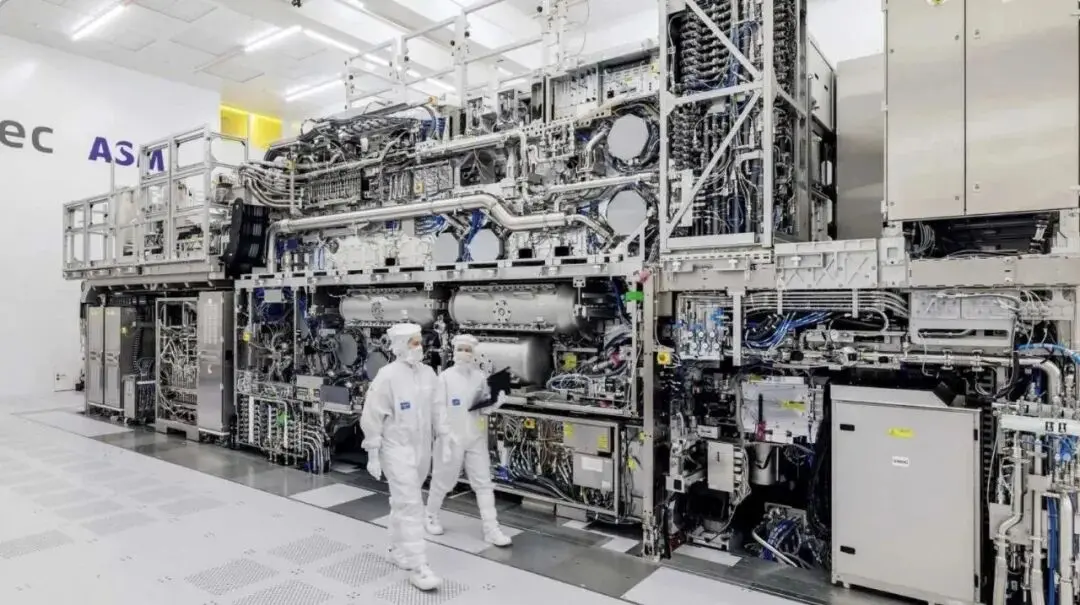
Despite short-term market sentiment pressure, strong demand for high-performance memory from AI infrastructure buildout still provides fundamental support for memory manufacturers. However, the beneficiary paths and potential challenges differ for the three major manufacturers.
Micron mainly benefits from HBM and server DRAM demand growth. SanDisk benefits from AI data center demand growth for enterprise SSDs. As an important player in the HBM market, SK Hynix enjoys strong demand visibility through its first-mover advantage and partnerships with leading customers.
However, robust AI demand is only the starting point for growth; converting demand into sustained profits and cash flow is what matters.
As earnings season approaches, memory manufacturers' capital expenditures, advanced process investments, and advanced packaging capacity expansion plans will also become important indicators for assessing the demand outlook for upstream semiconductor equipment.
Bearish voices and market concerns are equally evident, focusing on extremely high capital expenditure pressure and upstream cost squeeze — in order to compete for dominance in the HBM3e and next-generation HBM4 markets, memory giants have become locked in the most intense equipment and capacity arms race in semiconductor history.
Samsung Electronics has committed to investing more than 110 trillion won (approximately $82.6 billion) in capital expenditures and R&D in 2026, setting a record for the company's annual budget; SK Hynix is fully expanding its Cheongju M15X facility dedicated to HBM4 and has spent $3.87 billion to establish an advanced packaging base in Indiana, USA.
Industry data shows that to meet the squeeze demand for HBM, by the end of 2026, as much as 25% of global memory giants' DRAM wafer capacity will be forcibly locked for HBM production. Massive capital expenditures significantly increase companies' subsequent equipment depreciation and amortization costs.
More critically, cost pressure from the upstream supply chain is further eroding profit expectations.
Previously, lithography giant ASML explicitly notified that starting January 2027, it will uniformly raise prices for EUV and DUV lithography replacement parts supplied to Samsung Electronics and SK Hynix by 10%. Meanwhile, price increase plans for lithography machines themselves are also imminent.
Against this backdrop, SK Hynix's current forward P/E ratio is only 6.96x, notably below the semiconductor industry average. On the surface, a valuation discount exists, but whether the discount is justified largely depends on whether the company can maintain the quality and sustainability of future profits under the dual pressure of massive capital expenditures and rising operating expenses.
04 Retail Investors in the Grip of Liquidation Fear

The risks of high-leverage trading among Korean retail investors had already sounded alarms as early as this summer.
Lee Seung-ho, a 24-year-old Seoul university student previously reported on by Reuters, became the most vivid early warning and typical epitome of this leverage risk.
Lee Seung-ho, a Seoul university student who suffered losses and liquidation
Reuters reported that Lee Seung-ho had saved 20 million won and engaged in 5x leveraged trading through a trading app, with his account assets at one point surging to 300 million won (approximately 1.55 million RMB). But as market volatility intensified in May, margin calls and forced liquidations followed one after another, and he lost all his gains and principal within just four weeks.
In the report, he described his physical and mental state at the time as "literally unable to breathe."
However, the risks accumulated from high-leverage trading were not promptly unwound, but instead spread and persisted to the present as single-stock leveraged products gained popularity among retail investors.
On October 12, the Korean stock market suffered a devastating blow, and this long-suppressed panic and anxiety erupted en masse on social platforms. After the close, Korean investors flooded social platform X with expressions of confusion and discontent.
Some retail investors compared the Korean stock market's trajectory with those of US and Japanese stocks, questioning why the Korean market continued to face pressure. Others pointed to sustained foreign capital outflows, arguing that the Korean stock market failed to fully benefit when global markets rose but bore greater pressure during corrections.
These posts reflected retail investors' strong dissatisfaction with market performance, but behind the emotions lie more noteworthy capital movements.
According to recent trading data, on October 12, foreign investors net sold nearly 2 trillion won of Korean stocks in a single day, with cumulative net selling over the past month reaching 29.7 trillion won (approximately 156 billion RMB). If the relevant statistics are confirmed, this means foreign capital withdrawal from Korean stocks has become an important source of pressure in this round of market adjustment.
If foreign capital outflows explain why the market is under pressure, leveraged trading is related to why the decline could be further amplified.
Controversy surrounding Korean single-stock leveraged ETFs has recently been intensifying in investor communities.
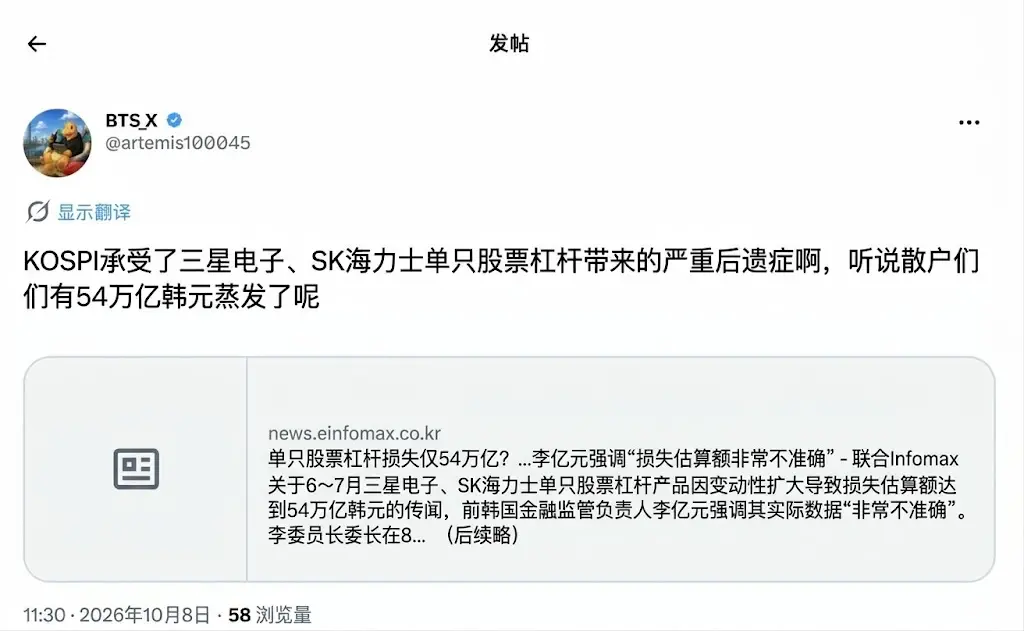
Some posts cited related estimates claiming that retail investors' asset losses in single-stock leveraged products reached 54 trillion won (approximately 283.5 billion RMB). This figure reflects the enormous destructive power of high-risk derivatives during market volatility, but has also sparked considerable discussion about its statistical methodology and calculation samples.
Leveraged products significantly amplify stock price volatility.
When the market declines, shrinking positions may trigger margin calls, forcing investors to liquidate passively and intensifying downward pressure. Whether the daily rebalancing mechanism of single-stock leveraged ETFs amplifies selling pressure on underlying stocks on specific trading days requires case-by-case analysis based on product structure and actual capital flows, and cannot be generalized.
From Lee Seung-ho's liquidation and zeroing out in July to the exclamations on social platforms about 54 trillion won in massive losses, the extreme fragility of high-leverage trading when the market reverses has been exposed.
Therefore, this adjustment in the Korean stock market reflects both investors' reassessment of AI industry growth prospects and the vulnerability of high-leverage trading when the market reverses — when stock prices no longer rise continuously, the return advantage brought by leverage can quickly transform into risk.
For some retail investors, what is cruel is not a temporary loss, but being forced to exit before a market rebound due to insufficient funds.
Former OpenAI researcher Leopold Aschenbrenner, hailed as "Wall Street's AI stock prodigy" at just 25 years old, serves as a typical example — his "tragedy" of being liquidated on 4x leverage at the end of July, just before the eve of a tech stock rebound.