AI trading logic shifts, global chip stocks tumble

Original author: Li Dan
Original source: Wallstreetcn
On Tuesday, October 13, the AI chip stock selloff continued to spread, with the global semiconductor sector suffering broad losses from South Korea and Japan to the United States.
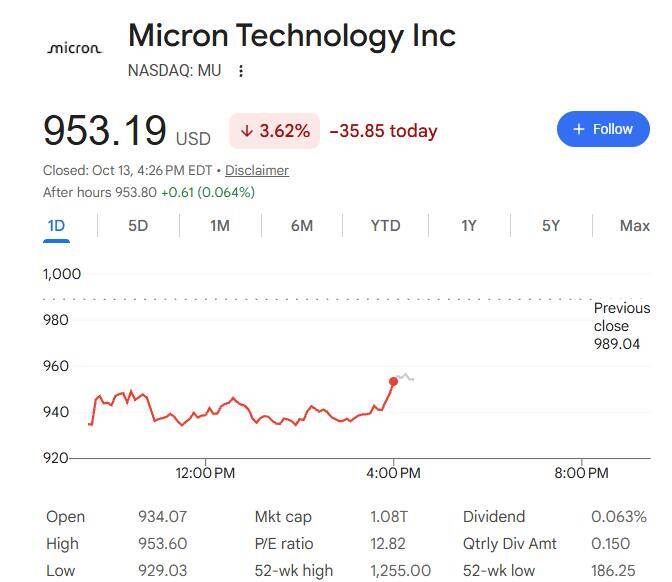
South Korea's KOSPI closed down 5.5%, and Japanese memory chip maker Kioxia fell more than 10%. During U.S. trading, the Philadelphia Semiconductor Index (SOX) fell more than 3% at one point, Micron Technology (MU) dropped over 6% intraday, and SanDisk (SNDK), Seagate Technology (STX), and Western Digital (WDC) also tumbled, each falling at least nearly 6% when hitting intraday lows.
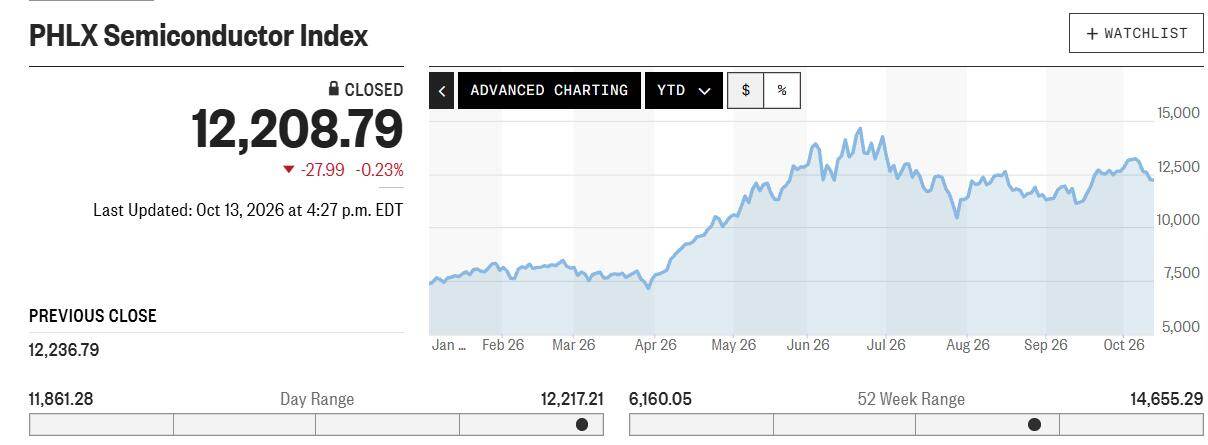
By midday, the decline in U.S. chip stocks moderated. At the close, the Philadelphia Semiconductor Index was down about 0.2%, Micron fell about 3.6%, Western Digital dropped about 1.6%, Seagate Technology declined 0.8%, and SanDisk fell about 0.3%.
This selloff was not driven by a single factor. Reuters analysis noted that after nearly four years of an AI infrastructure investment boom, market sentiment is shifting: rising interest rates, heightened bond market volatility, escalating AI financing costs, and whether massive capital expenditures can translate into actual returns are all coming under stricter scrutiny.
Last week, Nvidia-backed data center operator Firmus shelved a planned $5 billion IPO in Australia; meanwhile, Chinese memory chip maker ChangXin Technology disclosed progress on its 4F² DRAM architecture R&D, further triggering market concerns about the competitive landscape of the memory industry.
ChangXin's technological progress may have served as the direct catalyst for this round of memory stock selling, but the deeper shift is that investors are moving from chasing AI growth to scrutinizing capital returns.
Wall Street insiders noted that among AI-related stocks that have posted significant gains this year, memory chip stocks are particularly vulnerable to profit-taking; and with crowded trades and elevated valuations, new competitive signals are enough to trigger concentrated selling. However, some analysts believe that ChangXin still has a considerable gap to close before achieving large-scale mass production, especially in advanced areas such as high-bandwidth memory (HBM), and is not yet capable of posing an immediate major threat to South Korean manufacturers.
The AI Trade Logic Is Changing: From Chasing Growth to Questioning Returns
Since OpenAI launched ChatGPT, capital has continuously flowed into semiconductor companies, data center operators, telecom infrastructure firms, and other companies benefiting from AI computing buildout. This investment boom has driven chip stocks sharply higher and also fueled expanding capital expenditures in data center construction, servers, and other infrastructure.
But now, cracks in these trades are spreading across different markets. Reuters noted that signs of correction in related assets appeared as early as June and have recently extended to the primary market and credit markets. Last week, Nvidia-backed data center operator Firmus shelved a planned $5 billion IPO in Australia due to weakened investor interest, highlighting that capital markets are becoming stricter in assessing risks for AI infrastructure projects.
The bond market is also sending cautious signals. As AI-related financing demand increases, investors are paying more attention to corporate financing costs and debt-servicing capacity. Tencent Holdings issued dollar bonds and dim sum bonds in Hong Kong on Tuesday, with the issuance guidance yield on its 10-year dollar bonds about 1.15 percentage points higher than the then-current U.S. Treasury yield. Japanese tech investment company SoftBank issued $4.5 billion in high-yield bonds last month with a seven-and-a-half-year maturity, promising interest payments of up to 9.75%.
Interest rates and bond volatility have become important drivers of market repricing. Damien Boey, portfolio strategist at Sydney-based Wilson Asset Management, said the key change is not just rising bond yields but also heightened bond market volatility, which is gradually transmitting to the pricing of various assets. He believes the AI capital expenditure boom may cool somewhat, and some participants could be hit as a result.
BlackRock's research division downgraded its outlook on U.S. equities to "neutral" on Monday, citing potential market volatility from AI infrastructure buildout, and shifted to favoring short-term U.S. Treasuries. The International Monetary Fund (IMF) also warned on Tuesday that the impact of an AI market correction could ripple globally. Although AI investment is expected to drive economic growth, uncertainty remains over whether related investments can generate returns in line with expectations.
This means the market's focus is shifting: previously, investors mainly bet on continued growth in computing demand and related companies expanding capital expenditures; now, capital costs, financing sustainability, and return on investment are becoming important variables affecting valuations.
From Japan and South Korea to the U.S., Chip Stocks Face Cross-Market Selling
Tuesday's decline in Asian markets extended to the United States. South Korea's KOSPI fell more than 6% intraday at one point, marking a fifth consecutive trading day of declines; Tokyo-listed memory chip maker Kioxia closed down more than 13%; South Korean stocks Samsung Electronics and SK Hynix closed down more than 7% and 10%, respectively.
U.S. chip stocks also came under pressure. The Philadelphia Semiconductor Index (SOX) closed down about 2.7% on Monday and probed lower again on Tuesday, falling more than 3% intraday when hitting a fresh daily low in morning trading, on track for a fifth consecutive losing session—its longest losing streak in nearly 17 months.
Memory and data storage-related stocks posted particularly sharp declines. Micron Technology (MU) fell more than 6% intraday; when hitting intraday lows, Seagate Technology (STX) dropped nearly 8%, Western Digital (WDC) fell more than 7%, SK Hynix's U.S. shares (SKHY) declined more than 6%, and SanDisk (SNDK) fell nearly 6%.
What makes this correction notable is that these stocks had already accumulated substantial gains. As of Monday's close, the Philadelphia Semiconductor Index was still up about 72.8% year-to-date, and Micron's stock had risen more than 240% this year. The previous strong rally has made investors more sensitive to valuations, position concentration, and potential competitive risks.
From South Korean memory giants to U.S. chip stocks, the broadening scope of the selloff also shows that market concerns are no longer limited to any single company's technological progress. Investors are re-examining the valuation basis of the entire AI hardware supply chain and whether continuously increasing capital investment can generate sufficient profits and cash flow.
ChangXin's Technological Breakthrough Sparks Concerns; Wall Street Says Investors Are Taking Profits
ChangXin Technology's 4F² DRAM architecture R&D progress provided a new catalyst for this round of memory stock correction.
According to Shanghai Securities News, ChangXin Technology President Cao Kanyu introduced the company's technological exploration in DRAM devices, 4F² architecture, and hybrid bonding at the 4th Integrated Chips and Chiplets Conference held from October 9 to 10, and announced that it expects to launch a new-generation DDR5 RDIMM server memory product integrating related technologies by the end of this year.
Currently, mainstream memory cells in the DRAM industry use a 6F² architecture. ChangXin's 4F² architecture changes the memory array layout through its self-developed VSG (Vertical Surrounding Gate) transistor to enhance gate control, improve leakage issues, and reduce memory cell area, thereby increasing memory density. If this direction can achieve stable mass production, it will provide a new technological foundation for Chinese manufacturers to further enter the server memory market.
However, the market has no consensus on how much ChangXin's progress will actually impact existing memory giants.
Robert Pavlik, senior portfolio manager at Dakota Wealth, described this round of trading as a profit-taking wave. He said that when investors realize potential competition may be coming, market participants may rush for the exits simultaneously. This metaphor reflects that in crowded sectors, even if a new competitive threat has not yet translated into actual market share changes, it can quickly trigger concentrated position reduction.
Media analysis, meanwhile, emphasized that ChangXin's technological progress is indeed significant, but it should not be directly equated with an immediate threat to existing manufacturers.
Phillip Wool, chief market strategist at Rayliant Global Advisors, believes ChangXin's technological progress is an important moment for China's chip industry, but the scale of Tuesday's overseas chip stock selloff may be disproportionate to its near-term actual threat. He noted that ChangXin has not yet proven it can achieve large-scale mass production, and its market share is far below that of Samsung Electronics and SK Hynix. More importantly, the current discussion mainly concerns conventional DRAM architecture rather than HBM; for the foreseeable future, South Korean manufacturers still hold a clear advantage in HBM.
Vey-Sern Ling, senior equity advisor at UBS, also said investors are looking for reasons to take profits, especially for AI-related stocks and memory stocks that have performed strongly this year. Chinese manufacturers still have a considerable way to go in advanced areas such as HBM.
These two viewpoints are not contradictory: ChangXin's technological progress may change investors' expectations for future competition, but it does not mean it is already capable of fully challenging international memory giants. For memory stocks that had previously posted massive gains, changes in competitive expectations may become a reason to trigger position reduction, rather than conclusive evidence that current earnings fundamentals have already reversed.
Musk also commented on China's memory chip industry development on a social platform Monday. He said that once China masters the manufacturing method for a certain product, its large-scale production capacity often has the potential to surpass the rest of the world, citing lithium batteries and the solar industry as examples. He also said China appears to be rapidly mastering general memory specifications such as LP5 and LP6.
However, progress in technological R&D, product launch, passing customer validation, and achieving large-scale mass production are different stages. ChangXin's progress has strengthened market attention on intensifying competition, but existing disclosures are not yet sufficient to prove that it has formed commercial competitiveness in the high-end server memory market sufficient to change the industry landscape.
Capital Costs and AI Investment Returns Become the Market's New Test
The correction in chip stocks is only part of a broader shift. As AI infrastructure buildout continues to consume capital, the market is paying increasing attention to related companies' financing costs, investment scale, and future cash flows.
Broadcom CEO Hock Tan said Monday at a related event in Singapore that capital could become one of the biggest factors constraining AI industry growth. This statement highlights the real problem facing the AI investment boom: even if computing demand remains strong, capital supply and funding costs may also limit the pace of buildout.
At the same time, investors also need to judge whether AI infrastructure spending can continue to translate into revenue and profits. Data centers, chips, and power infrastructure require long-term investment, and whether related returns can be realized in a timely manner will affect companies' financing capacity, cash flow, and valuations.
The IMF also warned in its latest report on Tuesday that the economic returns from AI-related investment may fall short of some market participants' expectations. If investment continues to expand but actual profits and productivity gains fail to keep pace, repricing of related assets could intensify further.
Therefore, this round of chip stock declines reflects not only competition concerns in the memory industry but also the entire AI trade's growing sensitivity to capital costs and rates of return.
The AI Rally Is Not Over, but the Market Is Starting to Examine Who Can Actually Deliver Returns
Despite the consecutive selloff in chip stocks, the market has not broadly concluded that the AI investment cycle has ended. After releasing a new AI model on Monday, Meta's stock rose about 3.4% against the trend, showing that investors' judgments on specific technological progress and product competitiveness are not fully synchronized with the entire semiconductor sector.
Marc Velan, head of investment at Singapore-based asset management firm Lucerne Asset Management, believes the massive swing in South Korean stocks reflects more of a position adjustment and capital cost issue rather than a deterioration in AI demand fundamentals. He judges that the AI cycle may be entering its next phase, where investors will increasingly focus on commercialization capability and return on invested capital rather than simply betting on infrastructure expansion.
This also explains why the current chip stock selloff cannot be simply equated with a collapse in AI demand. Whether AI computing demand continues to grow, whether infrastructure investment can earn reasonable returns, and whether competition in the memory industry will compress profit margins are related but distinct questions.
For the market, the key going forward is not just how much more money AI companies will invest, but whether those investments can translate into revenue, profits, and cash flow. Shelved star IPOs, rising financing costs, heightened bond volatility, and changes in competitive expectations brought by ChangXin's technological progress together form the backdrop for this shift in trading logic.
The AI investment boom may not be over, but the phase of simply relying on growth expectations to drive valuations higher is facing stricter scrutiny. As rising capital costs, changing competitive dynamics, and uncertainty over commercial returns all enter the pricing, the correction in global chip stocks may be a signal that the market is reweighing the risks and rewards of AI investment.