Dalio Warns: US Treasury Bear Market 'Far From Over,' Supply-Demand Imbalance Risks Continue to Accumulate

Original Author: Li Dan
Original Source: Wallstreetcn
Ray Dalio, co-founder of hedge fund giant Bridgewater Associates, has once again issued a warning about U.S. Treasuries: the Treasury sell-off is far from bottoming out, and the structural imbalance between supply and demand is pushing U.S. Treasuries toward a historic-level debt crisis.
In a post on LinkedIn on Tuesday, October 13 (U.S. Eastern Time), Dalio said the United States is entering a vicious cycle in which debt expansion and shrinking demand reinforce each other—rising interest rates drive up borrowing costs, which in turn inflate the scale of debt, and this spiral will continue until "the economy and financial markets are sufficiently stressed and supply and demand return to balance." He wrote: "The bear market in bonds (in the U.S.) may have a long way to go."
Dalio's remarks stand in stark contrast to the positions of institutions such as BlackRock and Morgan Stanley Investment Management. The latter have turned bullish after the 10-year U.S. Treasury yield surged to its highest level since 2002 earlier this month, approaching 5.4%. According to reports, a Bloomberg index tracking U.S. Treasuries has fallen about 2.4% year-to-date, and U.S. Treasury prices are on track for their first annual decline since 2022.
U.S. Government Debt Rises to Highest Level Since World War II
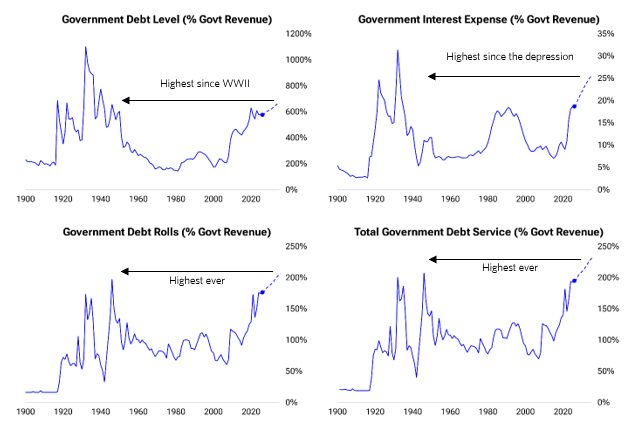
Dalio supports his assessment with extensive data in the article. He estimates that, measured by the ratio of total borrowing scale and debt servicing costs relative to government revenue, the current U.S. government debt burden has risen to its highest level since World War II and is expected to continue deteriorating in the years ahead.
As of the end of September 2026, marketable U.S. Treasury securities outstanding totaled approximately $32 trillion, up 8% from a year earlier. The U.S. Treasury has issued approximately $1.5 trillion in net new debt year-to-date, with full-year net issuance expected to reach $2.1 trillion. At the same time, the Treasury must roll over approximately $10 trillion in maturing debt.
Dalio warns that even a slight decline in investors' willingness to reinvest could create a massive financing gap.
In terms of debt structure, the U.S. Treasury is increasingly turning to short-term bill issuance to ease the supply-demand imbalance in longer-dated bonds. Short-term bills currently account for approximately 50% of total issuance, far above the historical norm of 20%—a ratio typically seen only during economic recessions.
Dalio points out that while shortening the maturity profile of issuance helps temporarily reduce interest expenses, it also significantly increases rollover risk and makes debt servicing costs even more elevated during interest rate hiking cycles.
Overseas Demand for U.S. Treasuries Shifts, with China and Japan Particularly Critical
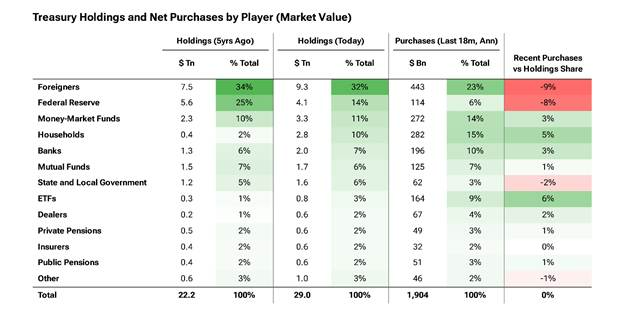
Dalio views shrinking foreign demand as one of the core factors weighing on the U.S. Treasury market. He notes that overseas investors currently hold approximately $9.3 trillion in U.S. Treasuries, making them the largest single holder group, accounting for about 32% of U.S. Treasuries, but their pace of purchases is slowing while supply continues to climb.
Among major overseas holders of U.S. Treasuries, developments in Japan and China warrant the most attention. Dalio says Japan holds approximately $1.1 trillion in U.S. Treasuries, of which about $600 billion is government reserves and about $230 billion is held by the Government Pension Investment Fund (GPIF).
He believes Japanese policymakers have strong incentives to guide domestic institutions to reduce U.S. Treasury holdings and repatriate funds to support the yen and stabilize the Japanese government bond market. Rising JGB yields would further reinforce this trend, and the unwinding of related yen carry trades could also cause severe market shocks.
Regarding China, Dalio says official U.S. statistics significantly understate China's actual holdings. He roughly estimates that Chinese companies and individuals hold approximately $1 trillion in U.S. Treasuries, while Chinese reserves hold another approximately $2 trillion, bringing China's total U.S. financial assets to potentially $4 trillion. As the renminbi appreciates, China's dollar-denominated assets face exchange losses, increasing the incentive to reduce holdings.
He warns that if just 10% of private dollar holdings were hedged or converted, it would trigger approximately $400 billion in dollar selling—enough to have a significant impact on currency and credit markets.
Dalio wrote: "Taken together, the expected changes in new debt supply and demand have long made—and still make—shorting U.S. Treasuries easier than going long."
Corporate Bonds and AI Financing Wave Intensify Competition for Capital
Dalio points out that the Treasury is not raising funds in isolation but competing alongside all other borrowers and asset issuers. In addition to approximately $2.1 trillion in net new federal borrowing, corporate bonds are expected to add approximately $1.4 trillion, and combined with household and local government borrowing, total net fixed-income financing demand for all of 2027 will reach approximately $4.4 trillion, excluding maturing debt that needs to be rolled over.
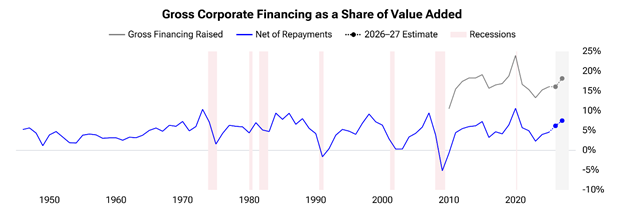
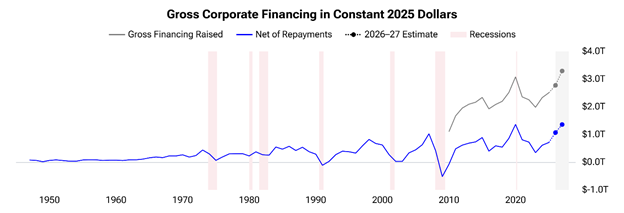
Structural changes in the corporate bond market deserve particular attention. Dalio notes that total U.S. corporate bond outstanding is approximately $15.7 trillion, and driven by the artificial intelligence (AI) capital expenditure boom, total corporate bond issuance this year has grown nearly 30% year-over-year. Among this, bond issuance by AI hyperscalers reached approximately $220 billion in the first half of 2026, compared with only about $108 billion for all of 2025.
More alarmingly, high capital expenditures are compressing corporate free cash flow, credit spreads have begun to widen, and investors are demanding greater "concessions" before they are willing to absorb new supply.
Dalio likens the corporate credit market to "the canary in the coal mine," viewing it as an early signal that stress across the broader financial markets will become more evident.
Debt Servicing Costs Erode Fiscal Space
Beyond the supply-demand imbalance, Dalio also focuses on analyzing the crowding-out effect of debt servicing costs on fiscal space.
He points out that with approximately $32 trillion in marketable U.S. Treasuries outstanding, if overall interest rates were to ultimately rise by 1 percentage point, interest expenses alone would increase by approximately $310 billion per year, adding approximately $3 trillion to government debt on a cumulative 10-year basis.
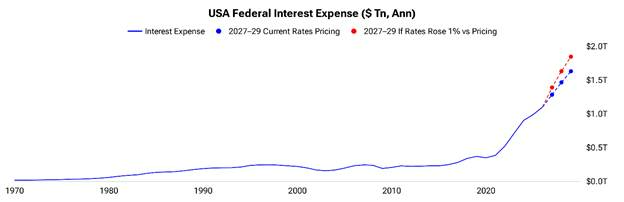
Currently, the average interest rate on existing U.S. debt is approximately 3.5%, while market rates are in the 4% to 5.5% range.
Dalio notes that even if rates do not rise further, interest expenses will continue to climb as old debt matures and is refinanced at higher rates. Treasury data shows that net interest expenses for the first three quarters of fiscal year 2026 increased by $78 billion year-over-year, a 10% increase.
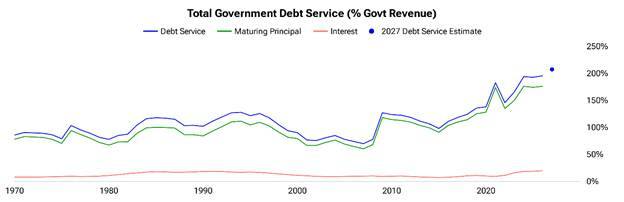
He further points out that the scale of debt principal rollover has risen to approximately 185% of federal tax revenue, and total debt servicing costs as a share of government tax revenue is approximately 200% and still rising—the risk of a "death spiral" can no longer be ignored.
Global Debt Competition Intensifies, Stock Markets Cannot Remain Unscathed
Dalio extends his analysis to a global dimension.
Citing data, he notes that total government borrowing by OECD member countries reached a record $17 trillion in 2025 and is expected to rise further to approximately $18 trillion in 2026, a 17% increase from 2024 and roughly double the level of a decade ago. European countries are ramping up sovereign bond issuance to finance defense and infrastructure, with Germany's total bond issuance expected to reach approximately €576 billion in 2027, while the European Central Bank is simultaneously reducing rather than expanding its government bond holdings.
Dalio also issued a warning about stock markets. He points out that over the past year, corporations have shifted from net buyers to net sellers (financiers) in the stock market, with equity issuance reaching an annualized $1.8 trillion in the first half of 2026, primarily driven by the AI construction boom. He expects equity financing pressure through IPOs, secondary offerings, and private placements to continue.
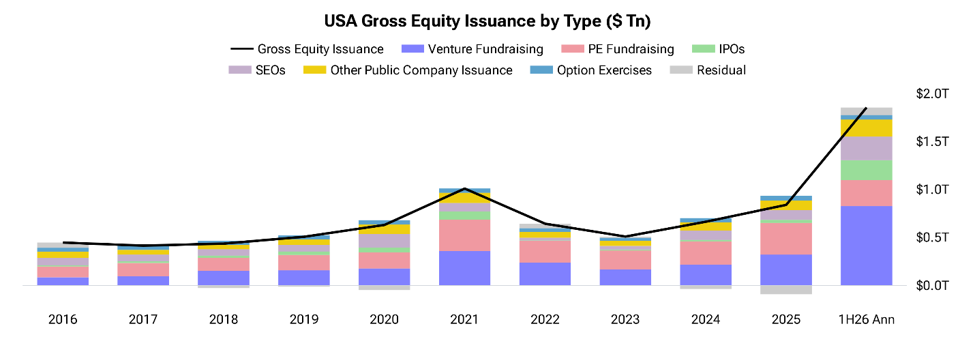
Dalio concludes that "the supply of financial assets (including debt and equity) appears to far exceed what demand can absorb."
He notes that the market is currently in the mid-cycle phase—after a significant rise in interest rates but before a notable decline in stocks and risk assets—and rates will continue to rise until the supply-demand imbalance begins to narrow, at which point interest-rate-sensitive markets and economic sectors will come under pressure first.