Conversation with Hyperliquid Founder: We're Not Trying to Replace Wall Street, We Want to Be the AWS of Finance

Compiled & Translated by: Foresight News
Guest: Jeff Yan, Co-founder & CEO of Hyperliquid Labs
Hosts: Joe Weisenthal, Tracy Alloway
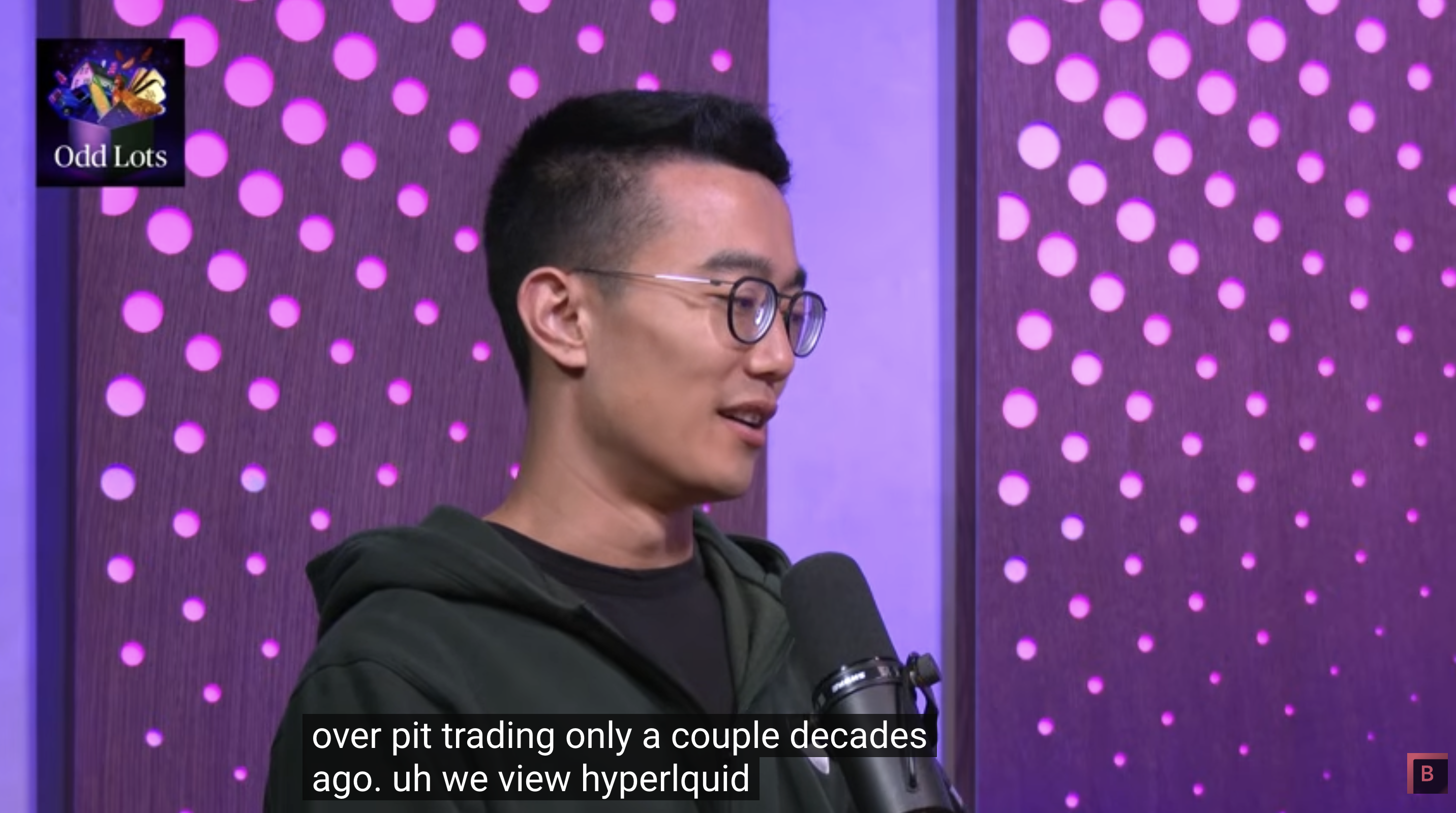
On October 15, 2026, Bloomberg's Odd Lots podcast aired a special interview, with hosts Joe Weisenthal and Tracy Alloway sitting down in the studio with Jeff Yan, Co-founder & CEO of Hyperliquid Labs. As the decentralized perpetual futures platform with the largest on-chain trading volume today, Hyperliquid has repeatedly broken into the mainstream this year — from 24-hour crude oil trading during the Iran war to Trump publicly calling it out while pushing for its compliant entry into the United States. In this nearly hour-long conversation, Jeff laid out for the first time a complete picture of Hyperliquid's underlying protocol design, the 500,000 HYPE staking-based market deployment mechanism, its U.S. regulatory pathway, and the long-term vision of "being the AWS of finance rather than replacing Wall Street."
Key Takeaways
- "We're not trying to replace anything. On the contrary, I think this technology can benefit institutions that currently operate markets in more traditional ways. Whether it's perpetuals or dated futures, what you need underneath is an order book, a clearing system, and global liquidity — these things have nothing to do with what the underlying asset is."
- "Regulation should fall on the layer that has control. Just like TCP/IP is a technology for building the financial stack, but it itself isn't regulated. Regulation has a locus — the deployer is the party exercising control, so regulation should target them."
- "If you're American and you use a VPN to access Hyperliquid, that violates the terms of service. Don't do it. This is not a joke."
- "At Hudson River Trading, it felt like being at a tech startup. When I left in 2023 to build Hyperliquid, the goal was to build something on-chain that people actually need — combining the product experience of a centralized exchange with the benefits of on-chain self-custody and no counterparty risk."
The following is a compiled transcript of the podcast conversation (content has been abridged):
What Hyperliquid Actually Is: Not an Exchange, but the AWS of Finance
Host: Let's start by explaining to our listeners — what exactly is Hyperliquid?
Jeff: Hyperliquid is a protocol. Our vision, or rather the shared vision of our community, is to "house all of finance." Simply put, it's a neutral underlying layer that can carry financial activity.
Just as decades ago, electronic trading was a step-function upgrade over open-outcry floor trading. We believe Hyperliquid is a step-function upgrade over today's fragmented electronic trading markets.
Many people interpret Hyperliquid as "Binance on-chain," which completely misses the point. We're not an exchange — we're a blockchain protocol, a set of permissionless validators jointly maintaining a globally unified state network. Hyperliquid Labs is just a very small team responsible for building the technology for this blockchain.
Trump previously mentioned publicly that U.S. regulators were pushing for Hyperliquid's compliant entry into the United States. I had no idea about this at the time — it was a complete surprise. The current situation is that U.S. users trading derivatives on Hyperliquid does violate the terms of service, but this administration has a relatively positive attitude toward on-chain financial infrastructure. They believe a way should be found to bring this technology into the existing financial system rather than banning it.
500,000 HYPE Staking + Dutch Auction: Who Gets to Open a Market?
Host: We've seen perpetuals on the platform for Nvidia, SK Hynix, the S&P 500, crude oil. Who opens these markets? How do you open one?
Jeff: We use the word "deploy," not "issue," because "issue" carries a lot of traditional finance connotations.
To become a deployer, you first need to stake 500,000 HYPE. Note — not $500,000 worth of HYPE, but 500,000 HYPE tokens. After staking, you unlock the deployment function on-chain, and then you define your own oracle system — that is, an off-chain price that a perpetual contract tracks.
The power of perpetuals is that they ultimately depend on just one number — the index price of the underlying asset. The oracle is the bridge that publishes off-chain price information on-chain. In the future, once spot trading also moves onto Hyperliquid, the oracle price could even be derived directly from on-chain attributes without any manual publishing.
Host: So could 10 people simultaneously open Nvidia perpetual contracts? How is that slot allocated?
Jeff: The protocol itself doesn't restrict who opens what. The protocol is just a basket of tools — deployers can use them however they want. But deployment slots are a scarce resource, because every order book and every clearing system consumes the network's computational resources.
So we use an on-chain Dutch auction to allocate them. Each round lasts 31 hours, with the auction price declining linearly from high to low, and the first person to bid gets the slot. Why 31 hours? Because 31 and 24 are coprime, so the auction start time automatically shifts across time zones each day, avoiding a fixed time.
Traditional auctions have many undesirable game-theoretic properties — people like to snipe at the last second, hold back information and bid at the end. Dutch auctions don't have this problem: whoever bids first takes it. And after each auction round ends, the next round's starting price is automatically set to twice the previous round's clearing price, creating a natural price discovery mechanism that gradually approaches the true market value of this scarce resource.
Oracles and Risk: A 1% Hard Constraint, No Subjective Judgment
Host: You're familiar with the Mango Markets attack, right? Because perpetual trading volume is so much larger than spot, an attacker only needs to spike the spot price, which transmits through the oracle, and they can make a fortune on perpetuals. How does Hyperliquid guard against this kind of risk?
Jeff: Let me first address the SK Hynix incident. That was Trade.xyz's own issue — they later published a detailed post-mortem report and made compensation. This isn't a Hyperliquid problem. Just like Apple's systems have bugs that need patching, software bugs are normal.
Back to your point about the volume ratio. Intuitively, you might think that if perpetual trading volume is much larger than spot, there will be problems. But I don't see it that way. Look at S&P 500 futures — their volume is far larger than the underlying stocks, and everything works fine, doesn't it?
The key isn't how large the volume ratio is, but whether there's smart money in the market. When the price deviates, is there a market maker willing to step up and say, "Your 1% move is wrong — no matter how much you want to trade, I'll take the other side"? As long as such people exist, price discovery can happen in the derivatives market, and the spot market actually becomes a reference.
Host: So if someone opens a market with extremely poor liquidity, would you reject them?
Jeff: The protocol fundamentally doesn't understand what "poor liquidity" means. At the protocol level, there's no semantic encoding for that kind of subjective judgment. The protocol only knows one hard rule: between two oracle price updates, the relative deviation cannot exceed 1%. If you try to report a 2% price move in one go, the system will "clip" it and only recognize 1% of it. You'll have to report the remaining 1% again.
This is a mathematical constraint, not a value judgment. It's like buying order book software — the software vendor doesn't judge whether the asset you're trading is reasonable. It just provides the technology for placing buy and sell orders; how you use it is your own business.
24/7 Trading and Funding Rates: Where Do Weekend Oil Prices Come From?
Host: During the Iran war this spring, Hyperliquid suddenly went viral because people discovered they could trade WTI and Brent crude on your platform even in the early hours of the weekend. But traditional markets were closed at that time — where did the real-time prices come from?
Jeff: That depends on how the deployer designs the contract — it's not a protocol-level matter.
But there's a very interesting point: today's perpetuals basically all use 24/7 oracle prices as a reference, but that's actually not necessary. The real anchoring mechanism of a perpetual is the funding rate. No matter how the price fluctuates, through periodic funding payments, the derivatives price will eventually converge to the underlying asset price.
So you could absolutely design a contract where: when traditional markets are open, the price follows spot; when traditional markets are closed, the derivatives price floats freely, with funding rate settlements at intervals. Convergence will be slower, but the mechanism itself is effective.
The U.S. Regulatory Pathway: Regulate the Deployer, Not the Protocol
Host: So what actually needs to happen for U.S. users to legally trade on Hyperliquid without a VPN?
Jeff: First, let me say again — Americans using a VPN is a violation of the terms of service. Don't do it.
The core point is that the CFTC's core regulatory principles are essentially technology-neutral — otherwise why would they be called "core principles" and not "technology rules"?
The problem now is that regulators still need time to understand what this thing actually is. They certainly want to move innovation forward quickly, but there's a heavy responsibility behind it — the existing system works well overall, serves many people, and has mature protection mechanisms. So naturally there's a cognitive process of "is this technology really consistent with our core principles?"
Host: So where should regulation fall? Should it regulate the Hyperliquid protocol itself, or the market deployers?
Jeff: I can absolutely imagine such a world. Just like TCP/IP is a technology for building the financial stack, but it itself isn't regulated. Regulation has a locus — whoever exercises control is who gets regulated. The deployer is the one setting rules and making decisions. So let the protocol continue to serve as the network and liquidity infrastructure layer, and let regulation fall on the deployer layer — that's the most natural division of labor.
And on-chain technology actually has a natural compliance advantage: anyone can audit it publicly, and the sum of all user balances on-chain equals the total amount of USDC in that address. In the traditional system, you need banks to proactively present their books and submit to audits — that's a process. On-chain, it's an inherent property. This "provable solvency" is actually a major cognitive breakthrough.
Founder Background: From Hudson River Trading to a Zero-VC Startup
Host: Tell us about your background. You were at Hudson River Trading, left to start a company after the 2021 crypto boom, and didn't take VC money. Why did you choose this direction at the time?
Jeff: I went to Hudson River Trading (HRT) right after graduating from college, and it was a great experience. Although HRT is a successful company, day-to-day it felt a lot like a tech startup. I learned a lot about markets there and met many impressive people.
When I left in 2023 to build Hyperliquid, the vision was actually very focused: to build something on-chain that people actually need. At the time, looking around, the crypto industry already had many centralized perpetual exchanges with excellent product experiences — users really needed this. But they were all centralized — if you deposit your money on an exchange, there's always counterparty risk.
So we saw a clear opportunity: can we combine the excellent product experience of centralized perpetuals with the benefits of on-chain technology — self-custody and no counterparty risk? If we could achieve that, it would be a step-function product upgrade.
Host: Did you set out from the beginning to do something this big — "house all of finance"?
Jeff: Of course not. Initially, we just wanted to build an on-chain perpetuals exchange. But as we went along, we realized that no existing technology could carry all of finance through just minor patches and incremental improvements. It's like the early consumer internet builders — as they went along, they realized, "Hmm, no, I need to buy my own servers. No, the network isn't good enough — I need to build the network first."
It's exactly that feeling. We set out to build an exchange, but as we dug deeper, we found we had to build our own underlying consensus layer. AWS started out as Amazon's internal infrastructure before opening up to the public. We're at that stage now — the thing is genuinely huge, but the difficulty itself makes it feel worth doing. If we don't try, who will?
Looking back now, other public chains certainly have their own strengths, but aside from Hyperliquid, none truly holds this precise vision of "building a globally unified state financial system."
Nodes and Decentralization: Running a Global Financial System on 128GB of RAM
Host: How big are your data requirements now? Have you built huge data centers in many places?
Jeff: Quite the opposite. There are now over 30 validator nodes, with the top 27 by stake actively running the network. And the hardware requirements to run a node are counterintuitively low.
One validator tweeted that he suddenly realized he could run this global financial system on just a very ordinary machine that anyone can buy — no need for a three-year exclusive contract with Nvidia, no need for high-end specs. Of course, we're not there yet, but that's the vision: no matter how many applications run on top, the cost of operating this network shouldn't be absurdly high.
Of course, you can't run a node on a phone. The current requirement is 128GB of RAM. That's not the cheapest laptop you can buy, but you can definitely buy a laptop with that spec. That's the balance point we want.
Epilogue: We Have No Competitors, Because No One Else Walks This Path
Host: One last question. You say your goal is to carry all of finance, but your team is very low-profile — you even have a completely anonymous co-founder. Will this anonymous status change in the future? Will people demand to know who's running this financial system?
Jeff: Actually, the Hyperliquid team is much larger than Labs. It's a constellation-like ecosystem — there's Perp, a Nasdaq-listed digital asset treasury company, deployers like Trade.xyz, and many, many participants jointly running this system.
I think there may be a misunderstanding that this network is owned by the developers. It's not. This network is the embodiment of a system that should be fair, should be transparent, and should support these tools. Of course, developers are still needed now to translate the community's ideas into code, and as software evolves, perhaps even this intermediary step won't be needed.
Host: So your ultimate goal is to truly become something like TCP/IP — no one knows who invented it, but the whole world uses it?
Jeff: Exactly. We don't want to be "remembered." We want to be "used."