Pearl Token Explained: Useful Proof of Work, AI Mining, and PRL Tokenomics

Original article from Datawallet Team
Compiled by|速递侠@Odaily

Editor's note: On October 15 Beijing time, GPU mining coin Pearl (PRL) briefly broke above $2, with a circulating market cap of approximately $700 million, setting a new all-time high. It is currently trading at $1.9. Over the past two months, PRL has surged by as much as 600%, making it the hottest mining coin in the crypto community in recent years.
In simple terms, Pearl is a blockchain derived from Bitcoin where miners no longer perform hash computations but instead run matrix multiplications on GPUs in exchange for PRL rewards. Matrix multiplication is the underlying arithmetic of all AI models. PRL has a maximum supply of 2.1 billion tokens, with approximately 332 million mined as of October 2, 2026. This design is backed by published cryptographic research, and Together AI is its only production-grade partner. However, an independent study found that most mining does not produce any AI results; more than one-third of existing PRL was mined within the first six days. Given that many readers are unfamiliar with this project, Odaily has compiled relevant content for reference.
What Is Pearl?
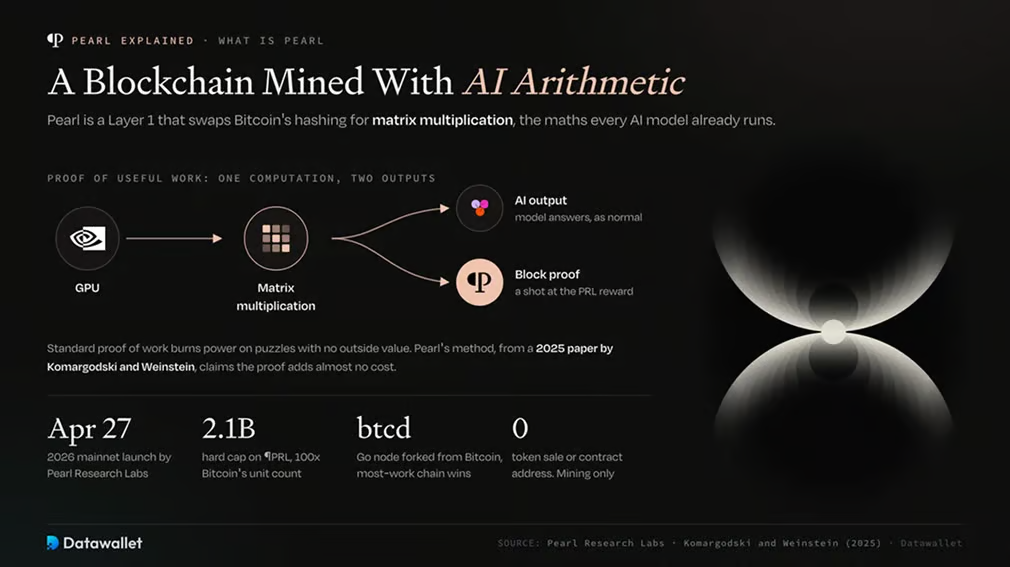
Pearl is a Layer 1 blockchain—an independent network with its own native token—that replaces Bitcoin's hash computations with matrix multiplications. Both AI training and inference rely on this arithmetic. As a result, a GPU already serving a language model can simultaneously compete for block rewards.
This approach is called Proof of Useful Work: it extracts mining proofs from computations that miners would already be running. Standard proof of work, by contrast, expends electricity on problems with no external value. Pearl's method originates from a 2025 paper by Ilan Komargodski and Omri Weinstein, which claims that generating this proof adds almost no extra cost to matrix multiplication.
Pearl Research Labs launched its mainnet on April 27, 2026. Its node software is forked from btcd—a Bitcoin node implementation written in Go—retaining Bitcoin's transaction model and the rule that "the chain with the most cumulative work is the valid chain." The native token PRL has a hard cap of 2.1 billion, written by the project as ¶PRL.
Most AI concept tokens are issued by teams to sell compute or coordinate models. PRL has neither a token sale nor a contract address. All tokens enter circulation through block rewards, making the mining rules and the early history at launch the key to understanding its distribution structure.
How Does Pearl Work?
Pearl retains Bitcoin's ledger but swaps out its mining function. The main differences center on three things: how miners win blocks, how they prove work, and how upgrades are completed.
1. Mining with Matrix Multiplication
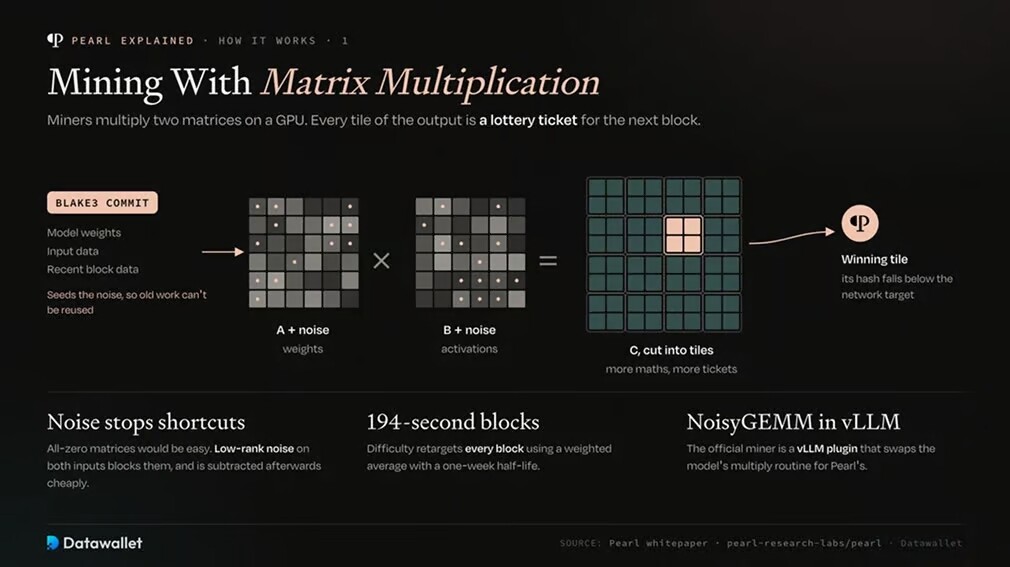
Neural networks are essentially composed of grids of numbers—matrices—multiplied together billions of times. To mine Pearl, miners choose two matrices and compute their product on a GPU. Typically, these two matrices are the model's weights and the data flowing through the model.
The protocol slices the output into small tiles, each equivalent to a lottery ticket. If a tile's hash value (a fixed-length fingerprint of the data) falls below the network target, that tile wins. The more computation performed, the more tiles produced, and the higher the miner's probability of finding a block.
Letting miners choose their own inputs would leave an obvious loophole: a dishonest miner could submit easily computable things like all-zero matrices. Pearl's countermeasure is to add random noise to both inputs. In the original Pearl whitepaper, the noise comes from low-rank matrices—a compact form that miners can subtract after computing, restoring the true result at minimal cost.
Before computation begins, miners must commit to both matrices and the latest block data via BLAKE3 (a fast hash function). It is this commitment that generates the noise, preventing miners from choosing inputs that cancel out the noise and from reusing old work on new blocks.
Difficulty adjusts with every block, using a weighted moving average with a one-week half-life. This parameter determines how hard it is to find a block, with a target block interval of 194 seconds—slightly more than three minutes.
Official mining uses a plugin for vLLM (an open-source language model serving engine). This plugin replaces the model's multiplication routines with Pearl's own version, called NoisyGEMM.
2. Zero-Knowledge Block Certificates
Winning tiles expose certain rows of the miner's matrices, which could leak proprietary model weights or user data. The raw proofs are also large—the whitepaper estimates that proofs for two 16,384 × 16,384 matrices would take up 0.5 to 2 MB.
To avoid publishing these inputs on-chain, Pearl wraps each winning proof in a zk-SNARK. This zero-knowledge proof confirms that the computation was correctly executed without revealing the inputs. Zcash uses the same family of cryptography to hide payment details; this technology also intersects with zkML (which focuses on generating proofs for AI computations).
Pearl uses Plonky2, a proof system built solely on hash functions. Three layers of recursion compress the certificate to under 60 KB. Each block carries this certificate (capped at 65 KB), replacing Bitcoin's nonce—the number Bitcoin miners constantly change to produce a valid hash.

3. A Bitcoin-Derived Foundation
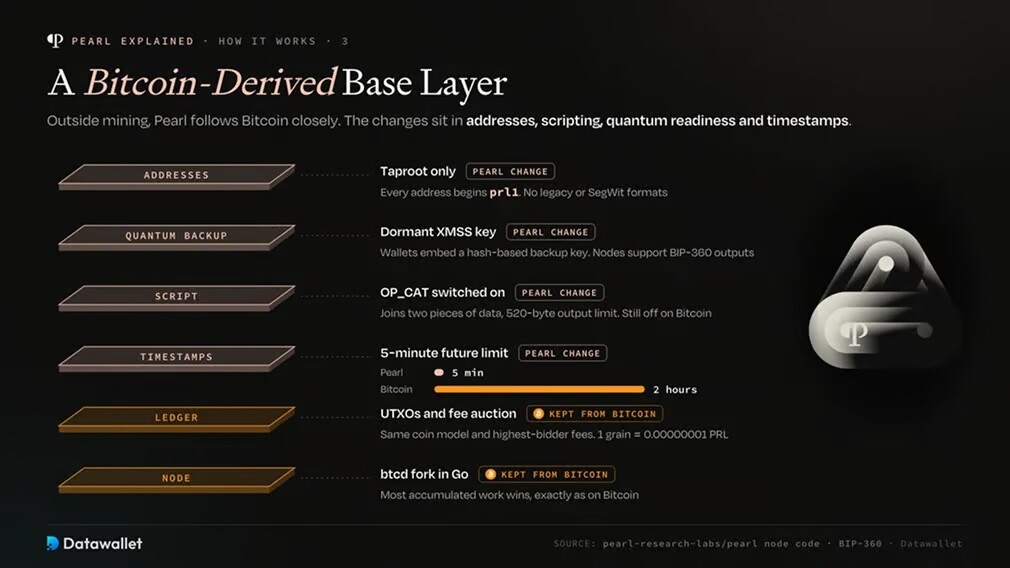
Apart from mining, Pearl largely follows Bitcoin. Tokens are recorded as UTXOs (unspent transaction outputs)—discrete chunks of value that are consumed and regenerated by payments. Transaction fees go to miners through the same highest-bidder auction mechanism. One hundred-millionth of a PRL is the smallest unit, called a grain.
How Pearl differs from Bitcoin:
- Quantum protection: Wallets embed a dormant XMSS backup key—a hash-based signature scheme designed to resist quantum computers, inactive by default and activated only when needed. Nodes also implement the Pay-to-Merkle-Root output proposed in BIP-360.
- Scripting: OP_CAT (an opcode for concatenating two pieces of data) is enabled on Pearl, with a 520-byte output limit. This opcode remains disabled on Bitcoin.
- Timestamps: Pearl rejects blocks with timestamps more than five minutes ahead; Bitcoin allows two hours.
4. Protocol Upgrades and the FP8 Plan
The node's mainnet parameters record four mining rule changes within Pearl's first four months. Hard forks require all nodes to upgrade; soft forks only tighten existing rules.
The four forks to date:
- MoE hard fork (block 71,935, June): Added v2 certificates and support for mixture-of-experts (MoE) models. These models route each input to a subset of expert sub-networks.
- Dense-only soft fork (block 91,630, July): Stopped accepting MoE proofs, restricting mining back to standard matrix multiplication. Pearl's code comments do not explain this reversal.
- Rank-penalty soft fork (block 96,251, August): Set a noise floor for each multiplication and imposed stricter winning thresholds on proofs with insufficient noise.
- Salted noise-seed hard fork (block 99,000, August): Introduced v3 certificates and changed how the noise seed is derived.
Pearl launched with integer-based mining, while production AI models increasingly use FP8 (an 8-bit floating-point format). A floating-point specification released in September 2026 describes mining directly on FP8 multiplications, relying on quantization (rounding numbers into that format) to close shortcuts.
The verification method draws on Hawkeye—research conducted with Stanford cryptographer Dan Boneh that can reproduce GPU-exact arithmetic on a CPU. When we checked the node's mainnet parameters on October 2, we found no FP8 activation height. Until a fork schedule is set, it remains only a published design.
How to Mine Pearl
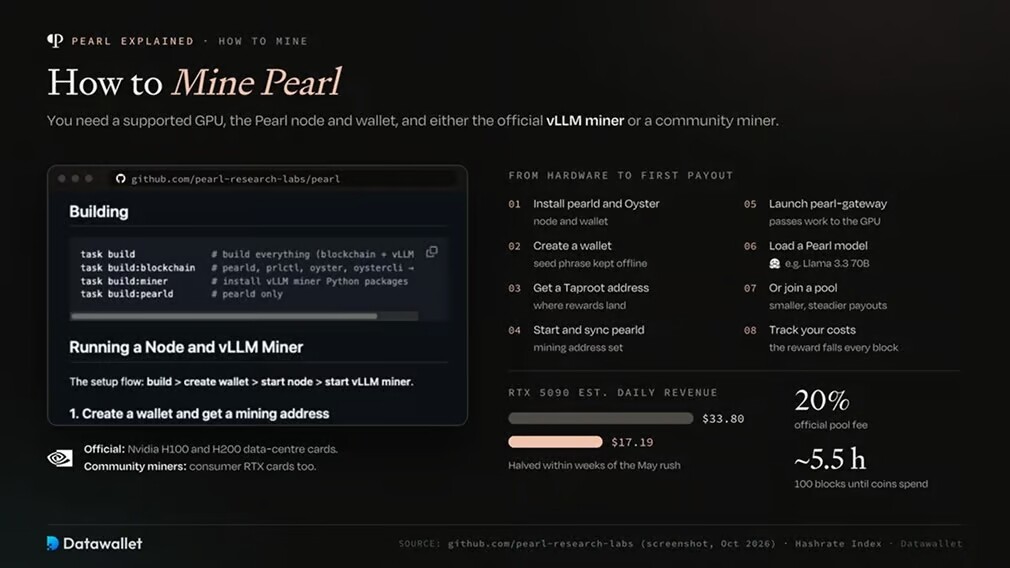
Mining Pearl requires a supported GPU, Pearl's node and wallet, plus either a community miner or the vLLM miner from Pearl's official codebase.
From hardware to first earnings:
- Check hardware: Official miner documentation only supports Nvidia H100 and H200 data center cards. Community miners additionally support consumer RTX cards.
- Install software: Use Pearl's codebase installer to obtain pearld (full node) and Oyster (wallet).
- Create a wallet: Open oystercli, set a passphrase, and write down the mnemonic offline.
- Generate an address: Request a new Taproot address from the wallet to receive block rewards.
- Start the node: Run pearld with the mining address configured, and wait for it to sync with the network.
- Start the gateway: Run pearl-gateway to pass tasks between the node and GPU.
- Load a model: Launch the vLLM miner with a Pearl-converted model from the project's Hugging Face page, such as its Llama 3.3 70B version.
- Or join a pool: Connect a community miner to a pool for smaller but steadier earnings, rather than betting on a rare full block.
- Wait for maturity: Newly mined coins require 100 additional blocks (about five and a half hours) before they can be spent.
- Calculate costs: Regularly compare earnings against electricity or rental costs. Block rewards are steadily declining.
As miners increase, mining revenue drops quickly. According to Hashrate Index, within weeks after the May mining boom, estimated daily earnings for an RTX 5090 fell from about $33.80 to $17.19 as difficulty rose. The report also noted that Pearl's official pool charges a 20% fee.
PRL Tokenomics and Supply
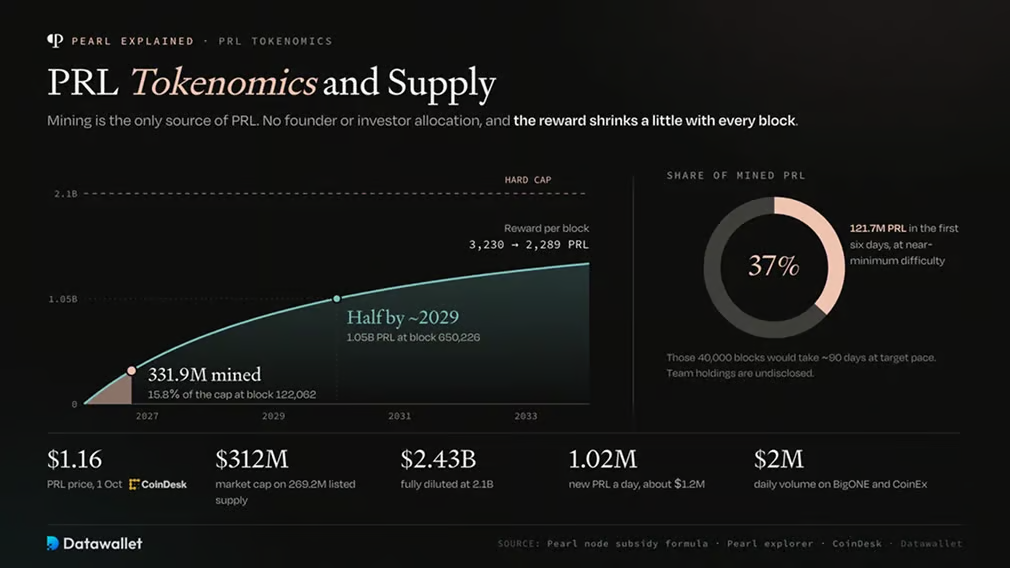
Mining is the only source of PRL. The code allocates no share to founders or investors, and issuance is determined by a formula in the node software.
Supply and Emission
Pearl adopts Bitcoin's scarcity model but scales up the unit count by 100x; however, it eliminates halving (Bitcoin's mechanism of cutting block rewards in half every four years) in favor of a block subsidy function that slightly reduces rewards with each block.
PRL supply and market data as of early October 2026:
- Maximum supply: 2.1 billion PRL. The node code enforces this cap, with no additional issuance mechanism.
- Mined supply: Approximately 331.9 million at block 122,062 on October 2, representing 15.8% of the cap. We recalculated this total using the subsidy formula and the block height shown on Pearl's explorer.
- Current block reward: Approximately 2,289 PRL; at block 1 it was approximately 3,230 PRL.
- Daily issuance: Close to 1.02 million PRL at the 194-second target block interval.
- Halfway point: Cumulative supply reaches 1.05 billion at block 650,226. At the target rate, this falls around the end of 2029.
- Publicly disclosed circulating supply: CoinDesk's Pearl price page lists 269.2 million, about 63 million less than the total calculated from the code. This discrepancy remains unexplained.
- Market cap: According to CoinDesk data, PRL traded near $1.16 on October 1. Based on CoinDesk's circulating supply, this is approximately $312 million; based on the code-derived total, approximately $385 million.
- Fully diluted valuation: Approximately $2.43 billion, i.e., price multiplied by the full 2.1 billion supply.
- Trading venues: CoinDesk tracks two markets, BigONE and CoinEx. Daily volume of about $2 million represents less than 1% of market cap.
Compared to the emission curve, the early launch period had a greater impact on ownership distribution. Pearl launched at near-minimum difficulty, and its block explorer shows block 40,000 appeared on May 3, only six days after the first block. At the 194-second target interval, these blocks should have taken about 90 days to mine.
These 40,000 blocks minted approximately 121.7 million PRL, close to 37% of the total mined to date. According to the whitepaper, the low initial difficulty was set to give early miners a fair chance and to ensure the core team had resources for R&D. This wording suggests the team participated in mining during that period, but its holdings have never been disclosed.
Utility
PRL's current functional scope is narrow.
Current uses:
- Mining rewards: Miners who find blocks receive newly issued PRL plus the block's transaction fees.
- Payments: Users transfer PRL between Taproot addresses and pay transfer fees in PRL.
- Inference subsidies: Operators can sell PRL mined while serving AI models to offset costs. Together AI uses this approach to fund its discounted inference service.
- Bug bounties: Pearl Research Labs pays discretionary rewards for security reports, ranging from 1,000 to over 50,000 PRL.
PRL carries no governance rights and does not support staking. Pearl's scripting system also lacks general-purpose smart contract capability. The whitepaper proposes a future market where the chain settles compute contracts, but this extension has not yet launched.
Is Pearl's "Useful Work" Actually Useful?
Pearl can prove that a matrix multiplication occurred, but it cannot prove that anyone needs the result. This is the most fundamental criticism of its design.
Researcher Abhinaba Basu published a preprint in June 2026 titled "The Usefulness Gap in Proof-of-Useful-Work." According to Tom's Hardware, Basu mined with random matrices unrelated to any AI model, and the pool accepted 44 of his shares (partial proofs counted toward earnings).
Basu also examined 8,012 machines in one pool, representing about 21% of the network. The dominant mining program contained no machine learning code. His research estimates Pearl's hashrate is equivalent to 320,000 RTX 3090-class GPUs, consuming 112 megawatts, and attributes a 38% increase in cheap GPU rental prices on Vast.ai to Pearl mining. His argument: as long as skipping AI computation is cheaper, miners will skip it—because the protocol allows useful work but does not require it.
Commercial activity provides counter-evidence. On May 15, 2026, Together AI launched the Gemma-4-31B-it-pearl endpoint (a paid access point for a hosted model) at more than 25% below its standard rate. The discount comes from expected earnings from GPUs mining PRL. Together called the partnership exclusive and said more Pearl products would follow.
Pearl Research Labs now also sells inference services through its own Pearl Inference Platform. The service lists eight open-source models from DeepSeek, Qwen, Z.AI, and Google, priced per token. The company has not disclosed how much of this traffic comes from mining.
Another concern relates to security: if the mining work itself has external value, an attacker is effectively paid while attacking. Cryptographer Rafael Pass examined this in "The Economics of Proof-of-Useful-Work." His model concludes that after prices adjust, the cost of majority attacks (attacks launched when a single party controls most of the hashrate) remains tied to block rewards. The model also finds that rewards can act as a rebate, lowering inference prices.
The planned FP8 upgrade would let operators mine on standard FP8 inference directly using the same numerical format employed by production models. But its specification likewise does not verify whether outputs have customer demand. The "usefulness gap" Basu describes will only narrow when paid workloads become the cheapest way to mine.