


For compute power, Zuckerberg is ready to burn through free cash flow

Original author: Su Yang
Original editor: Xu Qingyang
Original source: Tencent Tech
Meta in the AI era is facing a mandatory question that is hard to answer.
On October 21, US local time, Meta released its third-quarter 2026 financial report. The company's quarterly revenue grew 26% year over year to $64.601 billion; but under large-scale infrastructure investment, free cash flow fell to negative $2.12 billion, compared with positive $10.625 billion in the same period last year.
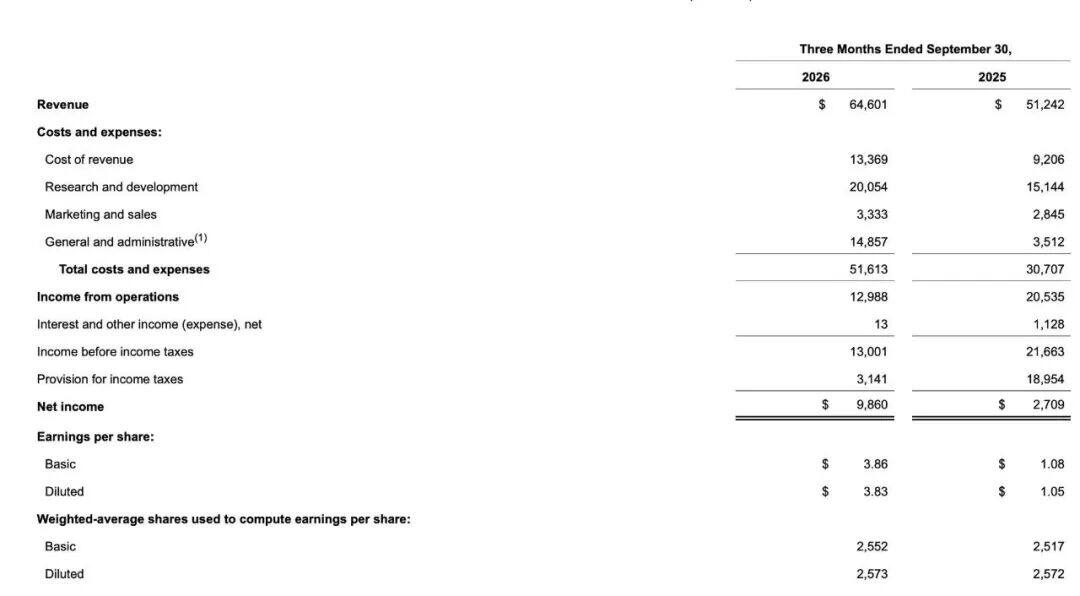
Meta's main financial data for the third quarter
Founder and CEO Mark Zuckerberg said the investments are paying off, and Chief Financial Officer Susan Li made it clear that the company will continue to increase investment in 2027. Meta also announced a new non-voting Class C share plan in its financial report, seeking to reserve capital and governance space for multi-year investments.
For Meta, aggressive investment has become an inevitable trend. The key issue now is not only whether the advertising business can continue to grow, but also whether the new investment can bring sufficient revenue and efficiency gains to cover expanding infrastructure costs.
Sky-high lawsuits and fines cloud drag on profit
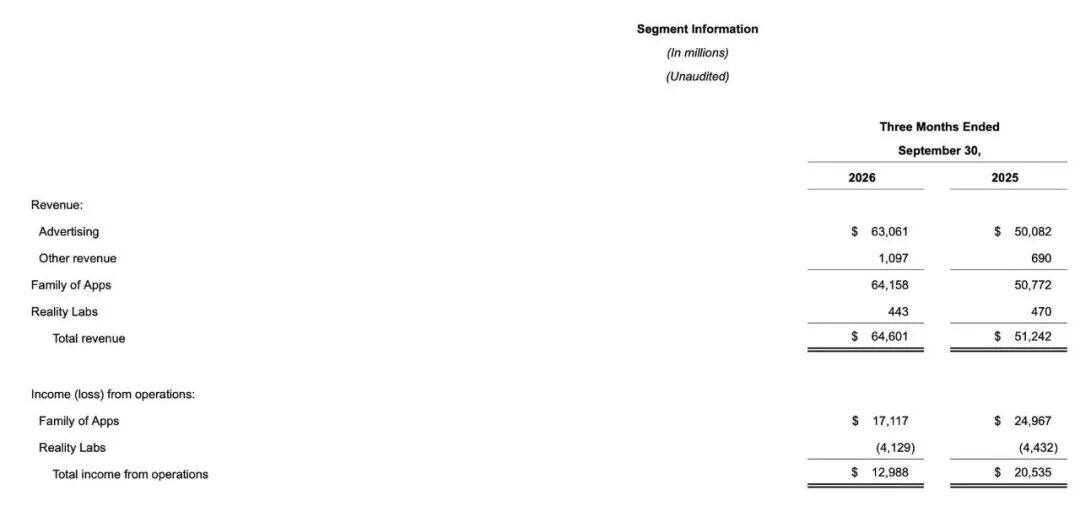
Meta's segment business revenue in the third quarter
In the third quarter, Meta achieved total revenue of $64.601 billion, up 26% year over year from $51.242 billion in the same period last year. On a non-GAAP basis, excluding a $113 million foreign exchange headwind, revenue growth at constant currency was also 26%.
This growth was mainly driven by the core advertising business, with advertising revenue reaching $63.061 billion in the quarter, up 26% from $50.082 billion in the same period last year.
Other revenue in the Family of Apps was $1.097 billion, bringing total Family of Apps revenue to $64.158 billion. Revenue from Reality Labs, the division focused on the metaverse and hardware, was $443 million.
On the traffic side, daily active people across the Family of Apps reached 3.64 billion, up 3% year over year. Ad impressions increased 10% year over year, and the average price per ad rose 14%, as the platform's advertising monetization capability continued to strengthen.
Management linked this performance to improvements in AI recommendation systems, believing that AI is helping boost user engagement and advertising delivery efficiency.
Compared with revenue growth, profit fell sharply, dragged down by large legal expenses.
In the third quarter, Meta recorded $9.89 billion in settlement expenses related to lawsuits over teen mental health. Affected by this, consolidated operating income fell to $12.988 billion, down 37% year over year; reported net income was $9.860 billion, with diluted earnings per share of $3.83.
On the same day the financial report was released, October 21, US District Judge Francis Matthew of the District of New Mexico ruled in the state's lawsuit accusing Meta of misleading consumers over data privacy, ordering Meta to pay the state up to $25 billion in compensatory fines.
AI begins to test cash flow
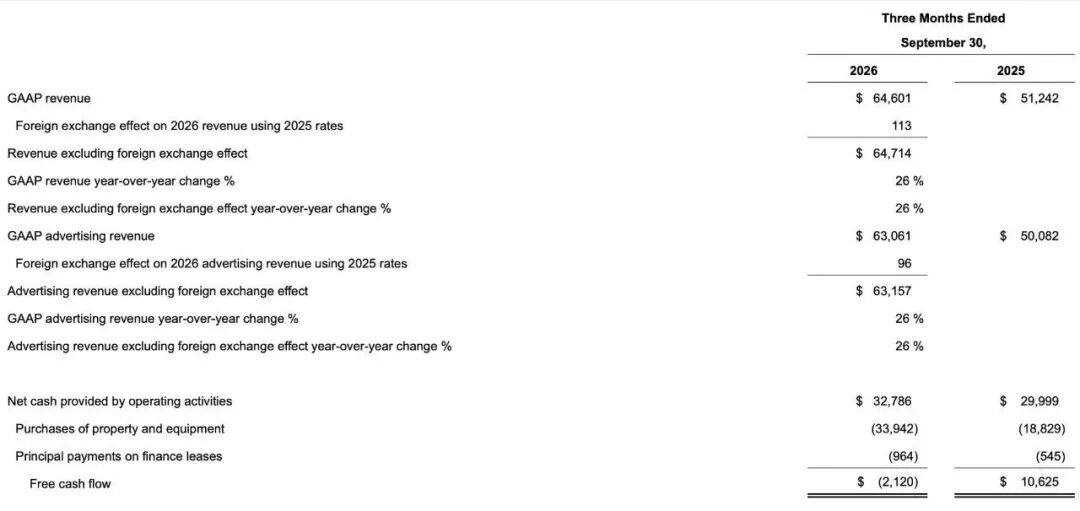
AI investment turns Meta's free cash flow negative
Although the advertising business continues to provide funding, infrastructure investment is changing Meta's cash flow position.
According to officially disclosed data, Meta's operating cash flow in the third quarter was $32.786 billion, higher than $29.999 billion in the same period last year.
On the spending side, cash outlays for purchases of property and equipment rose to $33.942 billion in the quarter, compared with $18.829 billion in the same period last year. Adding $964 million in principal payments on finance leases, related cash outlays totaled $34.906 billion.
Based on Meta's official data, free cash flow for the period fell to negative $2.120 billion. By comparison, free cash flow in the third quarter of 2025 was positive $10.625 billion, and cumulative free cash flow for the first nine months narrowed to $11.049 billion from $29.508 billion in the same period last year.
Negative free cash flow does not mean the company has a liquidity crisis. Meta's operating cash flow in the quarter remained high at $32.786 billion, and the negative free cash flow mainly reflects that capital expenditure grew faster than operating cash flow.
As of the end of the third quarter, the company's net property and equipment had increased to $253.222 billion from $176.40 billion at the end of 2025, and long-term debt had increased to $80.922 billion from $58.744 billion.
The key going forward is whether Meta's operating cash flow can continue to grow and whether the newly added assets can gradually translate into revenue and profit.
Still aggressively investing in 2027
Faced with the cash burn, Meta's management did not signal any pullback.
For fourth-quarter performance, the company expects revenue of between $73 billion and $76 billion, with a midpoint of $74.5 billion, representing roughly 15.3% sequential growth from the third quarter.
As resources are reallocated, losses in the Reality Labs division are expected to be somewhat contained, with full-year 2026 losses expected to narrow to $18 billion to $19 billion, and further narrowing to around $15 billion in 2027.
On capital expenditure, Meta raised the lower end of its full-year 2026 capex guidance by $5 billion to a range of $135 billion to $145 billion. CFO Susan Li made it clear that although the 2027 budget is still being formulated, the company expects to continue its aggressive investment pace.
As for the sources of investment returns, based on management's statements and product planning, they can be divided into three levels.
In the short term, AI improvements to recommendation algorithms and advertising delivery efficiency are bringing incremental revenue to the core advertising business. In the medium term, the personal AI assistant Muse and the frontier model Muse Wonder launched in the third quarter are gradually testing subscription models and developer interfaces, exploring commercialization directions in enterprise services and transaction scenarios. In the long term, Meta hopes to improve internal operating efficiency and open up new commercialization opportunities through its superintelligence lab and computing infrastructure buildout.
Management said that although the return cycle for investment in frontier AI technology is relatively long, with technology accumulation and product iteration, the company is optimistic about maintaining overall revenue growth.
Reserving capital space for long-term strategy

Data centers Meta is building
To support infrastructure construction and long-term strategic planning, Meta announced in its financial report a plan to adjust corporate governance and capital structure, with the board having approved the creation of a new non-voting Class C common stock.
According to the disclosed plan, the company intends to distribute a stock dividend of one Class C share for each share held by existing Class A and Class B shareholders.
The company said the distribution of Class C shares will not change the existing shareholder voting structure. A special committee of the company has signed a related agreement with Zuckerberg aimed at continuing the existing governance arrangements.
In 2014, Google parent Alphabet completed a stock split through a proportional distribution of non-voting Class C shares, enabling founders Larry Page and Sergey Brin to lock in control of the company while continuing to issue shares for employee equity incentives and acquisitions.
The non-voting Class C shares will mainly be used for Meta's future employee equity incentives, potential strategic acquisitions, or other capital operations. The stock dividend itself will not directly bring new cash flow to the company. This arrangement reflects Meta's hope to emulate the mature capital tools of other tech giants and reserve space for future equity incentives and capital operations while maintaining the existing control structure.
For an AI strategy that requires years of sustained investment, a stable governance structure helps management advance long-term planning, but the actual effect will still depend on the efficiency of subsequent capital use and investment returns.
Meta's third-quarter financial report presents two curves moving forward simultaneously: the advertising business continues to generate revenue, while AI infrastructure continues to expand capital demands. Advertising revenue growth provides the funding base, but it does not mean AI investment will necessarily yield corresponding returns.
Meta has made it clear that it will continue to increase investment in 2027. For Zuckerberg, sticking to the long-term strategy is only the first step. As investment continues to expand, the company needs to prove that the incremental revenue and efficiency gains brought by AI are enough to support this multi-year infrastructure expansion.
The following is a condensed transcript of Meta's third-quarter earnings analyst call:
Zuckerberg first gave his remarks:
In the third quarter, 3.64 billion people used our Family of Apps every day, and engagement on Facebook and Instagram both hit all-time highs. Threads monthly active users have surpassed X, and WhatsApp message volume also hit a new high.
We are rapidly advancing our goal of "bringing personal superintelligence to everyone," and the launch of the Muse personal agent has been very successful. Just a month and a half after launch in the US and Canada, it has surpassed 10 million setup users, with about 25% of them using it every day. The most common use case is shopping (over 25% of usage, with average spending above $200).
Because first-week transaction volume far exceeded expectations, we had to work with Stripe to temporarily raise credit limits. Next, Muse will come to Meta smart glasses starting next month.
On model development, we released our first closed-source frontier model, Muse Wonder, which is at the industry's most advanced level on several key metrics; we also released Muse Spark 1.2/1.3, Muse Code, and two open-source open-weight models, Muse Glimmer and Muse Spark Open. Going forward, we will continue to push the intelligence frontier and plan to distill frontier models into smaller, more efficient product models.
On computing and efficiency, we are building computing capacity capable of serving more than 1 billion people in the coming years. Although Muse is currently a compute-intensive application, we expect cost efficiency to improve more than 10x next year, which will allow it to become profitable at scale. We expect that in a year we will be able to deliver equivalent intelligence in smaller models at a fraction of the cost of the current Muse Wonder.
On segment adjustments, we will change the release cadence of VR devices and instead prioritize delivering personal superintelligence. Reality Labs operating losses are expected to narrow to about $15 billion next year and trend toward profitability from there.
CFO Susan Li then added information on capital expenditure and capital allocation. She noted that Meta's capital expenditure will continue to increase in the coming years, mainly to support the core business and emerging AI initiatives. Although AI investments take longer to generate returns than the core business, they are already bringing substantial incremental revenue to core advertising by improving recommendation and monetization efficiency.
The following is the analyst Q&A session:
Q: What are the user growth constraints as Muse moves forward? What is Meta's vision for the enterprise business?
Zuckerberg: The biggest constraint for Muse right now is mainly compute intensity, so it has not yet been broadly rolled out outside the US and Canada; we are working to improve computing efficiency and build enough compute to support a scale of more than 1 billion users in the future.
On the enterprise business, the near-term focus is model APIs and Muse Code, and in the future we will build a Muse agent network so that consumers' Muse can directly negotiate and transact with enterprise agents.
Q: What friction currently exists in agentic commerce? How is the company addressing it? Also, what are the considerations behind the new share class announced tonight for the capital structure and future AI investment?
Zuckerberg: The vast majority of businesses are very excited to support this right now, because they see that it can not only increase sales and improve existing customer experience, but may also bring in new customers. Adoption speed will vary by business, and we will work on terms that are reasonable for all parties. In the long run, making this work well is valuable for everyone, and we are currently on a good trajectory.
Susan Li: Agents will become an important part of how reality evolves, and the market will eventually move toward more permissioned, structured interactions—including authenticated APIs, approved agent partnerships, or direct communication between consumers' personal agents and enterprise agents. We are working with partners such as Sierra, Walmart, Stripe, and Shopify to develop the "Personal Agent Protocol" to define safe and reliable ways to interact. Many experiences in the near term will still be AI-assisted rather than fully autonomous, but as trusted integrations develop, more businesses will actively participate.
Regarding the new share class, we created this new class of non-voting capital stock (Class C shares) to distribute to all existing shareholders through a stock dividend, creating publicly tradable non-voting stock that can be used for financing, employee compensation, acquisitions, and other general corporate purposes, while preserving the voting rights of existing Class A and Class B shareholders.
This move maintains the founder-led structure, expands financing tools, and gives us the ability to invest flexibly amid strong AI-driven momentum. There are currently no specific financing plans, but establishing an appropriate capital structure framework is prudent.
Q: What is the approximate per-user cost structure for Muse? How will the cost curve decline in the future? What is the company doing to reduce costs?
Susan Li: We don't have specific numbers to share, but as Zuckerberg said, computing costs are currently quite high. Ensuring focus on computing efficiency is one of the key vectors for both scaling Muse and developing it into an ideal business.
In the long run, as LLMs scale, we expect to be able to accomplish more tasks with fewer tokens, and rely on the AI models themselves to help improve the efficiency of the software used to run the models. There is still a lot of work on the efficiency roadmap that can help bend the cost curve, and the arc of AI technology progress will also bring greater savings.
Q: Does Muse's monetization pace need to be faster than previous new products, because the related costs are significantly higher than in the past? Also, does the data point of 25% of users engaging in shopping with average spending above $200 include travel purchases?
Zuckerberg: We will start monetization earlier than the normal playbook, mainly for two reasons: first, both the cost and the size of the opportunity are large, and we must make progress in order to scale; second, the use cases people are heavily using are themselves commercial. That data does include travel. We will build a model to capture a certain percentage of the value we help people create. Making that math work is important so that we can continue to build computing capacity and reach the scale of serving everyone.
The trend we see is that, year over year, in a year we will be able to deliver the same intelligence level as the current Muse Wonder (or any current frontier model) in smaller models at a fraction of the cost. If that represents a baseline level sufficient to support product-market fit, continued model development will drive efficiency gains.
Of course, in a year most