

AMD盘后狂拉10%又回吐一半:财报兑现与选举悬念的拉扯

In Tuesday's trading, growth expectations for AI compute companies were being revised upward, while the policy uncertainty brought by the midterm elections had not yet fully played out. During the day session, chip stocks rebounded, with the Nasdaq up 0.83% and the S&P 500 up 0.36%, ending a three-day losing streak. After the close, AMD reported its third-quarter results, issuing fourth-quarter guidance of $17 billion and, for the first time, explicitly stating that total revenue growth would exceed 80% in 2027. The stock rose as much as 10% after hours before narrowing to around 5%.
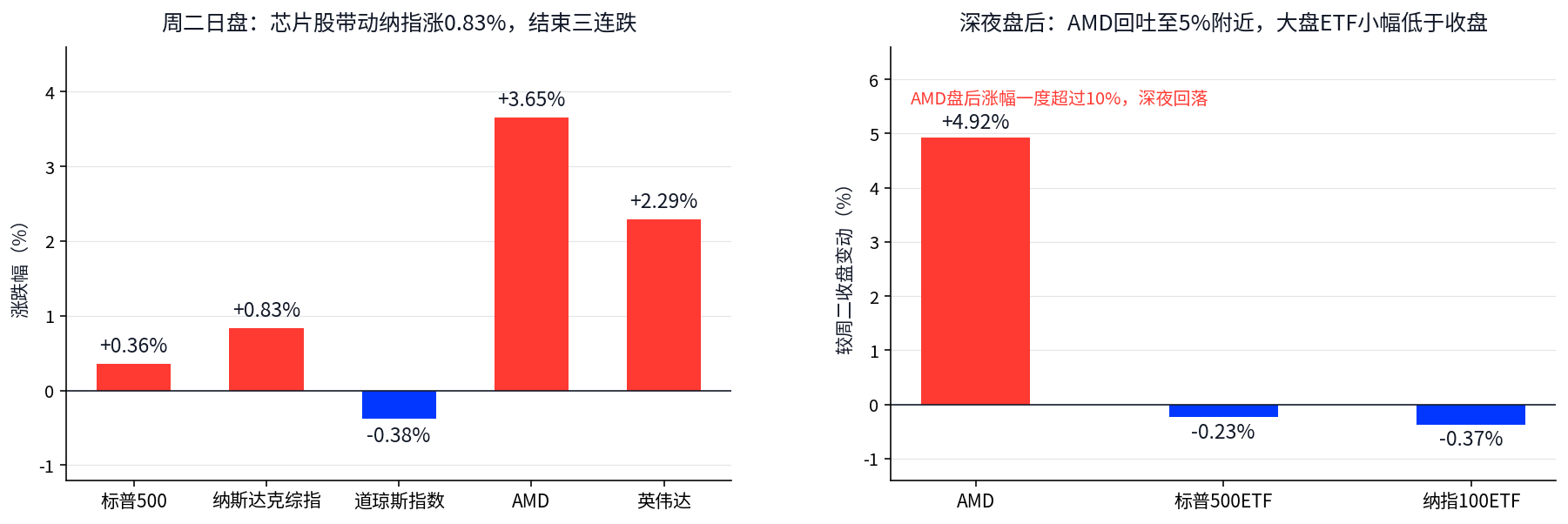
Comparison of AMD and the broader U.S. stock market's gains and losses during Tuesday's day session and late after-hours session
1. AMD Pushes Growth Expectations Out to 2027, With Data Center to Account for Over 80% of Revenue
The incremental value of this earnings report lies in extending growth expectations from the next quarter out to 2027. Whether this path holds depends on delivery, margins, and cash flow.
Third-quarter revenue was $13.38 billion, up 45% year-over-year and above the upper end of prior guidance. Data center revenue was $8.55 billion, up 97% year-over-year, accounting for 64% of total revenue, compared with 47% a year earlier. Overall gross margin was 56%, up 1.9 percentage points year-over-year, and operating income was $3.9 billion, up 75% year-over-year. Client and gaming segment revenue was $3.7 billion, down 8% year-over-year, while the embedded segment grew 29% to $1.1 billion.
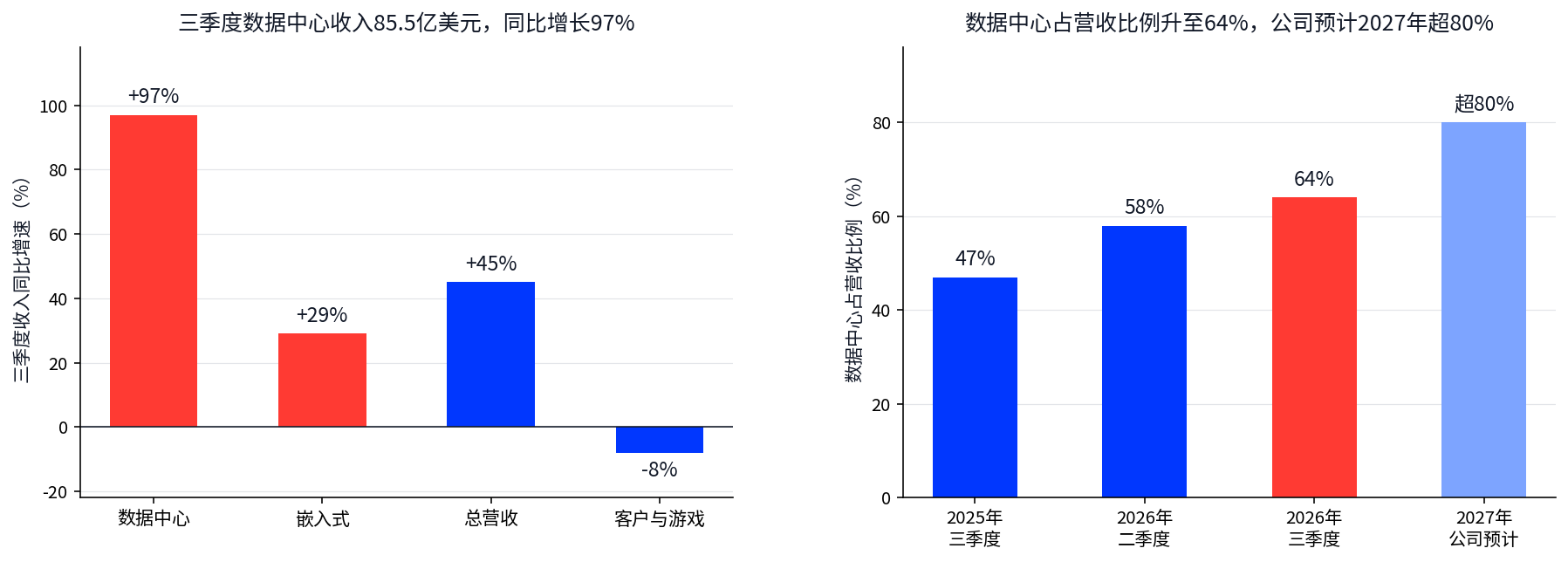
Changes in segment growth rates and data center share of revenue in the third quarter; the company expects the share to exceed 80% in 2027
The guidance is more aggressive than the current quarter. Fourth-quarter revenue guidance is $17 billion, plus or minus 3%, corresponding to roughly 66% year-over-year growth and about 27% sequential growth, with the data center segment growing about 50% sequentially and the client and gaming segment declining more than 20% sequentially. The company expects full-year 2026 data center segment revenue to more than double from 2025. For 2027, the company expects total revenue growth of over 80%, equivalent to more than twice the long-term financial model growth rate given at its November 2025 analyst day. By then, data centers will account for more than 80% of total revenue, with server revenue doubling year-over-year.
Product progress is in sync with guidance. MI455X began volume shipments in the third quarter, with the first Helios racks coming online for Anthropic, Meta, Microsoft, OpenAI, and Oracle. The company expects Helios deployments to increase significantly in the fourth quarter, with system partners such as HPE, Dell, Lenovo, and Supermicro beginning shipments.
The number that most needs to be tracked in this earnings report is actually free cash flow. Third-quarter free cash flow was $554 million, about 4% of quarterly revenue. The company's explanation is increased inventory and capacity investment, including back-end capacity locked in for data center demand. The more aggressive the guidance, the greater the cash tied up. The prerequisite for delivering 80% growth in 2027 is that both the supply chain and collection节奏 proceed without problems. When judging the credibility of this path, cash flow is a data point that sends warnings earlier than revenue figures.
2. After-Hours Gain Once Exceeded 10%, Then Gave Back Half: What Is the Market Digesting?
The after-hours spike was supported by the earnings report. The late-night pullback is still hard to distinguish between profit-taking and changes in election pricing; overlapping timing alone cannot establish causation.
Snapshots from multiple media outlets in the early after-hours session showed AMD up anywhere from 7% to 11%. A market data feed showed an after-hours quote of $507.70 at 7:52 p.m. ET, up about 4.9% from the $483.90 close. Cumulative after-hours volume through 7:52 p.m. ET was 35.17 million shares, already exceeding the average daily volume over the past three months (about 20.67 million shares). Over the same period, the S&P 500 ETF was quoted at $752.65 after hours, about 0.2% below the close, while the Nasdaq 100 ETF was about 0.4% lower. The 10-year Treasury yield was around 4.95%, essentially flat with the close.
The sequence was as follows: the Georgia seat projection appeared at 7:18 p.m. ET, more than half an hour before the after-hours quote above, while AMD's pullback occurred between the evening and late evening, overlapping with the time window of vote-counting progress. Existing public data cannot separate the two explanations. Index futures and spot pricing around Wednesday's open will be a clearer observation window.
3. The Suspense on Election Night Is in the Senate: The House Is Priced, a Sweep Is a Tail Risk
A Democratic takeover of the House is already close to the market's base case. Senate control remains uncertain, and a sweep of both chambers is a tail risk that warrants close attention.
According to CNBC and IBD's election-night live coverage, index futures rose after earnings reports including AMD's were released, with S&P 500 futures up as much as 0.2% to 0.3%, Nasdaq 100 futures up 0.5% to 0.55%, and Dow futures slightly lower. The reports explicitly stated that futures were mainly following after-hours earnings at that moment. In prediction markets, Kalshi priced the probability of Democrats winning the House at about 94% (November 2), and CNBC reported that Senate Democratic contracts were priced above 70%.
The first batch of heavyweight seat projections came from Georgia. Decision Desk HQ projected at 7:18 p.m. ET that Democratic incumbent Senator Ossoff would defeat Republican challenger Collins to win re-election, just minutes after polls closed in the state; the Associated Press had not yet followed suit that evening. Georgia was one of the Democratic seats Republicans most wanted to flip, and holding it is a plus for the Democrats' Senate path. The remaining suspense is concentrated in seats in Ohio, Maine, Texas, and other states, and results may not all be settled that night. In 2020, Georgia's two Senate seats were dragged into a January 2021 runoff. In 2022, Senate control was not settled until December. Delayed vote counting is normal in U.S. midterm elections.
Institutions have offered judgments on both outcomes for Wednesday. JPMorgan gave both sides: if Democrats win both the Senate and the House, the S&P 500 would fall about 0.5% on Wednesday; if Republicans hold both chambers, it could rise as much as 1%. Citi's strategy team argued that if Republicans lose the House but keep the Senate, that would actually be a tailwind for stocks through year-end. These are merely the views of the institutions concerned. Earlier, Man Group calculated that S&P 500 options priced only about 1.2 times the normal daily swing for the day after the election, assuming results come out relatively quickly. Putting these together, the market's thinking on election night was roughly this: who controls the House is largely reflected in prices, a Senate majority is the base case, and the real surprise would be one party sweeping both chambers.
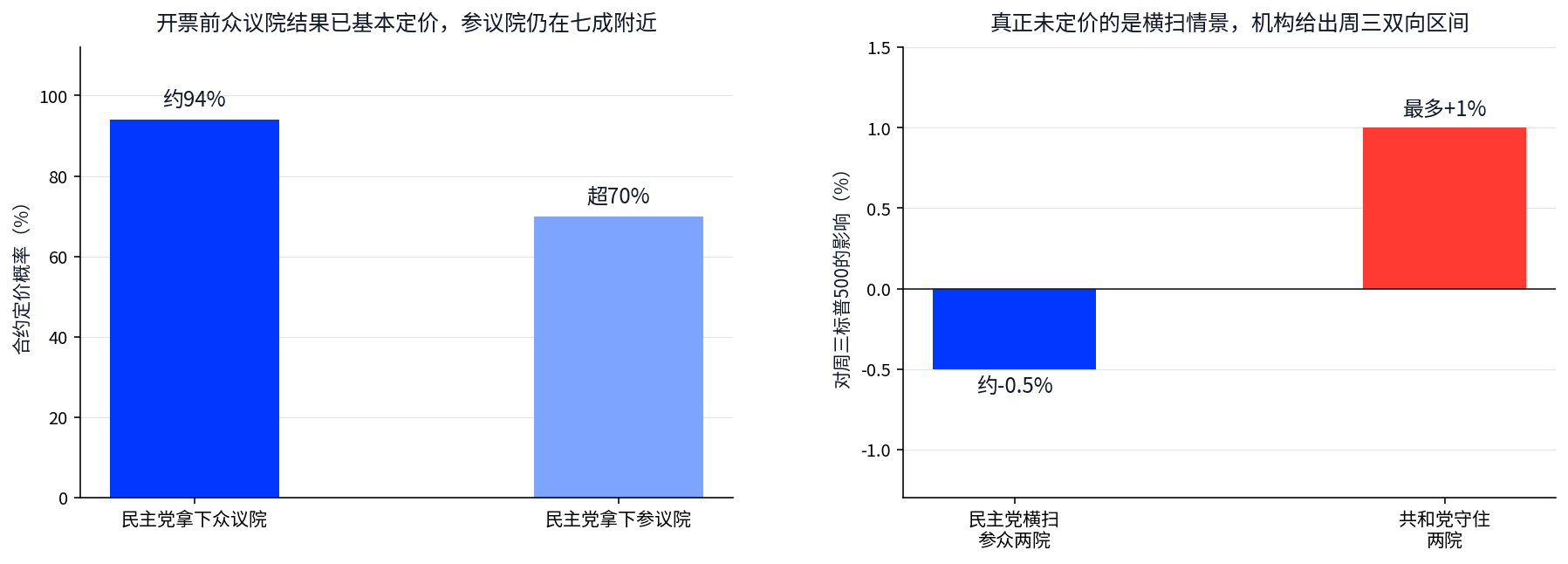
The probability of Democrats winning the House is priced around 94%, and institutions' Wednesday scenario range is between negative 0.5% and positive 1%
4. What Is AMD's Valuation Premium Buying? The Next Verification Is the Fourth-Quarter Earnings Report
The guidance was delivered after the stock had fallen 17.6% cumulatively over two days. Whether the premium can hold depends on whether fourth-quarter data center growth and cash flow can be delivered item by item.
Last Friday (October 30), AMD fell 10.9%, and this Monday it fell another 7.5%, for a cumulative two-day decline of about 17.6%. At the time, the market attributed the drop to Intel's weaker outlook and concerns about the pace of orders in the compute chain. Precisely because the stock had already fallen so much, this better-than-expected earnings report and relatively high guidance carry more weight. The market had been most focused on fourth-quarter guidance and the pace of new product ramp-up, and neither disappointed this time.
There are two tracking points. The first is the guidance for about 50% sequential growth in fourth-quarter data centers and whether it can be delivered; the first verification will come with the fourth-quarter earnings report around the end of January next year. In the same report, also watch whether full-year 2026 data center revenue doubles. In the interim, focus on Helios shipment pace and supply chain changes.
5. Hong Kong Stock Connect Southbound Net Buying of HK$23.42 Billion: Inflows Concentrated at the Index Level
The single-day net buying of HK$23.42 billion interrupted 14 consecutive trading days of net outflows. Buying was concentrated in broad-based ETFs, which is not yet enough to confirm a full recovery in risk appetite at the individual stock level.
On November 3, the Hang Seng Index rose 0.57% to close at 23,525.97 points, and the Hang Seng Tech Index rose 0.74%, with Hong Kong stocks rising for a third consecutive trading day. Southbound funds recorded net buying of HK$23.420 billion for the full day, with buy turnover of HK$59.434 billion and sell turnover of HK$36.013 billion, the highest single-day level since May 16. Among actively traded stocks, Tracker Fund of Hong Kong received net buying of HK$16.507 billion, CSOP Hang Seng Tech Index ETF HK$4.315 billion, and Hang Seng China Enterprises Index ETF HK$4.309 billion, totaling about HK$25.1 billion for the three, higher than the full-day net buying total, indicating that some individual stocks were also being net sold during the same period. Southbound turnover for the full day was HK$95.447 billion, accounting for about 40% of the Hong Kong market's total turnover of HK$236.404 billion.
On the same day that U.S. stocks were concentrated on pricing elections and earnings, some funds chose to buy broad-based index ETFs in Hong Kong. Concentrated inflows into broad-based ETFs are closer to an adjustment of overall market exposure; interpreting them as stock-selection judgments on Hong Kong tech names is not supported by existing data. Whether the return flow can continue depends on whether southbound funds maintain net inflows over the next three trading days.
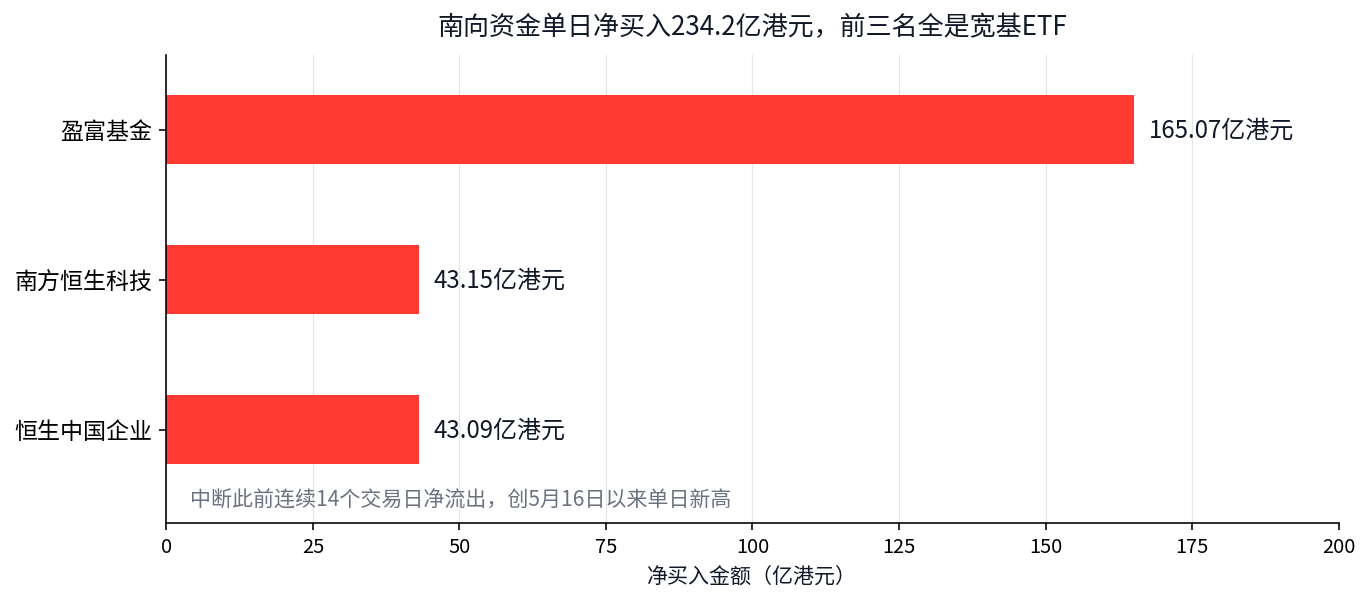
Southbound funds recorded single-day net buying of HK$23.42 billion, with all top three net buys being broad-based ETFs
6. The Next Macro Checkpoint: Friday's Nonfarm Payrolls and Rate Expectations
The impact of nonfarm payrolls on rate expectations depends on whether Senate control is settled before Friday.
At 21:30 on November 6 (Beijing time), the U.S. releases the October nonfarm payrolls report. The market expects about 63,000 new jobs, compared with 29,000 in September. If Senate control becomes clear before then, the pricing of nonfarm payrolls into the rate path will be reflected more directly in asset prices. If key seats remain unsettled, the market will have to digest two uncertain timelines at once. On the AMD side, the next hard checkpoint is the fourth-quarter earnings report around the end of January next year, with Helios shipment pace and supply chain dynamics as observation items before that.
There are variables in both the election results and the delivery of company guidance, and price volatility in the related assets warrants attention.
Final Thoughts: Three Sets of Numbers That Determine How to View the Market Next
The first set is AMD's $17 billion, about 50% sequential data center growth, and over 80% total revenue growth in 2027: these represent the growth commitments the company has made, corresponding respectively to the verification windows of the fourth-quarter earnings report and 2027 operating performance. The next step is to observe whether revenue, delivery, margins, and free cash flow can be delivered together.
The second set is election night's 94% and above 70%: a House flip is close to the market's base case, while the Senate remains uncertain. One of the market's biggest potential variables is Democrats winning both the Senate and the House, and whether the final results can be settled in the short term.
The third set is southbound funds' HK$23.42 billion: buying was concentrated in broad-based ETFs and cannot be directly equated with a full turn to strength in Hong Kong tech stocks. Fund flows and buying structure over the next three trading days will determine whether this return flow is sustainable.
Short-term observation order: first see whether election results are settled, then see how Friday's nonfarm payrolls change rate expectations; for AMD, use fourth-quarter data center growth and cash flow as the core verification points; for Hong Kong stocks, watch whether southbound funds can sustain net inflows. All three require subsequent data verification; conclusions cannot be drawn from a single trading day's moves alone.
Disclaimer:
This content is for general informational and market commentary purposes only and is based on public information compiled as of the times stated in the article. Relevant market data, expectations, and probabilities may change as market conditions evolve. The views and investment strategies of third-party institutions, analysts, or other persons cited in this article represent only the views of the relevant third parties at specific times and do not represent the views or recommendations of BIT. This article does not constitute investment advice, investment research, an offer, solicitation, or recommendation of any securities, investment products, or trading strategies, and should not be relied upon as the basis for any investment decision. Financial markets involve risk; securities prices and market performance may fluctuate, and historical performance and past market trends do not represent or guarantee future results. Investors should independently assess relevant risks based on their own circumstances and seek professional advice when needed. BIT's Hong Kong stock trading services are not provided to Hong Kong residents or users in other restricted jurisdictions.