


US Stocks Daily | Apple's Market Cap Tops $5 Trillion, Microsoft and Amazon Surge Over 6%, Oil Prices Plunge 8.5% (November 5)

1. Top Stories
- The Democratic "blue wave" sweeps Congress, clearing out the political uncertainty premium in one stroke. Democrats flipped 7 Senate seats, nearly 30 House districts, and 5 governorships (CNBC); the Dow rose 1,569.40 points (+3.03%) in a single day, hitting a one-year high, while the VIX fell from 20.83 to 16.61 (-20.26%). What the market is trading is "legislative predictability," not the direction of policy itself.
- Oil prices collapsed on bets that the "Iran war may be winding down." Vice President JD Vance publicly said the "real reason" for the Republicans' crushing defeat was the Iran war; Brent crude fell 8.46% to $94.83/barrel and WTI fell 8.13% to $88.27/barrel, at one point hitting the lowest level since September 4. This is the most direct source of the pullback in inflation expectations this round, and the main driver of the decline in long-end yields.
- The AI/data center chain sold off against the trend, the only systematic loser within tech on the day. The Texas governorship was won by Democrat Hinojosa (whose campaign centered on opposing "data center madness"), compounded by at least 29 community referendums nationwide supporting restrictions on data centers (Decrypt); the Philadelphia Semiconductor Index fell 3.13%, Micron dropped 7.00%, CoreWeave fell 9.90%, and Bitcoin miners/hashrate stocks generally posted double-digit declines.
- Apple's market cap tops $5 trillion for the first time, completing a "throne swap" with Nvidia. Apple rose 5.31% to $349.51, with a closing market cap of $5.08 trillion, surpassing Nvidia's $4.82 trillion (FourWeekMBA); Microsoft rose 6.68% to a record high and Amazon gained 6.12%, together adding $424 billion in market cap.
- Crypto assets rebounded amid "regulatory headwinds + $6.3 billion theft." Bitcoin reclaimed $80,000 ($80,518, +3.98% over 24 hours), but Binance confirmed that North Korean hackers infiltrated via fake interviews and stole $6.3 billion in assets; Fairshake, the industry's largest political action committee, lost in multiple states, and the outlook for the Clarity Act dimmed.
2. US Stock Market and Macro
2.1 The Three Major Indices and Volatility (2026-11-04 Close, EST)
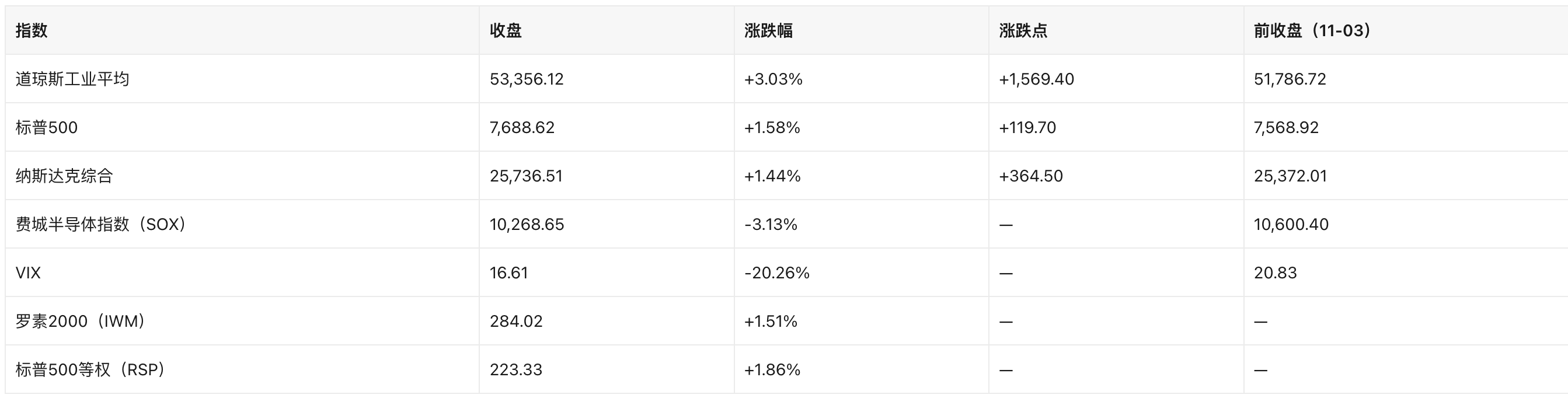
Core drivers (ordered by weight):
- The election results themselves: The expectation of a divided government materialized, eliminating the tail risk of extreme tax/regulatory scenarios, suppressing volatility and lifting risk appetite. The Dow's gain far outpaced the Nasdaq—a typical "low volatility + cyclical weighting" rally.
- Oil price collapse: The energy sector (XLE -4.74%) was the biggest drag, but its positive pass-through to transportation, consumption, and inflation expectations outweighed the impact of energy equity weightings.
- Cracks in the AI capex narrative: Semiconductors (SOX -3.13%), power equipment, and data center operators fell, forming a sharp divergence from the rise in large software/cloud vendors—the market is repricing between "AI demand is still there" and "power/permit bottlenecks in AI infrastructure."
2.2 US Macro Data Released on the Day (Published November 4)
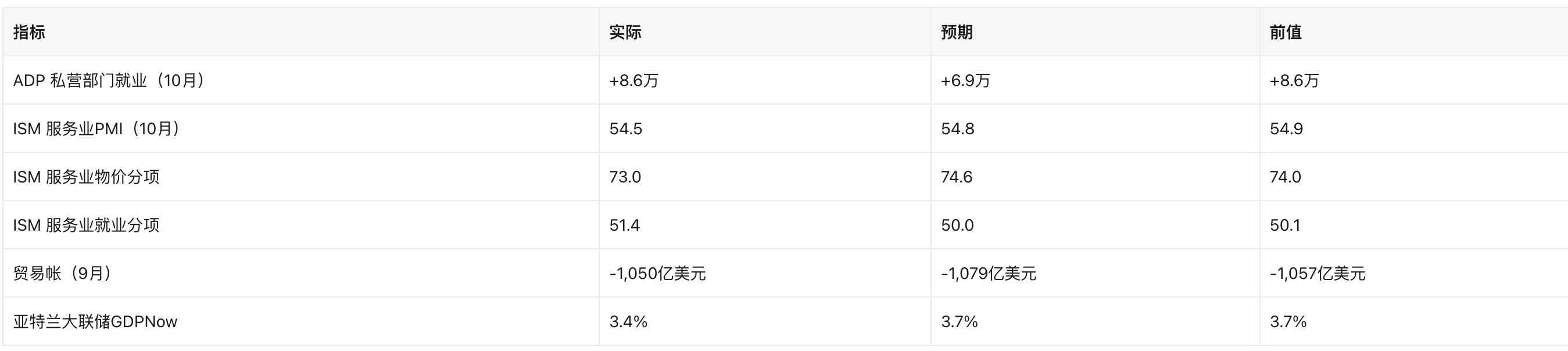
Interpretation: Labor market resilience (ADP beat expectations, the services employment sub-index returned above 50) coexisted with price stickiness (the prices sub-index at 73.0 remains elevated); services activity edged down slightly but remained in expansion territory. The data itself leans toward "no rush to cut rates," but on the day it was completely overshadowed by oil prices and the election narrative.
2.3 The Fed and Interest Rates
- Policy stance: The Fed held steady at its late-October meeting, while inflation has risen to a three-year high. The direction currently priced by the market is rate hikes rather than cuts: former St. Louis Fed President Bullard publicly bet on a December hike; on November 4, MarketWatch discussed the path under the headline "Will the Fed stop after two more hikes?"
- A reverse trade emerged on the day: Influenced by the oil price plunge and the pullback in AI stocks, some short-term interest rate (STIR) traders began betting that the Fed would "blink" in December. That is: rate hike expectations remain, but are being eroded at the margin by oil prices.
- Global synchronized tightening: Eurozone inflation rose to 4% in October (a three-year high), and an ECB December hike is "nearly certain" (Reuters/CNBC); the Bank of Japan signaled a December hike; the Reserve Bank of Australia has raised rates to an 18-year high. This is not a US-only problem, so the relative appeal of dollar assets has not collapsed.
2.4 US Treasuries, the Dollar, and Commodities (2026-11-04)
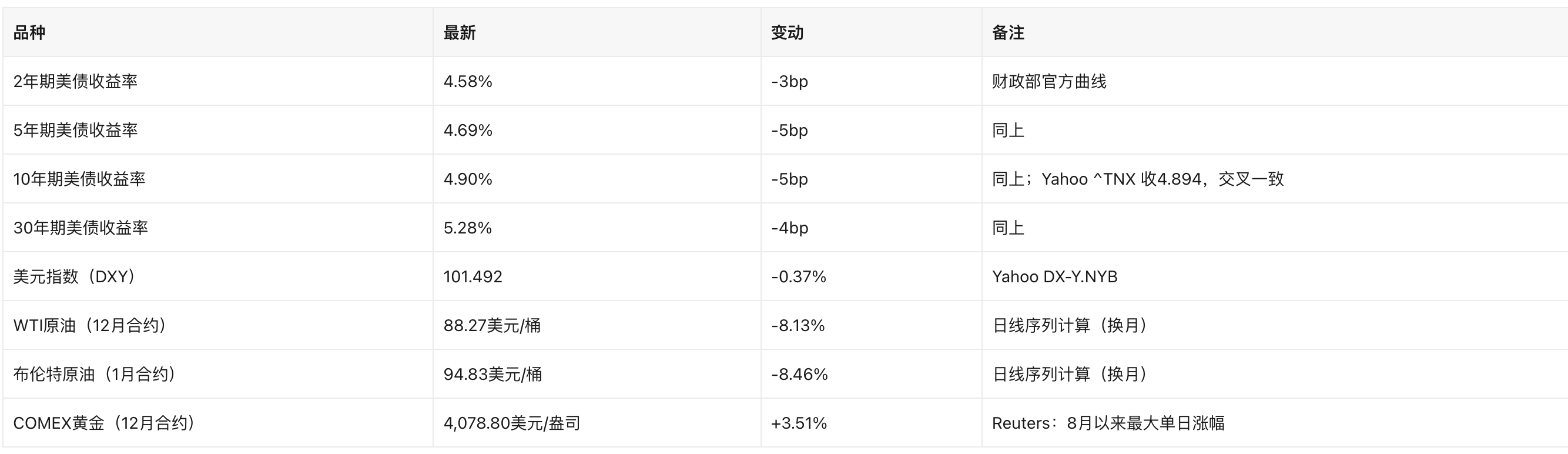
Yield curve shape: The 10Y-2Y spread is 32bp, and the 30Y-10Y spread is 38bp. Long-end yields are still running above 5%, indicating that "inflation relief from falling oil prices" only压低 (lowered) marginal pricing and did not change the medium-term logic of fiscal supply pressure (JPMorgan's Michele publicly called on the Treasury to cancel 20-year bond issuance).
3. Hot Stocks and Sectors
3.1 Big Tech: The Concentrated Beneficiaries of the Election Certainty Premium
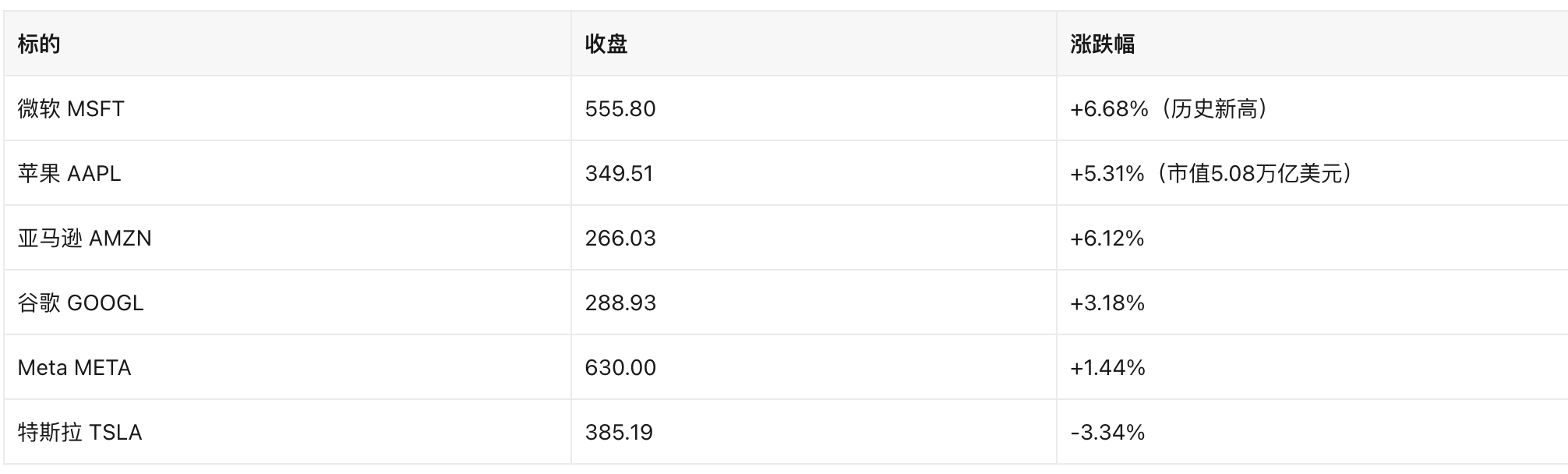
- Microsoft: A single-day gain rare in recent years, hitting a record high. CNBC attributed it to "election results eliminating investor uncertainty," while market concerns over the financing arrangements for hyperscalers' AI capex (Meta's debt financing progress) eased.
- Apple: Market cap closed above $5 trillion for the first time, overtaking Nvidia to become the world's most valuable company. The driver comes from defensive allocation demand for "safe-haven attributes + services cash flow"—amid AI capex anxiety, Apple is seen as "the tech giant that doesn't burn cash."
- Tesla: Diverged from the broader tech rebound, falling 3.34%, the only notable loser among big tech on the day.
- Implication of the divergence: Buying software/cash flow, selling hardware/capex—the clearest style signal of the day.
3.2 Semiconductors and AI Infrastructure: The Day's Biggest Losers
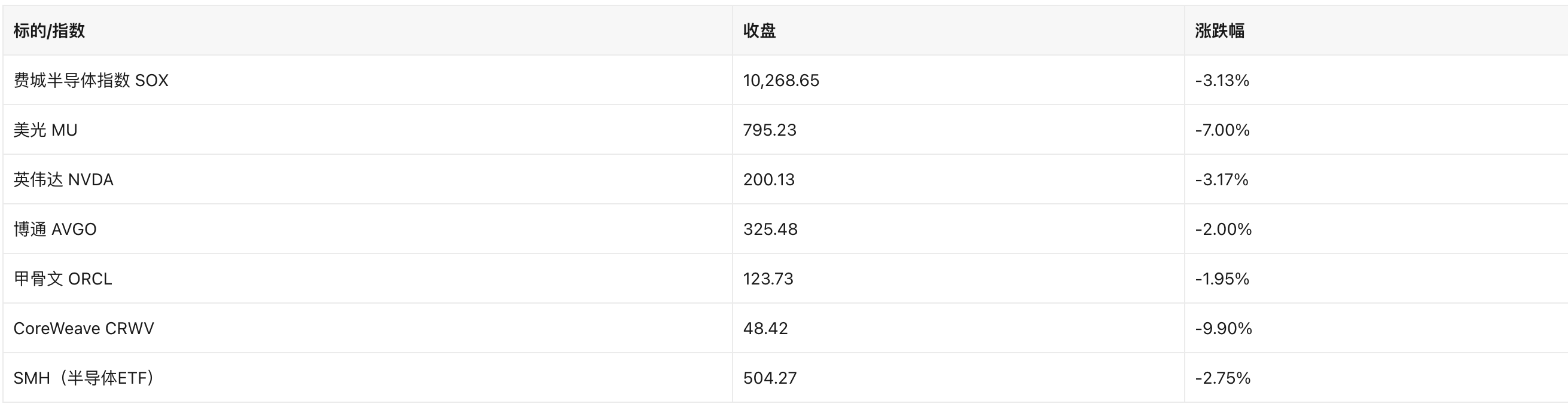
Transmission logic: Texas gubernatorial election + 29 community referendums restricting data centers → rising uncertainty over power access and construction permits → the market marks down the 2027-2028 rack/power delivery pace → first the "shovel sellers" of compute leasing and storage get hit, then it spreads to GPUs and equipment.
Uncertainty: Already-approved projects may instead benefit from tighter supply (CoinDesk citing analyst views), which is also why some miner/data center stocks diverged on the day.
3.3 Energy: The Direct Victims of Oil Prices

Energy stocks fell in tandem with oil prices; Caterpillar's decline was interpreted by the market as a setback to "data center order expectations for power generation/backup equipment" (a market attribution, not a company disclosure).
3.4 Financials, Consumer, and Clean Energy: The Beneficiary Side of the Election Trade
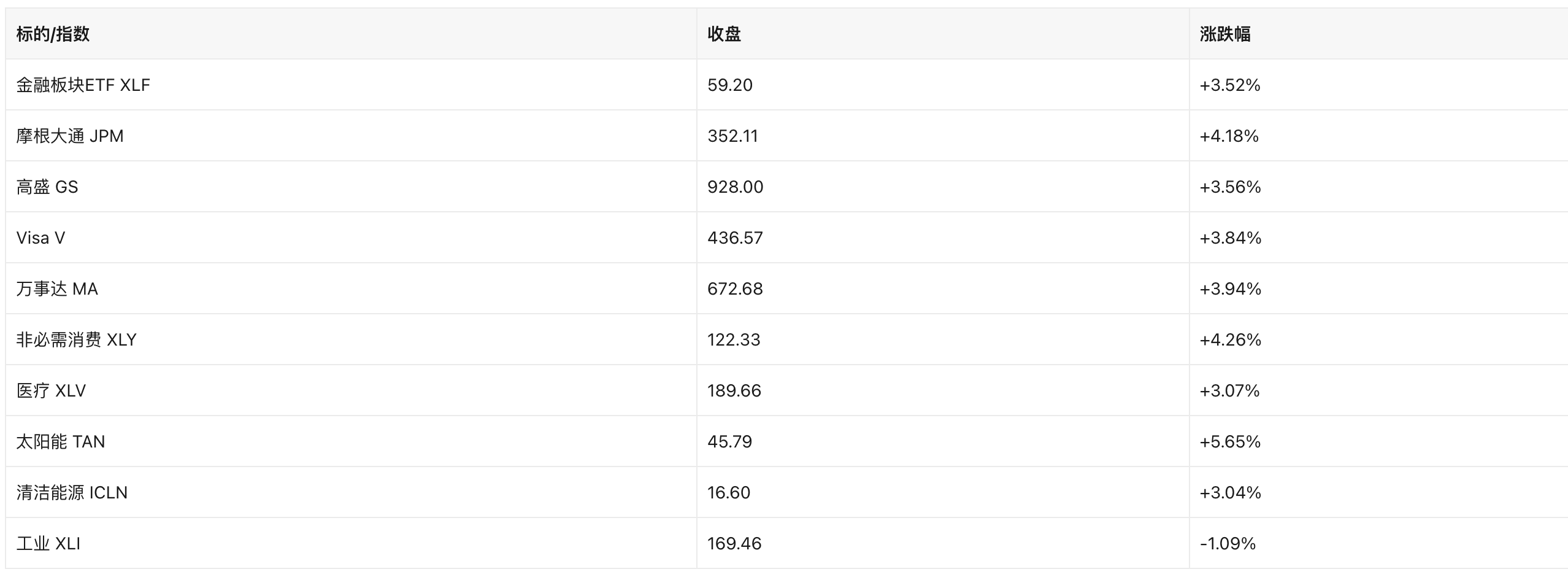
Clean energy is the direct beneficiary of "Democrats controlling Congress → reduced subsidy policy risk"; financials and payments benefited simultaneously from falling yields and expectations of consumer resilience. Industrials fell against the trend, reflecting concerns over capital goods demand related to data center construction outweighing traditional infrastructure expectations.
4. Crypto-Related US Stocks
4.1 DAT Leader: Strategy (MSTR)
Holdings and Cost (SEC 10-Q, filed 2026-11-02)
- As of October 25, 2026, holds 848,517 BTC, valued at $68.27 billion based on Coinbase's 16:00 ET quote of $80,456 that day; 847,666 as of September 30, and 672,500 at the end of 2025.
- Disclosed on November 2: Added 811 BTC between October 26 and November 1, spending $65.5 million at an average price of $80,846. Post-purchase holdings: 849,327.
- No new convertible bond issuance announcements; during the same period, executed $208.2 million in STRC preferred stock repurchases (cumulative $208.2 million), and raised the STRC dividend rate to 11.5%. A rising preferred stock yield usually means higher financing costs, a signal of "funding-side pressure."
Q3 Financials (10-Q)
- Total revenue $125.4 million (vs. $128.7 million a year earlier), with the software business base continuing to contract slightly.
- Net income $19.533 billion (vs. $2.785 billion a year earlier)—mainly driven by the rise in BTC fair value and the release of deferred tax valuation allowances; this is book profit under accounting standards (ASU 2023-08 fair value measurement), not operating cash flow.
- Net long-term debt $6.715 billion (vs. $8.190 billion at the end of 2025), with 2029 convertible bonds reduced from $2.98 billion to $1.49 billion.
Valuation basis (self-calculated, inputs all traceable)
- Based on 422.35 million total shares as of October 25 (402.714 million Class A + 19.640 million Class B) × November 4 close of $142.54 = market cap $60.20 billion.
- Holdings value = 849,327 × $80,518 = $68.39 billion.
- Market cap / holdings value = 0.88x (simple basis, excluding $6.715 billion in long-term debt and preferred stock; including $6.715 billion in long-term debt, it is 0.98x). This means MSTR has shifted from "buying coins at a premium" to "trading at a discount," and the premium premise of its financing-to-coin-purchase flywheel has clearly weakened.
Stock price: +5.10% to $142.54, but still significantly below its 52-week high; it had previously hit an 8-month low on November 2. Separately, according to Yahoo Finance, the company's CFO has departed, and the market is watching the continuity of the financing team.
4.2 Other DATs and Accumulators

Crypto US Stock Watchlist
- No new US-listed companies "announced coin purchases/DAT conversions" this period.
- New risk watch: NXTT—the first DAT to publicly discuss reducing holdings due to "custody security + quantum risk"; if executed, it would be the landmark case of a "treasury company shifting from buying to selling" this cycle.
- Hut 8 (HUT) has sold 3,102 BTC to repurchase $250 million in stock (24/7 Wall St), with shares -23.23% to $48.94 on the day—the market's pricing of "selling coins to buy back stock" was negative.
4.3 Broad Crypto US Stocks: Exchanges, Stablecoins, and ETFs
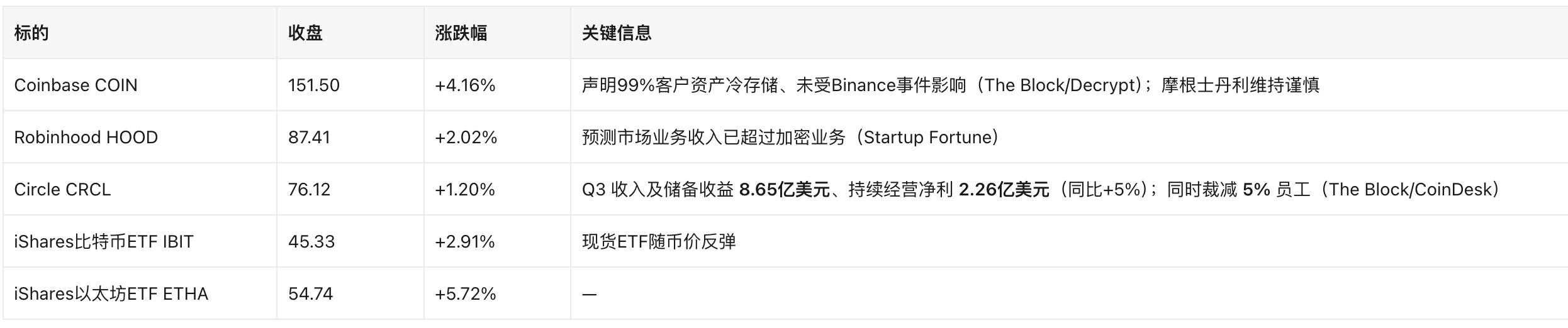
ETF Fund Flows (as of November 3; November 4 data not yet released)
- US spot Bitcoin ETFs saw net outflows of $115.6 million on November 3, the third consecutive trading day of outflows; cumulative net outflows over three days totaled $1.16 billion (HedgeCo, AMBCrypto).
- IBIT saw single-day net outflows of $405.3 million, the largest single-day outflow since June (Coinpaper reported on November 3, corresponding to November 2 data; 24-7 Wall St also cited the same figure).
- Structural implication: ETFs are selling, Saylor is buying—the marginal buying in this rebound came from corporate treasuries and short covering ($380 million in shorts liquidated, Bitcoin Foundation), not ETF flows.
4.4 Miners and "Mining-to-AI": The Day's Hardest-Hit Sector
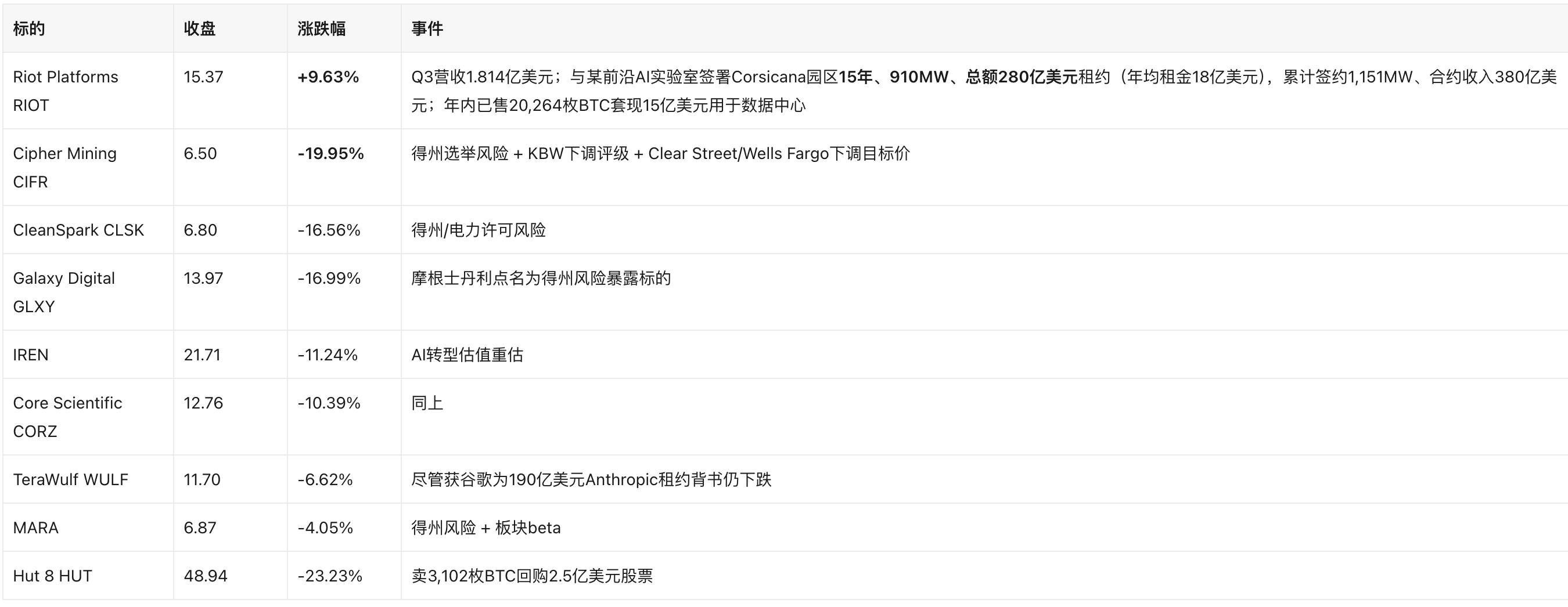
Data sources: RIOT data taken from the company's Q3 earnings release (SEC 8-K Exhibit 99.1); other individual stock events and target price adjustments per The Block, CoinDesk, 24/7 Wall St, Blockspace, and Investing.com reports.
Core contradiction on the day: RIOT proved the cash flow value of its AI pivot with a "largest-ever lease" (+9.63%), while other miners were uniformly suppressed by "Texas political risk." Bernstein cut target prices for 7 miners on the day, and Morgan Stanley separately flagged Texas exposure for Cipher, Galaxy, and MARA (Blockspace). This means the sector has moved from "rising and falling together" into a phase of "differentiation by the quality of approved projects."
4.5 Regulatory and Accounting Drivers
- The midterm elections are the first variable: With Democrats controlling Congress, market consensus is that the probability of the Clarity Act passing in its current form has fallen sharply (CoinDesk: "possibly the final nail in the Clarity Act's coffin"). At the Senate level, former Senator Sherrod Brown returned in Ohio, directly hitting industry PAC Fairshake—more than one-third of its spending this cycle failed to hit its targets.
- Areas of relative resilience: Tokenization and stablecoins are widely believed to be able to continue advancing under existing law—DTCC's tokenization service has signed 20 institutions, Morgan Stanley completed tokenized conversions of stocks and Treasuries; SEC staff gave a "digital commodity" no-action position on Canton Coin (Decrypt/CoinDesk). This constitutes a layered landscape of "tighter regulation but no reversal of institutionalization."
- Accounting rules: Fair value measurement is now in effect, as evidenced by MSTR's $19.5 billion single-quarter book profit; but it also means falling coin prices will directly hit the income statement, and the accounting halo of the "treasury premium" is turning into a double-edged sword.
5. Geopolitical Impact
5.1 The Iran War: From "Escalation" to "Seeking an Exit"
- Events: Vice President Vance attributed the Republicans' crushing defeat to the Iran war after the election; President Trump said the same day he was weighing whether to strike further (Yahoo Finance); Treasury Secretary Bessent said "the world can live without Iranian oil."
- Market interpretation: The White House linking the war to the election loss was read by traders as a