

Unpacking Variational in 10,000 Words: How an Exchange Without an Order Book Became the Runner-Up Behind Hyperliquid?

Source: Duldul (@Duldul_Capital)
Compiled by | Odaily (@OdailyChina); Translator | Azuma (@azuma_eth)
The first time I opened Variational, I didn't understand why anyone would want to use an exchange without an order book. I was used to order books, used to seeing who my counterparty was.
Months later, I came back — this time to execute a delta-neutral trade on Variational against Lighter. As it turned out, my view changed.
You simply click to place an order, the system quotes a price for your entire trade size, the trade fills, and that's it. Beyond that, the cost of this trade was noticeably lower than when I first tried it.
By weekly trading volume, Variational is now the second-largest Perp DEX behind Hyperliquid. The platform offers over 570 trading markets, covering assets such as equities, crude oil, and gold, and it operates on a zero-fee model.
Variational's native token VAR is scheduled to launch in Q4, with OTC pre-market valuations currently around $1.5 billion.
The question this article aims to explore is — is that price reasonable?
First, I'll introduce the team behind Variational and how it works, then discuss what impressed me, what concerns me, and what I think it's actually worth.
Who Runs Variational?
Variational was founded by two quantitative traders. Since 2017, they have been doing exactly what they now want to bring on-chain — market making and OTC (over-the-counter) trading.
Two Alumni Who Lived in Adjacent Dorms
Lucas Schuermann (CEO) and Edward Yu met during their freshman year at Columbia University, living in the same dorm building designed for entrepreneurs, in rooms right next to each other.
Schuermann could be considered a prodigy — he began studying mathematics at the University of Oklahoma at age 12; he later attended Columbia University for computer science and interned at Goldman Sachs and Google X.
Yu graduated from Columbia University with a degree in applied mathematics, worked at Facebook, and published papers on Bayesian statistics.
In 2017, the two co-founded Qu Capital, a fund focused on cryptocurrency statistical arbitrage that raised capital from institutional investors. In 2019, the fund was acquired by Digital Currency Group (DCG), founded by Barry Silbert.
The two subsequently joined Genesis. At the time, Genesis was one of the largest OTC trading platforms in the crypto industry. Schuermann served as VP of Engineering, responsible for building the infrastructure of the OTC trading platform; Yu served as Head of Quantitative Research, responsible for market making in linear contracts and options markets.
The two left Genesis in 2021. Two years later, in 2023, Genesis collapsed — by then, they had long since departed.
This detail is worth mentioning because having the name Genesis on a resume today inevitably raises some questions.
Trading First, Protocol Second
Variational was not originally a DEX.
Before officially launching the product, the team operated in stealth mode for about two years, active as a proprietary market maker across major centralized exchanges (CEXs) and decentralized exchanges (DEXs).
This experience led the founding team to three lessons that directly shaped today's product design:
- Building an order book from scratch is very slow — each new trading pair requires separate negotiations with market makers;
- Exchanges cede a substantial portion of value to market makers, and that value ultimately flows out of the ecosystem;
- OTC derivatives trading is still plagued by lawyers, endless communication, bank wires, and a large operational staff. In Schuermann's words, that's just how it is.
Omni (Variational's current core product) solves the first two problems, while Pro (Variational's planned upcoming product) targets the third.
Team Size
As of May 2026, Variational has 24 employees, a significant expansion from 7 in 2024. Its developers and quantitative researchers come from companies such as Google, Meta, Virtu, IMC, and Jane Street.
The company is incorporated in the Cayman Islands, with the team working from New York.
Interestingly, the team's attitude toward profitability. Schuermann says revenue is their most important metric. The reason is simple — unlike competitors with massive VC war chests, they cannot afford to lose money for years to compete for users.
This is also why, before the TGE, Variational's treasury has already accumulated nearly $12 million.
Investors
Variational has raised approximately $62 million across three funding rounds. The investor list isn't long, but the lineup is quite impressive.
The seed round used standard equity financing with 1:1 token warrants attached, meaning the number of tokens investors receive corresponds to their equity stake.
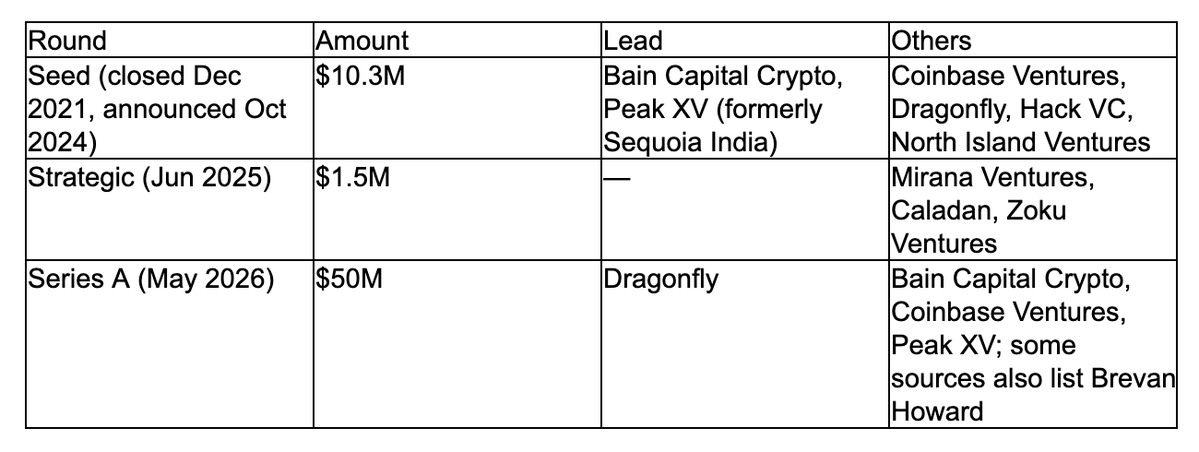
A few things worth noting:
- Dragonfly is the most noteworthy. It led Variational's Series A round, with capital from a new $650 million fund. Schuermann has also publicly stated that Dragonfly can help him open up collaboration and integration channels in traditional finance (TradFi).
- The same group of investors once backed dYdX. Dragonfly and Bain Capital Crypto also participated in dYdX's 2018 Series A. dYdX was once the king of perpetual contracts, but its token price has now fallen 97% from its all-time high. Great investment firms don't necessarily guarantee great token performance.
- Brevan Howard is a signal of traditional finance background. This institution is one of the world's largest macro hedge funds. Its presence aligns with Variational's narrative of connecting with traditional finance market makers, but not all sources confirm this investment relationship.
- The JPMorgan relationship has not been officially confirmed. According to unofficial sources, Variational has a direct credit line with JPMorgan. However, I could not find any public information to confirm this.
How Does Omni Work?
Omni is more like a currency exchange counter than a traditional exchange.
On a traditional exchange, you post orders into a shared order book and wait for someone to fill them. At an exchange counter, you simply ask for a price, the counter gives you a quote, and you can choose to accept or decline.
In Omni, this counter is the Omni Liquidity Provider (OLP) — a market maker owned by the protocol itself.
The process for each trade is roughly as follows:
- You input the asset you want to buy or sell, along with the trade size;
- The OLP provides a quote for your entire trade size;
- You accept the quote, and the OLP becomes your counterparty;
- The OLP then hedges its position wherever liquidity exists — for example, Binance, Hyperliquid, or traditional bank dealers.
Omni charges no fees. Its revenue comes from the spread between the quoted price and the actual hedge price, with approximately 20% of this revenue currently flowing to the protocol treasury.
This means Omni doesn't need to build liquidity from scratch for each trading market. It can list perpetual contracts for Apple stock or Brent crude oil because liquidity for these assets already exists in other markets.
This is also why Variational can offer over 570 trading markets, with RWA trading volume now accounting for more than half of the platform's total trading volume.
Schuermann says that in his view, Hyperliquid is not a competitor but one of his own liquidity sources. Compared to traditional exchanges, Variational's positioning is actually closer to Robinhood.
What Impressed Me?
No One Can Hunt Your Orders
In a traditional order book, large orders and stop-loss orders are visible, and market makers can use this information for targeted trading.
In Omni, no one except the OLP can see your orders. For those who need to trade large positions, this is a real advantage. Of course, to be fair, the OLP can see everything — your positions, trade size, even your liquidation price.
This is more of a broker relationship than a fully anonymous dark pool.
Convenient and Cheap
The entire order only requires accepting a single quote — no need to split it into multiple small orders filled one by one.
Currently, the spread on ETH is about 1.3 basis points, while spreads on index and crude oil markets are even below 1 basis point.
Real Money Already in the Treasury
As of October 28, Variational's treasury holds approximately $11.8 million in USDC, with about $2.5 million flowing in during September alone.
According to the team's plan, all treasury revenue will be used to buy back and burn tokens.
By comparison, Lighter did not have similar financial support on its TGE day. It initiated buybacks about a week after TGE, when the treasury held approximately $1.35 million.
TradFi Resources Are More Than Just Talk
When equity and index perpetual contracts launched, TradFi dealers committed to providing over $1 billion in open interest (OI) capacity.
Within a week of launch, trading volume for these contracts reached $2.8 billion.
Everyone Has an Independent Fund Pool
Each trader's position is held in a separate contract with the OLP. If the trader next to you gets liquidated, their losses won't propagate to your account.
This contrasts with what happened on some other trading platforms during the market crash on October 10, 2025.
Smart Contracts Have Been Audited
The protocol has passed security audits by Zellic and Spearbit, and has experienced no hacking incidents to date.
However, Variational runs on Arbitrum, so it also bears the associated risks of Arbitrum itself.
Who Are Variational's Competitors?
RWA is not an uncontested blue ocean, and Variational is not the largest player in this market.
After Hyperliquid opened external market deployers (HIP-3), RWA accounted for more than half of its total trading volume for two consecutive weeks in July, with one of the largest deployers being trade.xyz.
According to September data from DefiLlama Research, trade.xyz's trading volume was approximately 3x that of Variational, at $255 billion and $80 billion respectively.
However, Variational is catching up quickly. In late July, Variational accounted for about 14% of the two platforms' combined trading volume; by September, this had risen to about 36%.
Additionally, there are Ostium (also deployed on Arbitrum), Lighter independently deployed on Robinhood Chain, and a growing number of perpetual contract products from regulated brokers.
So Variational's real advantage is not RWA itself, but how it sources liquidity. Hyperliquid and trade.xyz must attract market makers for each new market, while Variational can directly tap dealers who already have the relevant liquidity.
If this model can be replicated across hundreds of markets, the advantage could persist long-term — but if TradFi dealers start quoting directly on Hyperliquid, this advantage could disappear.
What Concerns Me?
A Potential Sell-Off After the Airdrop
At TGE, the entire initial circulating supply is expected to come from the airdrop — 32% of total supply, fully unlocked from the first minute. At a $1.5 billion valuation, that means approximately $480 million worth of tokens will go directly into the hands of "points farmers." For many, this is life-changing wealth, so they are likely to sell.
By comparison, the approximately $11.8 million in treasury funds represents only 2.5% of this circulating supply. Buy pressure at TGE launch must come from exchanges, funds, and market narrative — not from the protocol itself.
Historical data offers some comfort. After Lighter's TGE, about two-thirds of airdropped tokens remained in holders' wallets; but conversely, one year later, 50% of tokens held by the team and investors will begin to unlock.
It's worth noting that actual circulating supply after TGE could also exceed 32%. Excluding the airdrop, investor, and team allocations, the remaining 18% of tokens belong to the ecosystem reserve, held by the Variational Foundation, which can decide how to use them at its discretion — no specific release schedule has been published. If some of these are allocated to market makers at TGE or used for exchange listings, the actual circulating token count would exceed what the airdrop alone suggests.
Some airdropped tokens may also be burned. Variational's terms exclude users from the United States, Canada, Taiwan, and sanctioned countries. Users must sign VAR terms when claiming tokens, and unclaimed tokens will be burned. If some points belong to users who are ineligible to claim, the actual circulating supply would be smaller. However, I don't think this number will be particularly significant — after all, everyone uses VPNs.
We don't know exactly who holds the points. I could not find public data on points distribution concentration. Dozens of whales holding half the airdrop versus tens of thousands of small points farmers each holding tokens creates completely different sell pressure.
Currently, VAR token has only one announced utility — using treasury revenue to buy back tokens. It has no governance, staking, or fee discount functions, with more details expected before TGE. Therefore, buying VAR now is essentially purchasing a buyback expectation backed by approximately 20% of OLP spread revenue.
How Much Trading Volume Will Remain After Points End?
A significant portion of Variational's trading activity today comes from points farming.
Based on the performance of other perpetual DEXs after launch, trading volume typically drops by about 54% on average in the first month after TGE. I expect Variational's OI and trading volume could decline by 30%–60%.
However, I believe its product has found product-market fit (PMF), and users will continue to farm points on other perpetual DEXs, so a considerable portion of trading volume will remain, using Variational as a hedging venue.
On traditional exchanges, declining volume typically triggers a vicious cycle — fewer traders, wider spreads, leading to more traders leaving. Omni can avoid this problem to some extent because the OLP hedges in other markets, and this cost does not depend on Variational's own trading volume.
The real problem lies elsewhere. Points farmers are actually the ideal customers for market makers because their trading behavior tends to lack regularity. After TGE, most remaining users will be more sophisticated traders. The OLP will make less money from them — or may even lose money. Ultimately, spreads for everyone could widen as a result.
API and Toxic Order Flow
This is my biggest concern.
Variational has announced it will open a public API before TGE. There will always be participants faster than the OLP — institutions like Jane Street, for example. They may have already captured opportunities after a price move on Binance before the OLP has had time to update its quotes.
I don't believe this can be 100% prevented. The real question is whether the resulting losses are within acceptable limits.
Deliberately introducing latency before order execution (e.g., 200 milliseconds) doesn't help much here. Research shows that such artificial speed bumps only mildly curb the speed race among participants. However, Variational does have a more powerful tool — the so-called Last Look.
If the price moves adversely before execution, the OLP can reject the order. It can also offer worse quotes to accounts that consistently profit from it. Forex brokers have been using this mechanism for years. It works, but it comes at a cost.
If the OLP starts rejecting orders every time the market price moves, what was a convenient exchange counter becomes a counter that only sells when it feels like it. In forex markets, abuse of the Last Look mechanism has led to banks being fined.
I once worked at a zero-fee exchange, so I don't buy the "our algorithms will be better" argument. There will always be someone faster and better than you. The real question is whether the losses the platform ultimately has to bear from toxic order flow are acceptable.
Who Pays When the OLP Loses Money?
The OLP is the counterparty to every trade on Omni, meaning all platform risk is concentrated in one place. If the OLP goes bankrupt, trader profits accrued from that point onward would not be paid out. The protocol documentation explicitly states this.
<