


Google Backstops TeraWulf's $19 Billion Anthropic Deal: Credit Support, Deal Structure, and Project Financing Risk Breakdown

Overview
The November 4 announcement changed the project's financing eligibility, not its revenue timing. TeraWulf signed a credit support agreement with Google LLC covering anticipated debt financing, and the announcement also noted that Alphabet's senior unsecured debt is rated AA+ by S&P and Aa2 by Moody's. This means the project debt can be priced using the credit of an AA+ rated entity, rather than being priced on the standalone credit of a company with a market cap of under $2 billion and roughly $5.21 billion in debt. That is the entirety of what "bankable" means here.
Three distinctions need to be made clear at once. The $19 billion figure is the total value of the twenty-year lease commitment signed on July 6—not Google's investment amount, and not any confirmed revenue. Amortized evenly over twenty years, it corresponds to roughly $950 million per year, equivalent to 5.3 times the company's annualized revenue of $179.2 million in the prior fiscal quarter; and the first serviced-ready capacity will not begin delivery until late 2027, phasing through the second quarter of 2028. In other words, this lease will contribute zero to the income statement over the next four to five quarters.
Key Takeaways
The announcement itself does not disclose four key terms: the amount of Google's guarantee, the consideration Google receives in exchange, the value of the Fluor contract, and the size and structure of the proposed project debt. What has been disclosed is that the project is the Justified data campus in Hawesville, Kentucky; the lease corresponds to roughly 401 MW of critical IT load; and Fluor Enterprises' engineering, procurement, and construction contract uses a guaranteed maximum price approach and covers three data center buildings. The key detail is that this guaranteed maximum price is still being determined as engineering and procurement proceed—meaning the construction cost ceiling has not yet been truly locked in. The August 2025 precedent in which Google provided a guarantee for the Fluidstack lease can serve as a term benchmark: two rounds totaling $3.2 billion in guarantees in exchange for 73.5 million warrants, representing 14% pro forma equity, equating to roughly $43.54 in guaranteed amount per share.
What the July Lease and the November Agreement Each Accomplished
The two announcements address entirely different problems; viewing them together will lead to misjudging progress.
The July 6 announcement established the revenue side. The twenty-year lease signed with Anthropic corresponds to roughly $19 billion in contracted revenue, covering facilities purpose-built for AI infrastructure at the Justified data campus, at roughly 401 MW of critical IT load, with initial capacity expected online in the second half of 2027 and full capacity in place by early 2028. On the same day, the company also sold its 50.1% interest in the Abernathy joint venture to an investor group led by Fluidstack; the invested cost of that interest was approximately $450 million, and the sale price exceeded invested capital. The stock rose more than 10% in early trading on the day of the announcement, following a year-to-date gain of roughly 85% based on the prior close.
The November 4 announcement addressed the funding side and the construction side, not the revenue side. It contains two components: a credit support agreement with Google LLC for anticipated debt financing, and a definitive engineering, procurement, and construction agreement with Fluor Enterprises, the latter building on the limited notice to proceed from March 2026. The announcement also mentioned that the Muskie data campus in eastern Kentucky has contracted power expanded to 1 GW—this is a separate project.
Putting the two on a single timeline: July locked in who pays, how much, and for how long; November locked in who executes construction and made borrowing feasible. What remains missing is the money actually arriving and construction completing on schedule—neither of which has happened yet. The gap between contracts and delivery in the mining-to-AI-infrastructure transition was discussed in the September 17 pre-market briefing.
What the $19 Billion Is, and What It Is Not
This is the set of numbers that most needs to be distinguished in this piece; the three are entirely different in nature.
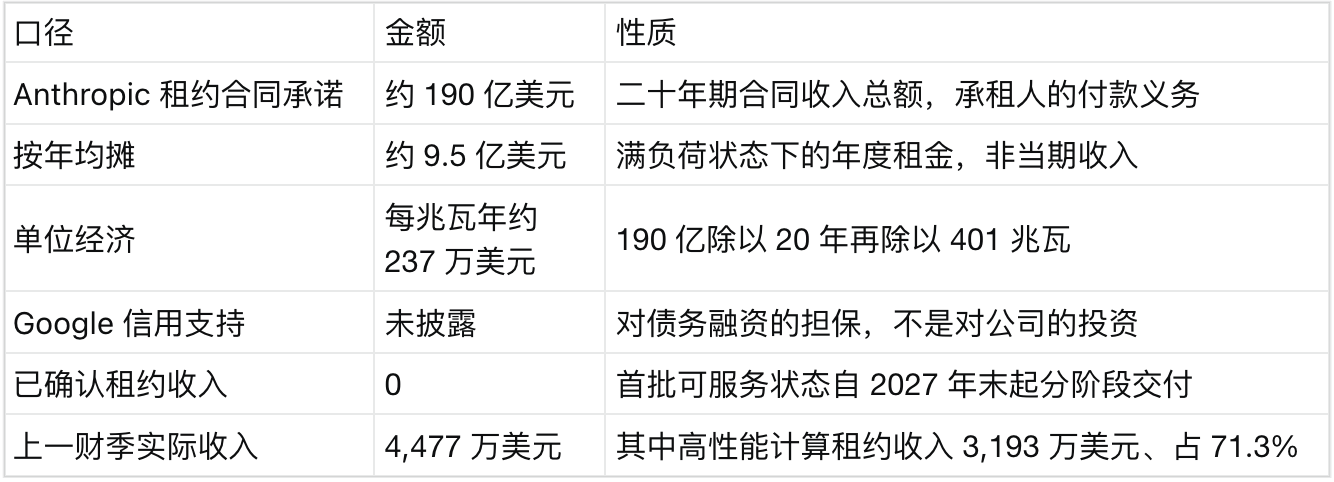
Comparing the second row with the last row: full-load annual rent is 5.3 times the company's annualized revenue from the prior fiscal quarter, or 6.03 times when annualizing first-half revenue. This multiple shows that once the project is operational it will fundamentally change the company's scale—and it also shows that before operation, the company's financial statements have no direct connection to this $19 billion.
Unit economics are worth calculating separately, because they determine whether the project itself is worthwhile. Over the twenty-year term, contracted revenue per MW of critical IT load is $47.4 million, while the company's disclosed construction cost guidance is $8 million to $10 million per MW of critical IT load, corresponding to $3.21 billion to $4.01 billion for 401 MW. Using the midpoint cost of $9 million per MW, twenty-year contracted revenue equals 5.26 times construction cost, or a range of 4.74 to 5.92 times at the lower and upper bounds. This ratio is reasonable for data center projects, but spread over twenty years, annual rent equals only 23.7% to 29.6% of construction cost—so the project's actual return depends heavily on how low financing costs can be pushed. This is precisely where the value of Google's guarantee lies.
What Google's Guarantee Took in Exchange
The announcement did not disclose the amount or consideration of this guarantee, but the same company's two rounds of arrangements in August 2025 provide a fairly precise term benchmark.

The first round guaranteed Fluidstack's payment obligations under the lease, used to support project-related debt financing, covering two ten-year high-performance computing hosting agreements at the Lake Mariner campus, over 200 MW of critical IT load, with total contract value of up to $8.7 billion if both five-year extension options are exercised. Four days later, Fluidstack exercised its expansion option, adding 160 MW at Building CB-5, and Google increased its guarantee accordingly.
This table has two directly verifiable internal consistencies. The guaranteed amount per share in the two rounds was $43.90 and $43.08 respectively, a difference of only 1.9%, indicating that Google's pricing approach was stable across the two rounds. Additionally, 73.5 million shares divided by 14% yields approximately 525 million shares, which is broadly consistent with the company's 522.9 million shares outstanding as of June 30; 73.5 million shares equals 14.1% of shares outstanding. These two cross-checks indicate that this set of precedent data is reliable.
From this precedent, one can discern Google's role in such arrangements. It does not provide capital or hold project equity; instead, it uses its own AA+ credit to guarantee the tenant's payment obligations in exchange for warrants from the issuer. The risk it bears is having to perform on the tenant's behalf in the event of default; what it gains is equity upside. Using the Fluidstack deal as a reference, $3.2 billion in guarantees corresponds to up to $8.7 billion in total contract value, a coverage ratio of 36.8%. The guarantee amount, coverage ratio, and warrant terms for this $19 billion lease have not been disclosed and will require the 8-K filing. Checking newly disclosed terms against the precedent benchmark of roughly $43.54 per share is the most direct way to judge whether this arrangement is more or less expensive.
It should be made clear that the above precedent ratios cannot be directly applied to this transaction. The tenant is different, the lease term is different (twenty years versus ten), and the project location and power conditions are different—all of which would change the pricing of the guarantee. The precedent is provided as a benchmarking reference, not to infer this transaction's amount.
Fluor's Guaranteed Maximum Price Contract: The Ceiling Is Not Yet Locked
This engineering, procurement, and construction agreement is a definitive contract rather than a letter of intent, covers three data center buildings, and uses a guaranteed maximum price approach. This approach theoretically transfers overrun risk to the contractor, which is a substantive positive for project financing, because what lenders fear most is construction costs spiraling out of control.
But one qualifier in the announcement changes the weight of this positive: the guaranteed maximum price is still being determined as engineering and procurement proceed. In other words, the contract form is confirmed as a guaranteed maximum price, but the specific number for that "maximum price" has not yet been set. For project debt lenders, this means the cost ceiling—a risk mitigation measure—cannot currently be fully priced. The contract value itself has also not been disclosed.
The delivery path determines when rent begins. Phased serviced-ready completion is expected to begin in late 2027 and continue through the second quarter of 2028, whereas the July announcement stated initial capacity online in the second half of 2027 and full capacity in place by early 2028. The two are close in framing, with the latter slightly earlier; the latest filing's language pushes to the second quarter of 2028. Under lease accounting, revenue recognition begins when the tenant obtains control of the corresponding capacity, so each building's serviced-ready acceptance is a rent switch, rather than the entire project starting to bill at once. This also means revenue before 2028 will appear in a stepwise rather than a jump fashion.
Construction Spending and the Balance Sheet
The relationship between project scale and the company's current balance sheet needs to be quantified.
At the cost guidance of $8 million to $10 million per MW, 401 MW corresponds to $3.21 billion to $4.01 billion in construction spending. The company's cash and cash equivalents as of June 30 were $2.6192 billion, or approximately $3.0286 billion including restricted cash. On the debt side, long-term debt of $3.0193 billion plus current portion of $90.72 million equals $3.1101 billion; short-term convertible notes of $1.1020 billion plus long-term of $1.0011 billion equals $2.1031 billion; total approximately $5.2131 billion, with cash covering 58.1% of debt.
The spending pace has already begun. Cash outflow for purchases and prepaid plant equipment in the first half was $1.3785 billion, up sharply from $213.6 million in the same period last year, plus $231.4 million in asset acquisition payments. Extrapolating from the first-half quarterly average of $689.3 million, $3.21 billion to $4.01 billion in construction spending equals 4.7 to 5.8 quarters at the current spending rate. This is also why the timing of project debt landing is more critical than the guarantee agreement itself: with cash covering less than 60% of debt, construction spending cannot rely on own cash for long.
The prior fiscal quarter's income statement needs one line item stripped out to see the operating picture clearly. Of the $940.8 million net loss, the change in fair value of warrants was $755.7 million, or 80.3% of the loss; excluding it, net loss was $185.2 million. This change is a non-cash accounting effect arising from revaluation of the warrants held by Google as the stock price moves, so a rising stock price actually widens the book loss. Adjusted EBITDA was negative $18.34 million, versus positive $14.53 million in the same period last year. On revenue structure, total revenue in the prior fiscal quarter was $44.77 million, down approximately 6.0% year-over-year, of which high-performance computing lease revenue was $31.93 million, or 71.3%, versus zero in the same period last year; digital asset revenue was $12.84 million, down approximately 73.1% year-over-year. Revenue after cost of revenue rose from 53.6% in the same period last year to 72.3%, an increase of 18.7 percentage points—a gross margin improvement driven by the business mix shift.
What to Check in the Q3 Earnings Report
The company will release its third-quarter earnings and hold a conference call on November 6 at 8:00 a.m. US Eastern Time, corresponding to 21:00 Singapore Time on November 6. US daylight saving time ended on November 1, with Eastern Time at UTC-5.
Four items to check. First, whether the amount of Google's guarantee and the warrant terms are disclosed in the earnings report or 8-K, with the precedent benchmark of roughly $43.54 per share. Second, whether Fluor's guaranteed maximum price has been determined and at what amount—this determines whether the cost ceiling risk mitigation can be priced. Third, the size, interest rate, and expected timing of project debt, as well as changes in cash and available liquidity in the third quarter. Fourth, the quarter-over-quarter trend in high-performance computing lease revenue, which was $31.93 million in the prior fiscal quarter; this comes from already-operational Fluidstack-related capacity, not the Anthropic lease, and the two should not be conflated.
On the stock price, WULF closed at $12.53 on November 3 and at $11.70 on November 4, down 6.62% for the day. In other words, on the day this announcement—viewed by the market as a significant development—was released, the stock fell. Compared with August 2025, when Google first got involved and the stock nearly doubled within a week, and the July lease announcement, when the stock rose more than 10% in early trading, the marginal effect of similar news has clearly diminished. Readers who want to check which narrative the market is pricing around the earnings release can mark the 21:00 time point on MEXC's WULF stock page and compare the pre-market and post-open movements. MEXC's US equities and crypto markets typically see brief changes in liquidity and spreads during earnings-heavy periods.
Exclusive View from the MEXC Editorial Team
The real meaning of this announcement is credit substitution, not capital arrival. Project debt pricing previously had to reference a company with 58.1% cash coverage of debt and negative adjusted EBITDA; now it can reference an entity rated AA+ by S&P and Aa2 by Moody's. The impact of this substitution on interest rates could be on the order of several hundred basis points, and in a twenty-year project where annual rent equals only 23.7% to 29.6% of construction cost, every one-percentage-point reduction in financing cost significantly changes the project's internal rate of return. From this perspective, the value of this guarantee may exceed any narrative effect from the $19 billion figure itself, since the latter was already announced back in July.
The most likely market misinterpretation is valuing the $19 billion as the company's revenue outlook. Amortized annually it is $950 million, 5.3 times the company's annualized revenue from the prior fiscal quarter, but the first rent payment will not come until the first building is accepted in late 2027, and full capacity will not be completed until the second quarter of 2028. Until then, the only thing on the company's statements generating high-performance computing lease revenue is already-operational Fluidstack-related capacity, which was $31.93 million in the prior fiscal quarter. Putting that $31.93 million and $19 billion in the same sentence without specifying the timing is the most common way this type of topic misleads.
What really needs to be watched is when Fluor's guaranteed maximum price is determined. The reason the guaranteed maximum price contract form is valuable for financing is that it transfers overrun risk to the contractor—and the announcement explicitly states that this price is still being determined as engineering and procurement proceed. Before the amount is settled, lenders cannot fully price the cost ceiling protection, and the project debt terms cannot be finalized. In other words, Google's guarantee solves the tenant credit side, while the construction cost side remains open. Only when both are closed can the project debt actually be issued.
The implication for cross-asset investors lies in the reflexive chain of the warrants. Google holds 73.5 million warrants, equivalent to 14.1% of shares outstanding, and the change in fair value of these warrants contributed 80.3% of the