


AI's Five-Day Plunge, Healthcare Down Only 0.04%: What Should We Watch Next?

Last week, the S&P 500 fell 2.70%, QQQ dropped 4.98%, yet XLV was essentially flat. On the first trading day after the midterm elections, XLV rose 3.07%, and Moderna gained 14.64% over the week. As AI trades begin to diverge sharply, healthcare is regaining capital attention. For investors preparing to build positions, the most important thing now is not simply judging "whether healthcare will rise," but distinguishing between large-cap pharma, biotech, and medical devices—three separate tracks—and identifying the real catalysts for each.
Key Takeaways
- During the week of the AI selloff, healthcare had already completed a relative strength test. From November 2 to 6, SPY fell 2.70%, QQQ dropped 4.98%, and the Nasdaq fell 5.52% in a single day on November 5. Over the same period, XLV fell only 0.04%, XBI dropped 2.42%, and IBB declined 1.83%. Healthcare was not completely immune to market shocks, but capital clearly did not flee in a concentrated manner the way it did from AI assets.
- The key to this rally is that after policy risk subsided, the market began repricing earnings certainty. After the midterm elections, drug pricing legislation was temporarily pushed to the back burner, easing the biggest policy overhang on the healthcare sector. Meanwhile, companies like Moderna demonstrated through earnings, profits, and cash flow that some healthcare assets have entered the monetization phase.
- But do not treat "healthcare" as a single stock. The rally logic for large-cap pharma, biotech, and medical devices is completely different. Eli Lilly grew revenue 39% yet fell 4.48% over the week, while Moderna saw a dramatic profit turnaround and rose 14.64%. Medical device names like IDEXX and Baxter also posted strong moves. The real opportunity has shifted from "buying the sector" to "picking companies."
- For ordinary investors, the most practical observation sequence going forward is: first use XLV to determine whether the sector has staying power, then choose large-cap pharma, biotech, or medical devices based on your own risk preference, and finally use earnings reports, FDA milestones, and valuations to decide specific entry points. If you chase in simply because healthcare has been resilient recently, you risk buying stocks that are already fully priced. If you wait until both capital flows and earnings are confirmed before researching, you will often miss the best prices.
1. Why Did Healthcare Suddenly Strengthen? Start with "Where Money Is Withdrawing From and Where It's Going"
The most obvious trade in US stocks last week was the concentrated unwinding of AI assets. From November 2 to 6, SPY fell 2.70%, QQQ dropped 4.98%, and the Nasdaq fell 5.52% in a single day on November 5. Semiconductors, cloud computing, and high-valuation growth stocks were the main selling targets, while XLV fell only 0.04% for the week, XBI dropped 2.42%, and IBB declined 1.83%.
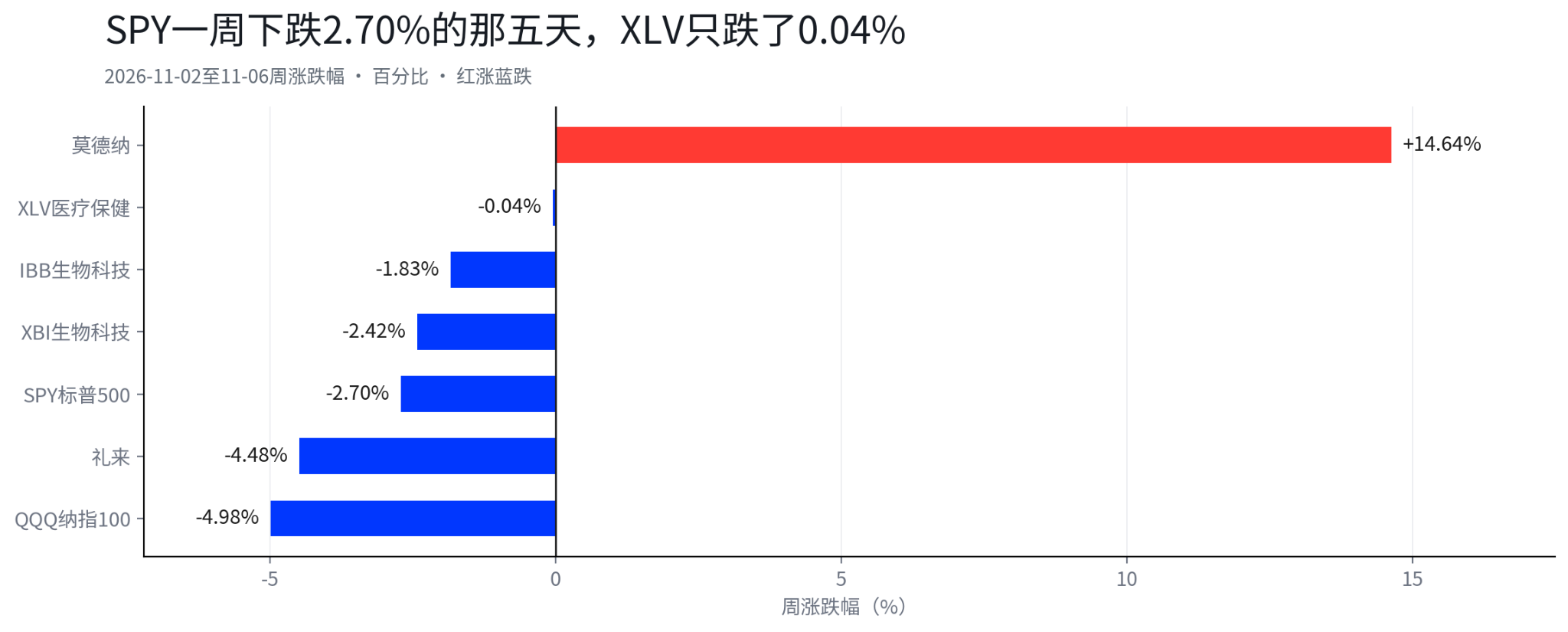
Caption: Weekly performance comparison for last week (November 2–6). Moderna and XLV were roughly flat, while QQQ and Eli Lilly led declines. Red indicates gains, blue indicates losses.
The real value of this data lies in proving that when the market began reducing positions in high-valuation assets, healthcare retained capital at a higher rate. On November 5, the day the Nasdaq plunged, XLV still fell 2.50% and XBI even dropped 6.73%, but over the following two trading days XBI rose 2.57% and 3.08% respectively, and XLV also gained 1.91% on November 9. Capital did not treat healthcare as a safe haven completely independent of the market, but it flowed back faster after the panic subsided.