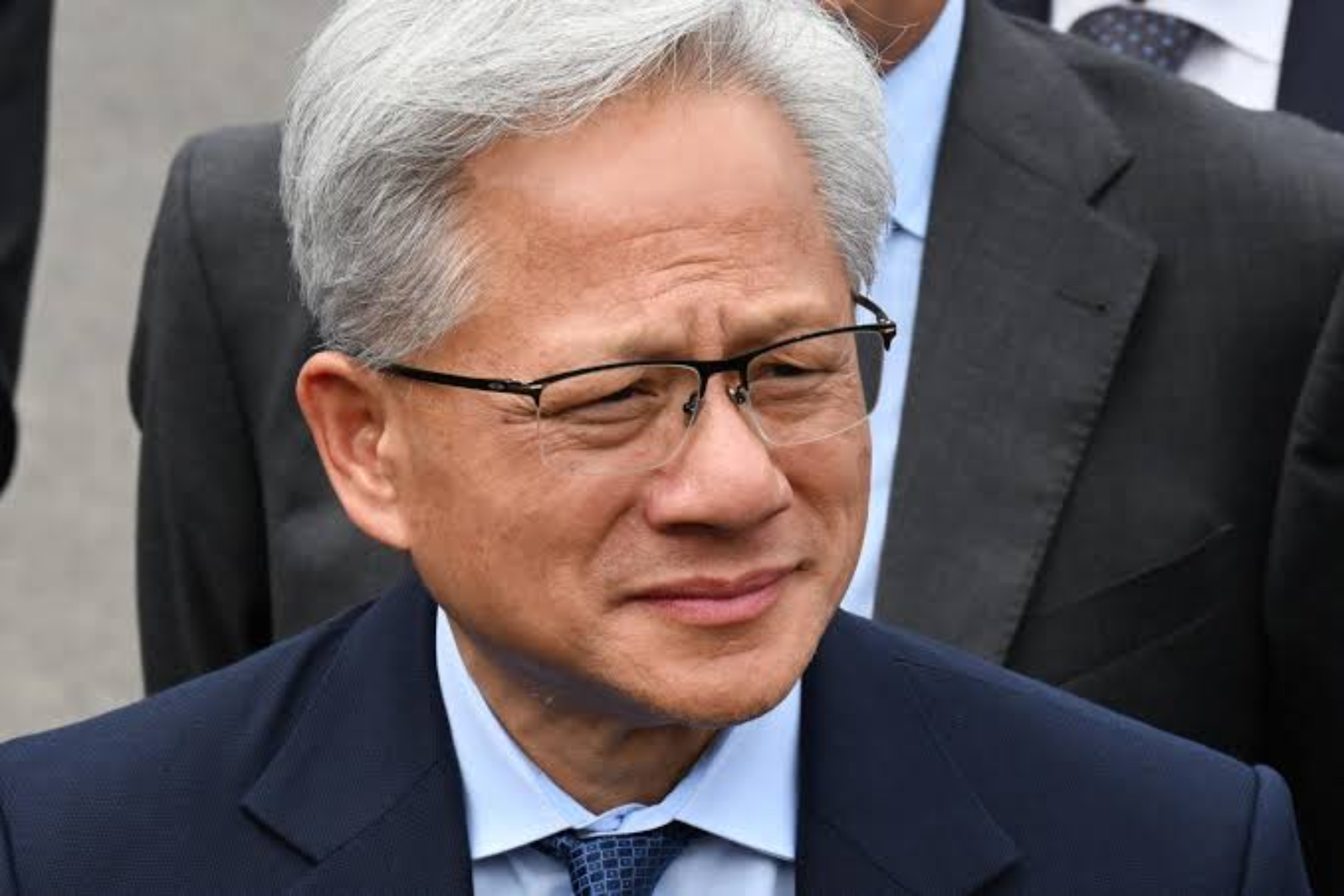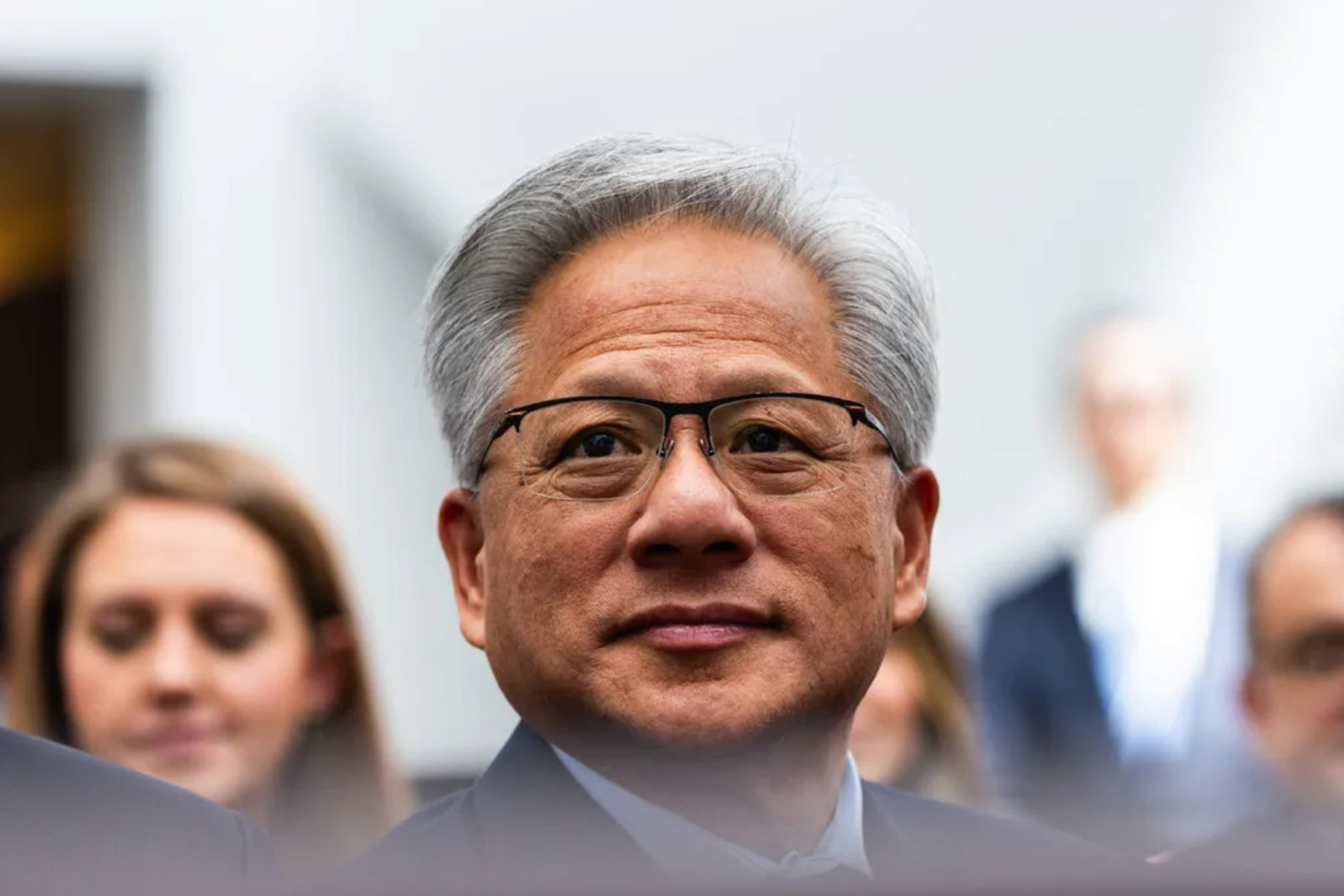


Nvidia continues to plunge, with $430 billion in market value wiped out over two days, as Microsoft briefly reclaims the global second spot

Original authors: Yang Chen, Dong Jing
Original source: Wallstreetcn
Nvidia's stock fell for a second consecutive trading day, dropping more than 6% at one point on Tuesday, with market value losses over the two days approaching $430 billion.
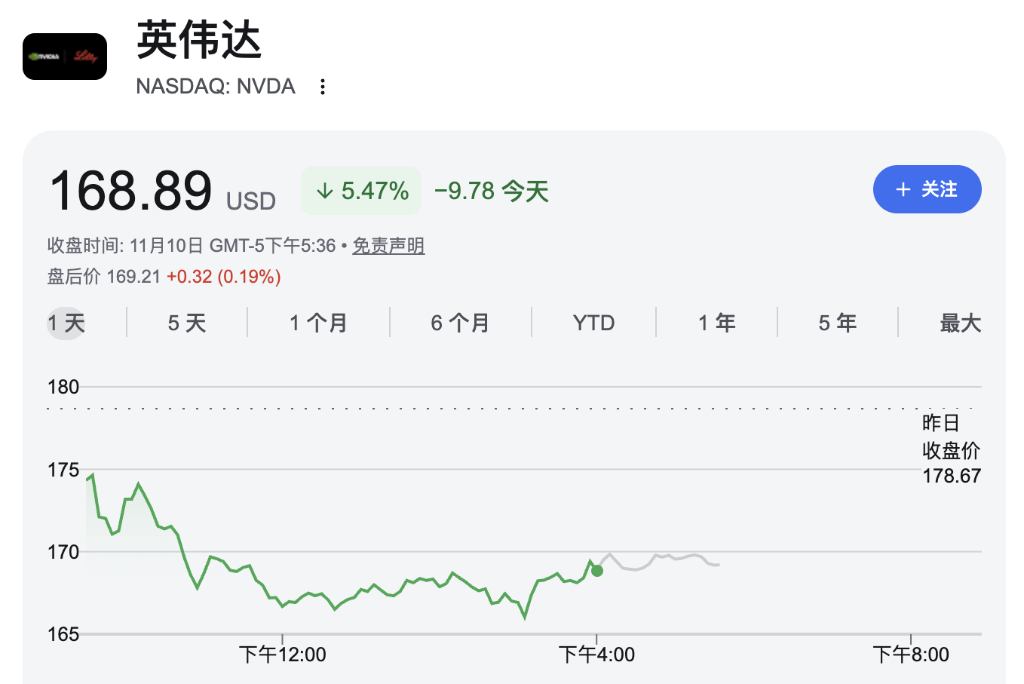
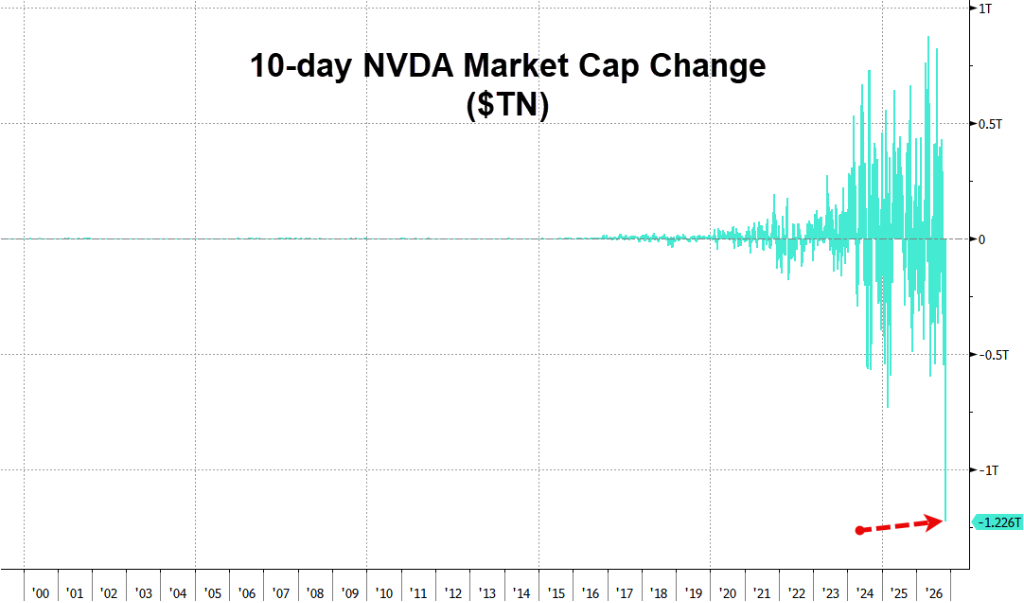
Data shows that nearly $2 trillion in market value has evaporated since its historic high, with losses totaling as much as $1.2 trillion over the past 10 trading days alone.
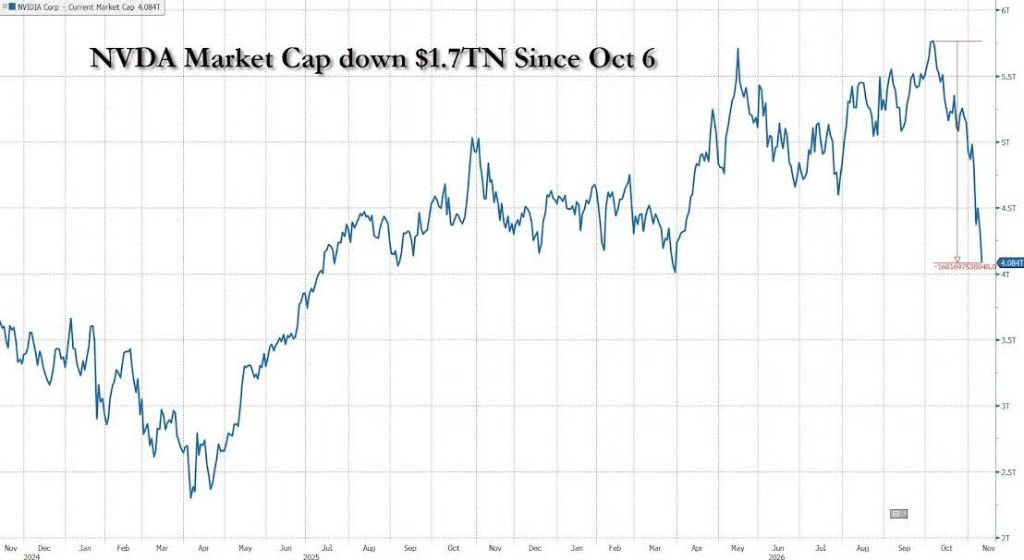
On Tuesday, Nvidia's decline was noticeably larger than that of other large-cap tech stocks, making it a significant drag on the tech sector's performance. Meanwhile, hotter-than-expected CPI data combined with hawkish comments from Federal Reserve officials pushed Treasury yields sharply higher, further weighing on risk asset sentiment and adding pressure on tech stocks.
Microsoft closed down 2.2%, Alphabet fell about 0.4%, Meta closed flat, Apple dropped about 0.6%, Tesla rose 0.5%, and Amazon gained about 1.5%. The S&P 500 declined about 0.4%, and the Nasdaq 100 fell 0.6%. Notably, the Nasdaq 100 has fallen about 2% since the election, with tech stocks broadly under pressure.

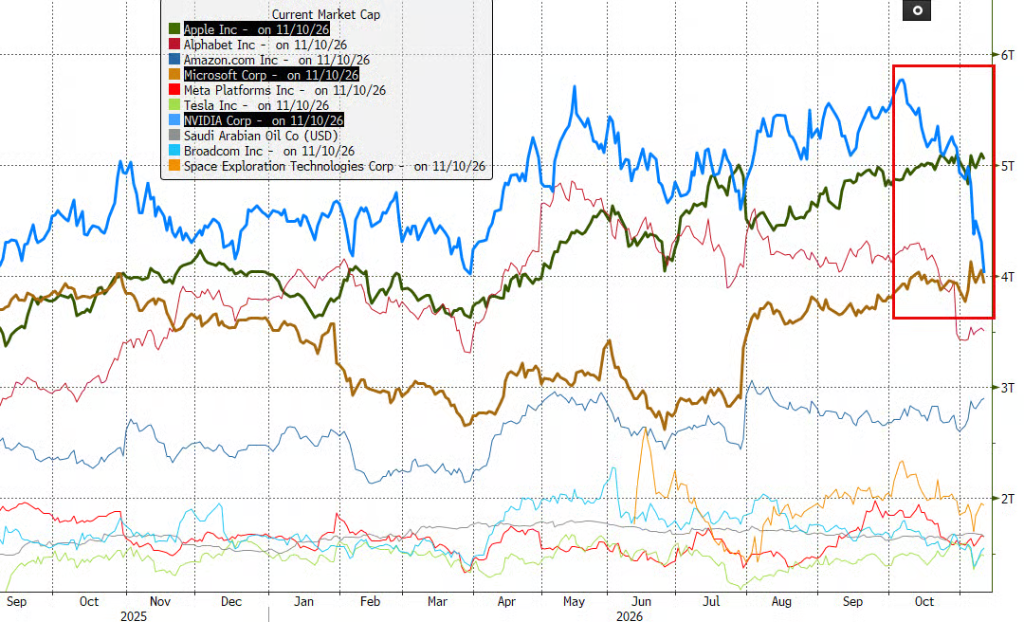
During intraday trading, Microsoft's market value briefly surpassed Nvidia's, making it the world's second-most valuable publicly traded company. Later, after Anthropic released an office suite, Microsoft's decline widened and it fell behind Nvidia once again. Nvidia's market value has now fallen back to levels comparable with Apple and Microsoft, with its previously commanding lead significantly narrowed.
Shareholders File Class Action as Corporate Governance Risks Escalate
Amid stock price pressure, Nvidia is also facing new legal and corporate governance challenges. A shareholder filed a lawsuit in California on Monday, alleging that Nvidia and CEO Jensen Huang misled investors in disclosures and responses related to prior events, seeking compensation on behalf of investors who purchased Nvidia shares during a specific period.
The lawsuit argues that the company and Huang failed to adequately disclose relevant relationships and the potential risks they posed, causing investors to buy shares without full understanding of the situation.
The plaintiff also alleges that the relevant events could pose significant risks to Nvidia's reputation and business prospects. The lawsuit is still in its early stages, the allegations have not yet been recognized by the court, and Nvidia has not yet made a formal response to the litigation.
Negative news surrounding Huang continued to mount on Tuesday: Nvidia's board announced it had hired an independent law firm to conduct an internal investigation; House Republicans were reportedly considering issuing a subpoena to Nvidia's CEO seeking a closed-door briefing; other media reports said Secretary of State Rubio had briefed Trump on Huang's contacts with relevant individuals; meanwhile, reports indicated that the FBI is investigating Huang's relationship with relevant individuals.
Previously, Nvidia's board had announced the formation of a committee of independent directors and the hiring of external independent legal counsel to investigate reports involving Huang.
The board stated that there is currently no reason to believe that Nvidia's national security interests or corporate secrets have been compromised, but the investigation will review all available information. Huang said he supports the investigation and pledged full cooperation.
Uncertainty Over AI Investment Prospects Combined with Executive Risks Put Nvidia Under Dual Pressure
Beyond governance concerns arising from the executive controversy, whether AI infrastructure investment can continue to generate sufficient returns remains a core issue for the market. As a key supplier in the AI computing power supply chain, Nvidia's stock performance is influenced not only by the company's own operating expectations but also, to some extent, reflects investors' assessment of the entire AI capital expenditure cycle.
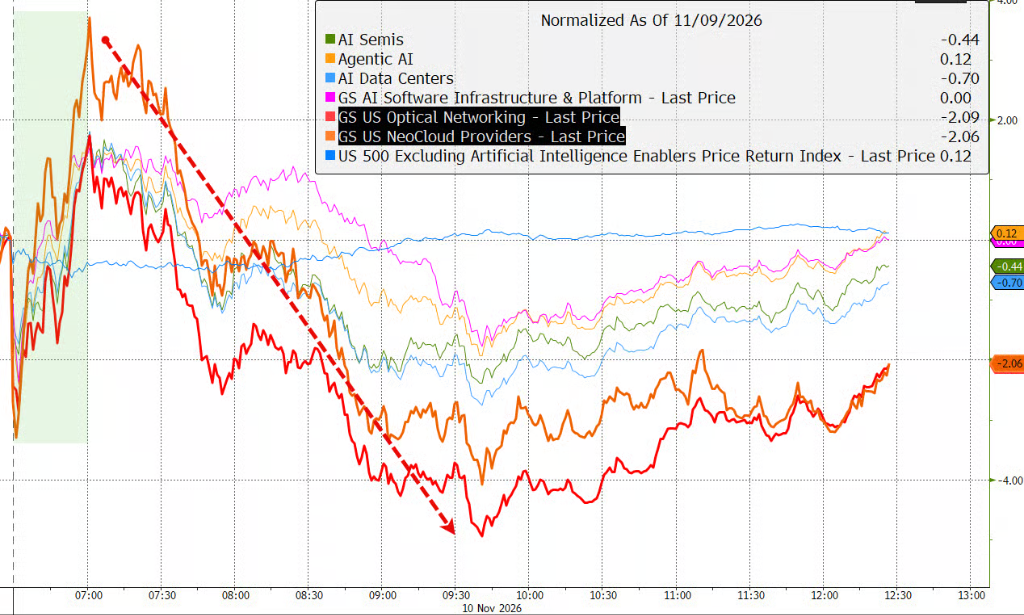
Data shows that AI-related stocks broadly underperformed the market on Tuesday, with emerging cloud computing (NeoClouds) and optical networking sectors leading the declines, while the portion of the S&P 500 excluding AI-related constituents was barely flat, indicating that selling pressure was highly concentrated in the AI supply chain.
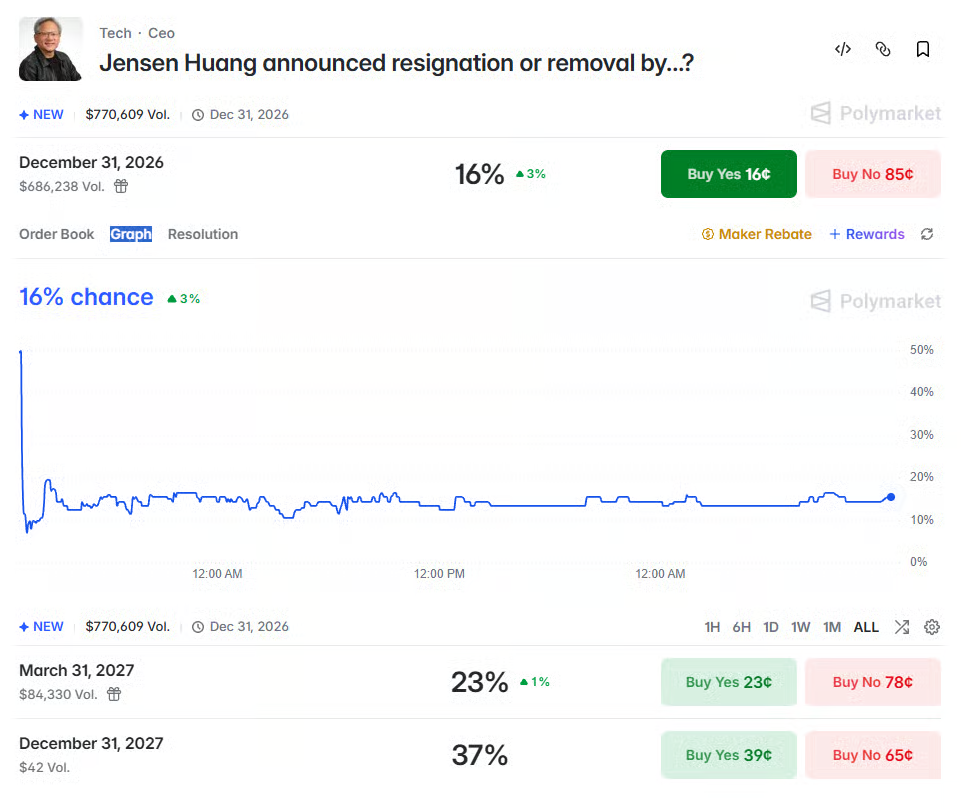
The Associated Press noted that Huang has led Nvidia for 33 years, and his personal image is closely tied to the company's strategy, business decisions, and market perception, so the related investigation has also prompted investors to focus on management stability and potential succession issues. Data from prediction market Polymarket shows that traders currently assign only about a 16% probability to Huang stepping down before year-end, with some analysts believing this pricing is too low.
From a market performance perspective, Nvidia has significantly underperformed other large-cap tech stocks for two consecutive trading days, indicating that investors are reassessing the risks facing the company. A Goldman Sachs trader report shows that Tuesday's selling was more driven by genuine fundamentals, with hedge funds and long-only institutional investors both net sellers, concentrated in the tech and industrial sectors.
In the short term, the progress of the board's investigation, the follow-up to the lawsuit, and management stability will become important variables affecting the stock price; meanwhile, the return prospects of AI infrastructure investment will continue to determine the market's judgment on Nvidia's long-term valuation.
Additionally, a previous Wallstreetcn article noted that Goldman Sachs estimates that commodity trading advisory (CTA) strategies will sell approximately $31 billion in S&P 500 futures over the coming week regardless of market direction, which would bring additional technical downside pressure on tech stocks.